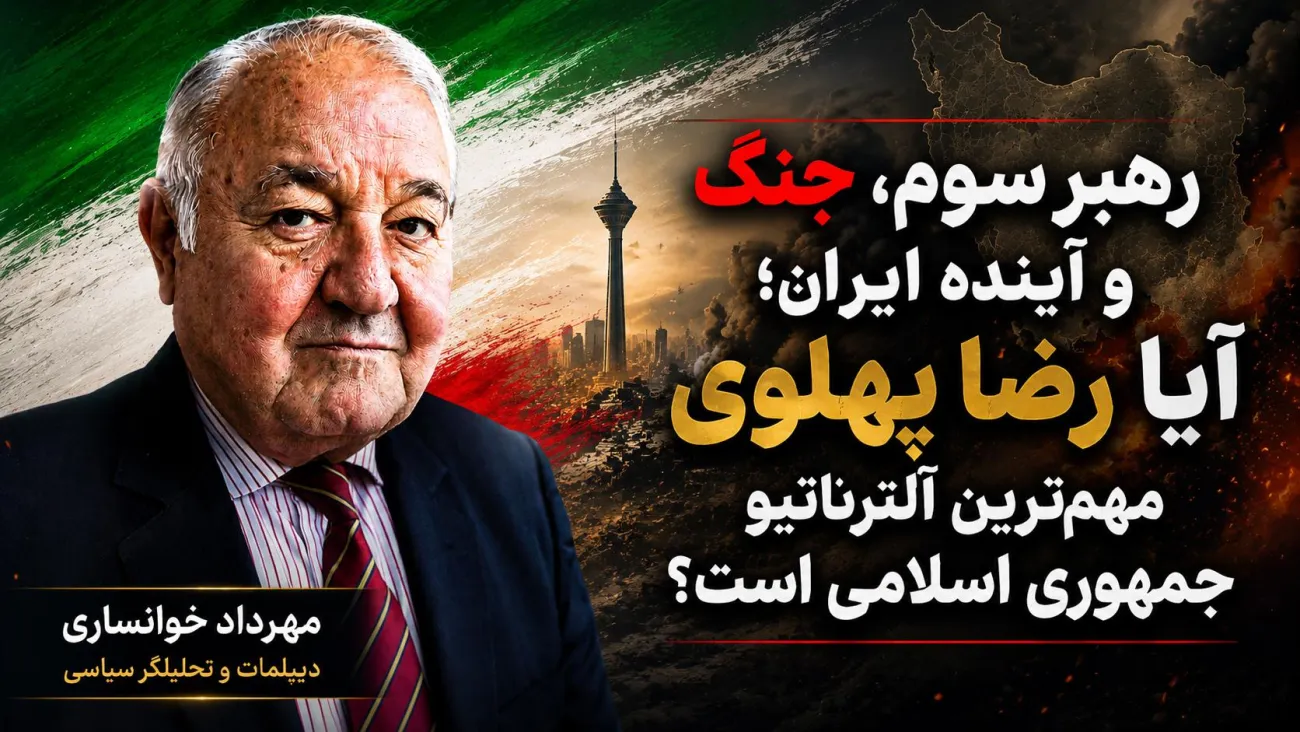
History is a testing ground for power, and in this testing ground, nations have repeatedly faced similar questions: when a political system enters a phase of erosion, or when for many it becomes conditional and reform is no longer enough, and for many the question arises as to when the survival of a government becomes its greatest issue, and more importantly, for many the question arises as to when the future separates from the past. Today, Iran is in one of the most sensitive periods of its contemporary history: the American and Israeli attack and the war that has changed the equations of the region, the killing of the second leader of the Islamic Republic, the emergence of the third leader of the Islamic Republic, changes in the balance of power within the establishment, the increasing role of security and military institutions, the intensification of political rifts, the current negotiations with the United States, and simultaneously, the return of the discussion of alternatives to the center of attention, and the return to a question that has loomed over Iranian politics for decades: Will the Islamic Republic pass through this historical turning point? If not, how will Iran's future be shaped?
Abdi Media: You are certainly aware of the issue, but before that, allow me to start with this: history is not a registry of events; history is a testing ground for power. In this testing ground, nations have repeatedly faced similar questions: when a political system enters a phase of erosion, or when for many it becomes conditional and reform is no longer enough, and for many the question arises as to when the survival of a government becomes its greatest issue, and more importantly, for many the question arises as to when the future separates from the past. Today, Iran is in one of the most sensitive periods of its contemporary history: the American and Israeli attack and the war that has changed the equations of the region, the killing of the second leader of the Islamic Republic, the emergence of the third leader of the Islamic Republic, changes in the balance of power within the establishment, the increasing role of security and military institutions, the intensification of political rifts, the current negotiations with the United States, and simultaneously, the return of the discussion of alternatives to the center of attention, and the return to a question that has loomed over Iranian politics for decades: Will the Islamic Republic pass through this historical turning point? If not, how will Iran's future be shaped? To examine these questions, tonight I am hosting a person who is not only an analyst of these developments but also part of the living memory of Iran's contemporary history. My guest tonight needs no introduction: Mehrdad Khansari, former diplomat of the Iranian Ministry of Foreign Affairs, member of Iran's delegations to the United Nations, a graduate of Georgetown University, an eyewitness to history in the final years of the Pahlavi rule, a colleague and advisor to Shapour Bakhtiar, former advisor to the son of Iran's former Shah, and a researcher who has closely followed Iran's developments, the opposition, and the international system for over five decades. Tonight, we are not just going to talk about the past; we are going to move from the experience of the fall of one government to the future of the Islamic Republic — from 1979 (1357) to 2026 (1405), nearly half a century, and from the question of "fall" to the question of "succession."
It is a great fortune and honor for me to be able to converse with you tonight. A conversation with a witness to history, for someone like me who is nothing more than a simple history reader, is very fascinating and valuable. Welcome to Abdi Media, and thank you very much for accepting my invitation.
Mehrdad Khansari: Thank you for your invitation. I hope my words can be helpful to the friends and loved ones who are watching this program.
Abdi Media: You are among the few Iranians who have witnessed the fall of a regime from a very close lens, even from within, and today, at the age of over seventy — if I am not mistaken, you look very young and vibrant — we are witnessing another great crisis in Iran's history. If we set aside all political analyses for a moment, when you see today's Iran, do you think more of 1979 (1357), or do you feel that the Islamic Republic has learned from that experience and that we are not repeating that fate?
Mehrdad Khansari: Without a doubt, the Islamic Republic has made great use of the experiences of that time. One of the most important achievements of the Islamic Republic from past experiences is that it has become very sharp in the field of crisis management. The previous regime — one could say it was a regime where the Shah was a man who did a great deal of construction in Iran, especially in the last fifteen years of his rule, that is, after the June 5, 1963 (15 Khordad) incident, when Khomeini's matter was settled for the first time. The major construction that took place in Iran happened in those last fifteen years. But the Shah did not have the skill and expertise in managing crises — whether from June 5, 1963, to the February 1979 (22 Bahman) incident — that he had in construction. The Islamic Republic has not succeeded in achieving great accomplishments in the fields of improving people's welfare and making Iran a better place for them. However, in crisis management, considering the experiences at that time, as we follow these issues, we see that in the worst conditions, they were able to preserve power for themselves, and they have shown and continue to show readiness to pay the price for maintaining power, and they do this with skill.
Undoubtedly, today's officials of the country and those who were or are role models for them, have certainly reviewed the experiences of 1979 (1357) carefully, and they are trying not to repeat the mistakes that led to the fall of the regime at that time
**Abdi Media:** I have heard this proposition from you many times: that the Shah was more than anything else a victim of a weakness in crisis management. If we take this as a criterion, what do you consider to be the greatest weakness of the Islamic Republic today?
**Mehrdad Khansari:** The greatest weakness of the Islamic Republic is its failure in development (construction). The Islamic Republic took over a wealthy country. It took over a country where, in terms of the living standards of ordinary people, compared to, say, the oil-rich Arab countries of the Persian Gulf, we were in a more privileged position. Today, those people are wealthy; their people have grown, and their economies have grown. But we, due to mismanagement and the ideologies they had, and the wrong policies they pursued, isolated the country and brought sanctions upon our people. In these areas, they were not successful. They have not had achievements comparable to those of the past.
**Abdi Media:** My question was: you said that the Shah was a victim of weak crisis management. I want to know, if we apply this same criterion, what do you consider the greatest weakness of the Islamic Republic today?
**Mehrdad Khansari:** It is general dissatisfaction in the country, which, for the reasons I mentioned, has been created and has worsened day by day, year by year. We are now in a crisis where we are still in a state of war — there is no peace; a ceasefire is fragile. But these are not the main dangers; war has proven not to be the main threat, nor is the current state of unrest. Rather, it is the peace that will probably come after the war. They have shown their ability to withstand the current pressures, but without fundamental changes, they clearly have this weakness: they cannot fully attend to the daily needs of the people and prevent the inevitable future protests. This is fully observed, and they themselves know it. And the hope of some of those who are currently engaged in internal factional conflicts, seeking power and a privileged position, is this: one of the issues on their minds is that if changes are not made in the direction or path the country is taking, those weaknesses will become much worse and will eventually bring them down.
You cannot keep a population of over 90 million hungry and thirsty forever and think that inappropriate actions will not be taken against you. How many times can you repeat the events of a few months ago? Its repetition cannot be practical, and many of them are fully aware of this difficult situation.
**Abdi Media:** Do you consider the people's dissatisfaction to be a historical repetition? In that same period of 1979 (1357), were the people dissatisfied? Were they at this level? They refer to the economic situation of that time, showing the shantytowns. Is this dissatisfaction of the people a historical repetition?
**Mehrdad Khansari:** There is dissatisfaction in every country — in the most democratic and just systems in the world, there is dissatisfaction. Our country, at the time when Mohammad Reza Shah came to the throne, was poor. You mentioned my age. When I was ten or twelve years old in London, my father was assigned to the Ministry of Foreign Affairs at the Iranian Embassy in London. They showed a film about Iran in the early 1960s. Back then, it wasn't like now, with Iran on everyone's lips. We all eagerly went to a hall rented on the main street of London to watch it. I remember in that film, the literacy rate in Iran at that time was said to be 4 percent — it might have been higher, but in any case, what expectations can you have of a country with a 4 percent general literacy rate? The behavior of officials and authorities in countries that are more backward is harsher and worse. As you move forward, people become more aware, more informed of their rights, and defend them, and the government, wherever it is in the world, is forced to show more flexibility. Without a doubt, in Iran in 1979, the system was not democratic — there is no argument about that. But it was a system that had managed to improve the daily lives of the people economically, better and better. The claim that Iran was a "Japan in Asia" is a reality; our economic growth was impressive, and the general standard of living had risen significantly.
The last time I was in Tehran, a few months before the revolution, I remember as we were walking down the street, laborers working on buildings were holding up signs saying "100 tomans a day," which for a laborer would amount to 3,000 tomans a month — 3,000 tomans at that time's dollar rate was about 750 dollars a month, which is about 700 dollars today. I'm talking about ordinary people, the laborers, the lowest level of work in Iran. No matter how you calculate the national per capita income, there was a situation and progress at all levels of the country.
**Abdi Media:** Some say that the people had a sense of well-being beneath their hearts. Would such people revolt? Do you believe in the revolution?
**Mehrdad Khansari:** Well-being doesn't "hit beneath the heart"; people's expectations rise. It's the people's right for their expectations to rise. At times, they wanted things that perhaps went beyond what they were actually receiving, but this could happen anywhere. In my opinion, the expectations and dissatisfaction were significant — I myself felt it existed. There was a feeling in society that everyone thought they deserved more than what they were getting. This feeling prevailed in society at the time, and perhaps it was because the Shah had given them many things so easily that they didn't appreciate them. But in my opinion, none of these conditions amounted to a revolutionary situation. Those who were dissatisfied and showed their dissatisfaction publicly were a small minority compared to the entire population. The Shah's popularity, despite all the wrong policies that made him unpopular among some individuals, was not at a level in society that I think was decisive. The failure to manage the crisis caused the Shah's situation and his approach to managing that crisis to be unable to have an effective outcome. I was surprised.
**Abdi Media:** Do you accept that a revolution happened? Some say it was an uprising.
**Mehrdad Khansari:** These — as they say — these perceptions are in people's minds. A group succeeded in removing a regime; there is no argument about that. The issue is whether they could have failed. Was it because of their own strength and the strength they mobilized inside Iran that caused the system to fall? Or was it the incompetence of the system in that situation and managing that current that helped them achieve much more than what was in their hands? I am among those who think that if the system had had the competence — and this is not about the Shah himself personally; they say the Shah was ill at that time, his condition was not good — what about the others? They existed: the officials, the army. I emphasize crisis management. I don't mean they should go and kill people — like the things we saw in December (Dey), or imprison people. They could have provided financial resources. In later years, especially in the Arab crisis, we saw examples like Saudi Arabia, which prevented dissatisfaction by providing more financial resources to the people and attracting their satisfaction. If Khomeini could mobilize a million people for the Ashura demonstrations, the Shah, with his government and financial resources, could have brought three million people and changed the atmosphere. In my opinion, a special kind of incompetence was required to let this happen — to not lose the main cards and ultimately be forced to leave the country. Fundamentally, what has happened twice — the significant difference between this regime and that regime — is that the head of the country should not leave the country. As long as the Shah was in Iran, the talk of the system's collapse was not there. But when the Shah left the country, the opposition made good use of it. Some in the international community who were supporters of the Shah said, "The Shah's work is done; we must somehow come to terms with the forces that come later," and the equation changed. In any case, after all these years of mulling over the issues in my mind, I cannot justify how it was allowed to reach this point.
**Abdi Media:** Let me ask another question — a very famous and prominent one. I usually try to ask witnesses of history a question that might not please many. I apologize in advance to you and to those interested in such figures. Looking back today, was the Shah a dictator? And did his dictatorship cause his downfall?
**Mehrdad Khansari:** To put it very simply, the Shah was the first person of the country and the main policymaker — without a doubt. Opponents called him a dictator; supporters saw him as someone who managed the country's affairs, and his management led to economic and social growth. Politically, we may not have had democracy, but we had economic and social freedoms. We had all these things, which are completely tangible today. The issue of "Woman, Life, Freedom" — these things did not happen during the Shah's time.
**Abdi Media:** It wasn't a concern for anyone.
**Mehrdad Khansari:** It wasn't among these concerns. I want to say that politically, the Shah was a dictator — there is no doubt; no other word can be used. He was the main policymaker. But a dictatorial system is different from a dictator. The Shah was not a brutal dictator. The point is that his intervention in the country's affairs was not in all fields. For example, the Shah had his own office, the Imperial Office, or the Ministry of the Court, which did not interfere at all in the political affairs of the country; it dealt with matters related to the royal family and financial and property issues related to the court. The Imperial Office was a place where political matters, reports, and so on, would come and be presented to His Majesty, but the Imperial Office was much, much smaller than an ordinary ministry. Compare the leader's office (Beyt) of Khomeini with the Beyt of Khamenei. When Khomeini was the leader of the Islamic Republic, the number of people working in the Beyt was perhaps fewer than a hundred. Under Khamenei, it reached 4,000 people. For every ministry, there was a parallel apparatus in the Beyt that directed it, following up on policies. These things did not exist during the Shah's time. The Shah intervened in two specific areas and was interested in pursuing them closely: one was foreign policy — I myself served as secretary to the Foreign Minister for two years in the Foreign Minister's secretariat and saw this closely — and the other was military and defense-related matters, equipment to be purchased for the army. The Shah was interested in these and followed them closely. But he did not directly intervene in other government organizations. One of the advantages of the system during the Shah's time was that if you were in the Ministry of Agriculture, or the Ministry of Housing, or the Ministry of Labor, you would rise based on merit. If the Shah saw someone competent, he would support them and help them. He did not have full familiarity with everything — it was practically impossible, since there are only 24 hours in a day. The Shah was truly one of the hardest-working people I have ever known. He was someone who sat at his desk from 8 a.m. to 8 p.m. On Fridays — I can say every Friday, when it was a holiday — all the reports would be in the office of the minister on duty, and we would send them to the minister's home, and he would send them on to the Shah. The Shah would review them and give his opinion the same day, and it would be communicated so that work would not be delayed. The work was continuous.
**Abdi Media:** What was the factor in his downfall?
**Mehrdad Khansari:** The factor in the Shah's downfall was dissatisfaction in society. The people had reached a point where they demanded more political freedoms, which were not available at the time. Of course, the Shah had taken steps in this direction. Two years before the revolution, he spoke of an "open political atmosphere." Many people close to him said that this opening of the political space caused the leap toward revolution to accelerate. But in any case, no one put a gun to the Shah's head to do this; he did it himself, because he wanted to gradually — the Shah knew what democracy was and was interested in making it happen, for progress, so that it would not hinder progress. This is a judgment that people make. Sometimes it works, sometimes it doesn't. Sometimes it works for a while, and then it stops working. So it was dissatisfaction — people had higher expectations. The system did not open up to the extent that it could have informed the people much better, that it could have presented points at the national level that would have appealed to the people's awareness. These were among the mistakes. The sum and result of it all is that a country is on the verge of becoming more aware, more informed of its rights, and demanding more. If the level of people's demands does not align with what the government is willing to provide, dissatisfaction arises. Negative propaganda from abroad — that the Shah was a violator of human rights, the role of SAVAK in society — for example, SAVAK was an organization that, in any case, did many things that it should not have done and did not need to do. I can say that, but look at what happened after the revolution. It has whitewashed SAVAK. The actions of the Islamic Republic — why don't these things that happen now happen then? Our fellow citizens should try to find an answer to this question. The Shah's regime could have been much harsher and worse than it was, but it wasn't. But that doesn't mean that the violence that existed at that time, to the extent we saw it, wasn't there. Many of us were interested in seeing reforms from within, with the Shah himself being the initiator of these reforms. I myself, today, might have been one of the reformists of that time, because I knew that that system could not last forever and fundamental changes had to be made.
**Abdi Media:** Speaking with you has become difficult for me — I fall into the trap of your words. Your words are sweet; I am captivated by listening to you. I am afraid of falling behind in the discussion. It is like honey in which I have become entangled — it is very sweet for me. From one perspective, I might lose the reins of managing the discussion. Do you see any similarity between the current dissatisfaction and the dissatisfaction of 1979 (1357)?
**Mehrdad Khansari:** No.
**Abdi Media:** Their nature is different.
**Mehrdad Khansari:** It is far different. Today, people are in the streets due to a lack of water, electricity, the price of bread, and so on. The economic situation of the people who participated in the revolution was not comparable to what we witnessed in December (Dey). The reasons were completely different. Today, people did not come to the streets in December because they were seeking democracy, nor were they in the streets for human rights or to free political prisoners. They came to the streets because of the lack of water, high prices of oil and meat, and everyday livelihood issues.
**Abdi Media:** Let's talk about this. In any case, in the last three months, rapid developments have occurred — some like a dream — and no one imagined that today they would see the Islamic Republic in this form. Two major events happened in the management sphere: one was the targeting of the second leader, Ali Khamenei, and the ascension of his son, Mojtaba Khamenei, to leadership. From your perspective, firstly, what change has this created in the real structure of power in the Islamic Republic, and what do you consider the selection of Mojtaba Khamenei to be a sign of? What is your interpretation?
**Mehrdad Khansari:** In my opinion, first of all, the taking out of Ayatollah Khamenei is a very important matter. It has created and will create conditions that, if our nation is vigilant and if the political forces that can play a role act correctly, the country can go to a very good level — a beginning to emerge from the crisis of life that the people have experienced due to the wrong policies that started with Khomeini and worsened with Khamenei. But the fact that Khamenei's son succeeded him — the system became hereditary — what difference does it have with the system they criticized so much? However, bringing him in and the quick action taken by those who were after this was in line with the same management they wanted to use to handle this crisis. That is, if we assume Khamenei had not been removed in this way, perhaps he might have died a natural death during the period when he was ill. Perhaps events might have happened that would not have led to Mojtaba coming to power. But this war and the conditions helped Mojtaba's rise. Replacing Ali Khamenei with him was one of the regime's tricks to demonstrate the stabilization and continuation of its own position. This was a clever move on their part. This has nothing to do with the quality of the system. Mojtaba Khamenei is not Ali Khamenei, just as Mohammad Reza Shah was not Reza Shah when Reza Shah left. You yourself know that when Reza Shah left Iran, it was like when Stalin died — Stalin's successors could not fill his place, and internal war between them was inevitable. When Reza Shah left, Mohammad Reza was a young 20-year-old who lacked experience. Mojtaba has been behind the scenes for years and is familiar with many issues — Mohammad Reza Shah was not at all. The matter does not end there. Those who have experience in this system have broken their teeth; they will not accept Mojtaba the way they accepted his father. It is natural. In Iran, we clearly see that the issue is where it will go, in what direction, and in what form this final conclusion will be reached.
**Abdi Media:** From the perspective of an Iranian diplomat — and I find it interesting to note that you have no personal attachment to the Islamic Republic — we witnessed, and I am defining the event from a neutral perspective, that a government, even an authoritarian one — the Islamic Republic, or whatever we call it, authoritarian with all its faults — a foreign force decides to attack this country and target its leader within its own soil. As a diplomat, what is your opinion?
**Mehrdad Khansari:** Without a doubt, this action is against all international laws. Firstly, the attack on Iran was against international law. From a legal standpoint, I do not think any judicial authority, if this matter is referred, would say anything other than this. I, who have been opposed to the Islamic Republic for many years and have had activities in this field, in any case, I cannot and will not promote or encourage a foreign attack on our country. I think it is a very wrong action, and it damages the work of constructive political forces. Without a doubt, it creates conditions where many people who had distanced themselves from the Islamic Republic, for national reasons, will stand behind the system, and this sets the work back; it does not help. Especially since the aggressors did not achieve any of their declared goals and created conditions where the Islamic Republic, despite all the damage it has suffered, is still standing, and no one can currently predict when they will leave the political scene. The conditions are different. From a legal standpoint, this action was not right; it was wrong. I do not think that if it were referred to the International Court of Justice in The Hague, anyone would say that this action was legally correct. It might go to the UN Security Council, and America would veto it there, but America's veto does not mean its action was correct; it knows that. But the political issues of the world are unfortunately not solved by who does the legal or illegal thing. Whoever has more power and authority exploits it maximally. Mr. Trump, regarding this matter, made a gamble from which he has not gained the expected profit, and he is now stuck. This attack on Iran, despite all the damage inflicted on the country — and this damage has nothing to do with the Islamic Republic; it belongs to the Iranian nation — in this recent war, we may have suffered more than 250 billion dollars in damage. During the summer war with Israel, thirty to one hundred billion dollars of the country's assets were destroyed. Not to mention the 7,000 to 8,000 lives lost in this war — people who had no connection to the system, people on the margins of the bombings, ordinary members of society, not individuals belonging to the IRGC or Basij forces.
Twenty-five to thirty thousand people are wounded in hospitals. Not to mention how many people became unemployed due to these events. So it is a disaster for the country. The Islamic Republic is not innocent in this matter. The provocative policies of the Islamic Republic over 47 years created conditions that led them to take such an illegal action. This illegal action of theirs did not happen in the sky; it was due to the policies and actions of the Islamic Republic against them over the past years. That is where the difference between the policies of the Shah's time and now is completely clear. We were foreign policy; we did not have these actions during the Shah's time. We did not threaten anyone. We did not want to have diplomatic relations with any country and Israel, but in any case, we did not want to eliminate their existence. Moreover, I myself, in addition to my mission at the UN, participated in five sessions of the General Assembly, and I was in the Special Political Committee. At the beginning of my service at the UN, the Special Political Committee was reviewing the issue of Palestine. The Imperial Iranian government always defended the rights of the Palestinian people against Israel's positions at the UN and other international bodies. Perhaps many guests do not know this.
**Abdi Media:** Israel did not have an office in Tehran during the Shah's time.
**Mehrdad Khansari:** We did not have a public relationship.
**Abdi Media:** What was the building that became the Embassy of Palestine in Tehran?
**Mehrdad Khansari:** We had a two-factor relationship. Compare Iran with Turkey. Turkey recognized Israel in 1948 when it was established, and had an official embassy and ambassador. But we did not do that. One of the Shah's considerations, especially due to pressure from the sources of emulation (maraji') at the time — the clergy always had a position in Iran. It was not that the Shah was an irreligious person who would ignore these considerations. One of the reasons the revolution was not properly managed was that when Khomeini came, there were 6 sources of emulation in Iran, and 5 of them were pro-Shah. How could you manage things so that the word of one of them would prevail over the others? The incompetence in managing the situation was so severe that all of this fell apart. But the clergy in Iran and the positions we held caused the Iranian government not to recognize the newly established state of Israel.
**Abdi Media:** What was the office?
**Mehrdad Khansari:** It was exactly as if Israel had an embassy in Tehran, minus the formal designation of "embassy," and the individuals there were not introduced as official diplomats. It was like an interests section. They would call it, for example, an economic office.
**Abdi Media:** It was a strange office.
**Mehrdad Khansari:** It was the Jewish Agency. We had a similar office in Tel Aviv at that time, and the people who served there were ordinary Ministry of Foreign Affairs employees who would go there on assignment. I myself was sent there for a temporary mission of a few days to prepare a report on Iran's security relations with the Arab countries of the Persian Gulf and the region at that time. I traveled to all the Arab countries of the Persian Gulf region on two occasions. On the second occasion, I was ordered to get the Israeli view on this matter, so I went to Tel Aviv.
**Abdi Media:** This building in Tehran was strange because I had a conversation with Salah Zawawi, the Palestinian Ambassador to Tehran — he has since passed away — and it was a strange building with strange doors through which letters could be passed from underneath.
**Mehrdad Khansari:** From a security standpoint, Israeli embassies all over the world are like this. I live in London; for fear that someone might throw a bomb or sabotage them, they have strict precautions everywhere, and the building's condition is completely different from other embassies because they are forced to take greater security measures.
**Abdi Media:** Has this war stabilized the Islamic Republic or made it more unstable?
**Mehrdad Khansari:** As we are speaking now, the war has not ended and peace has not been established.
**Abdi Media:** It is a state of neither war nor peace.
**Mehrdad Khansari:** Currently, in my opinion, the Islamic Republic is not more unstable. The attention of the forces within the system that are in competition with each other, and the masses of people who are not happy with the system and have their own daily and livelihood concerns, is focused on how long this situation will remain and what conditions will emerge from it. The priority is to come to terms with these conditions at this time. But when the situation changes — and this situation cannot last forever — there are many pressures inside America, not to mention those opposed to the war within Trump's administration, who say, "You must pursue this war toward the original goals you had." Not all of them are for reconciliation and peace. There are very powerful forces on the other side of the issue. If this matter drags on, their hand may become stronger, and much damage could be done to our people and country. I am not worried about the Islamic Republic and its officials; I am worried about our own people. This situation cannot continue. In fact, neither the Islamic Republic nor the US government wants to return to the battlefield. But when peace is established, then the Islamic Republic, given all the damages that have occurred and its lack of financial resources — and there is talk of releasing Iran's assets in exchange for peace; Iran's assets are 12 billion dollars, 20 billion dollars — 300 billion dollars in damages over the past year is nothing to restart Iran's economy and put bread on people's tables. These are points that, if not addressed, could cause the Islamic Republic to become unstable.
**Abdi Media:** In part of your comments, you used the term "aggression" regarding the attack. Do you believe that America and Israel should pay reparations to Iran?
**Mehrdad Khansari:** The issue is that the government of the Islamic Republic has requested reparations. Whether they should pay reparations is a completely different matter. For the US to legally pay reparations, the matter would have to go to an international body. An international body would have to judge, which would go back to the Security Council, where the US would veto it. There is a world of difference between the theory of receiving reparations and the reality. It is simply impossible for them to pay reparations; such a thing is not practical. However, the Islamic Republic can raise this for propaganda purposes and for the uses it wants to make of it. No one can say it has no standing.
**Abdi Media:** My point is one thing: the Islamic Republic, or any government, is a tenant of that land; its time is limited. Many governments have come and gone. My position is Iran. A future government — for example, let's say the monarchy is restored — would a future government after the Islamic Republic have the right to pursue reparations for this war?
**Mehrdad Khansari:** Here again, we must make a distinction. The question you are asking — since you raise a topic and we discuss it and draw conclusions — the Iranian government can request reparations, as it has done. They themselves say if we can collect money from ships for shipping, it might be considered reparations, over time. But of course, this is a demand that is completely contrary to international law, just as they can rightly say, "We have been aggressed against; you attacked our country, so our demand is..." This action in the international waterway will worsen Iran's and the Islamic Republic's situation in the long run. If they push this issue too much and think they can make this argument prevail over time, it will cause everyone in the world, except those who today condemn the US and Israeli move against Iran, to unite with them on the issue that this regime's way of thinking should not be in the Persian Gulf waters. But the answer to your question is complex. Yes, the US attacked Iran; Iran is demanding reparations. If it wants to demand reparations, a body, a legal council with international credibility, must endorse this demand so that the US is forced, say, to take action in this regard. When that council comes, it will not say, "On February 28, the US attacked Iran." It will say, "What led to the US attacking Iran?" This issue goes back to the 47-year history of the Islamic Republic's relations with the US: from the hostage-taking, the killing of Americans in Beirut, the kidnapping of the CIA station chief in Beirut and his killing in Beirut...
**Abdi Media:** It's a long story — the hostility between the two sides.
**Mehrdad Khansari:** Suppose, at the end of all this, the International Court of Justice says the US is the aggressor and the US wants to pay reparations. It goes to the Security Council, and it is vetoed there. So, apart from wanting to make propaganda use of it — that the Islamic Republic can say, "We were attacked; they should pay reparations" — it should not go into the 47-year history. Some might think it is Iran's right to receive it. So if I don't give a definitive answer that it is Iran's right, that does not mean I have a different position. I am saying Iran can make such a claim. But they can also say, "If we did this, it was not without reason, due to the provocations you have made in various places — you killed Americans, harmed our interests, took diplomats hostage, occupied the embassy, and took other actions..."
**Abdi Media:** If the Islamic Republic overcomes this crisis, do you think, firstly, it will overcome it, and if it does, in what form will it continue? Will it be the same system, or will we witness a different system?
**Mehrdad Khansari:** This is an extremely difficult question. It depends on the forces within the system, those hidden within the government — those who came with Khomeini in 1979 and seized power. That group, those who were part of Khomeini's spectrum, have diminished over time. Perhaps only 10 to 15 percent of that ruling body remains. But all the levers of power are in the hands of that 10-15 percent who run the country. For example, in the decision-making body of Pezeshkian's government, I do not see people like Khatami or Zarif included; they are outside the body that makes the final decisions. But among them — and I said that Khamenei's departure is important — because as long as he was there, he managed them; he had mastery, his own experience. In any case, Khamenei was a capable individual in his position; he cannot be underestimated. His opponents might make this mistake, but underestimating someone who is in front of you is a big mistake for anyone. But now, those individuals are in competition with each other to determine the path that Iranian policy should take. For example, [certain figures], and the group known as the "group of four," wanted to pursue revolutionary policies. Another [figure] came later and became the father of modern China, which turned it into a major economic power that now competes with the US. They wanted to take the country in another direction. Among them, there was conflict for a year or two until the constructive forces won. In Iran, there is such a situation. If the constructive forces can reach an agreement with the US that can be sustained, and anti-Americanism ends — I don't mean good relations with Israel, but anti-Israelism of the previous kind is removed from the agenda — sanctions are lifted by Mr. Trump, and the assets that exist are released at this time, the country will go in another direction. The first thing that will happen is that Iran's economy will open up. The Europeans who left Iran's economic scene due to the US tearing up the JCPOA will be able to return and invest. Trump and those around him are interested in investing in Iran's oil and gas industry.
**Abdi Media:** How likely is this scenario?
**Mehrdad Khansari:** In my opinion, this scenario is much more likely. I hope its probability is high, because the important thing for our country is that any changes that take place should be beneficial — meaning that Iran should not become another Iraq, Afghanistan, or Syria. Our people's security and social order should not be destroyed, because if these matters are not observed, economic growth becomes impossible; capital will not come to Iran, and construction will not happen. And this is where those officials, or individuals outside or inside, who think about the country's future, must act and think responsibly about these issues. This is so that we can encourage America and Israel to let them go. If there is no order in society, if civil war occurs, if there is deficiency, the people's situation will become far worse than it is now. We have seen these scenes in Syria and Iraq; we do not want them to be repeated in our own country.
**Abdi Media:** In recent months, we have witnessed talk of a revolution called the "Lion and Sun Revolution," led by Mr. Reza Pahlavi. You have certainly heard more about this and know him more closely. Firstly, I want to know: do you consider this a revolution? Is this "Lion and Sun Revolution" something we can say is a revolution under this title or led by him? Given your experience in observing revolutionary situations, do you see the conditions as revolutionary?
**Mehrdad Khansari:** Firstly, the Lion and Sun is the symbol of our country. For people like me, this has no connection to the fact that some people — for many Iranians who are not supporters of the monarchy or the prince — the Lion and Sun has a different status. Even the MKO (Mujahideen-e Khalq) uses the Lion and Sun symbol. Naming the people's revolution with something that is a national symbol for all opponents of the Islamic Republic — to be honest, I have not heard this term used in the way you said.
**Abdi Media:** What has been announced by him is the "National Lion and Sun Revolution."
**Mehrdad Khansari:** They can call it whatever they want. But a "national revolution" — I don't know what these people are, but I 100% agree with its Lion and Sun. (Laughter)
**Abdi Media:** You have the Lion and Sun flag behind you.
**Mehrdad Khansari:** The Lion and Sun was on the wall outside the Iranian Embassy in London, and the revolutionaries wanted to destroy it. I managed to save that Lion and Sun. I hope we can one day put it back in its place. The current conditions — conditions in which a force outside wants to enter the scene — it does not seem that the prince (Reza Pahlavi), without a doubt, is an exceptional Iranian. He is the only Iranian whose father was the Shah. Monarchy in Iran has its own specific meaning and concept, which perhaps, in addition to being historical, is also cultural. But the issue is that we are in a situation where 47 years have passed since the monarchical era. Without a doubt, the constitutional monarchy has many supporters in Iran, but they have lived without a king for 47 years. The monarchy might not return for another hundred years, but they are in Iran and will remain, and their spiritual connections will not be cut off. For example, in France, the monarchy was abolished in 1870, but those who support the monarchy — who, in terms of family, mental and cultural connections, go back to that era — still hold a distinguished position in the administration of the French state today. There is no connection. Monarchists who are in Iran or will return can serve a logical Iran for their country and reach a high position. The issue is that we must get out of the current crisis. What must be agreed upon, in essence, is the replacement of the sovereignty of Velayat (Guardianship of the Jurist) with the sovereignty of the people. The people may, at some point, lean toward a monarchical system and want to bring the prince back to Iran. That is the people's decision. But at this time, the possibility of referring to a general vote is not possible; the conditions are not right. However, without a doubt, the removal of Ayatollah Khamenei from the political scene — his sidelining — has "discredited" (loath) the concept of Velayat, because determining a successor can allow this path to continue.
Abdi Media: Do you consider Mr. Reza Pahlavi as the next alternative?
Mehrdad Khansari: Mr. Reza Pahlavi can be one of the alternatives, but in the current situation, I doubt that there is a place for his work or his views, especially these plans that he announced recently, I do not see any viable alternative in the short term. The Islamic Republic is not on the verge of collapse, if the Islamic Republic changes its ways and methods as I said, if there is a consensus around the rational forces that are in it, i.e. the non-elite, those who think technocratically are thinking of constructiveness, they are thinking of ending the national crisis, if they can overshadow those elite and radical forces, the country will go in another direction. When an alternative comes to Iran, everyone hoped that the country's reform system would take it in another direction. In the current situation, it is realistic that we look at the forces that are outside and the forces that are related to activists and political figures that are inside Iran. In order to be effective, you must have a relationship with those who are at work, but if you do not have a relationship with the likes of Khatami, Rouhani, Zarif Mousavi and X, then this does not seem realistic. Construction in these days when these facilities are provided should lead people to breathe and hope for a better future.
Abdi Media: You were once with Mr. Reza Pahlavi. How do you see him today? He invited America and Israel and supported this attack. I will not list what you witnessed. Has Mr. Pahlavi changed?
Mehrdad Khansari: In my opinion, Prince is a bright person and in all the years that I had the honor of being close to him and working with him, he was a democratic person, he had democratic positions, he did not fight to restore the monarchy to Iran, he fought to save Iran, and I had nothing but appreciation for this way of thinking. Today, the behavior that I see from him that many people are talking about and the plan that he announced for the transition period, in my opinion, does not match the principles that I used to have when I was in his service.
Abdi Media: Do you think Sultanate can return?
Mehrdad Khansari: Political people have different political activities and they themselves are responsible for the actions they take and the consequences of those decisions are whether they are in people's hearts? Is it realistic or not? Prince is an exceptional character in our region and we have to see how things go. Personally, I am fascinated by the positions that I had with him and this history that I am telling you is not one year or two years, his speech and words were different for 30 of these 47 years, the groups that he tried to bring around him were different, now as it seems, it can be said that the issues of the past state have been lost, we have to see where it goes, it has no effect on the activities and work that I or others do, because we follow that plan, but Khosrvan knows his own interests. They are a national symbol, a flag for national unity, can they be one?? They can be in the national struggle, and as an Iranian fighter who works abroad, I am interested in his personality not being lost, not getting involved in issues that cannot be controlled or contradicting his institutional position as a constitutional king, it is very important to observe these issues. I'm not saying that he shouldn't be active, don't talk, don't do anything, but he should be in a framework that doesn't differ from his institutional position.
Abdi Media: What do you see as the weak points?
Mehrdad Khansari: I don't see any weak points in that sense, I think he should be open to everyone, even people who do not agree with his views within the spectrum, some have views that are not in line with the views presented by him. I do not have a specific opinion except that I cannot personally be a supporter of these positions announced by him. This does not mean that I will disagree or hold a protest placard, in fact, there is no difference in the matter. To keep him at a time when his presence could and can be effective, this is not help, it is not his time, he cannot do anything about the current situation in Iran, but at a time, if we assume that something happens inside Iran, he could play a role that would help a national process, and we should try to convince him as much as possible to advance his plans and activities in this direction.
Hear without filter in the cassette box
**Abdi Media:** Many people in Iran have called for him; many outside Iran have marched for him; many oppose him; many who were once beside him are no longer there. In any case, these discussions are necessary for a better understanding of events — in a place where there is enough time, and I do not intend to steer you with my questions. That was not my intention. My aim is for people to hear your words directly, without media pressure or fantasy-selling. I see it more as you, as a prominent diplomat and someone who has experienced the ups and downs of life and holds Iran in your heart, analyzing these events. What matters to people is: what happens tomorrow? What happens economically tomorrow? The people who are in mourning, the blood that was spilled since December (Dey). Iran's situation is not in good order; people are living in emergency conditions. This situation requires people's eyes to be open, and we should not sell them dreams. Can the Islamic Republic change technically? Does it have alternatives or not? What lies ahead of us? This has been the subject of my conversation in this program.
**Mehrdad Khansari:** At the end of my talk, I must say that every politician — from the prince to others — must have a method and path by which progress or the improvement of their standing can be possible. The prince, a few weeks ago, had 250,000 people — they say — participate in a demonstration in Munich. Can they do this again next week? Can they have 300,000 people instead of 250,000 in two weeks? What are the conditions? Do the actions taken in the meantime help in that direction or diminish it? The factor that can be effective in this direction is the programs presented; the acceptance it gains from the form of expression and the content of the program presented to the people either attracts or critiques. His personality is one that attracts because of his exceptional and historical position. Many people criticize those around him or his team. If there are people who have no solidarity with the spectrum at all and are not acceptable, it will prevent the continuity necessary for progress. In countries that want to establish democracy and say "one person, one vote" — once, every man, one vote — we want these demonstrations and progress to be sustained, not just one-off events. Mr. Esmaeilion was able to bring 100,000 people to Berlin during the "Woman, Life, Freedom" protests. But where is Esmaeilion now? Can he gather a thousand people? I don't think so. This is why political figures must act carefully and not damage their image. For me, for the struggle of all Iranians, for anyone fighting against the Islamic Republic, if the prince can strengthen his position and status, it is beneficial.
**Abdi Media:** Mr. Pahlavi and those around him have said it is the "Lion and Sun Revolution." They say they are in a revolution. If we want to compare the 1979 revolution of Mr. Khomeini with it — in terms of his team and those around him — if you were to compare Mr. Khomeini's team in the 1979 revolution with Mr. Pahlavi's team, what differences do you see?
**Mehrdad Khansari:** I don't know Mr. Pahlavi's team well. I have heard some names, but I am not familiar with the quality of their work in that sense. Regarding those around Khomeini, with the passage of time and more familiarity with their actions — both when Mr. Khomeini was in Paris and when many of them came to power, and we saw — we can make judgments. But I am truly not in a position to comment on the quality of people's work. However, I can sense that among the constitutionalists, the unity that should exist is not there. Of course, I must say that my generation is different from this young generation that is just coming to the demonstrations. Those who were part of the elite of the previous regime are different from those who have come from Iran today — it is not clear whether they are truly supporters or are just looking to ride a wave and move forward, thinking they will reach somewhere. But the truth is that the regime is not on the verge of collapse. Mr. Pahlavi is not on the verge of occupying Iran and making the transition he has spoken of. This work takes time, and we must maintain our credibility. For me, as someone who supports a constitutional system, preserving the prestige of Prince Pahlavi is important. It is not necessary for me to have a close relationship with him. As a constitutionalist, I do not want him to be damaged, and I am concerned when I see currents that harm him, without a doubt. But this program he has announced — and that he wants to play a role like Khomeini during the transition, or a role like his father — in my opinion, it does not fit. With the assumptions I have about a constitutional monarch and the position he should ultimately have in Iran — or that his wife might want to form a political party — these are contrary to the position that could be suitable for the possible restoration of the monarchy in Iran. We do not want an absolute monarch; we do not want a dictatorial monarch. It must be a constitutional monarchy, which has its own rules. Our people today are far more experienced than in the past, in 1979 — in any case, more political. One of the reasons for the 1979 revolution was that people were not political; they could not resolve in their minds the coming to power of Mr. Khomeini — "this one goes, whoever comes." Today, they do not think this way. Some might say, "Let war happen," and some might say, "It will be easier." But when they saw their own homes destroyed, they understood that they would not get "sugar and nuts" from military aggression; nothing happens, especially since it did not happen and they are stuck. So we must think responsibly and pay attention to these issues, and in these conditions, we should demand things that are in line with the future circumstances. He could be the head of a council during the transition, where that council would run the country during the transition until conditions for free elections are provided. The fact that he has announced a program determining who will be in charge — this goes against all our assumptions. As an Iranian who cares about him and does not want him to come to any harm, I cannot accept this at all.
**Abdi Media:** History has not yet given its final answer. Whether the Islamic Republic will pass through this turning point or whether Iran will enter a new chapter is a question whose answer we will see in the coming days, months, and years. We are deeply thirsty for hearing the truth without censorship or retouching.
**Mehrdad Khansari:** A point I would like to make in conclusion is that our focus really should not be on criticizing each other. Your questions regarding the prince — I did not want to conceal my true positions. Our motivation should be to focus more on the points that bring us closer together, because there are people who will try to exploit these issues. Perhaps some will magnify parts of my statements to align with their own goals, whereas my motivation in this honest conversation with you was something else. Our priorities today and the realities of the time — as I said, the Islamic Republic is not on the verge of collapse. Our country stands at a major crossroads. Choosing the right path can lead the people's victory and their future in a better direction. If certain forces win and come to power, they will face instability and a thousand other fundamental problems; we will face a complex situation. Ultimately, my motivation is to present a picture as a group of people who want to help each other and find a suitable solution for the future of the country.
**Abdi Media:** My aim is to ask questions impartially and without bias, so that through this, without selling dreams, I can present accurate information and realities to the people. Sometimes realities are not sweet; they have bitterness, but that bitterness results in awareness, and I do not think anything is sweeter than awareness without selling dreams to anyone. This session was historical and valuable for me. I hope it will be repeated often.
Full recording of Abdi Media's conversation with Mehrdad Khansari, former diplomat and political analyst
Take less than a minute, register and share your opinion under this post.
Insulting or inciting messages will be deleted.
Sign Up