
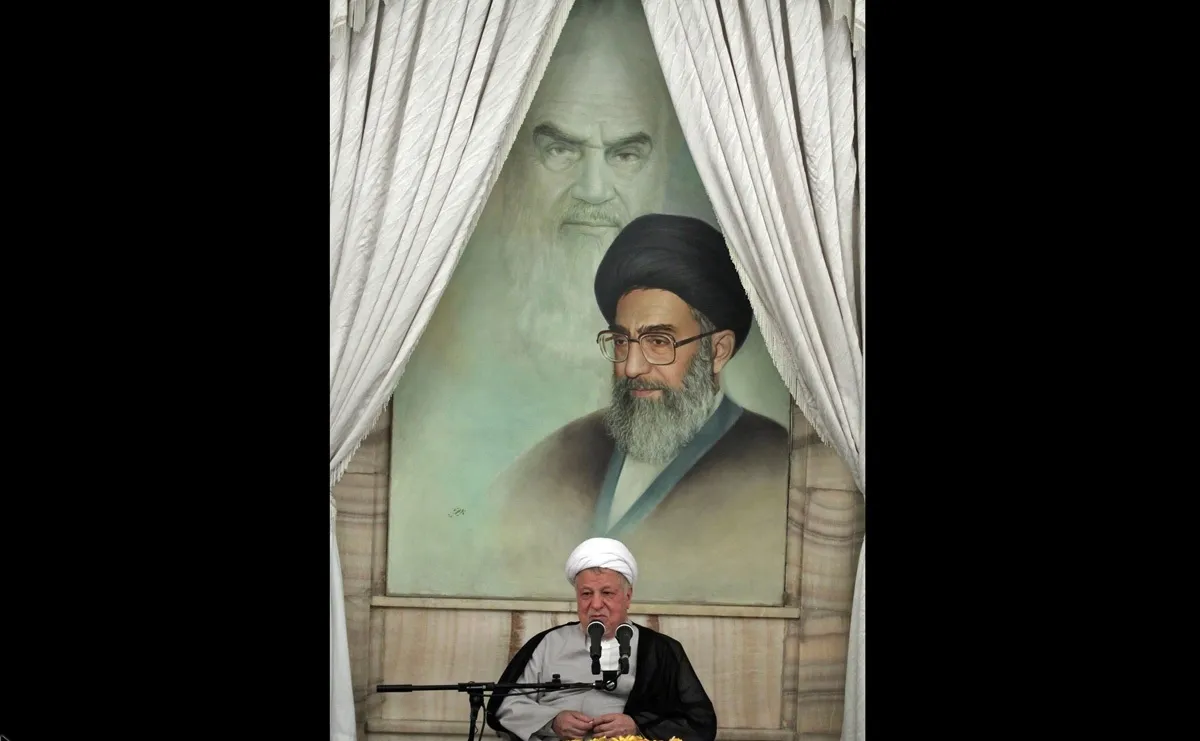
With the acceptance of the agreement between Kofi Annan, [the UN Secretary-General], and Iraq by the Security Council, a sense of calm has arisen in the international arena, and with the announcement of the European Union's opinion, based on initiating ministerial-level negotiations with Iran, a step has also been taken towards our cooperation with Europe. Initially, to
With the Security Council's acceptance of the agreement between Kofi Annan, [the UN Secretary-General], and Iraq, a calm has been created in the international atmosphere, and with the European Union's announcement of its opinion on starting negotiations at the ministerial level with Iran, a step has also been taken toward our cooperation with Europe.
First I went to the Baqi' Cemetery. We entered the area of the dome's site and sat beside the graves. The Ziyarat-e Jame'eh and other prayers and the Ziyarat-e Aminollah were recited by Messrs. Iranmanesh and Doaei. The journalists took film and photos. The ladies had remained behind the wall; they do not allow them to enter. I told the custodian of Baqi' to agree that they enter; he did not accept and said it is forbidden. I said it is not forbidden. He still did not accept. I insisted; they spoke by telephone with the higher authorities and finally they agreed. It caused indescribable happiness for the companions and the ladies. They too went to the graves. Our ambassador and others say it is unprecedented in the modern history of Baqi'. We also took a tour of other sections of Baqi' and recited Fatiha.
They have kept Uthman's grave too, like the graves of our Imams, in a dusty state. My heart ached for the loneliness of the graves of the Imams of Baqi'. Four Imams! Imam Hasan (AS), Imam Sajjad (AS), Imam Baqir (AS), and Imam Sadiq (AS), and according to them, the grave of Hazrat Fatima, the Prophet's (PBUH) cousin, within the dome's area, has been destroyed by the Wahhabis; they only have a grave-like form. In the dusty area, I picked up some of the pebbles from the graves of the Imams and put them in my pocket; others did the same.
In the Baqi' Cemetery, corpses are still buried and it is the only cemetery of Medina. They first take all the dead to the Holy Shrine and pray over them and then take them to Baqi'; apparently they apply a medicine to them so that the bodies decompose sooner so that they can bury new dead.
From there we went to the Center for the Printing and Publishing of the Holy Quran. They gave explanations. It is a huge center, with 1,800 employees and a printing capacity of 30 million copies of the Quran per year, of which they usually print 10 million copies per year. They said they give all of them free to Muslims around the world. They have a modern cassette-tape duplication set that fills Quran tapes and gifts them to Muslims. They have printed the Quran with 20 translations from the living languages of the world, and they gifted me a sample of all of them.
We visited the large hall of the printing house. I saw the large printing machine up close; it is worthy of praise. Most of the workers are from other countries. I spoke with a Bangladeshi technical worker; he said he has been working here for three years and receives 400 Saudi riyals in salary. Fundamentally, most labor work is done by foreigners. In their memorial book I praised their important work.
After renewing the ablution in the office of the complex's head, to see the other blessed places, we went to the Zu Qiblatayn Mosque. Two mihrabs facing each other in the north and south of the mosque, exactly in the mihrab on the side of the Al-Aqsa Mosque, in Arabic, Persian, and Urdu lines, have indicated the change of qibla toward the Kaaba. We prayed the gift prayer of the mosque. We went to the site of the Fath, Salman, Ali, Abu Bakr, Umar, Fatima, and other mosques.
In the Fath Mosque, we prayed the gift prayer. Several Egyptian women were also there. They said they are residents of Medina. They have closed the door of the Hazrat Zahra Mosque. I asked them to open it. They have completely demolished the Abu Bakr Mosque. They said it is for rebuilding. These mosques are located in the area of the Trench battle. They gave explanations about the battle scene; because no traces of the trench remain, it could not be matched. Mr. Mowlavi Ishaq Madani, who is accompanying us, said that at the time when he was studying in Medina, there were traces of the trench, but now that place has become a residential area.
From there we went to the Quba Mosque. We participated in their noon prayer. We followed the mosque's imam. After the prayer, we greeted and negotiated with the mosque's imam in the mihrab. He is a teacher of the Quran at the Sharia University. He is a memorizer of the Quran and has a good recitation tone. I tested him on memorizing the Quran; two verses that are similar in the Surah al-Tawbah: "Let not their wealth and their children impress you" and they have several minor differences, I asked him to recite; he recited well and was aware of the differences.
From there we went to the Jame Mosque and then to the Uhud area. After visiting the graves of the martyrs of Uhud from behind the windows—the door of the area was locked—we heard explanations; about the scene of the Uhud battle and the famous pass from which the infidels attacked the rear of the Muslims, but there were several opinions about the location of the pass and we did not reach a conclusion. We were tired. We returned to the hotel.
After lunch and rest and studying the reports, to visit the project for the improvement and completion of the Holy Shrine, we first went outside the city. Beside Medina al-Hajjaj, we visited the power plant and the water cooling section for the ventilation of the shrine. They have eight power generating plants with a capacity of 20 megawatts for backup, and they send the cooled water from there through pipes to the shrine area. The outgoing and return pipes pass through a huge and vast underground tunnel.
From under the ground of Salam Street, we came toward the shrine; they said it is nine kilometers. It ended at a very huge and modern parking lot that they have built under the shrine area, on two floors with granite and beautiful and expensive. It has a capacity of four thousand five hundred cars. In the memorial book, I praised this effort.
We returned to the hotel. A group of companions came. We spoke about the importance of the shrine development project and also the development project around Baqi'; they said about six billion dollars have been spent. Early in the evening I wrote yesterday's memoirs. I went to the Holy Shrine for pilgrimage. We prayed the night prayer in congregation with them. After the prayer, we engaged in various pilgrimages. Until they cleared the shrine and then we completed the pilgrimage in calm. We saw other sections of the shrine's development. We returned to the hotel. I read the reports and the summary of the news and Tehran newspapers from the computer.
Take less than a minute, register and share your opinion under this post.
Insulting or inciting messages will be deleted.
Sign Up