
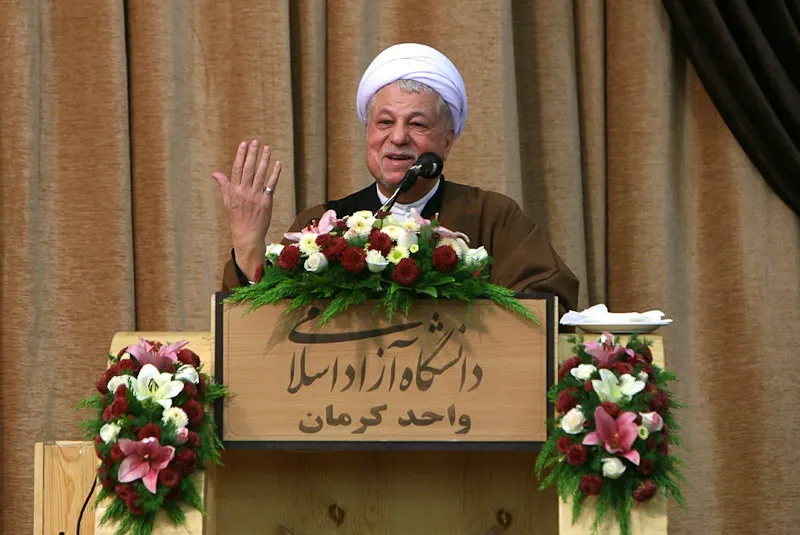
In the morning news, the initial agreement between Saddam [Hussein, President of Iraq] and the United Nations is noteworthy; however, the United States has said it will wait for the details to become clear. Effat spoke about yesterday's program, where they had gone to visit the Riyadh center for the disabled, and the warm and cordial hospitality of the Amir Abdullah family
In the morning news, the preliminary agreement between Saddam [Hussein, the President of Iraq] and the United Nations is noteworthy; but America has said it is waiting for the details to become clear. Effat gave explanations about yesterday's program, which had gone to visit the Riyadh Center for the Disabled, and about the warm and sincere hospitality of Prince Abdullah's family and other princes.
Mr. Sabah Zangeneh, [Iran's representative to the Organization of the Islamic Conference], came. He spoke about the Jeddah programs. Mr. Ahmad Reza Kazemi, the CEO of [Homa Airlines], came and asked me to emphasize to the Saudis that they should expand air transport cooperation.
I went to the Consultative Council. First I shook hands and greeted the representatives one by one. Then the Speaker of the Council spoke to give a welcome speech and emphasize the unity of Muslims and the cooperation of Iran and Saudi Arabia. I too gave a detailed speech about the benefits of cooperation and the harms of non-cooperation and addressed the issue of oil and Palestine and Iraq and Iran's progress, and in conclusion I proposed that the slogan of the elimination of weapons of mass destruction should be taken up by the Muslims, which is compatible with the spirit of Islam, and not by America, with its record of arming Israel with weapons of mass destruction and using the atomic bomb in Japan.
We visited the various sections of the Council. They have a large, equipped, and modern hall that has five times the capacity needed for the 90-member Council. We prayed the congregational prayer led by me right there.
Then we went to King Saud University. We visited the central office, the library, and the Faculty of Dentistry and heard the university president's report. They have 54 thousand students in seven branches across the country. Education is free for the students. They charge little tuition. They have three times as many professors and instructors, all holding doctorates. Women are separate from men. 34 percent of the students are female. They have an annual current budget of two billion riyals. They have luxurious, vast, and magnificent buildings. They have 220 thousand students in the university system. Because capacity exceeds demand, they do not hold an entrance exam. The nurses and assistants of the Faculty of Dentistry were mostly Filipino.
We went to the Chamber of Commerce and Industry. The introduction was made. The head of the chamber, while giving a welcome speech, spoke about the importance of cooperation with Iran. I too gave a detailed speech about the important effects of the Construction era and the high capacities for cooperation between the two countries. The Saudi private sector is more active than Iran's. We were lunch guests there and it lasted until four in the afternoon.
From there we went to the Diplomatic Quarter; a beautiful and clean neighborhood. We visited our own embassy. Then at our own residence I met with the embassy members. After their Quran recitation and welcome, I, while consoling them, emphasized the effort to strengthen cooperation with Saudi Arabia. Then I visited the cultural center in that same area; it is a luxurious and vast building.
We returned to the residence. I rested a little and looked at the reports. In the reports, the achievement of an agreement between Iraq and the UN Secretary-General is important, which has removed the shadow of war, but America has not yet commented. At night, Mr. Saud al-Faisal, the Foreign Minister of Saudi Arabia, came for a meeting. He warmly thanked me for my trip and said it has been the long-standing wish of the people and officials of Saudi Arabia. We negotiated about the Iraq crisis and the oil price crisis and made decisions to strive to correct the oil price.
Then, accompanying me, he came to the banquet of Prince Salman, the governor of Riyadh, at his old palace, which he said is the heart of Riyadh. Prince Salman gave a warm welcome. The main heads of the country were at the banquet. Like other places, we shook hands with everyone. Before and after and during dinner I had a lot of talk. I praised the development progress of their country. He expressed interest in coming to Iran; I invited him. He has been the governor of Riyadh for more than forty years.
After dinner, together we visited the Jame Mosque next to the palace and the Justice Square where they carry out judicial rulings. Then we visited the historic Masmak Fortress. The Saudis began their work by capturing this fortress. They have set up an interesting exhibition there for the history of the Saudi family's development and dominance. In the memorial book, I asked them to also revive the Islamic historical works of Medina and Mecca in this same way. They have introduced Abdulaziz as a hero. I came to the residence. I listened to the twelve o'clock Tehran news and slept. Effat and the companions had also today visited a club that had a separate section for ladies, and at night they were guests of our own embassy.
Take less than a minute, register and share your opinion under this post.
Insulting or inciting messages will be deleted.
Sign Up