Rumble

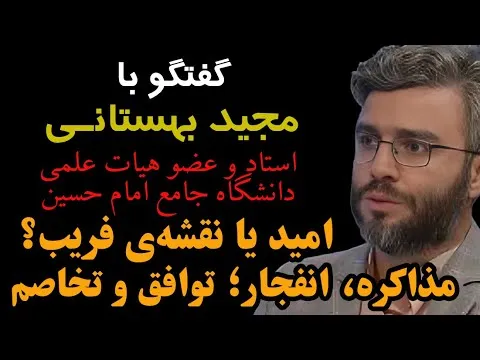
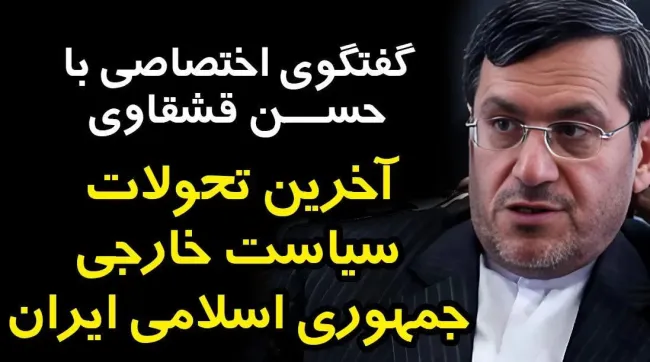

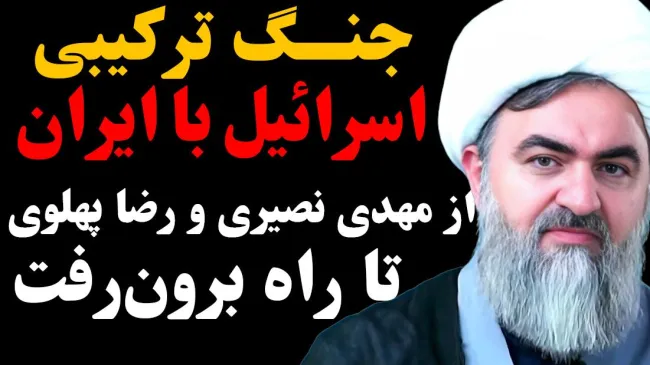
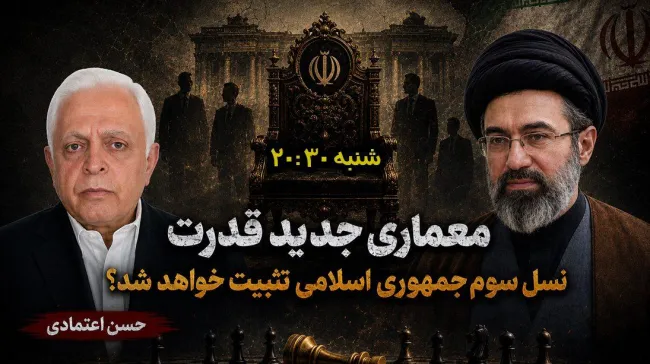
See | Mojtaba Khamenei and the New Architecture of Power; Will the Third Generation of the Islamic Republic Be Established? Interview with Hassan Etemadi, Political Analyst
Now on Abdi Media's YouTube channel
Read more![متقی: حادثه [دیماه] کاهیت کاملا تراژیکی داشت](/sites/default/files/styles/max_650x650/public/1404-12/ebrahim-motaghi_13.jpg.webp?itok=-MOHBDWf)
Motaghi: The [December/January] incident had a completely tragic quality.
Reformist groups were unable to act as intermediate social forces and got caught up in the crisis themselves.
Read more
Motaghi: Israel should coordinate with America in strategy
The regime change is related to the last stage and it is created in an environment where a full-scale war between Iran and America will be created.
Read more
Motaghi: The war will be tactical in nature and will be based on "power shift".
Iran is the last link in the axis of evil that George Bush Jr. proposed (minus North Korea).
Read more
Motaghi: The probability that Reza Pahlavi will come to power in Iran is very limited
In Iran, a "transition" may be formed or a "power shift" may be created; But in any case, Reza Pahlavi will not have a structural position
Read more
Motaghi: Iran will never experience the imperial atmosphere again
Reza Pahlavi has no will, authority, strategy and tactics
Read more
Motaghi: The Americans will never deploy military forces in Iran
Americans emphasize space control; However, the Israelis' view is that the atmosphere should be made critical, violent and bloody
Read more
Motaghi: Trump is not looking for a full-scale war
American military operations are for more bargaining and a more effective role in building power
Read more
Motaghi: Today there are many differences in Iran's social structure
If the political processes in Iran become too radical, there will be violence that will cover the whole of Iran!
Read more
Motaghi: I consider Reza Pahlavi a stage tool
In the coming months, we will see an escalation of violence
Read more
Motaghi: The separation of the construction of power from the social forces leads to the transformation of the foreign force into a "liberating actor".
[In January] a large part of the social space felt that it could no longer have peaceful discourse formats.
Read more![متقی: اقدامات مسلحانه هیچ تأثیری [در پیروزی انقلاب ۵۷] نداشت](/sites/default/files/styles/max_650x650/public/1404-12/ebrahim-motaghi_3.jpg.webp?itok=aDJ6wsDC)
Motaghi: Armed measures had no effect [in the victory of the 1978 revolution].
The United States and France also used non-violent policies during that period
Read more
Motaghi: A system that is inefficient is more inclined to mechanical action
Read more
Motaghi: The current atmosphere bears a strong resemblance to August/September 1978.
Read more
Motaghi: No one can ignore the role of media and international factors in political subversion.
The field of governance had a lot of opportunity and experience to heal wounds
Read more
Motaghi: The social structure in Iran has been transformed.
"Heroic Flexibility" means that when you cannot realize your politics, power, ideals, and patterns, you must accept what is imposed upon you!
Read more
Mottaqi: Over the past years, the political system has tried very hard to unify the space.
This mechanical integration is one of the main factors of structural fragility.
Read more
Mottaqi: The media created conditions for someone who was never a political activist to become bold.
What started in Iran will continue because none of the actors achieved their goals.
Read more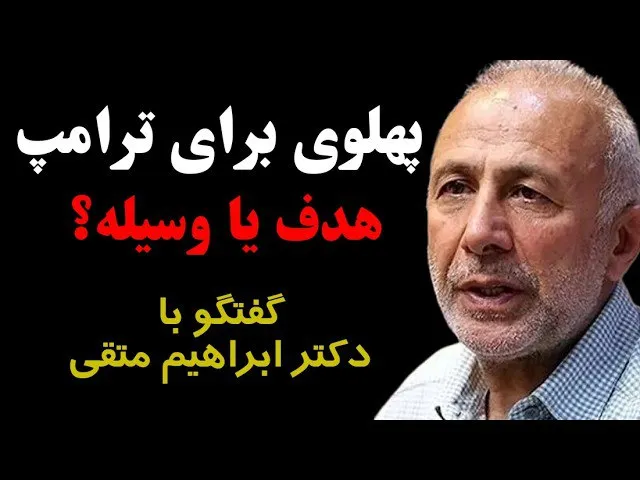
See: Pahlavi for Trump: End or Means? | Has Iran's defining moment begun?
With the presence of Dr. Ebrahim Motaghi, professor and faculty member of the Department of Political Science, Faculty of Law and Political Science, University of Tehran
Read more
Listen | A major revelation by Ali Shakouri-Rad, former Sixth Parliament MP and former Secretary-General of the Union of Islamic Iran People Party, about the regime’s organized suppression
Read more
Roghani Zanjani: All government policies are reflected in the budget
The U.S. military budget is $4,800 billion, our military budget is $60 billion!
Read more
Saeed Zibakalam: I do not regret the 1978 Revolution.
The Islamic Republic is not subservient to any country.
Read more
Roghani Zanjani: First of all, I consider the current crisis to be an economic crisis
The priority of saving the Muslim community from Israel is costly!
Read more
Saeed Zibakalam: With Reza Pahlavi's arrival, this situation of democracy, discrimination, embezzlement, and bribery will not be resolved.
We, the political activists, are also affected by corruption and discrimination in the field of politics
Read more
Roghani Zanjani: A huge legitimacy gap has formed between the new generation and the previous generation
Hijab has now become a tool of resistance
Read more
Saeed Zibakalam: I am opposed to any sudden change enforced by force and physical means.
These practices will continue the cycle of authoritarian rule and authoritarian culture.
Read more
Saeed Zibakalam: Hassan Rouhani has committed plagiarism, lied, and tricked people!
He has neither the necessary university education [for the guardianship of the jurist] nor the necessary seminary knowledge.
Read more
Roghani Zanjani: You cannot tell the Houthis to fight and not provide them with resources!
Strategic policies dictate the allocation of resources and indicate the strategic priority of governance
Read more
Saeed Zibakalam: As long as political and media activists stay silent, the current approach will continue.
I can easily imagine that this current Supreme Leader or the next Supreme Leader will revise everything that has been done so far.
Read more
Roghani Zanjani: The government's public revenues for this year are nearly 2,446 trillion rials.
The budget deficit for the first eight months of the year 2024 was 783 trillion rials.
Read more
Roghani Zanjani: This year's budget tries to prevent the crisis
The unemployment rate will increase by 12% in 2025
Read more
Saeed Zibakalam: The Guardianship of the Jurist is also a theory; don’t peg it to religion!
Some religious authorities and seminary scholars do not accept the guardianship of the jurist.
Read more
Saeed Zibakalam: We revolutionaries have made mistakes that we need to reconsider.
One of the factors behind the slogan 'Reza Shah, may your soul be happy' is the people's living conditions.
Read more
Saeed Zibakalam: Which of our political and press courts will be held with the presence of a jury?!
How did Articles 26 and 27 get out of our constitution?!
Read more
Saeed Zibakalam: Today, without having a court, we actually have a court!
We have a court that has added "deception"—the third wing—to its existing "wealth and power."
Read more
Saeed Zibakalam: We turned our backs on republicanism, democracy, and political parties!
The decadent political culture of the monarchy slowly moved forward from February 1979 to March 1979.
Read more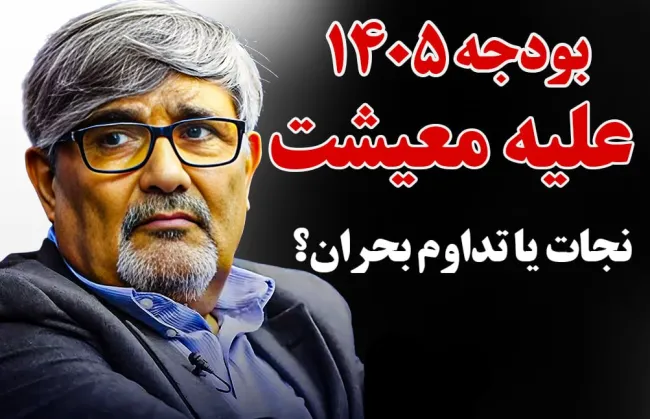
Watch | 2026 Budget Against Livelihood; Rescue or Continuation of the Crisis? Featuring Masoud Roghani Zanjani
Read more
Saeed Zibakalam: I am sure many ministers and officials know a lot of things; but they don't reveal them until they feel the time is right!
When disorder arises, some members of parliament start talking; they bring up things from three, four, or ten years ago!
Read more
Saeed Zibakalam: During the Pahlavi era, we didn't have anything called culture or party activity
After the first step of the revolution, we had to move on to forming political parties.
Read more
Saeed Zibakalam: Our parties are either scripted or decorative!
I don't know of any powerful party in Iran.
Read more
Saeed Zibakalam: In the 1979 revolution, only one step of the revolution was taken
The 1979 revolution was nothing more than removing a number of important and influential political figures from the Shah's regime!
Read more
Watch/ Examining the obstacles of republicanism in the midst of structural reforms and political obstruction with the presence of Dr. Saeed Zibakalam, professor of philosophy at Tehran University
Read more
Abdolreza Davari: I believe that part of the future of the Islamic Republic lies in the ideas of Mr. Qalibaf
The third leadership period will bring a transformation based on authority and pragmatism and moving towards development
Read more
Abdolreza Davari: I consider the issue of the monarchy returning to Iran to be out of the question
Mr. Reza Pahlavi has distanced himself significantly from the monarchy paradigm.
Read more
Abdolreza Davari: The officials of the Islamic Republic were themselves subversives before 1979!
The Islamic Republic knows how to contain protests because it was once a subversive government itself.
Read more
Abdolreza Davari: I see Mr. Pezeshkian's government—within the paradigm of governance—as being in a complete dead end.
The 2026 budget is a war budget.
Read more
Abdolreza Davari: Mr. Pezeshkian must either change his strategy or step aside.
Mr. Pezeshkian's government is a peacetime government.
Read more
Abdolreza Davari: Concentration of power reduces accountability; however, it must increase efficiency.
I believe that the Iranian people prefer a concentration of power that increases efficiency in proportion to that concentration.
Read more
Will the Islamic Republic collapse after Ayatollah Khamenei?
In the moment of an existential crisis, the entirety of society's religious forces—despite their criticisms—become a unified whole.
Read more
Abdolreza Davari: Structural reform is absolutely not part of Ayatollah Khamenei’s leadership paradigm.
Ayatollah Khamenei considers strategic retreat to be religiously forbidden (haram).
Read more
Abdolreza Davari: In the new era, the IRGC will have the upper hand over the clergy.
Since the establishment of the Islamic Republic, two power blocks, the "Clergy" and the "Hezbollah and the IRGC," have maintained a clear presence.
Read more
Abdolreza Davari: The third leadership will not deviate from the track established by the second leader.
There may be differences in some tactics; however, the track remains the "Second Step of the Revolution."
Read more
Abdolreza Davari: Sanctions have completely ruled out the possibility of regime change, uprisings, and popular revolutions in Iran.
A society that is fighting for its survival does not have the energy for structural change.
Read more
Abdolreza Davari: The Baqiyatallah al-Azam Headquarters is the implementer of the "Statement of the Second Step of the Revolution."
I consider the "Chastity and Hijab Law" to be a part of the "society-building" process within the framework of the Statement of the Second Step of the Revolution.
Read more
Abdolreza Davari: From the perspective of the author of the "Statement of the Second Step of the Revolution," the current crisis lies within the structure of the government.
My prediction is that the "Second Step of the Revolution" will bring about a structural change within the Islamic Republic.
Read moreAbdolreza Davari: What is proposed in the "Statement of the Second Step of the Revolution" is not compatible with liberal democracy or pure republicanism.
The "Statement of the Second Step of the Revolution" is a very transparent and clear document.
Read more
Abdolreza Davari: If our structural changes are based on the "Statement of the Second Step," responsibilities will become transparent.
Today, in the midst of various crises, you cannot hold anyone accountable.
Read more
Abdolreza Davari: The 20-year vision document could not function without a foreign policy compatible with the global order.
If our foreign policy had not entered into such conflicts, that document would have been achievable.
Read more
Abdolreza Davari: Since 2019, no power source has had the ability to influence the leadership's direction-setting.
After 2019, a period of undisputed space began for Ayatollah Khamenei.
Read more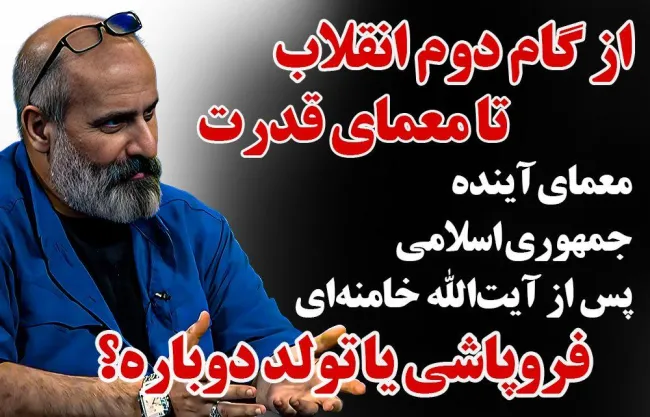
Watch | From the Second Phase of the Revolution to the Mystery of Power / The Mystery of the Future of the Islamic Republic After Ayatollah Khamenei; Collapse or Rebirth? Featuring Abdolreza Davari, Media Activist.
Read moreMost Read
Popular reads across Abdi Media