
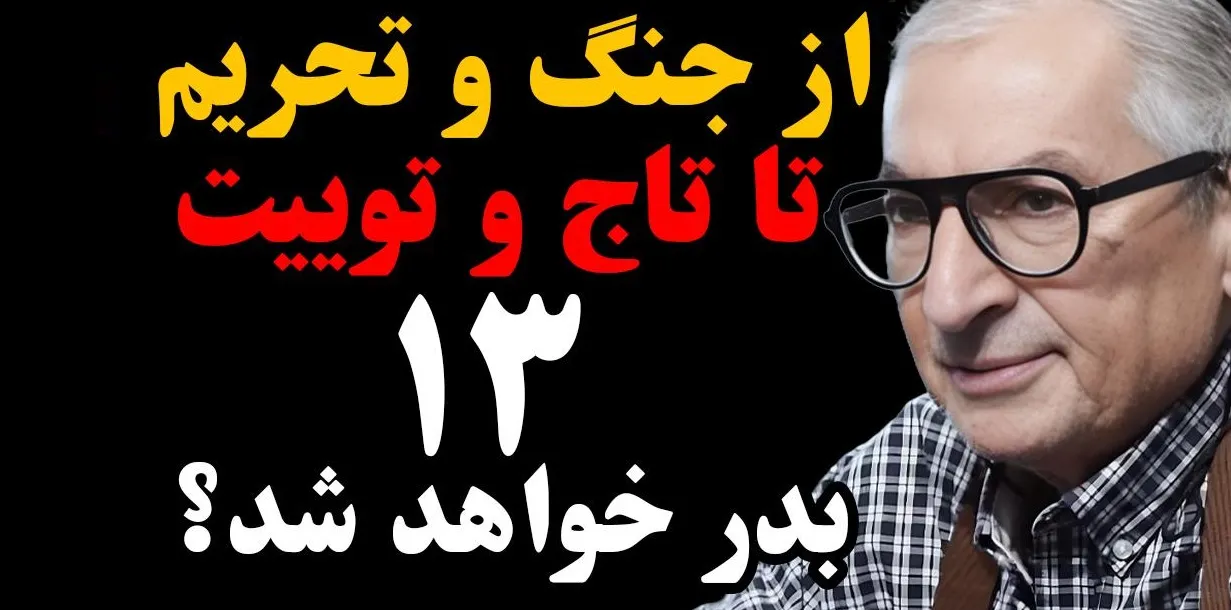
If you are a person of analysis, if you still ask amidst the smoke, fire, and propaganda what will be the end, you are exactly in the right place. In a world where war is neither declared nor ended, in an era where truth is judged not by reality but by virality, and in a homeland whose people are burning in the fire of sanctions, war, lies, and promises, the main question is no longer just who stays or who goes. The question is whether anything of us will remain.
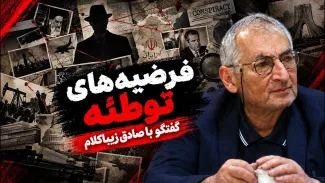
Abdi Media: If you are a person of analysis, if you still ask amidst the smoke, fire, and propaganda what will be the end, you are exactly in the right place. In a world where war is neither declared nor ended, in an era where truth is judged not by reality but by virality, and in a homeland whose people are burning in the fire of sanctions, war, lies, and promises, the main question is no longer just who stays or who goes. The question is whether anything of us will remain. Tonight, on Abdi Media, amidst this thick political dust—from missiles in the sky to various tweets, including those of monarchists and the opposition in different forms, from the jungles of Tehran and Tel Aviv to the prince's message from afar—I will ask. In the end, for me, the more important question is whether the 13th will be the day of departure. My guest tonight needs no introduction. He has stood in criticism of Iranian politics for over four decades, been pushed back, and is still here. Sadegh Zibakalam, university professor, author of various books you are surely aware of. You are someone who speaks simply, but I never found your words simplistic. One of your prominent features is simple writing and simple speaking. I've felt this in your various works, in your books—in How We Became Who We Are, in Tradition and Modernity, in Sociology in Simple Language, in Five Discourses on Government, and in your latest book, Why Don't They Arrest You? It's clear, and I understand what you're saying. During these 12 days—the 12-day war, before and after—the overthrow-seeking opposition was propagandizing that the people are actually against the Islamic Republic. Some of the opposition, while supporting national principles, opposed the war in any case. Some inside the Islamic Republic, on state TV, use the rhetoric that the people created a national epic and a national unity has been formed. The narratives in these three areas, in my opinion, can be summarized. Some of the opposition have said one thing, others have said another, and the internal narrative—now everyone is looking for war and when the ceasefire will come. I ask you, what did you see during these 12 days, before and after?
Sadegh Zibakalam: In the name of God, and with greetings and respect to all our viewers and listeners. I have also been exposed to these two sets of narratives. The first set says that during these 12 days, this great nation, this brave nation, this heroic nation proved their unity against the external enemy, showed it. "Hail to this people, hail to this nation, hail to these heroes." And there is another narrative that says this war was between the Islamic Republic and Israel; it was not a war between Iran and Israel, and many people, in fact, did not want to be present in this war because they did not accept it.
The reality is that in both narratives, ideology is embedded, a political view is embedded, and neither of them, in fact, is very close to reality. Because on the Friday when the Israeli attacks began—from dawn, around 4 or 5 a.m., the attacks started, a surprise attack, whatever name we want to give it—in the first two or three days, people were stunned, bewildered; some had nervous breakdowns. The sound of drones, the sound of missiles, the sound of planes, the sound of air defense—it really disturbed many people. Among my own close relatives, my daughter Maryam was actually going crazy, and many others like Maryam were in the same state. To say that amidst this chaos, where everyone was distraught and confused, they took up the tricolor flag and said "Hail to His Majesty Reza Pahlavi, hail to Israel," or came and said "Hail to the heroes of the Islamic Republic"—this was not the case. People were terrified, worried. Gas lines became terribly long; many who could leave Tehran left, with the worry of what to do if they ran out of gas on the way. Bakery lines were astonishing. Offices practically shut down. In such a situation, where the system itself realized a terrible chaos had arisen, even some mosques and Hussainiyahs announced advertisements—or whatever—that fellow citizens could stay for free in mosques and Hussainiyahs. These were people who had left Tehran, Isfahan, Shiraz, Tabriz, and other major cities—many had left. When you leave Tehran to go north, where many go, it usually takes 5 hours, or 6 with a stop. But it took 12, 14, 15, 20 hours—sometimes people were on the road that long, because traffic was that heavy. These were realities. You asked me what I saw? I saw these. They don't fit the Islamic Republic's narrative that everyone came and said "Hail to the warriors of Islam," nor the opposition's narrative that everyone was happy Israel attacked and said "It's over, the Islamic Republic's life is finished." In the panic that was created, in the desperation, people were thinking about gas, shelter, a safe place, bread, water, oil, etc. Many supermarkets and grocery stores would only give one tray of eggs, one pack of 5 loaves of bread. These were realities that happened. Now that those 12 days are over, to make such political and ideological exploitation of it, in my opinion, is not right. But this discussion arose, and I was one of those who raised it. Now, I say this with some pride—why with pride? Gradually, this discussion arose towards the end, as we were slowly approaching the ceasefire, after the Americans came and struck Fordow and Natanz, and it became clear there was nothing left to continue the war. From two or three days before, this discussion had been raised: how should we look at this war? Or in other words, how should we look at the parties to this war? Should we look at it as the opposition says—especially the monarchists and royalists—that this war is not between Iran and Iranians; this war is between the Islamic Republic and Israel? Or as the Islamic Republic says, this war is between Islamic Iran, the Islamic Republic, and Israel? Such a discussion gradually arose from the 7th, 8th, 9th days and continues. Why do I say this with pride? Because on that Friday, after the first hours, when I realized an attack had happened, a surprise attack as you say, I tweeted: "How can one expect an Iranian, despite all the criticisms of the Islamic Republic—which Sadegh Zibakalam has, and you, Abdullah Abdi, know better than anyone—how can one stand with Israel and Netanyahu? How can the prince come and stand with them? No matter how much one complains about the Islamic Republic, is aggrieved, is displeased, doesn't want its head on the system, how can one stand with Israel? Stand with America?" Some did it. Some Iranians actually did such a thing. At that time, I raised the question: if this is correct, if standing with the external enemy is acceptable, defensible, and justifiable, then why did we criticize Massoud Rajavi and the MKO so much? When in 1981–82, Massoud Rajavi and the MKO all went to Iraq and joined Saddam, he too could have said, "I have differences with the Islamic Republic; the enemy of my enemy is my friend"—which is what the pro-monarchists and part of the opposition say: "We are enemies with the Islamic Republic, we have no enmity with Israel, we have no enmity with America. Since these two have enmity with the Islamic Republic, we support them." But in my opinion, this approach, for many reasons, is neither justified nor ethical.
Because after all, this is our homeland, this is our country. If the Israelis hit it and destroy it—whether the Islamic system remains or not—it is Iran that will be destroyed, it is Iran where not a single lamppost will remain intact. We should not, due to hatred and animosity toward the Islamic Republic, be satisfied with Iran being destroyed. This is the biggest and highest reason. Rather, we should make our utmost effort—what Sadegh Zibakalam said should not happen; we must prevent this. The mere fact that I have many problems with the Islamic Republic does not mean I should cooperate with Israelis and Americans to overthrow the system.
I'll give a simple example. I don't know if you have children or not; I hope if you don't, God gives you children—they're a headache, but their headache is amazing. However much your child wrongs you, torments you, disobeys you, drives you crazy, how can you throw them out of the house? How can you say "this is not my child"? Some might say ethics tell us we should put them aside, but no—in the final analysis, it's your child. I believe the Islamic Republic, despite all its errors and mistakes, all the wrong things it has done, all the bullets fired at people in protests, all the political prisoners who were imprisoned for years—ultimately, I cannot stand with Israel and America and cooperate in leveling Iran to the ground. It cannot be done; it's not right.
Abdi Media: Some cite a historical point: they say that in World War II, foreign forces came and liberated Germany. Or some interpret it as Imam Khomeini himself being brought to Iran by foreign forces—how did France bring him to Iran? A foreign force supports a dissident or overthrowing leader, and the leader makes changes. Do you have a response to this?
Sadegh Zibakalam: How far behind are we in the automobile industry? Very far. The cars produced in Iran, compared not even to Mercedes-Benz but to cars produced in Malaysia, India, Turkey—we are 30 years behind, 40 years, 5 years—I don't know. But I do know that in the humanities, including political science and history, we are 500 years behind the developed countries. The difference is that in a normal situation, you can go to a developed company, sign a contract, and bring the technology to Iran. In a few years, Iranian-made cars using that technology could enter global markets. But we cannot do that in the humanities. We cannot go to Harvard, Stanford, the Sorbonne, or London and sign a contract for them to make Iranians less captive to conspiracy theories and "Uncle Napoleon" hypotheses, for them to make us gain political, historical, and cultural awareness like Westerners, and not be so captive to conspiracy theories.
Who says the French brought Imam Khomeini to Iran? Why didn't we say this in 1979? Why didn't we say it in 1989? Why not in 1999? Why have we been saying it for the last 4 or 5 years? Because of the hatred and animosity we have developed toward the revolution and the Islamic Republic. We didn't say it 10 or 15 years ago because we weren't so consumed by hatred and animosity toward the Islamic Republic. But now, prominent history and political science professors in America, as easily as drinking water, say Haizer told the Iranian generals, "Don't support Mohammad Reza Pahlavi anymore; you must support Ayatollah Khomeini." It wasn't foreigners who brought Ayatollah Khomeini to Iran. This meaning and concept we keep reproducing is mostly due to the backwardness of the humanities—we cannot understand the historical developments that happen in our own homeland or abroad—and partly due to hatred and animosity. Why didn't anyone say "the plot of '57, the sedition of '57" five years ago? It had slowly started, but now it has become widespread. I don't know—perhaps if a survey were taken now, maybe 70–80% of educated Iranians would say the revolution was nothing, the same thing the Shah said in '79: they removed him because he was progressing, because he had raised oil prices, because he had said no to the Americans, because he had said no to the British companies. Hatred and animosity have created this culture, this view. Therefore, Ayatollah Khomeini was the product of the political and social developments of Iranian society. But because we are sterile, barren, miserable, paralyzed, we cannot understand the political and social developments that led to the '79 revolution—what they were, how they happened, where they started, what role the working class played, what role intellectuals and women played. Why can't we, like Westerners, understand these things? We say "foreigners brought them to destroy Iran's progress and make the country miserable"—which they did.
Abdi Media: This point was interesting to me. You said that in 1979 itself, what percentage of people actually believed Imam Khomeini was brought by Westerners? I want to say, now what percentage believes that if Reza Pahlavi were to come to Iran, he would be brought by foreign forces?
Sadegh Zibakalam: That is—fundamentally, I want to say your question is not right. The issue is not whether if Netanyahu holds Prince Reza Pahlavi's hand, puts him on a plane, brings him to Iran, defeats the Islamic Republic's army, defeats the IRGC, defeats all those who support the Islamic Republic, Netanyahu and Trump hold the prince's hand and enter Mehrabad or Imam Khomeini airport—if anything is left. The issue is whether the Iranian people's national pride would be hurt by foreigners bringing Prince Reza Pahlavi into the country. Is that the issue? Is that the fundamental question? I believe no. The fundamental question is: from a country that Americans and Israelis have beaten so much that they could hold the prince's hand and enter it—nothing would remain of that country. They would have to level the Islamic Republic to the ground to bring Reza Pahlavi. The issue is not whether Sadegh Zibakalam's national pride is hurt. If I believed that if Prince Pahlavi came to Iran, everything would be rosy and there'd be no problem, I'd go to welcome him myself. But who says that if he comes to Iran—under any conditions—he has the competence, authority, and ability to govern Iran with 80–90 million people and its numerous problems? A few years ago, they gathered—Abdullah Moqtadi, Masih Alinejad—he didn't have the political ability to form a coalition leadership of the opposition. He didn't have that ability. Look how much debate and argument there was over bringing Abdullah Moqtadi—he is a Kurd. He doesn't have the ability to gather 4 people in a coalition as an opposition abroad.
Abdi Media: In the comments, they say the mullahs don't have that ability either.
Sadegh Zibakalam: The mullahs, the engineers, the doctors, the National Front, the reformists don't have it either—no one does. But our discussion was that you asked me if foreigners bring Prince Reza Pahlavi into the country, would the Iranian people accept him? Would they be offended that foreigners brought an Iranian and said "let him rule"? I say that is not the question. The main question is whether he has the ability to run the country, regardless of whether he fought inch by inch or Trump and Netanyahu held his hand.
Abdi Media: His supporters say he will have renowned advisors beside him. On water, the environment, they will rebuild the homeland—whatever was destroyed, they will rebuild. Instead of the mullahs sending our oil money to Syria and looting it.
Sadegh Zibakalam: My answer to the advisors is that you didn't have the ability to form a limited coalition of the opposition abroad. Today is July 1, 2025. Has Prince Reza Pahlavi, over the past two or three years, been able to form a group, a committee, a coalition—not 4 or 10 people who worship and obey him like a deity—that he could gather around himself? Has he been able to form an alliance with republicans? Has he allied with Islamists who don't believe in velayat-e faqih? Has he been able to ally with Kurds? With whom has he been able to form an alliance? With no one. Let's set aside diplomacy—he hasn't even had any interaction or relationship with those who are considered opposition inside Iran and have stood against the Islamic Republic. What relationship has he had with Seyyed Mohammad Khatami? With Mostafa Tajzadeh, Narges Mohammadi, Faezeh Hashemi, the reformist group? The royalists—monarchists—only and only tried to respect and name those who, when they want to take a photo, have the Lion and Sun flag behind them. What is his problem with Mostafa Tajzadeh, the opposition inside the country? The problem is that when they take photos, the Lion and Sun flag shouldn't be behind them. Mostafa Tajzadeh, Seyyed Mohammad Khatami—he hasn't been able to establish even the smallest connection with the opposition inside the country. He hasn't been able to establish even the smallest connection with the opposition abroad. This is the main issue. It's not that "I wish the Israelis would hold someone's hand and bring them; I wish Trump would hold someone's hand and bring them who could run the country, who could prevent it from being destroyed." I am certain of his inability, and conversely, I have serious and fundamental doubts about his ability. I'm not saying this arbitrarily; I have no grudge against the Pahlavis. How much interaction has he had with the opposition inside the country?
Abdi Media: The connection between the staunch monarchist supporters and the reformists—the most is "our connection to you is a lamppost." That's what I'm reading. The prince himself hasn't commented.
Sadegh Zibakalam: I have fundamental doubts about his ability to run Iran after the Islamic Republic. A simple example is the council he couldn't gather 4 people around. Second, he has had no interaction with the opposition inside the country. Third, whether we like it or not, whether we accept it or not, we have a problem called "Bijar, Kurdistan"; a problem called "The People of Kurdistan are Victorious, Reaction is Destroyed." My question to the prince is: what is your approach to the Kurdish issue? Suppose Iran is 100% in your hands. You come to Iran and it's entirely yours. What will you do with the Kurdish issue? What will you do with the "Yashasin" issue in Azerbaijan? What sign have I seen from him? What sign have I seen so far? Can you say, "No, he has a plan for the Kurds, ethnicities, Sunnis, etc."? Saying in general terms that "everyone will get their rights, everyone will get what they want, most people will gather, choose whoever they want"—beautiful words. Imam said many beautiful things in Paris; the revolutionaries in '79 said many beautiful things. But what was the result? Because many issues were not thought through, not reflected upon. When the revolution happened, 20 days, two weeks, three weeks later, the Sanandaj garrison fell to the Kurds. The Kurds said, "The People of Kurdistan are Victorious, Reaction is Destroyed." None of us in Tehran had any solution for the Kurdish issue. Not the Revolutionary Council, not Imam Khomeini, not Dr. Ebrahim Yazdi, not Sadegh Zibakalam, not Bani Sadr, not the Combatant Clergy. None of us knew there was a problem called "The People of Kurdistan are Victorious, Reaction is Destroyed." It's the same now. Prince Reza Pahlavi has not the slightest thought, idea, awareness, or plan regarding the most basic issues of Iran—whether he comes with Netanyahu or whether the Iranian people go and place him on their heads and bring him to Tehran.
Abdi Media: Some of those who became "opposition" in recent years and somehow managed to leave the country have taken the side of Prince Pahlavi. A clear example is Mehdi Nasiri. You must have seen Nasiri's statements, which in a way defended Israel's attacks on Iran and stood with Reza Pahlavi—very bluntly saying that the Islamic Republic was the initiator of the attacks, and from the other side, officially and without hesitation, supporting Reza Pahlavi. What is your opinion? He has a decree from Imam Khomeini. In Kayhan, his soap has probably been rubbed on you too.
Sadegh Zibakalam: Nearly 47 years have passed since the revolution. I can understand an individual whose parents emigrated to Canada or America 4 or 5 years after the revolution, during the war—who were in their 30s—they emigrated, went to America, had a child there, the child grew up in America, 40 years have passed, the child is in their 30s, and is fiercely anti-Islamic Republic and fiercely defends His Majesty the Prince. I can completely understand that. He was born in New York, grew up in California or Toronto. I can completely understand. But I cannot understand the revolutionaries who were flesh and blood in the revolution—like Mostafa Vahidi, Mehdi Nasiri, Mehdi Mahdavi Azad, Kambiz Hosseini, etc. How can you, Mr. Mehdi Nasiri, have had those beliefs in the revolution and its struggles and ideals...
Abdi Media: Velayat-e faqih—he was appointed by Ayatollah Khamenei.
Sadegh Zibakalam: It's not just them. I respect Shahrbanou Tabari, I respect her, but really, it's a question mark for me. Someone who was a 17- or 18-year-old girl during the entire Mohammad Reza Pahlavi era, went to England, was in the Confederation—how can someone who spent 30 or 40 years of their life as a Marxist, with the Confederation and the left, become a fervent monarchist? I really can't understand. Mostafa Vahidi, who until the day before yesterday was Karroubi's right-hand man, is now a monarchist. Mehdi Nasiri, someone who was dissolved in velayat, is now a monarchist. I can understand the post-revolution generation that wants no head on the system—they haven't seen anything positive from the revolution. But it's very different for Shahrbanou Tabari, Vahidi, Kambiz Hosseini, Mehdi Mahdavi Azad.
I really can't understand how Sadegh Zibakalam, who has written books for 40–50 years, can get on a plane at Imam Khomeini Airport and land in Boston, and then become a supporter of His Majesty. What happens to those books? I really can't understand. I made many mistakes in the past; I had beliefs that were not very correct. But I believed in democracy with all my being—the '79 revolution for me is about democracy and pursuing democracy. My biggest mistake in life was that after the revolution, I didn't continue democracy advocacy. I fell into the decadent, polluted swamp of anti-Americanism and enmity with America—not just me, many others did. We didn't continue democracy advocacy. When free elections and democracy were discussed, we said "these are bourgeois games" and "this is the wave of anti-Americanism, the wave of anti-arrogance"—it took everyone except the late Engineer Mehdi Bazargan.
Abdi Media: I want to ask about your previous statements. You said war would not happen. Do you consider these 12 days a war? They have called it a war, but I want to know your view. Do you think war, a heavier military confrontation than what happened, will occur? What do you believe? Do you still stand by what you said—that you believe war hasn't happened? What has to happen for us to call it war?
Sadegh Zibakalam: Often, people, politicians, and analysts speak so vaguely and ambiguously that no matter what happens, they can say "we predicted it." But the reality is, if I want to defend what I said—God is my witness—it's not because of stubbornness. If it was wrong, I would say it was wrong. As I'm telling you now, my biggest mistake was not continuing democracy advocacy after February 11, 1979, and many beliefs I had about the Shah's regime, which I later realized were very wrong—not political beliefs, but social and economic ones. I said war would not happen. What did I mean by "war would not happen"? I meant that not a single lamppost in Iran would remain intact. How would this happen? Iran's missiles would cause more casualties to the Israelis—instead of 30 or 40 Israelis killed, only one soldier was killed, not 300 or 400. They would hit sensitive sites. And besides, Iran—I said all this when I talked to you—Iran would fire missiles at Qatar, Dubai, the oil facilities of Aramco in Saudi Arabia, and the American base in Qatar. That was a joke: the 6 missiles that went toward the base—6 missiles, 7 of which were shot down by the Qataris.
Abdi Media: They had also been informed.
Sadegh Zibakalam: This is not war. What I said was that Israeli casualties would be high; Iran would attack American bases; Iran would attack Arab countries; Iran would close the Strait of Hormuz. Then it would be America's and Israel's turn. The things Iran could do are closing the Strait, hitting Ain al-Asad, Qatar, Saudi Arabia, killing a few hundred Israelis, killing a few Americans.
Abdi Media: This capability exists.
Sadegh Zibakalam: Yes, I say this is its maximum capability. Then it's their turn, and they wouldn't leave a single lamppost intact in Iran. Did we close the Strait of Hormuz? Except for the joke of 6 missiles, which we had informed about and Qatar shot down—did we tell Saudi Arabia "the eyebrow is above the eye"? Did we tell Ain al-Asad we were going to attack? None of that happened. What I said, I'd bet on it. What happened was that perhaps Netanyahu, the Israelis, and Trump thought that if that attack—the surprise attack you call it—happened, the Iranian people would pour into the streets, and like "Woman, Life, Freedom," like November 2019, January 2018, 2009 after the election announcement, that kind of thing would happen. I don't know, perhaps such a thought occurred to Netanyahu and Trump: "If we attack, the people will take to the streets, and the Islamic Republic's work will be over." If Trump had known me, he would have consulted me. If Netanyahu had consulted me, I would have told them, "Whoever told you that was mistaken; you have no understanding of Iranian society." In practice, what happened was absolutely not what the Americans thought—that the people would rise against the system—what Netanyahu thought.
Abdi Media: They say this will happen.
Sadegh Zibakalam: Of course, Iran International tried very hard to blow on the embers, hoping it would happen. They said in Ekbatan they shouted "Death to Zibakalam," in Narmak they shouted "Death to Abdullah Abdi," they poured into the streets—they did a lot of these things, but it was nonsense. In those days, people were not seeking the overthrow of the system or validating the system; they were seeking to get from here to there, whether they had gas or not, if they got 5 loaves of bread today could they get bread tomorrow? Who said people were seeking to overthrow the system? What kind of mountain-sized thought was this? I don't know who among the monarchists had put this in the heads of Israel and America?
From this perspective, it was not war. If you call these 12 days a war, what do you call Ukraine—three years of Russians pounding Ukraine day and night? What do you call Gaza? A genocide. What do you call Gaza? What do you call the 8-year Iran-Iraq war? What I meant by "war will not happen" was that scale. The reason is clear: the Islamic Republic absolutely does not want this war, regardless of the slogans they give. Netanyahu and Trump also don't want such a war, because what they want to achieve—they can achieve without a large-scale war. That thing is to paralyze the Islamic Republic's nuclear capability. They paralyzed it to some extent, according to one narrative. Trump says "we completely paralyzed it"; Grossi says "not completely, partly." So what will they do? They will attack Fordow again, attack Natanz again. If images and information show it has the capability, in a few months it will start enrichment again; they will hit again. What will we do? We'll fire a few missiles at Israel, cause a few casualties, hit a building or two, and we'll sit back. But Israel will have succeeded in pushing back our nuclear process again.
Abdi Media: I spoke with one of the greats; he said this war is part of the grand strategy of the "Aein-e Ghodrat" [not sure about this term]. What is your opinion?
Sadegh Zibakalam: Do you know what our misfortune is? Our misfortune is that many of our dear ones, when they come to speak with you, speak as if we are in a political science class at the University of Tehran or an international relations class at Shahid Beheshti University. Listen to the analyses of the British, Americans, Canadians—see if any of them have these pretensions that "this has been said, these are constructs of our own minds." The America I know—I don't bring these grand theories about America. The America I know, in front of my eyes in August 2021—three or four years ago—fell flat on its face. Who did it? The Taliban. The America I know fell flat on its face in Vietnam. The America I know had blundered so much in Iraq that after Saddam's fall, they just started scratching their heads, not knowing what to do. The Americans had acted so thoughtlessly in Iraq. Friends raise things that "America is like this." No, that's not the news. Look at Trump now—has he said anything coherent? In the 5 or 6 months since he became president, has he said anything solid to hold onto? On Saturday he said "we want to negotiate with Iran"; on Sunday he said "no, we're not negotiating." On Saturday he said "tariffs should be like this"; on Sunday he said "no, we'll delay it for a month." On Saturday he said "we'll expel foreigners"; on Sunday the court stopped him, and he said "I'll destroy the court." I don't accept any of these chic theories that friends talk about regarding America and the new world order. A few years ago, the "soft war" started. Every day I went to the university, there were posters hanging about "soft war and Islam," "soft war and the Islamic Republic," "soft war and the new Middle East," "soft war and Joseph Nye." Huntington proposed the "clash of civilizations." I have a couple of dozen theses, Master's and PhD, on soft war—none of these are done in America because they are advanced in the humanities. But we, on soft war, theorize and say "it will happen like this." When America gets stuck and falls flat on its face with the Taliban—we saw America's greatness fall flat before our own eyes. Which of these theories is compatible with that? The calamity the Americans got stuck in in Iraq—which theory is it compatible with? Why go far? Right now, Trump has agreed that the B-52s struck Natanz. According to one narrative, nothing is left; according to another, not much happened, and at most, in a few months, the Iranians can compensate. In my opinion, taking refuge behind these foreign names and these terms is a bit of "grandstanding." I don't accept these.
Abdi Media: In your earlier remarks, you mentioned it but passed over it quickly. I want you to explain more: did the Islamic Republic succeed in creating national unity from this 12-day war? Did it gain anything? Was what was created solely the fruit of the people? If something was created, it was solely the fruit of the people, and the Islamic Republic has no share?
Sadegh Zibakalam: What happened, the solidarity that happened, the unity that happened—it was by people like Sadegh Zibakalam, Hossein Dehbashi, Mohammad Fazeli, Mohsen Borhani. It belonged to those who, despite their differences, fundamental criticisms of the Islamic Republic, when external war came, did not defend the system, but they did not stand with Israel. They came and stood with the Islamic Republic. This happened.
Abdi Media: The opposition outside Iran—some journalists, political figures—will this happen?
Sadegh Zibakalam: I mean something else. I mean the Islamic Republic didn't do this. The Islamic Republic shouldn't take credit for it. The Islamic Republic doesn't have the ability to do this. This was done by a group of people on their own initiative. But national unity can be built from the continuation of these 12 days. How? Instead of the crackdown the Islamic Republic has now started—partly, it has the right because it was truly surprised; apparently, many of the explosions and attacks and drones were from inside Iran itself, and the system had no idea such things were happening. The Islamic Republic could somewhat loosen its "crackdown and tighten the noose" policy against those who write, who study and teach. It could free some political prisoners, allow political parties and organizations, allow press freedom, reduce security institutions' interference in political affairs. If the Islamic Republic moves in this direction, the results of those 12 days, despite the damage caused, could be beneficial. But if it uses those 12 days as a pretext for suppression and crackdown, then those 12 days, in terms of long-term effects and consequences, will have been counterproductive for opening Iran's political space and bringing it closer to democracy. It's a bit early to judge whether these 12 days have improved democracy in Iran or whether they have choked off the little democracy there was, or made it more closed and restricted.
Abdi Media: On the day the attacks stopped from both sides, I wrote a 10-point note. In one point, I wrote that Netanyahu destroyed some facilities and also destroyed the efforts of civil society. After the war, the wartime conditions, the security conditions—as we continue discussing—will not allow space for civil movements, for non-violent freedom movements to act.
In your opinion—I'll go to the main point without extra explanation—do you think the Islamic Republic is approaching its natural end, or its imposed end? Or is it a beginning of an end? What will happen?
Sadegh Zibakalam: If the Islamic Republic wants to continue the same policies it pursued before these 12 days, with the same intensity and severity, then I become seriously worried and fearful for its future. I hope and pray that there are those within the Islamic Republic—among the IRGC commanders, the parliament, the government, the Leader's office, the Guardian Council, anywhere within the ruling system—who will turn to themselves and ask, "What can we do to increase that national unity, that cohesion that we trumpeted so much after 12 days?" It was little; we don't need to tell anyone—we realized ourselves that the unity we talked about didn't happen much; we kept our faces red with slaps. But if they go and seek "what should we do to have less influence in our country in the long term? What should we do so that many more people come and support the system? What policies should we implement?" I hope that such wisdom, such understanding, exists in the leadership of the Islamic Republic. If not, they will bear the consequences themselves. This is my answer to you.
Abdi Media: Following up on this question, I want to go back more than a decade. I've followed your remarks for years, and I've had the fortune that you've kindly given me time for conversations, which I always consider as a lesson. Two decades ago, during Mahmoud Ahmadinejad's era, you were among those who openly and clearly criticized the Islamic Republic's nuclear program, always opposing it. Many fundamentalists, even many reformists, attacked you—asking how you could criticize a program that could lead to the country's development. They said these programs would enhance Iran's geostrategic position, using such interpretations. But you always opposed these nuclear policies. Are you still opposed? If the Islamic Republic had a nuclear bomb today, perhaps this attack wouldn't have happened. What is your view today?
Sadegh Zibakalam: Let me start from the end. We had a colleague at the Faculty of Law and Political Science; his office was next to mine. He was also the head of the faculty's international relations department for a while—Asgarkhani. I haven't been affected by Alzheimer's yet. May God have mercy on him—last year, it seems he passed away due to COVID. Our offices were next to each other. Whenever he came in the 2010s, 2015–2016, he would come to my office—the door was always open. He would say, "Don't betray so much," half-jokingly, half-seriously. He believed—ten, fifteen years ago, with all his being—that Iran should produce nuclear weapons. Can you understand why he said "don't betray so much"? Ten or fifteen years ago, the nuclear bomb had its place. I was totally opposed to Iran's nuclear program. If I'm not mistaken, I have three or four files in the judiciary for saying "the eyebrow is above the eye" regarding nuclear, and for calling the nuclear horse a "Yabu." It wasn't just the late Asgarkhani; there were and are and will be others in the Islamic Republic whose argument is: "Zibakalam, open your eyes. Iraq was torn apart because it didn't have nuclear weapons. Libya was torn apart because it didn't have nuclear weapons. Afghanistan was torn apart because it didn't have nuclear weapons. But they don't dare tell North Korea 'the eyebrow is above the eye.'" They say this and ask, "Did we have nuclear weapons? If we had one, two, three, four, Israel wouldn't dare look at us sideways; Netanyahu and Trump wouldn't dare delay responding to our greetings." But this entire argument is wrong. Do you know why? Because without Russia's food aid, without China's, without even South Korea's and the EU's, the people of North Korea would face famine. Who says nuclear weapons bring us security? Bring us comfort? What deterrence has it brought? What prosperity? What could nuclear weapons have brought us? This is my answer to those who point to countries without nuclear weapons that live without anyone looking at them sideways. Why did Israel attack us? Because we were the ones who said "Israel must be destroyed." Israel has attacked now—in July 2025, late June—did Israel attack us ten years ago? No. Were we not saying "Israel must be destroyed" ten years ago? Didn't Imam Khomeini say after the revolution that "Muslims can pour a bucket of water on Israel and it will be destroyed"? It was us who, from February 11, 1979, wanted to destroy Israel. So we should build a nuclear bomb so Israel won't attack us? Isn't it simpler to stop attacking Israel, to stop wanting to destroy it? This is for those who say "if we get the bomb, we'll be reassured and they won't attack." Regarding your question—you said you're surprised; it's not just you—everyone was surprised and attacked me. Don't look at now; ten or fifteen years ago, everyone's neck veins were bulging. During Ahmadinejad's time, they said "nuclear energy is our absolute right; these Western [insults] have their own atomic and nuclear technology, and now this Islamic Republic, these hardworking, sacrificing people want peaceful nuclear energy, and these oppressive Westerners, these oppressors, this arrogance, are stopping us." Why was I opposed to nuclear? Because I realized that nuclear, more than being for economic considerations and power generation, had become a tool in the hands of the Islamic Republic for confrontation with the West, for anti-arrogance, for saying "Death to America" and "we will destroy Israel." From the early 2010s, I gradually realized this nuclear program was becoming a weapon in our hands, serving anti-Americanism and anti-Western sentiment. In practice, that's how it happened. In 2003, it became known that we had a nuclear program—we had started a few years before, after the war, during Hashemi Rafsanjani's presidency. My question—I'm not saying from the beginning, but perhaps after the war, we sought nuclear to launch the Bushehr nuclear power plant; Hashemi loved such things—trains, speed. Initially, perhaps nuclear was just for its own sake. When the Mujahedin revealed that they were working in Natanz, Khatami, in February 2003, confirmed that we had nuclear and it was peaceful. Some discussions arose: "If it's peaceful, if you're doing it, why didn't you tell the IAEA?" That aside. A series of negotiations started during Khatami's time, conducted by Ali Larijani and Rouhani—Saadabad. The issue was being resolved.
Sadegh Zibakalam: Until 2005, the miracle of the third millennium became president. When he became president, nuclear energy was no longer an economic process, an economic project, an economic paradigm. It became our absolute right. Ahmadinejad inflicted one of the greatest blows to Iran's national interests, especially in the first four years and one or two years of the second four, by turning nuclear into an ideological weapon for the Islamic Republic—"our absolute right." Then came the sanctions. From that point on, the radicals and extremists realized they could use nuclear as a bargaining chip with the West and America—to make them take us seriously, to enrich to 60-70%, to have advanced centrifuges. Why is Sadegh Zibakalam opposed to nuclear? Because nuclear was not about economics, electricity, energy, or radiopharmaceuticals. Nuclear became a tool in the hands of the Islamic Republic for anti-Americanism, anti-Westernism. How many years has it been since the nuclear issue? From 2003 to 2025—22 years. In these 22 years, how many nuclear power plants have we built? Dr. Ali Akbar Salehi, the head of the Atomic Energy Organization, and I were talking at a university conference. I said the same things. He said, "I'm surprised; as a university professor, how can you say nuclear shouldn't exist?" He said by the end of the 2010s—by 2020, entering 2021—we would build 5 nuclear power plants, each capable of producing as much as Bushehr. Now it's July 2025—four and a half years have passed since that promise, and we haven't even built half a nuclear power plant. I can understand why: nuclear was for "Death to America," for fighting global arrogance.
Abdi Media: Why didn't Israel attack during Ahmadinejad's time? At that time, they said nuclear energy was our absolute right. Why did Israel attack today?
Sadegh Zibakalam: I have two reasons for the Israeli attack. One is that I believe the Israelis wanted to take revenge for October 7 from the Islamic Republic one day—they might think they did. That was one reason for their attack.
Listen without filter on the Abdi Media Castbox.
Abdi Media: I remember we spoke after October 7, and you said they would take revenge.
Sadegh Zibakalam: Yes, that was one reason. Another reason for their attack is that there is evidence and indications from nuclear facilities, activities, and programs that raise the question: is the Islamic Republic really not seeking to build nuclear weapons? True, they say they are not. Gradually, moderate and middle-of-the-road individuals say, "We said we won't produce nuclear weapons; if we do, it's none of your business." Kamal Kharrazi says this—he's not Hamid Rasaii, Nabavian, or Saeed Jalili, not those illogical extremists. Kamal Kharrazi is one of Iran's most weighty political figures. Ali Larijani says this: "If we produce, we produce; it's none of anyone's business." Ali Larijani is one of Iran's most moderate and middle-of-the-road figures. He's not Hossein Shariatmadari, that we can say "forget him, he says some things." They are gradually saying, "If we produce nuclear weapons, it's none of your business; you threaten us, and we want it for deterrence."
A third reason for the attack relates to Israel's internal dynamics. I believe, and still do, that if a ceasefire is reached in Gaza today or tomorrow—July 2, 2025—and hostages are freed, and things return to normal, Netanyahu would fall from power and not be able to stay. I believe one reason the Israelis remain in Gaza is Netanyahu's political calculations to stay in power, along with the extreme religious Zionist group that is now part of his cabinet.
If a poll were taken tomorrow, I believe the Israeli attack on Iran has increased Netanyahu's popularity. That's another reason—Israel's internal political dynamics also contributed to the attack. Putting these together, we can understand why they attacked in July 2025 and not in July 2015—because those reasons didn't exist then, or weren't as strong.
Abdi Media: At this moment, do you see collapse as probable?
Sadegh Zibakalam: At this moment, I'm so tired that I'm gradually beginning to say "I don't know what I'm saying," as you went after collapse. First, I believe collapse will not happen—contrary to the opposition who thought if Israel attacked, collapse would happen. Collapse will not happen. The system's future hinges on one fundamental question: will the system move toward political reform or not? If it doesn't pursue political reform and continues the same way it has managed politics, I don't know which direction its future will take. But if there is enough collective wisdom within the Islamic Republic's ruling system that we inevitably must move toward political reform, then political reform will act like a vaccine, protecting it against collapse.
Abdi Media: Regarding the recently passed bill that imposes severe punishments for those suspected of espionage and cooperation with Israel—a wave of arrests has also occurred. I've seen you express concern about the passage of such bills and the treatment of suspects. What is your view on this?
Sadegh Zibakalam: I have two fears about this bill. One is that under the pretext of finding spies and tightening the security belt, the little open political space we have will be finished. That's one fear. My second fear is for Afghans. I am one of the few Iranians who neither hates Arabs nor Afghans, unlike my colleagues. I believe it's true that a number of Afghans came and cooperated with Mossad and Israeli agents—I can accept that. But who were they? They were mostly those who, after Karzai's government fell and the Taliban came to power, were part of the army, organization, and security and military apparatus of the pre-Taliban government. Some fled to Iran, some to Germany. If I were Mossad, who would be useful to me? An educated Afghan military man, or an Afghan street sweeper cleaning Mellat Park? Clearly the former. I'm concerned that Iranian racism will cause trouble. Before these 12 days, there were groups on Telegram, WhatsApp, and social media calling for expelling Afghans—a bunch of poor, wretched people who sought refuge here, have been here for 10 or 5 years, have become laborers, have wives and children. "Expel them!" In this chaos of Israel's attack, Afghans cooperated. I am very upset and concerned about this bill that was passed. Unfortunately, the parliament is an extremist one, representing less than 50% of society. One can ask: how can the resolutions of a parliament that, at best, 70% of the people didn't vote for—representing only 20–30% of the people—have popular and legal support? My fear is that in trying to catch spies, the circle of civil liberties will tighten, executions will increase, and the expulsion of Afghans and injustice toward Afghans will increase. That's why I'm concerned about this bill. Besides, when did our law enforcement, when expelling Afghans, say "the law says this"? When did security officials, when taking someone to Evin Prison, say "the law says this"? They do whatever they want. Whenever they wanted, they expelled Afghans; whenever they didn't, they didn't. It wasn't because the law said so. Unfortunately, in Iran, what governs is often not the law.
Abdi Media: How do you see Iran's future? What do you foresee as the final outcome of this war? I used the expression in the title: "Will the 13th be the day of departure?" Because the war lasted 12 days; if we add a 13th, it's an unlucky number. Do you think the 13th will mark the end?
Sadegh Zibakalam: I believe that regarding Israel, a scenario similar to the Hezbollah situation might play out. We know a ceasefire was formally established between Hezbollah and Israel, and Israeli forces withdrew from southern Lebanon. But whenever the Israelis sense or perceive that military transfers are happening—a Hezbollah group moving weapons from point A to point B—they have claimed the right to strike. They have repeatedly attacked Hezbollah and parts of Lebanon, despite the ceasefire and despite having withdrawn from Lebanon.
My impression is that the same could happen with Iran. The Israelis are watching like hawks, monitoring what we are doing in Fordow. No one really knows what remains—whether it's 80 or 90 meters underground—it's all speculation, whether from Netanyahu, Trump, the head of Iran's Atomic Energy Organization, or Grossi. But if the Israelis feel that Iranians are gradually restarting activities, they won't wait for Grossi to say "this has happened" or for the EU to trigger the snapback mechanism. They will attack as soon as they sense we are doing something. What will we do? The same as always—"True Promise 3," "True Promise 4"—fire a few missiles. If the Israelis calculate that the cost is too high—people are frightened, fleeing, casualties occur—they might decide on a more serious response. I don't know what that would be, but it could be more serious. In the short term, whenever the Israelis feel we are advancing on nuclear issues, I think they will attack us.
Abdi Media: Is there anything you'd like to add in conclusion?
Sadegh Zibakalam: What I want to tell people is: don't wear yourselves out so much. Don't listen so much to Zibakalam's remarks or Iran International's. Don't pay so much attention to these threats of attacks. Go to the cinema, read a book, do research, take your family out. Don't be so consumed with wondering what the final outcome will be—whether the ceasefire will hold or not. Don't get so caught up in all of this.
Abdi Media: Everyone is looking for the final outcome. Abdi Media is an independent media outlet with no affiliation or allegiance to any political group inside or outside Iran.
Full conversation between Abdi Media and Dr. Sadegh Zibakalam, Professor of Political Science at the University of Tehran.

Take less than a minute, register and share your opinion under this post.
Insulting or inciting messages will be deleted.
Sign Up