
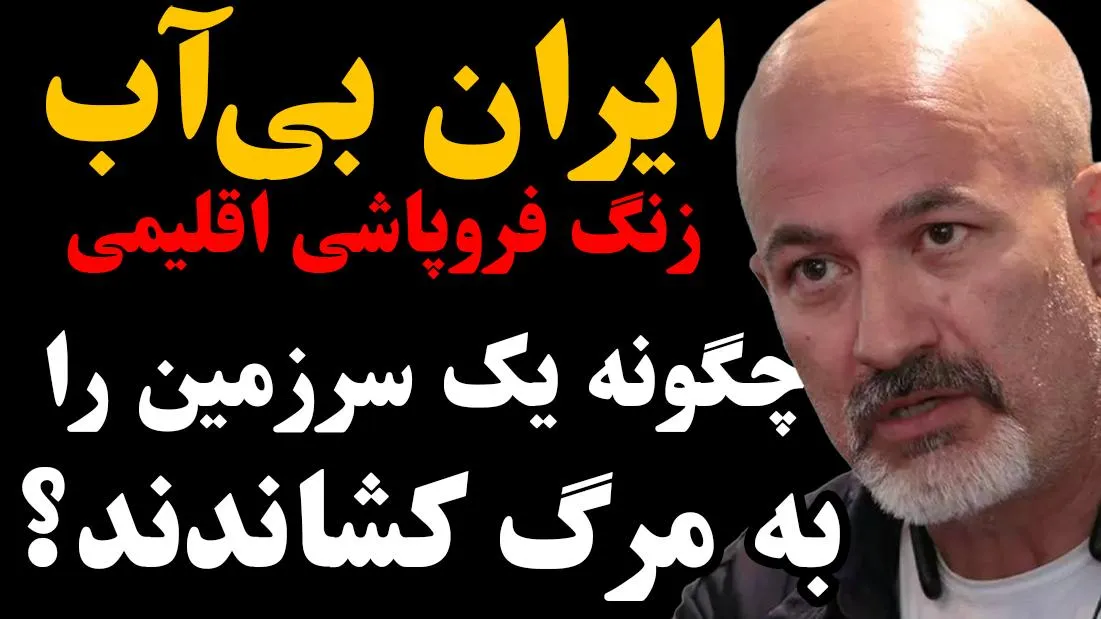
Iran is thirsty, not only due to lack of rain but also due to lack of thought. Not only due to water scarcity but also due to the folly of a history that has forgotten water and soil. Tehran, the capital of Iran, now stands on the precipice of absolute waterlessness. Groundwater aquifers have been emptied. We look to the sky with supplication, and officials offer pumps and reservoirs. This is our concern. In the midst of this, the main question is not how much rain we have; the question is why we have no management. Why has no one thought of the future water rights? Who decided to sacrifice the fate of a land for development? And now the bells have tolled—not for someone else, not in another country. The bell of a land's end is right here, in the heart of Iran. The water crisis has passed from a crisis to the brink of climatic collapse.
Abdi Media: Greetings to you, thoughtful audience, the elite, and the followers of Abdi Media. Today, we are going to hear our voices from beneath the subsided layers of soil, from the heart of a thirsty land on the brink of oblivion. If you've come this far, it means you still think asking is not a sin, and perhaps even the beginning of liberation. Here, we seek neither confirmation nor denial; we seek understanding. Sometimes, to understand, you must pass through fire. If you find this kind of dialogue useful, subscribe to the channel right now, hit the bell, share your opinion, ask your question—don't let this voice remain in silence. The continuation of this voice is you; you can help the free flow of information by sharing these conversations. You are the body of support; every independent voice needs a worthy backing, and that worthy backing is you. You can support the independent voice of Abdi Media with the cost of one or several cups of coffee.
Many have been waiting for this program. We were a nation that had the art of using water in our roots—from qanats, karizes, rivers, and springs to today's thousands-of-meters-deep wells. The sound of pumps from reservoirs has replaced the beautiful murmur of water. Iran is thirsty, not only due to lack of rain but also due to lack of thought. Not only due to water scarcity but also due to the folly of a history that has forgotten water and soil. Tehran, the capital of Iran, now stands on the precipice of absolute waterlessness. Groundwater aquifers have been emptied. We look to the sky with supplication, and officials offer pumps and reservoirs. This is our concern. In the midst of this, the main question is not how much rain we have; the question is why we have no management. Why has no one thought of the future water rights? Who decided to sacrifice the fate of a land for development? And now the bells have tolled—not for someone else, not in another country. The bell of a land's end is right here, in the heart of Iran. The water crisis has passed from a crisis to the brink of climatic collapse.
Years ago, amidst the uproar of conspiracies, cries, and grand promises, a voice arose—not from behind a desk, but from the heart of the soil. A voice that saw rain not just as a blessing but as a test, and drought not as a divine calamity but as the result of earthly policies. He spoke of water, but his meaning was not just water. He spoke of trees, but pointed to the roots of society. He spoke of soil as the wounded memory of a nation. My guest tonight needs no introduction. He is one of the most outspoken and compassionate environmental voices in Iran. Mohammad Darvish is a writer, researcher, renowned environmental activist, and the calm narrator of a silent catastrophe, a witness to climatic collapse. I am very happy to be able to speak with you tonight. I am very sorry that the topic of our program with you is water scarcity. I had hoped that one day we would talk about prosperity and you would depict prosperous faces for me and the viewers. But your presence on this program is a blessing. How serious is the issue? Are we talking about water scarcity, or the death of a land?
Mohammad Darvish: Thank you for giving me this opportunity to discuss important environmental issues with you on your widely viewed media outlet. The issue of water and drought, as you mentioned in the introduction, is an age-old issue in Iran. Iranians, over the past several thousand years as one of the oldest human civilizations, have always been dealing with drought. We are, after all, located in a part of the Earth in the 25 to 40 degrees north latitude, known as the global dry belt. This region receives between one-third and one-quarter of the global average rainfall, and its evaporation is at least twice the global average. The rate of soil formation in this region is twice the global average. These are the ecological realities of this land. Despite these realities, there was enough intelligence in the men and women of this land to continue their civilization for several thousand years.
But unfortunately, we are now facing a truly serious crisis, and this crisis stems from the fact that we have mocked these ecological realities, not taken them seriously, and thought that by overcoming them with a structural approach to water management and an exaggerated reliance on technology, we could solve any environmental challenge. That hasn't happened, and now we are talking in a situation where, according to official statistics from Iran's Water Resources Management Company, the imbalance in groundwater aquifers has exceeded 150 billion cubic meters. That is, Iranians over the past half-century have extracted 150 billion cubic meters more than what has entered the aquifers—one of the highest records in the world. This becomes even more thought-provoking when recently the head of the University of Tehran, himself a renowned professor of irrigation, Dr. Omid, said, "I don't accept this official government figure; this figure is at least 250 billion cubic meters," which is much more alarming. More recently, a study at Shiraz University, which Dr. Abbas Keshavarz, a veteran of the agricultural sector, has also cited, even says this figure is higher, at 350 billion cubic meters. In any case, even the 150 billion is a disaster. It has caused us to be among the top three countries in the world for land subsidence. According to the latest research by the Geological Survey of Iran, at least 100,000 square kilometers of Iran's soil is experiencing subsidence of more than two centimeters per year—another unparalleled record on Earth. In some parts of the country, in Fars province, between the Fasa and Jahrom plains, point subsidence of up to 54 centimeters per year has been reported, which is about 140 times what is considered a critical condition. In southwestern Tehran, in the Shahriar plain, up to 36 centimeters per year has been reported; in Mashhad-Chenaran, 25 centimeters; in Isfahan, 23 centimeters. The situation is truly alarming. Except for Gilan province, where no subsidence has been officially confirmed, 30 other provinces are facing the great crisis of land subsidence, caused by the continuous imbalance of water resources.
When we talk about water imbalance and subsidence, we shouldn't be surprised. This phenomenon is the result of at least thirty years of continuous imbalance. For thirty years, the country's water managers did not realize that the extraction rate and the recharge rate were not equal—or they did realize but couldn't get their voices heard by the government and officials.
Abdi Media: It would be good to explain what "imbalance" means. It seems to me that people need a definition from a trusted and impartial source, like an environmental activist with no vested interest, to explain what this imbalance is and how we got here.
Mohammad Darvish: We have around 100 to 105 billion cubic meters of available water per year. This is based on the precipitation that occurs in this country. We can plan for about 100 to 105 billion cubic meters. If we round it to 100, about 46 to 47 billion cubic meters is surface water, and about 53 billion cubic meters infiltrates the ground and becomes groundwater. That is, if we extract around 50 to 53 billion cubic meters of groundwater each year, assuming the average precipitation doesn't change (though it does—this year, for example, precipitation is about 38% lower than the long-term average), we shouldn't extract more than 52-53 billion cubic meters to maintain a balance between recharge and extraction. However, we are talking in a situation where, as I said, an imbalance of 150 to 350 billion cubic meters has been created. That is, we have extracted much more than what was recharged into the aquifers, qanats, and wells. As a result, our groundwater levels have dropped lower and lower. Statistics from the Water Resources Management Company show that in the central plains of Iran, this drop has been up to 2 meters per year, which is truly alarming. In short, imbalance means we have not respected the ecological balance of this land's water resources.
Abdi Media: As I understand it, from ancient times, we had the art of using water resources and even exported it. We knew how to use these resources, where to cultivate—rainfed and irrigated agriculture existed. Can we say with certainty that this imbalance is solely the product of managerial mistakes? Could Iran have managed its water affairs under any circumstances?
Mohammad Darvish: Absolutely, 100% correct. In fact, what happened in Iran is that the number one culprit is the lack of wisdom in the country's governance system.
Abdi Media: Besides being familiar with environmental issues and this space, you are also familiar with culture and management culture. If we were to give a reason—whether for dam construction, wheat self-sufficiency policies, agricultural issues, or establishing industries in unsuitable locations—what culturally caused these decisions? Do you see this as a result of negligence? Or what? Did those making these decisions lack knowledge? Were they not compassionate? Were they infiltrators from the West? What was it?
Mohammad Darvish: There are several components that have led us to this unfortunate outcome. One is that half a century ago, about 30 million people lived in this country. You now live in Norway?
Abdi Media: Geneva?
Mohammad Darvish: You are in Geneva, Switzerland. How much population did Switzerland have half a century ago?
Abdi Media: Much less, not what it is now.
Mohammad Darvish: Half a century ago, the entire European Union—27 or 28 countries—had about 560 million people. But half a century ago, Iran had 30 million people. Now, the EU population has decreased by about 100 million to about 460 million, while Iran's population has at least tripled. We are talking about the EU, located at 60 degrees latitude, with much better rainfall, more abundant rivers, and much lower evaporation. So one component that has led us to such a disaster is that Iran's population growth rate has been very high, above the global average. Note that 50 years ago, we had about 120 billion cubic meters of available water for 30 million people. Now, our available water is about 105 billion cubic meters, and our population has reached 90 million. Fifty years ago, we had about 15 million hectares of forest; now our forests are 12 million hectares. Our natural resources have also decreased. This itself is a huge challenge, even if the most modern or people-friendly government on Earth existed. It has reduced the per capita water availability for Iranians to about 1000-1100 cubic meters per year, whereas 50 years ago this figure was several times higher.
With such a situation, we also adopted a doctrine for the country's development: that because the whole world is against us, we must be independent, stand on our own feet, and produce our own food at any cost and under any conditions. So we went after businesses that could maintain our independence, without paying attention to the ecological realities of this land. We mocked them. There is a famous quote from Mr. Mahmoud Ahmadinejad: when he was told that the water situation is bad and the groundwater aquifers cannot withstand such extraction, he said, "What are these words? Whoever has teeth should have bread," and ordered more extraction. This sped up the destruction of the land and its water reserves. Instead of pursuing businesses that don't require water consumption, we went after water-intensive businesses. We treated water not as a biological commodity essential for the survival of Iranians, but as an economic commodity to be sold. Worse, we made the water authority independent, telling it, "You have to generate your own income; we won't give you a budget." So the more water it sells, the more income it has to pay its employees. An institution whose bread comes from selling water, not managing consumption, is like a tire repair shop that would go out of business if it advertised that tires never get punctured. This is the problem with the Ministry of Energy—it has never gone after consumption management; it has never created incentives. If it tells citizens to consume less water, it is reducing its own income—a conflict of interest.
Mohammad Darvish: Throughout these 40 years, we never moved toward consumption management; we moved toward discovering more water resources to build more dams, expand water transfer projects, and build more desalination plants to generate more revenue. This itself creates a paradox. We faced this problem in other sectors too. We made hospitals, universities, and research centers self-sufficient, telling each to find its own clients. For example, in the natural resources sector, who is the client for reducing desertification and soil erosion? Researchers in this field usually face serious problems and are forced to pursue "yellow" research that cannot solve the fundamental problems of this country's future. Their voices are not heard; they pursue research that has a client. Our Ministry of Energy has fallen into such a disaster, and suddenly we are all shocked—"Oh, why is there no water in the capital of Iran?"
The country's governance system, in less than ten years—I can confidently say—could turn this country into one of the wealthiest and most prosperous countries, not just in the Middle East but in the world. Even now, with the current situation, if this management shift happens, there is still a chance for recovery. The worst thing that has happened in our country is land subsidence. We have effectively lost 100,000 square kilometers of Iran's soil. Even if we manage to bring the imbalance to zero, it would take at least 50,000 to 70,000 years for those areas to regain their resilience, to be suitable for production, to build a town on, to lay a railway or power transmission line. However, those 100,000 square kilometers are very suitable for lightweight structures, such as solar panels. Instead of wasting other lands with agricultural potential by installing solar panels, we could install them on those 100,000 square kilometers. Every thousand hectares of Iran's soil can produce at least 1,000 megawatts of electricity on average. There is no place on Earth that can claim higher solar energy reception than Iran. Together with parts of North Africa, Saudi Arabia, and Australia, Iran is among the highest in solar energy reception. So we could become the largest exporter of energy. We could provide our surplus energy to Afghanistan, which is facing severe water shortages, and in return, secure water rights for the Harirud and Helmand rivers, solving water problems in Mashhad, Sistan, and Zabol, and building a strong friendship based on mutual dependence. I was recently in Baghdad; their electricity is cut off 17 times a day. They are facing a severe energy crisis. We could strengthen ties between our nations and governments by exporting energy to these countries, while also reducing greenhouse gas emissions, reducing the imbalance dependent on thermal power plants or hydroelectric dams, and thus improving Iran's livability. We could reduce air pollution, which, according to the latest report from the Majlis Research Center, costs $23 billion per year. The country would become more attractive. We would have more environmental water rights to keep rivers flowing, revive dried wetlands, and restore areas like the Zayandeh Rud, Gavkhouni, Hor al-Azim, Bakhtegan, Tashk, Arzhan, Parishan in Fars, and Lake Urmia in West Azerbaijan, East Azerbaijan, and Kurdistan. Natural tourism attractions would increase, biodiversity would improve, the temperature difference between day and night would decrease, and we could turn the country into a hub for natural tourism—a country with unparalleled historical and cultural attractions. Iran has the most attractive and ancient forests in the world, even the Amazon doesn't have what we have in Hyrcania. If this country had security and wisdom, if the world recognized it as a responsible country and not a bogeyman, then many people would come to Iran to enjoy its beauty and culture. Our income would be far greater than that of the UAE or Turkey, which are currently reaping the benefits of tourism. This is while I haven't even mentioned wind energy, geothermal energy, tidal energy, green startups, creating space for Central Asian republics to use open waters, and many other attractions. I am sorry that we went after the worst type of money-making: establishing a collection of water-intensive and energy-intensive industries. We take pride in exporting cement to Afghanistan, while Afghanistan builds dams that block the Helmand River, causing us to dry up. Or we take pride in selling cement to Russia, the largest country in the world, without thinking why Russia shouldn't produce its own cement. We take pride in surplus steel production and in increasing agricultural exports fourfold over the past thirty years. But at what cost did we increase agricultural exports fourfold?
Mohammad Darvish: This mindset is still heard in some voices in this country. For example, if you look at the debates of candidates entering the Pasteur building last year, you would see Mr. Jalili, in one of his statements, said that we could have captured an $11 billion market for exported fruits and vegetables after the Russia-Ukraine conflict. How can Mr. Jalili not understand that we have at least a 150 billion cubic meter imbalance? We are a body that is bleeding; the priority for a bleeding body is to stop the bleeding, not to say, "Bring your other hand; donating blood is recommended." When we don't understand such simple logic, it's clear we will reach this point zero. Our country is unique; we shouldn't have put all our eggs in a basket that looks to the sky. We could have chosen an economy not based on water and become one of the most powerful countries in the world. We can still move in this direction. Fortunately, signs of wisdom have emerged in the last year or two. In the five-year plan, for the first time, the government was obligated to supply 15,000 megawatts of solar power. President Masoud Pezeshkian has said this should be 30,000 megawatts—unprecedented in history. In the last two years, nearly 2,000 megawatts of solar power are being built. These are signs of wisdom. Instead of incurring exorbitant costs for desalination or water transfer projects, we should be focusing on wastewater treatment and greywater recycling. Why doesn't anyone ask what happens to Tehran's greywater—the 1.2 billion cubic meters of water consumed? Is it not true that most of it is sold for agricultural development? Why aren't we using greywater for sanitation and construction to meet people's needs and avoid such a crisis in Tehran? Why hasn't building treatment plants and recycling water been a priority? Because there are businesses in this country whose bread comes from implementing water transfer projects, desalination projects, and dam construction. Those businesses can place their own experts in the Management and Planning Organization, appoint their own governors, and even change the Friday prayer leaders to move in their direction. The voices of environmental activists and experts have been warning for years that this approach endangers the country's food security. We are labeled with security tags and subjected to various pressures to silence us. But fortunately, nature has dealt them a harsh blow. Just the day before yesterday, the President said at the Department of Environment that he will no longer allow any development projects in the central plateau, and these projects must be directed toward the Persian Gulf and the Oman Sea. This is something we have been saying for 30 years. These voices have reached the Pasteur building late, but they have finally reached it.
Abdi Media: You are not alone; the people are with you, and the people are together. You are part of the people. I want to mention a dear one who is not with us today—one of the environmental activists you mentioned, the late Kavous Seyed Emami. I want to remember him and send my regards to his soul. These figures will not be forgotten in the memory of the Iranian people. Throughout history, governments have always been tenants of the people, and they will always remain in the minds. From what you said, a question came to mind—a point that is a bit painful for me. As I mentioned before the program, I wished we were talking about another topic, and it pains me to talk about water scarcity with you. There were much bigger and more valuable topics we could have discussed. This is regrettable. But the fact that you say we are seeking to return, to truly return—that the past is our wish for the future—is also painful for me as an Iranian. Do you think Iran now needs international help? Can international help assist, or must everything happen from within Iran? Can we think about this scenario?
Mohammad Darvish: The world is run on give and take, on exchange. The time has passed when we say, "I am an independent family; I must provide all my needs myself, weave my own carpet, make my own TV, make my own furniture." It's clear that some things can be done, but it takes time. Everyone has skills in life, develops expertise, produces wealth, and with that wealth, acquires the best quality goods. Look at a country like Japan, with 125 million people. Does it produce all its own food? Are its people haunted by the fear of hunger? No. It has wealth; it produces wealth; it exports, and from its exports, it secures its food needs. Our problem is the backward and traditional thinking that has ruined this country: the idea that we must provide all our own needs because the world is against us and will never give us anything. So we are forced to stand on our own feet. Standing on your own feet means having the art of relating to others. It means doing something so that when an aggressor attacks you, not just ten or eleven countries condemn it, but the whole world condemns it with one voice. What have you done so that no one hears the voice of the oppressed Iranian people? Why have you made everyone feel that the Islamic Republic is a bogeyman that should be subdued? This is the problem created in our country. We must break and solve this problem. We must show that we are a committed member of the international community, that we believe in international laws, and that we are moving toward improving the state of the planet, recognizing our rights. This is truly possible. I have no doubt that when this happens, voluntary investments will pour into Iran. Many Iranians abroad, with their economic and intellectual capital worth thousands of billions of dollars, will return to their country because they love it and will serve Iran. Iran will become a powerful country, and no one will dare attack it or sanction it; sanctions will be meaningless. This is the important event that must happen. Look at the UAE, which covers 26,000 square kilometers—less than our Isfahan province—without Menar Jonban, Si-o-se-pol, Khaju Bridge, or Naqsh-e Jahan. Yet it can generate up to $1 trillion in non-oil trade. A country with rainfall like Yazd and temperatures like Ahvaz, with nothing but sand and dust. Imagine what a country like Iran, with all its attractions in various fields, could achieve if wisdom returned to its governance. How can some deny these realities? Instead of extending a hand of friendship to the international community, they have made others look at Iran with caution and fear.
Abdi Media: Your words, while I know you are suffering and are expressing these things, also pain me. In normal circumstances, I would say watching this program is not recommended for everyone—although we are talking about water. Indeed, for your friends who are watching, if you have heart problems or a specific illness, I really ask you to leave this program, as it may disturb you. The issues that have come upon our country are very bitter. Do you think there is a plan—for example, in the Islamic Republic, or in the management of water resources in the Ministry of Jihad-e Agriculture, the Department of Environment, or the relevant authorities—is there a plan to manage water? For instance, is there a plan to change the type of agriculture or do things that would help restore what you mentioned? How hopeful are you that this will happen?
Mohammad Darvish: I am still trying; I am still being cursed from both sides because I hope something will finally happen. If you had asked me this question two years ago, in May 2023, I would have been much more discouraged than I am today—believe it or not. But finally, we environmental, agricultural, water, and soil activists, with over 600 experts and PhDs working on the National Food Security Document for seven or eight years, saw it rejected repeatedly as unworkable. But eventually, this document was approved and ratified under President Ebrahim Raisi in July 2023, at the Constitutional Building in the presence of officials. According to this document, water consumption in the agricultural sector must be reduced by 30 billion cubic meters by the horizon of 2032. That is, the government heard and recognized our voices—that you cannot run the country this way. By the horizon of 2032, in less than seven years, the imbalance must be reduced to 105 billion cubic meters. In addition to reducing agricultural water consumption by 30 billion cubic meters, consumption in other services, industry, and drinking water must be reduced by 15 billion cubic meters. The country is moving toward solar and wind energy, investing in water recycling, and thermal power plants are no longer a priority. This is the result of a wise shift. If sanctions are lifted, if the country is not subjected to foolish and terrible attacks, and if politicians can fulfill their duties—if our time is not wasted on whether a lady's headscarf has fallen off or not, and we focus on strategic priorities—if we allow anyone who wants to serve Iran to do so, without questioning their faith or prying into their private lives, then we can move faster in this area and solve our problems more quickly.
This response is AI-generated, for reference only.
Abdi Media: Our demand is to implement this National Food Security Document. Two years have passed since its ratification; just the day before yesterday, a responsible official was appointed to oversee its implementation. This official must now report on how the Ministry of Jihad-e Agriculture, the Ministry of Energy, the Ministry of Industry, Mine and Trade, and the Department of Environment have fulfilled their duties. We must hold them accountable. The document is good; we didn't have it before. Previously, I would be taken for interrogation by security agencies for opposing self-sufficiency. Now I can say, "You yourselves ratified this document under Ebrahim Raisi." They can no longer accuse me of speaking against national security. A segment of the government has accepted this wisdom. Now we must demand—media, professors, NGOs, everyone who loves Iran—that this National Food Security Document be implemented. We can reduce agricultural water consumption not just by 30 billion cubic meters but by 45 billion cubic meters, and using modern technology, greenhouse cultivation, and other methods, we can increase production. We don't need to worry about becoming dependent on food imports. We are still trying to make money through horizontal expansion of agricultural lands instead of increasing productivity. So my answer is that even within this system, if serious demands are made, I am very hopeful. A significant part of the government, headed by the President, has explicitly said that development projects in the central plateau—Tehran, Alborz, Markazi, Isfahan, Semnan, Yazd—must stop. What could be better than that? Now we must support this happening, prevent those who want to circumvent the President's orders, and help through media and representatives at various levels. The people have a right to be distrustful—they have heard many beautiful promises that were not fulfilled. But I think this government and its politicians have learned many lessons, which will help this process change. As activists, our duty is to ensure that the country moves toward sustainability with the least bloodshed and stress. We must do what we can to bring Iran to its rightful place with minimal tension.
Abdi Media: The reason I asked whether there is a plan or project is due to recent remarks by Mr. Aliabadi, the Minister of Energy, at the 33rd International Conference of Mechanical Engineers. You must have heard him ask: "The dams are empty, why isn't it raining? Why has it become hotter? Why don't the clerics do something?" What role can the clerics truly play in improving the water situation? Did he mean they should issue recommendations? What can they really do?
Mohammad Darvish: If by "clerics" he means the top leaders and senior managers of the Islamic Republic, since our country is a religious government, perhaps he means that when you ordered the economy to be water-based and we have reached this bankruptcy—dams empty, subsidence increasing—you must help this apparently painful surgery happen.
Abdi Media: I think he meant the sources of emulation or the clergy. From your perspective, what can they do?
Mohammad Darvish: There is a popular view, often joked about, but even those clerics and maraji' can issue fatwas that moving toward establishing more water- and energy-intensive industries is forbidden. That we should not move in that direction. That we should not carve mountains—the most important source of fresh water—for raw material sales and civil activities. How is it that clerics can issue a fatwa for someone's death, but not issue a fatwa for the prosperity of people's lives? They could say that when our country is facing a crisis of inactivity, with over 89% of women and 81% of men suffering from diabetes, fatty liver, heart attacks, and high blood pressure—and over 200,000 billion tomans, two and a half times the budget of the Ministry of Interior and Education, is spent on treating non-communicable diseases—then we should move toward changing urban furniture from car-centric to something else. Mayors should create safe bike paths and attractive walking routes, increase mobility in cities, reduce air pollution and traffic, and treat inactivity.
Instead of the Friday prayer leader of Isfahan saying that if women ride bicycles, Islam is in danger, the truth is that if women don't ride, Islam and the government are in danger; people become sick. Clerics can have a very significant role.
Abdi Media: They can ride motorcycles, but what's the difference between a bicycle seat and a motorcycle seat? I respect religious beliefs; rain prayers are certainly respected from a religious perspective, or we see that some pour the head of Imam Hussein's shrine into a river to prevent water scarcity. But aside from that, the point you made is very interesting—I'm not saying it as a joke. Clerics can indeed play an important role—they shouldn't stay silent and should actually act. Just as a fatwa was issued forbidding sugar, and many other prohibitions have been issued, they could issue such a fatwa for the benefit of the nation and the people's welfare. At least we could say they might play their historical role.
Mohammad Darvish:
Abdi Media: It pains our hearts too. I've said several times that even when we've discussed war in programs, I don't usually give this warning, but here I've said it several times: if you have heart problems or any condition, don't watch this program—you will really be disturbed.
The point that concerns me, and why I asked about having a plan or not, is that the official solution currently being proposed to manage the water crisis—the one that is becoming complicated—is installing pumps and tanks. Will this solution really work? What is the solution that is becoming complicated? What is your view? How can this pump or tank help? What benefits and harms could it bring to Tehran?
Mohammad Darvish: First, from a higher perspective, we don't need to get into such issues at all. A country that needs only 8.5% of its total available water to meet the drinking and sanitation needs of all its people—why should we make people worry about water supply and fear thirst? The core issue is this: if I, as a citizen, see that our government comes and says, "Don't worry, this year awful conditions have arisen; we were involved in war and sanctions, but we promise that by next year, all the worn-out pipes, all the 'bully' subscribers who don't pay water bills, and the 30% of drinking water that doesn't actually reach consumers—we will identify and fix these. We promise to make it a condition for every building to have independent water meters, just like gas and electricity meters, to create incentives for citizens to conserve water and use smart spray faucets that regulate consumption. We promise to separate drinking and sanitation water to encourage saving. We will do these things in the next two to three years." When you don't say any of these things and instead say, "Sorry, this is the situation; we must pray for rain, and for now, go get a pump and a tank for yourselves," and express no hope that things will be better next year, that is a problem.
This response is AI-generated, for reference only.
Mohammad Darvish: In the 1970s, prominent ecologists in this country announced in a study that this alluvial fan called Tehran, covering 750 square kilometers on the southern slopes of the Alborz Mountains, could at most serve a population of 2.5 to 3 million people. We technocrats and engineers said, "This is nonsense. We will bring water from the headwaters of Kurdistan and the Sefidrud River to Tehran. We will change the course of the river that flowed into the Caspian Sea and bring it to Tehran. We will take water from the Karaj Dam, which used to go to the Shahriar plain, and bring it to Tehran. We will build the Lar, Mamlu, and Latiyan dams, and finally provide water for the people." Instead of three million, you have now settled ten million people, and the outlook is that Tehran remains one of the country's main recipients of migrants, with its population still growing. Look at what has happened in District 22. These are concerns. If it were temporary, yes, people would go to a blood bank to save someone from death. But when you see that the patient keeps losing blood, and your solution is to give them a blood bank, you must first stop the bleeding. If we can stop the bleeding, then others will cooperate. If not, you say we have an electricity crisis, and then you say, "Go get a pump." But the pump itself consumes more electricity. Don't you say that old coolers are not energy-efficient, that they consume too much water and waste energy? Don't you say that new-generation coolers produced after 2021 can reduce water consumption by 40%, increase cooling, and reduce energy consumption? If you want to solve the problem, order banks to provide interest-free loans to property owners to replace their coolers with environmentally friendly ones. Invest in this area.
Abdi Media: Lower the price so people can buy them.
Mohammad Darvish: Exactly.
Abdi Media: If the government were to come in and say, "An environmentally friendly faucet costs this much; anyone who installs it and has it confirmed by our expert can submit a photo to the system and get the money back in their bank account," who wouldn't do it? When the government offers abundantly—for example, offering a cooler with a certain consumption rate—then price becomes meaningless. That citizen isn't crazy to consume more and pay more. All the things you mentioned have been implemented in other countries. If officials come and talk to the people, saying, "Here is our plan, and you help too," the people are always ready to cooperate. But what is the plan? What plan will support them?
Regarding Tehran's water situation and elsewhere, how likely is it that the water becomes contaminated? One of the concerns is water pollution.
Mohammad Darvish: According to the latest data from the Water Resources Management Company up to July 19, the severity of the drought in the country is 38%—that is, rainfall is 38% below the long-term average. Thirty provinces are affected by drought; only Gilan province has +6% rainfall above the long-term average. The worst conditions are in Sistan and Baluchestan, Hormozgan, Bushehr, and Khuzestan, which are in the red zone—rainfall is 50% to 76% below the long-term average. Tehran is at -42%, meaning its drought severity is 4% worse than the national average, but still better than many other provinces. The problem in Tehran is that a large portion of its water resources is used for drinking and sanitation. Tehran doesn't have much agricultural land. Many people say, "Go reduce agricultural water consumption by 10% instead of pressuring people." In many provinces like Khorasan, Azerbaijan, Kerman, Isfahan, and Fars, this can indeed be done, but not in Tehran, which has little agricultural land. Annually, 1.2 billion cubic meters of water are consumed for drinking and sanitation in Tehran. But Tehran has 90% of its water and sewage network designed and implemented. The question is: why isn't this 1.2 billion cubic meters prioritized for recycling? Why aren't we expanding treatment plants? Why is this water still sent raw to agricultural lands to make money by selling water? This is what our serious demand should be.
If we do this, we won't worry about contamination of groundwater aquifers or the intensification of subsidence in the coming years. The President should go and break ground on or inaugurate a treatment plant in Tehran at least every three weeks, so that people can be hopeful that in the coming years they won't see such a crisis. Then they will cooperate this year. Everyone must reduce water consumption this year—even you, living in Switzerland, one of the countries with the highest water per capita, where people don't waste water. Why should we waste water? Why should we leave the tap running while brushing our teeth or performing ablution? Why do we think we are giving a "blow to the mullahs" by wasting water? This is our own land, our own country; we must preserve it. If you are used to taking a 20-minute shower every day, this year is tough. Reduce it to 5 minutes, shower every other day. We can do many useful things to get through this difficult summer, provided we see that the government has understood and has designed a hopeful and wise plan for the coming years, rather than always placing the burden on the people.
This response is AI-generated, for reference only.
Abdi Media: Given your knowledge, is there a possibility of waterborne diseases like cholera? God forbid, I hope not. Do you think there is a plan in place, and we shouldn't worry? Because I am concerned about these ad-hoc solutions like tanks and pumps—each time we add intermediaries in the water delivery process, along with the country's specific security conditions. What do you think?
Mohammad Darvish: The likelihood is very low. Even in the worst conditions two years ago in Hamedan, where nitrate was detected in drinking water, it was managed. People suffered, but no disease was reported because it was monitored. Tehran's situation is far better than the crisis in Hamedan two years ago. I find it very unlikely, because the wells are continuously monitored for biological parameters. Unless sabotage occurs, such an event is highly improbable under normal conditions, and people should not be worried.
Abdi Media: I want to talk later about some of the water supply projects. But you mentioned that land subsidence is a silent earthquake. Do you think this issue has been taken seriously—by the people, society, and the government?
Mohammad Darvish: We have had 14 governments so far, and except for the 14th government, no president in Iran had ever used the word "subsidence." Despite it being a very dangerous crisis, everyone ignored or denied it. The first president to explicitly use and warn about subsidence is Masoud Pezeshkian. So the history of taking this issue seriously at the Pasteur building and the presidential level goes back to this current administration. We lost 46 or 47 years, but at least now this issue is being taken seriously.
Let me tell you a story. In 2021, the head of the Geological Survey of Iran and his colleagues called me and said, "Mr. Darvish, no matter how much we talk about the danger of subsidence, no one takes us seriously. You are in the media; your words are heard more. Please help us reflect this danger." I said I was ready. We planned to go to every province and prepare field reports to show how serious the subsidence risk is. We started with Isfahan province and showed the 72-kilometer crack in the Taherabad plain of Kashan and parts of northern Isfahan, which gained significant media attention, with foreign networks reporting on it. We planned to go to Fars and Hamedan, but the head of the Geological Survey called and said, "Mr. Darvish, lower the heat a little. Security agencies come to us every day; you are making people hopeless and scared. Don't talk about it anymore." Even at that level, these friends couldn't tolerate these realities being raised. They buried their heads in the sand like partridges, thinking if they don't see, others won't either. The Geological Survey, which used to publish annual reports publicly, has been forced to print classified reports. But as I said, these reports have reached the President, and he has reacted. The fact that we are not going toward thermal power plants because they intensify the imbalance and subsidence, that dam construction is no longer a priority, that we are moving toward solar energy—this is because the risk of subsidence is, in any case, being taken seriously by a part of the government. However, I think we still have a long way to go. The day I see the official responsible for implementing the National Food Security Document come and say, "The Minister of Jihad-e Agriculture was removed for not fulfilling his obligations," that is when I will understand that the entire government has truly taken this issue and the risk of subsidence seriously and is moving away from a water-based economy.
This response is AI-generated, for reference only.
Abdi Media: Do you hope to see that day?
Mohammad Darvish: I am very hopeful. I deeply believe, as I said, that Iran can be one of the most powerful, prosperous, and best countries in the world.
Abdi Media: I knew the answer—that you are hopeful—and I asked deliberately. Because if you raise your right hand in front of the camera, it shows you still have hope. It shows that this cherished tricolor flag of Iran, and the lump in your throat and in the throat of all of us Iranians, shows that there is still hope in Iran. The hope for building will never die in an Iranian. This land has faced the brink of collapse many times; great empires have lost territories, but Iran has remained and will remain, and Iran will be eternal forever. This is the fire of hope that will never be extinguished in any Iranian's heart.
Following your answer, I want to ask: you haven't been invited to state TV for years. Do you think your views and environmental perspective conflict with the official narrative of the system? Why aren't you invited? Why isn't this voice allowed to appear in the official media? Perhaps it's better that it doesn't appear in the official media, given what we see its nature has become. It pains me because I grew up with that media and learned from it. We are speaking about things that are painful for us. Why do you think they have a problem with your voice? What do you think?
Mohammad Darvish: I was banned from appearing on TV during the second term of Hassan Rouhani. These people aren't used to explaining why you were banned; they just say, "Your presence, we were told, endangers national security." So I was effectively not invited to appear on national TV. Sometimes some of their managers say, "Mr. Darvish, the problem is solved; you can return," but it never actually happens. The truth is, as you said, they have brought such ruin to national TV that it's no longer watched. When you can't tolerate your most important social assets, like Adel Ferdowsipour, who worked on a sports program, and you remove him—the same Adel Ferdowsipour whose program could have helped a lot at such critical times to promote water conservation and energy reduction, and people would have listened to him—then naturally you face such a loss of audience. I expected a tangible change after the 12-day war; that these people would understand that to bring vitality back to society, you must free the internet, change the incompetent managers of national TV, bring back popular figures, issue a general amnesty, and say anyone who loves Iran can return and serve Iran, assured that we won't interfere in their private lives. You must declare that anyone can appear in public with any attire, and we won't interfere with their hijab, as long as they love Iran and serve it. These are actions that could create hope, even in these difficult conditions. If we see signs of hope for the future, we can endure the hardships because it's our country, because we love it, because it's our motherland, our beloved father's home—where else would we go? But you see, they don't want to understand. Every time I was interrogated by security agencies, the first question was, "Why haven't you left? Why did you stay?" What do you mean, "Why haven't you left?" We must stay, we must fight, and we must build this country.
Abdi Media: I want to address one or two national projects and ask your opinion. One of the most misunderstood issues is inter-provincial water transfer projects. What is your view on this? Isn't this a policy against climate justice? How do you see these water transfer projects? Can a province's water be supplied from elsewhere?
Mohammad Darvish: Thank you for addressing this important issue. If we assume we have 100 billion cubic meters of available water, we can allocate 40 billion as environmental water rights—to revive wetlands, keep rivers flowing, and reduce the imbalance. That leaves 60 billion cubic meters for drinking, industry, and agriculture. About 9 billion of that would be for drinking and sanitation, 51 billion for other uses. We can allocate about 12 billion to industry and around 30–40 billion to agriculture. With proper management, we can easily run this country without plundering water resources. Why is this important? Kuwait, the UAE, Bahrain, Saudi Arabia, Oman, and Yemen combined have only about 4.5 billion cubic meters of available water. We alone have 25 times more water than all those countries. None of those countries' people worry about drinking water, thirst, or hunger, yet we are always worried. Only 8.5% of our available water is needed to meet drinking and sanitation needs. In Saudi Arabia, with 35 million people, they have only 1 billion cubic meters of available water—they need 350% of their available water just for drinking, forcing them to rely on desalination. But we don't have to. We are acting like a family that burns 100,000-toman bills in the fireplace to stay warm, then raises its hands and says, "Help, we're bankrupt!" Instead of insulating our homes or using solar energy, we do nothing, burn more money, and then wonder why we ran out of water, building water transfer projects to compensate. Why do we have a collection of water-intensive industries—glass, rubber, bricks, ceramics, tiles—in Yazd, then say it has no water? We take water from the Zayandeh Rud and pit Isfahan against Yazd. They are even bringing water from the headwaters of the Dez and Karun rivers, creating conflicts between Chaharmahal and Bakhtiari, Kohgiluyeh and Boyer-Ahmad, Isfahan, and Khuzestan. Isfahan, with its Si-o-se-pol, Chehel Sotoun, and Ali Qapu, should not be proud of its steel and petrochemical industries. Why shouldn't it generate wealth through its unique attractions? Yazd, the world's mud-brick capital, why does it need 35 processing plants? Ardakan, with an area as large as Mazandaran province—believe it or not—has a population of only 120,000. How can you create an air pollution index of 600 in such a vast area? That's truly a reverse miracle. It reminds me of the famous saying: if you give the reins of a desert's sand to an incompetent government, you'll face a sand shortage in less than five years. That you could make Ardakan the most polluted city in the world is worse than any miracle, yet you did it. Isfahan, which could be the most attractive city in the Middle East, has now become a place where half the children from Gilan and Mazandaran speak with an Isfahani accent. This is the greatest betrayal. Then they implement water transfer projects.
A study by Mohsen Soleimani at the University of Tehran's Faculty of Social Sciences found that after implementing water transfer projects, ethnic violence in Chaharmahal and Bakhtiari, Kohgiluyeh and Boyer-Ahmad, Yazd, and Isfahan increased by 45%. If you're looking for an enemy, this is it.
Abdi Media: We could have held inter-ethnic festivals where they could share their art and handicrafts.
Mohammad Darvish: Exactly. Our hearts ache.
Abdi Media: If you had to introduce one of Iran's five most costly dams as a symbol of environmental disaster, which would you choose?
Mohammad Darvish: Unfortunately, we have many such dams. We have 650 dams, 300 of which are unnecessary. The most costly is the Gotvand Dam. The Chamshir Dam, recently built under Raisi, could be a second Gotvand. The Shahid Madani, Kuri, Lar, and Sefidrud Dams were built under the Pahlavi regime and were also terrible. One of the most famous, which a study by the Strategic Research Center of the Presidency found to have increased salinity in the Khuzestan plain by 20%, is the Gotvand Dam. The world spends billions to desalinate seawater, but we spent billions to make the fresh water of the Karun River salty and dump it into the Persian Gulf and Khuzestan plain. If this isn't stupidity, then what is?
Abdi Media: Why do they build dams?
Mohammad Darvish: In a letter, Mr. Mohammadizadeh, head of the Department of Environment in the second term of Ahmadinejad, wrote to Mr. Namjoo, the then Minister of Energy, explicitly saying, "Mr. President, do not invite him to the Gotvand Dam's water filling ceremony; we have received reports that the clay seal you have installed will not hold, and it will be a disaster and embarrassment." When Namjoo ignored the head of the Environment Department and said, "Come to the opening ceremony yourself," he didn't attend, but they went ahead and inaugurated the dam. Why? Because we have at least 100,000 consulting engineers—with bachelor's, master's, and doctoral degrees—working in hundreds of consulting engineering companies whose bread comes from the dominance of structural thinking in water management. The luxury cars you see in Tehran, Isfahan, Mashhad, Tabriz, and Shiraz are paid for by this dam-building and water transfer industry. Believe me, there are more Porsches in Iran than in Germany. How are they funded? When you bring in loaders and bulldozers, you need cement and concrete; steel mills must work; pipes must be laid. These water transfer projects feed the steel industry. When we ask why we have so many steel plants that consume so much water, they say, "The country must develop." But what is their idea of development? Water transfer projects. They are essentially giving each other bread and making the country miserable. A perfect example is Gilan province. Its average rainfall is four times the needs of its people—800 to 2000 millimeters of rain annually—making it the only province with ample water. Yet even there, you have to ration water? Why is there water rationing in Rudbar? They say, "There is water in Gilan, but its quality is poor." Why is the quality poor? Because garbage leachate enters surface water, and sewage enters surface and groundwater. The water quality drops, so they build dams to supply drinking water—Shaft, Shahabijar, Lask, and dozens of other dams. They have turned Gilan into a dam construction site, cutting down thousands of valuable Hyrcanian trees, increasing erosion rates because it's profitable. Then we ask, "Why isn't the priority treatment plants?" The Anzali treatment plant's first batch of employees has retired, but the plant still isn't operational. They say, "It costs 400 billion tomans; we don't have it." How is it that you can spend a trillion tomans on Lask and upstream projects, but you don't have money for a treatment plant? How is it that you say you need 6,000 billion tomans to solve the waste problem, but you can't find it, while you spend more than 6,000 billion tomans annually on dam construction? How is it that you have money for dams but not for solving the waste problem?
This powerful lobby changes governors, ministers, and members of parliament to get what they want. Right now, billions of tomans are being spent on an emergency water transfer project from Taleqan to Tehran. Why can't you spend this money to give citizens environmentally friendly coolers or smart faucets? Why spend it on emergency projects? Because that's where the money is—these companies make money from these projects.
Abdi Media: Another "why": despite the collapse of water resources, why do projects for greenhouse farming, industrial complexes, and water-intensive factories in dry regions still continue?
Mohammad Darvish: We are dealing with a mindset in some parts of the government that is extremely traditional and backward—a century behind civilization. They think a land's prosperity comes from issuing licenses to dig wells, starting agricultural projects, creating a few jobs, or, at best, building steel and cement factories. They don't understand development beyond that. If we moved from traditional agriculture to increasing productivity per unit area and limited our agricultural lands to under 10 million hectares—compared to the current 20 million hectares—we could ensure the country's future and meet most of our strategic needs for wheat, barley, corn, and rice. But to export watermelon, alfalfa to the UAE, supply vegetables to the Russian Union, or sell dairy to Central Asian republics—a kilogram of cheese consumes seven times more water than a kilogram of iron, which itself consumes seven times more than the average industry—we are clearly going nowhere. For change to happen, we must reconcile with the world. If you want to upgrade infrastructure for historical and cultural tourism, you must reconcile with the world so tourists come and we can provide alternative livelihoods for people. We must use technology for solar panels, wind turbines, geothermal, and tidal energy. This requires technology transfer, which is currently blocked. But I ask: how is it that under these sanctions, you can produce yellow cake, but you can't make progress in these fields? Because you didn't have the will; you didn't want to use the fruits of Iranian knowledge and thought in these areas.
Abdi Media: One of the discussions related to the nuclear industry, alongside these disputes, is water desalination using nuclear technology. Is it really a solution? Can it help? Are there similar examples in the world where seawater is desalinated with nuclear technology? How feasible is it? We've talked a lot about nuclear electricity; I don't know how much nuclear power reaches homes and how cost-effective it is.
Mohammad Darvish: Currently, the Bushehr power plant produces 1,000 megawatts of electricity. The solar power plant in Kohan Payeh, once operational, will initially produce 600 megawatts and eventually 1,000 megawatts. In the Seventh Five-Year Plan, we aim to produce 30,000 megawatts of electricity. We could use nuclear energy to power desalination, and this has been done elsewhere—Israel does it. But the question is: why, in a country as vast as ours with immense solar energy potential, would we need to go toward nuclear energy for desalination? We can use solar panels to power desalination, as Saudi Arabia and the UAE do with their desalination plants. Nuclear energy carries risks—if a tsunami or accident occurs, as in Japan, we might not have the technology, resources, or wealth to handle the consequences. Why burden ourselves with such worries when we have better potential?
More importantly, according to the latest Ministry of Energy data, we have over 30 billion cubic meters of wastewater and greywater from drinking, industry, and agriculture. Why are we not treating and recycling more than 2% of it? Most of it is still entering groundwater, destroying its quality and wasting it. Why go toward desalination when we should first treat this wastewater and greywater? If we still fall short, then we can go toward desalination—using solar energy.
Abdi Media: In 2018, Benjamin Netanyahu released a video where he poured water and drank it, offering a proposal to help with the water crisis. Perhaps at that time, the water crisis wasn't taken as seriously as it is today. You and many environmental activists were warning about it. Maybe that's why many environmental activists were accused of espionage. But today, the harsh blow of reality has hit many, because reality is not polite. What was your opinion of Netanyahu's proposal? When we put these pieces together—the attacks, infiltration at high levels, and the number of elements in the upper echelons of governance—today, perhaps we need a different interpretation of Netanyahu's water proposal. What is your view?
Mohammad Darvish: Netanyahu's record—justifying the killing of 20,000 children for his strategy—is clear. He is so despised that the International Court of Justice has labeled him a war criminal. It's obvious he doesn't care about the Iranian people's thirst; if he did, he wouldn't have killed over a thousand of our compatriots in the 12-day war or created such terrible stress during negotiations. Netanyahu will soon be thrown into the dustbin of history—I have no doubt. The cries of those innocent people will haunt him. After this 12-day aggression, a large part of the Iranian people, who thought Israel was a friend, realized how unreliable these people are. I had hoped that our government would appreciate these people who didn't fall for Netanyahu's tricks, who didn't accept calls for rebellion, who stood by Iran. I hoped they would release political prisoners, create a refreshing breeze in Iran, free the internet, and allow anyone who wants to defend Iran to do so freely. I am deeply disappointed by the continued rigid and foolish behavior of some in our government, failing to use this historical opportunity to unite Iranians behind the name of Iran, and still wasting opportunities. As for Netanyahu and his like, their fate is clear, and the Iranian people, even in the worst conditions, will never smile at such cruel war criminals.
Abdi Media: Israel itself is facing a severe water crisis. One of its sacred wetlands couldn't secure its water rights and dried up. They had to spend billions of dollars to desalinate seawater and pour it into that wetland because it's important for Jews to maintain appearances. Israel, despite its loud claims, faces serious water supply problems. And then it wants to solve our water problem? A country that had Dr. Kowsar and Kardavani...
Mohammad Darvish: May their souls rest in peace. What did you do with Kaveh Madani? One of the world's top water experts, respected by the international community. Apologize to him for what you did, invite him back officially. When Kaveh Madani returns, it won't just be him—hundreds of other experts who love Iran will also return.
Abdi Media: Hope returns.
Mohammad Darvish: Hope returns. These actions are not difficult. Why are you wasting opportunities?
Abdi Media: Regardless of Netanyahu's political motives, they say if your enemy says something, you should reflect on it. I think that's rational thinking. When this warning about water is given, I think it carries a big message. Is this warning a threat? Because when I look back, this glass of water has a different meaning for me—besides being an environmental issue, it defines security issues for me. Could it be that even an enemy like Israel could make a scientifically correct point about water, and if they do, can we ignore it?
Mohammad Darvish: Not at all. In fact, I want to say that if some parts of the government finally heeded our warnings and ratified the National Food Security Document, it's because a classified report was read in the U.S. Congress, prepared by the State Department, saying, "There's no need to attack Iran; the environmental crisis, water scarcity, and subsidence will soon cause the Islamic Republic to collapse." This issue is very serious. Netanyahu also recognizes this danger—that water can trigger social unrest and water wars. By highlighting it, he wanted to fish in troubled waters. Some parts of the government have realized this and are making changes. Even some groups mock the President, saying, "Your relative must have imported solar panels and left them on your hands." But if we're looking for spies, look for enemies of Iran in these very statements.
Abdi Media: I have three or four questions; our conversation has gotten long. May I ask them, or should I summarize? I want to ask about agriculture. We export billions of cubic meters of water annually in the form of water-intensive agricultural products. Should we consider this trade or a betrayal of national resources?
Mohammad Darvish: Definitely a betrayal of national resources. The Ministry of Jihad-e Agriculture prides itself on increasing agricultural exports fourfold since the revolution. It would be a point of pride if these exports didn't increase the water imbalance. But it's like someone figuring out they have 8 liters of blood, two kidneys, a liver, and two lungs—if they sell them, they could buy a house in Lavasan, but they would die. That's not a point of pride. Exactly what we did. We shouldn't be creating wealth through virtual water exports. Why do we still need to prove that day is bright and night is dark? Someone like Jalili, who talks about "strategic depth," says these things on national TV and during election debates. I'm sorry for his rivals who didn't challenge him in those debates—they don't have the necessary information, nor advisors who could tell them, "This is a bear hug; don't build dams to bring water to the Zayandeh Rud and destroy the headwaters of the Karun, devastating the people of Kohgiluyeh and Boyer-Ahmad and Khuzestan, creating hatred between them and Isfahan." This is a crime against the noble people of Isfahan, who are among the country's greatest entrepreneurs and can create sustainable wealth without such borrowed water, as they have shown in their civilization. Look at what they're doing to Sardasht, Kani Sib, and Lake Urmia. They bring water to Lake Urmia, but along the way, everyone steals it, agricultural areas expand, and no water reaches the lake, intensifying the crisis and ethnic tensions. Even in the most optimistic analysis, this shows an eclipse of wisdom—we've replaced the elite with incompetents who can't make the right decisions.
Abdi Media: You said that if we don't act today, Iran will face social collapse within the next 15 years. How exactly will this collapse occur?
Mohammad Darvish: Currently, our per capita water availability in central Iran is about 400 cubic meters. If it falls below 1500, we enter water stress, a very serious crisis. Now, in central Iran—Tehran, Alborz, Semnan, Markazi, Isfahan, Yazd, Kerman, parts of Fars—the situation is far worse than water stress. If this continues, people will have no choice but to migrate. But where? To the most concentrated and populous part of the country? For example, to a narrow strip in the north? Obviously, they can't go everywhere. Insecurity will increase, dissatisfaction will grow, and these will intensify security tensions, leading to political instability and social unrest. There should be no doubt that this will happen if we continue on this path.
Abdi Media: Do you think the government's official policy on water is aimed at saving Iran or merely managing the crisis superficially?
Mohammad Darvish: Again, if you had asked me two years ago, I would have said it's superficial management. But really...
Abdi Media: Today you are hopeful?
Mohammad Darvish: Now I am hopeful. Because the National Food Security Document has been ratified, even under Raisi's government. Today it has an official responsible. Today the government is moving toward supplying 30,000 megawatts of electricity from solar and wind, as dam construction has drastically decreased. I am hopeful because we are moving toward water recycling. I am hopeful because we have set aside the hijab bill, at least moving it to the Supreme National Security Council. A wise segment of this system is finally gaining more power. These are all signs of hope.
Abdi Media: A major part of the government may not have the capacity to face the dissatisfied masses anymore—you also mentioned this. So some of this may be wisdom, and some may be out of necessity. I think we should always see the people's power as fundamental, and the growing awareness of the people determines how their tenants—the governments—treat them. I hope this awareness increases day by day.
If we could take one immediate action to save Iran in the environmental sphere, what would you propose as a priority?
Mohammad Darvish: My proposal is to accelerate the transition to solar energy. Transform all areas affected by land subsidence into solar farms. Turn Iran into an exporter of solar energy and generate wealth. Alongside this, prioritize the plan to plant 8 billion trees in the 8 million hectares of forest we have lost over the past century. You might ask, "Do we have water to plant trees?" But in the 8 million hectares of forest we lost in Hyrcania, Zagros, and Arasbaran, we don't need water. We need to protect those areas and let the forests regenerate. This will increase specific heat capacity, reduce erosion, restore biodiversity, increase oxygen production, and reduce carbon impact. The country can manage a large part of its air pollution. These two actions together could be among Iran's main environmental priorities.
Abdi Media: This is your opportunity to give us a concluding summary. Please say whatever is on your heart.
Mohammad Darvish: Thank you very much, Mr. Abdi, for this opportunity. Environmental dialogue needs to be heard in these same forums, on widely viewed social media that aren't specifically environmental. We need interdisciplinary thinking. We must listen to each other. An economist must understand what an environmentalist says, and an environmentalist must understand what an economist says. A politician must understand both. We must talk to each other. This dialogue should have been facilitated on national TV, in discussion-oriented programs without censorship, but unfortunately, that hasn't happened. Fortunately, social media has filled this gap. I believe the environment is Iran's opportunity, not its challenge, not a barrier to development. The environment is the guarantor of Iran's economy. Everywhere we have sacrificed the environment for economic considerations—like Lake Urmia for agricultural water development, or Khuzestan for the Azadegan oil fields, drying up Hor al-Azim; or Bakhtegan for rice cultivation; or the Zayandeh Rud and Gavkhouni for steel, water-intensive industries, onion exports to Iraq, and rice, or growing peaches, apricots, and nectarines upstream—everywhere we have sacrificed the environment, we have suffered a heavy blow. I hope this becomes a great lesson.
Instead of frightening politicians, environmental officials should present an attractive roadmap showing that the environment can create jobs, employment, sustainability, and minimize the tens of billions of dollars in damage from ignoring environmental considerations in water, air, and soil. More than ever, I truly believe Iran will become one of the most important, strategic, and wealthiest countries in the world. I would love to see that day, but even if I don't, it doesn't matter; I will strive to realize this ideal.
Abdi Media: Thank you very much, dear Mr. Darvish. It has been an honor to speak with you. This small media outlet of mine, which is seen and heard thanks to the support of great hearts, is always at your service for any environmental message. It is my honor to convey your voice.
Abdi Media is an independent media outlet with no affiliation to any group or political current inside or outside Iran. The people support this media, and thanks to them, Abdi Media has been formed and continues. I thank you once again for your generous time and for sharing your concerns. May God bless your words, your expression, your actions, and your research, and grant you honor.
In the final words of this conversation, let me share a voice from the depths of history, carved into the stones of Apadana thousands of years ago—not for beauty, but as a reminder. Darius the Great wrote: "May God protect this country from the enemy, from drought, and from falsehood." This is not merely a king's prayer but the essence of a thought deeper than time. A land can be brought to ruin not only by the enemy's sword but also by the cracking of the sky, the hearts of its people, and deceit on tongues. Today, in this moment as we speak, Iran faces more complex enemies, deeper drought, and more hidden lies than ever. So if we are the inheritors of this soil, we are also inheritors of this prayer: "O God, protect this land from the enemy, from drought, and from falsehood."
The full file of Abdi Media's conversation with Mohammad Darwish, senior expert in environment, rangeland and watershed management and environmental activist.



Take less than a minute, register and share your opinion under this post.
Insulting or inciting messages will be deleted.
Sign Up