
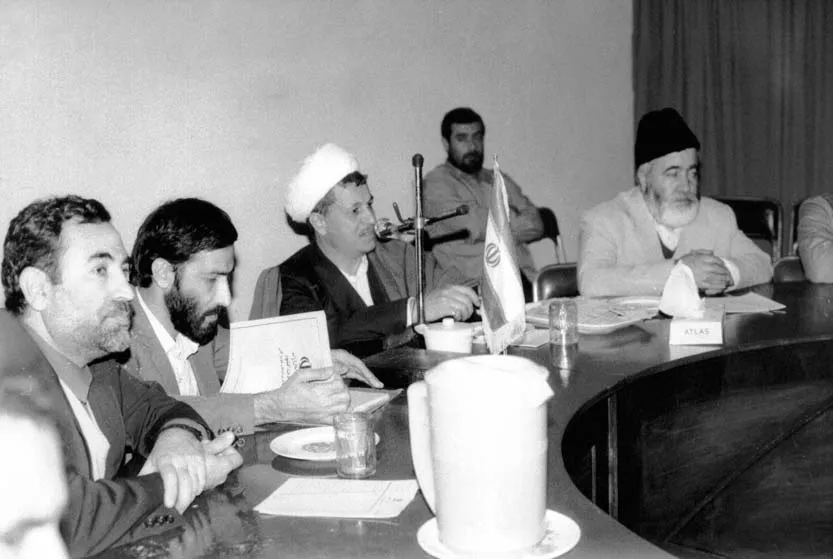
We were at home until eleven o'clock in the morning. We prepared for the trip. I closed my suitcase and helped Rajab Mashhad. The companions arrived at the airport. Efat and I arrived at half past eleven. I had a radio interview. We flew to Riyadh at twelve o'clock. Mr. Dr. [Ali
In the morning we were at home until eleven. We got ready for the trip. I packed my suitcase and also gave a little help to Mashhadi Rajab. The companions reached the airport earlier. Effat and I arrived at eleven-thirty. I had an interview with the Broadcasting Organization. At twelve we flew toward Riyadh. Messrs. Dr. Ali Akbar Velayati, Hossein Mahlouji, Bijan Namdar Zangeneh, Akbar Torkan, Issa Kalantari, Abdolhossein Vahaji, Abbas Akhoundi, Seyyed Mahmoud Doaei, Hossein Marashi, Mehdi, Mohsen, Yaser, Mohammad Ali Hadi [Najafabadi], Mahmoud Vaezi, Gholamhossein Karbaschi, Effat, Fati, and a large number of the companions' wives and guards and other managers were accompanying.
On the way we had useful discussions. With Mr. Zangeneh, [the Minister of Oil], there was talk about the oil and petrochemical projects and also the purchase of gas from Turkmenistan and how to strengthen the oil price. I greeted the companions. We also had lunch on the way and at two in the afternoon Riyadh time we arrived.
They gave a warm welcome. Prince Abdullah, the Crown Prince, and almost all the members of the government and the military and law enforcement commanders and the Speaker of the Parliament and the governor of Riyadh had come to welcome. The official guard of honor was similar to ours, and we shook hands with the welcomers and sat for a while in the vast and luxurious hall of the airport. The ladies and companions got off after me. I asked how many runways the airport has; he said four or five; it turned out he did not know.
Dr. Motleb bin Abdullah al-Nafiseh, the Minister of State, was the minister accompanying me. From the airport to the residence, which is about forty kilometers, I asked many questions. They have had a lot of rain this year and the plains are green. Both sides of the highway along the route are green with palm and fruit trees. He said part of the city's water is brought from wells and dams and part from the desalination plants on the Persian Gulf coast in Jubail.
The city of Riyadh, [the capital of Saudi Arabia], has a population of three million. The houses are mainly villas with 450-meter plots. They have good squares, bridges, and streets. They do not have a traffic problem. The Conference Palace is our residence. It is very vast and luxurious. In the afternoon, Dr. Seyyed Mohammad Sadr, the [Arab] Deputy of the Ministry of Foreign Affairs, came. He gave a report on his negotiations with Messrs. Fahd, [the King], and King Abdullah, [the Crown Prince]. From the portable computer [laptop] we have brought, I read the news. It connects to the Tehran center by telephone. The important matter is Kofi Annan's, [the UN Secretary-General's], negotiations in Baghdad and the result is not yet known; they have extended the stay by one day.
Early in the evening we went to meet King Fahd. They said he cannot rise from the chair; he made an effort to rise, I prevented him. After sitting, they allowed the journalists to enter. They said to try not to make the meeting long, because after a quarter of an hour passes, he loses his balance. I briefly raised topics such as the oil price, the problem of Iraq and Afghanistan and Palestine, and the cooperation of the two countries. His answers were not off-topic; only regarding Palestine he mixed it with oil.
We returned to the residence. I wrote the memoirs up to this hour. Early in the evening Mr. Mohammad Reza Nouri [Shahroudi, Iran's ambassador to Saudi Arabia] came and gave a report on Prince Abdullah's complaint about an article published in Mr. Reyshahri's magazine Values; he said it had made sharp attacks on the Wahhabis.
At nine-thirty at night, we went to the Royal Court Palace for the banquet ceremony that Prince Abdullah had arranged. We were Prince Abdullah's dinner guests. It lasted until twelve at night. It is a huge palace. Part is at the disposal of King Fahd and part at the disposal of Prince Abdullah. It has large and luxurious halls. All the Saudi figures, military and civilian, judicial and legislative and executive and cultural, were at the ceremony and all came forward to shake hands and give welcome speeches.
While having dinner, I negotiated with Prince Abdullah about important issues; for example, the Iraq crisis, where it became clear that they agree with the removal of Saddam, but they are not sure that America will do this, and they are surprised that in Tehran there were demonstrations in favor of Iraq after the Friday prayer, and they expect Iran to be more desirous than them of striking Saddam.
They believe that if Saddam survives, he will become more dangerous in the future, but they do not want to declare these thoughts. It became clear that they have not given America permission to directly use the Saudi bases, but they do not prevent American planes that are in the Saudi bases from going to another country—like Kuwait—and operating from there. They have complained to America in the meeting with Mrs. Madeleine Albright, [the US Secretary of State], about imposing the costs of the war on the Arabs.
We spoke about the oil price. It became clear that the fall in the oil price has created many problems for them and they welcome cooperation to correct the oil price. We negotiated about a trip to the desert to see the Bedouin areas.
After dinner, we held a meeting with the companions and the Saudi officials. Prince Abdullah once again praised me abundantly for the role I have played in creating understanding between the two countries and said that if it were not for my effort, the Islamic Conference in Tehran would not have been held. In the meeting with Mr. Seyyed Mohammad Sadr, [the Deputy Foreign Minister], who had brought Mr. Seyyed Mohammad Khatami's, [the President's], message, he said, "You should be grateful to Mr. Hashemi; he is a great person and has caused the problems of the two countries to be solved."
I too, thanking him for his role, determined various topics for the companions to negotiate; about oil and petrochemicals and industries and agriculture and commerce and Iraq and Palestine and Afghanistan. He too accepted raising the number of our Hajj quota and it was arranged that the officials of the two sides would negotiate and present the result at the next negotiation session. Mr. Saud al-Faisal, the Foreign Minister, while praising Mr. Velayati, expressed regret that the Iranian Ministry of Foreign Affairs has been deprived of him.
At half past midnight we reached the residence. I listened to part of the news of Iran and the world. The major issue is the Iraq crisis. Today's negotiations of Kofi Annan have not yet reached a result and the reports raise doubt and fear and hope; it is arranged that he will meet Saddam tomorrow.

Take less than a minute, register and share your opinion under this post.
Insulting or inciting messages will be deleted.
Sign Up