
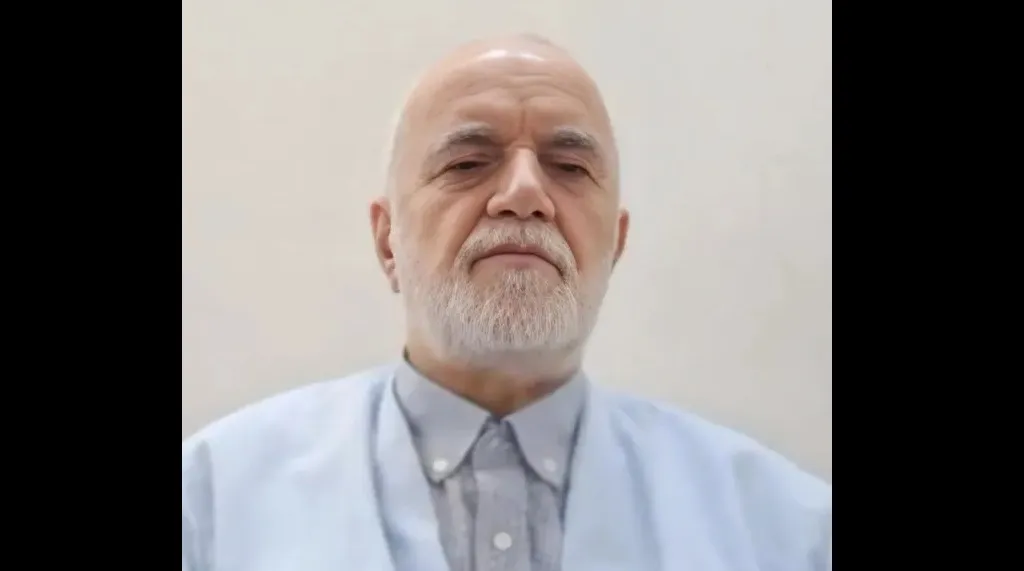
Sheikh Mostafa Sanaeifar—a jurist, first-class attorney-at-law, and former senior administrator within Iran's judicial and security apparatuses—is a highly distinct critical figure with an establishment background in contemporary Iran. His professional portfolio was formed at the intersection of key institutions, including the Ministry of Intelligence (serving as the judicial advisor to the minister and deputy head of intelligence protection) and the Special Clerical Court (serving as the deputy prosecutor at the time). Having experienced arrest and torture by SAVAK prior to the 1979 Revolution, Sanaeifar has played an active role in recent years in critically re-examining power dynamics by publishing open letters concerning sensitive cases, such as the events of 2009, financial allegations associated with Kazem Sedighi, and a re-evaluation of the Chain Murders.
Who is Sheikh Mostafa Sanaeifar?
Sheikh Mostafa Sanaeifar—a cleric, retired judge, first-class attorney-at-law (a member of the Central Bar Association with license number 20426), and a highly publicized insider whistleblower—is one of the rare former senior executives of the judicial and security apparatus in the Islamic Republic of Iran to engage in public, critical re-examinations of the state's sensitive political history.
Sanaeifar’s career sits at the direct intersection of three foundational pillars of the state's security and judicial architecture: the Ministry of Intelligence (MOI), the Judiciary, and the Special Clerical Court. He previously served as the judicial advisor to Minister of Intelligence Ali Fallahian, the deputy head of the MOI’s Intelligence Protection Department (Hefazat-e Ettela'at), and the deputy to Gholam-Hossein Mohseni-Ejei (the current Chief Justice of Iran) during the latter's tenure as the prosecutor of the Special Clerical Court.
In recent years, Sanaeifar has broken the traditional silence expected of former security officials by releasing open letters, detailed analytical notes, and recorded interviews that address classified or sensitive historical records—ranging from the 1990s Chain Murders to internal management decisions during the 2009 post-election crisis.
Revolutionary Background and Ideological Framework
Unlike external opposition critics, Sanaeifar anchors his political identity within the founding generation of the 1979 Revolution:
Early Activism: According to his open letter dated May 2, 2025 (12 Ordibehesht 1404 SH), he entered the revolutionary movement at the age of 13 during the late 1970s.
SAVAK Detention: Before turning 18, he was arrested, detained, and subjected to torture by SAVAK (the Pahlavi state security service), an experience that solidified his credentials within the revolutionary cadre.
The "Insider-Critic" Persona: Sanaeifar explicitly describes himself as a "soldier of Islam, the Imam (Khomeini), the Revolution, the country, and the Leadership." He argues that his public whistleblowing is not an attempt to weaken the system, but rather an act of revolutionary accountability intended to expose deviations by current political factions—specifically targeting elements close to the hardline Jabhah-ye Paydari (Front of Islamic Revolution Stability).
Structural Career and Judicial-Security Positions
Sanaeifar spent nearly three decades operating within high-level, behind-the-scenes legal and protective roles:
Ministry of Intelligence (MOI) Portfolio
During the presidency of Akbar Hashemi Rafsanjani and the tenure of Minister of Intelligence Ali Fallahian (1989–1997), Sanaeifar served as the Judicial Advisor to the Minister. This was a highly volatile period for the ministry, marked by complex foreign and domestic counter-intelligence operations. He was subsequently elevated to Deputy Head of the Intelligence Protection Department within the MOI, the internal security division responsible for vetting personnel, preventing leaks, and supervising counter-intelligence within the ministry itself.
Special Clerical Court Portfolio
His most structurally significant role was serving as the Deputy Prosecutor of the Special Clerical Court, working directly under Gholam-Hossein Mohseni-Ejei. Because the Special Clerical Court operates independently of the standard judiciary to investigate and prosecute offenses within the clerical class, this position gave Sanaeifar deep insight into the internal affairs, factions, and legal disputes of the country's religious elite.
Legal Practice
Following his retirement from state service, Sanaeifar transitioned into private practice as a first-class attorney-at-law under the Central Bar Association, a credential that provides him with the statutory framework to review and comment on complex legal cases.
Key Whistleblowing and Public Disclosures
Sanaeifar’s emergence as a public critic has been defined by high-profile letters and media appearances, most notably on the digital platform Abdi Media, where he serves as a frequent analyst and guest. His disclosures span several highly sensitive domains:
Critical Accounts of the 2009 Post-Election Crisis
In an open letter addressed to the Supreme Leader on January 14, 2025 (25 Dey 1403 SH), Sanaeifar made serious allegations regarding the management of the 2009 election unrest.
Focus on Saeed Jalili: He focused heavily on the role of Saeed Jalili, who was the Secretary of the Supreme National Security Council (SNSC) during the 2009 crisis. Sanaeifar claimed that Jalili utilized his structural authority within the SNSC secretariat to block a peaceful resolution to the protests.
The Broadcast Intervention: Specifically, Sanaeifar asserted that Jalili actively opposed allowing reformist candidate Mir-Hossein Mousavi to address the public on national television to de-escalate the situation, allegedly stating that Mousavi "has no path forward except repentance." These disclosures provoked sharp pushback from hardline media outlets like Kayhan, which denied that Jalili was responsible for the prolonged duration of the 2009 events.
Legal Demands Regarding Clerical Financial Allegations
Sanaeifar drafted an open letter to the Chief Justice demanding formal judicial transparency regarding publicized financial and property acquisition allegations involving Kazem Sedighi, the temporary Friday Prayer Leader of Tehran. He questioned why standard judicial scrutiny was not being visibly applied to high-ranking clerical figures, framing his critique as a defense of the judiciary's moral authority.
Historical Re-evaluations (Chain Murders and State Figures)
Through a series of analytical notes published in mid-2025, Sanaeifar offered specific internal perspectives on major historical events:
The Chain Murders: He published a balanced but detailed review of the late-1990s targeted assassinations of intellectuals, a case intricately tied to the ministry he once served.
Ali Razini & Hashemi Shahroudi: He penned a retrospective detailing the relationship between the veteran judge Ayatollah Ali Razini (who survived an assassination attempt in late 2024) and the former Chief Justice Mahmoud Hashemi Shahroudi, focusing on the historical evolution of the judiciary.
Ali Larijani: He published structural assessments of former Parliament Speaker Ali Larijani’s long-term shifting position within the conservative establishment.
Institutional Pressures and Current Status
Sanaeifar’s public legal-political activism has faced resistance from his former peers. In an open response issued on May 2, 2025, he acknowledged that former judicial and intelligence colleagues had formally warned him that his open letters and media interviews were being viewed as "weakening the system" and "disturbing public opinion."
Sanaeifar rejected these characterizations, asserting that his historical accuracy and insider testimony are vital to preserving the original rule of law and moral standards of the 1979 generation. Despite these structural pressures, he remains highly active as a practicing attorney and an independent analyst, with his interviews frequently cited across domestic analytical platforms like Khabar Online, Ensaf News, and independent political commentators.
Frequently Asked Questions (FAQs)
Who is Mostafa Sanaeifar? Sheikh Mostafa Sanaeifar is a cleric, retired judge, and practicing first-class attorney who previously held senior executive positions within the Ministry of Intelligence and the Special Clerical Court. He is known for his detailed public commentaries on sensitive political and historical cases in Iran.
What were his major positions inside the security and judicial apparatus? He served as the judicial advisor to Minister of Intelligence Ali Fallahian, Deputy Head of MOI Intelligence Protection, and Deputy Prosecutor of the Special Clerical Court under current Chief Justice Mohseni-Ejei.
What did he allege regarding Saeed Jalili and the 2009 events? In an open letter in January 2025, Sanaeifar claimed that as Secretary of the Supreme National Security Council in 2009, Saeed Jalili prevented a peaceful resolution to the election crisis by blocking proposals to let opposition candidates speak on television and demanding absolute capitulation instead.
What is his stance on current political factions? Sanaeifar identifies as a traditional revolutionary loyalist but acts as a sharp critic of the hardline Jabhah-ye Paydari faction, frequently challenging what he views as their deviation from the foundational judicial and moral principles of the early revolution.
Where does he publish his analyses? His primary media outlet for detailed video interviews and historical commentary is the digital investigative platform Abdi Media, with his writing frequently analyzed across mainstream Iranian political news sites.
Take less than a minute, register and share your opinion under this post.
Insulting or inciting messages will be deleted.
Sign Up