
Exclusive to Abdi Media, unfiltered, listen on Abdi Media on Castbox
From the YouTube channel of Abdi Media
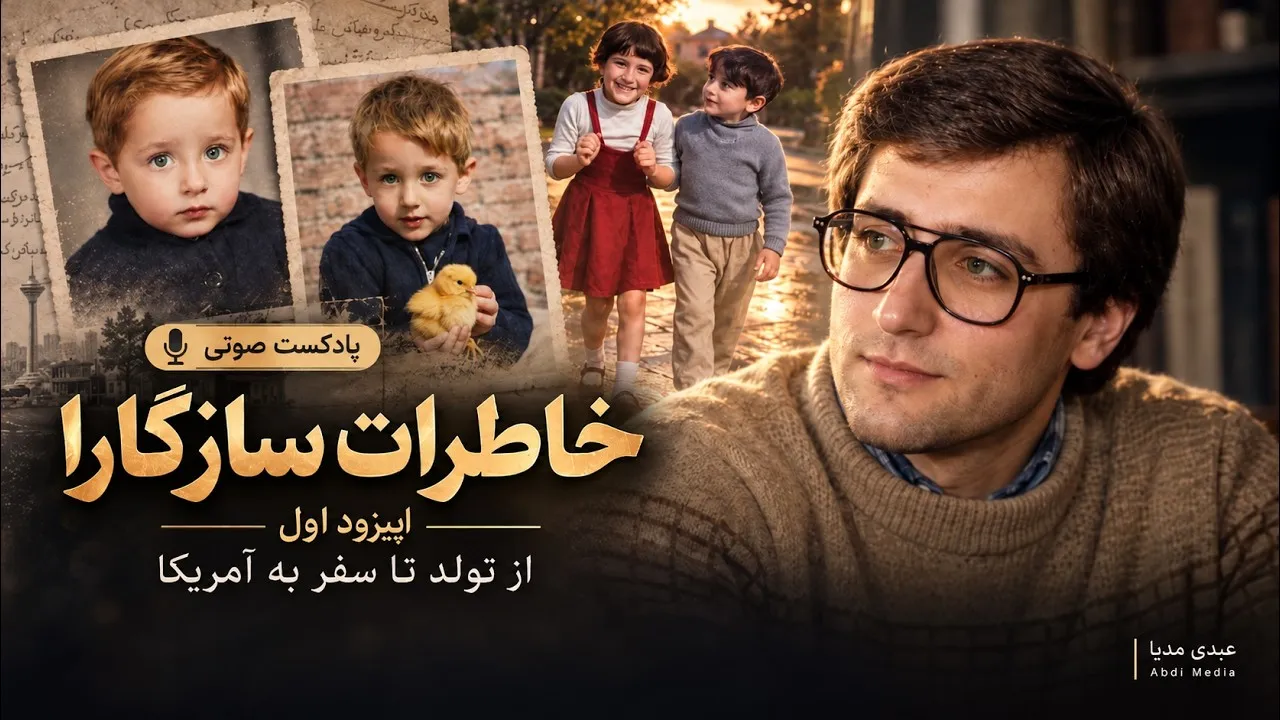
Episode One: From Birth to the Journey to America
In the first episode, the story begins with his childhood years and family environment and continues to the point when Sazegara leaves for the United States to pursue the next stage of his life and education.
This is the beginning of a series that seeks to tell the life story of one of Iran’s well-known political figures, not through the words of others, but in his own words.
Hello.
For a long time, I had been thinking that, as a duty and as a way of paying my debt to the younger generation, future generations, and history, I should record and present my memoirs. But being busy and lacking the determination to do it kept getting in the way. Until a very dear friend sat me down at his home and, over the course of two weeks, patiently recorded my memories with a persistence that I myself did not have.
But editing and publishing those voices, which were trapped inside a computer, was delayed for another two years. Finally, through the efforts of Mr. Abdi, this collection was prepared for publication.
Mr. Abdi, who, with genuine dedication and tireless effort, has been working for years to collect and preserve contemporary history, will have a great debt owed to him by future generations. If it were not for these two dear friends, this collection would never have been prepared and would never have reached you.
I am deeply indebted to both of them and very grateful.
Together, let us begin this journey into the past. I hope I can be a good companion for you on this journey.
I am the sixth child in a family of seven children. My father had worked from childhood. When I was born, he had a haberdashery shop. My mother was a homemaker.
We lived in the Darvazeh Dolat—or rather Darvazeh Doulab—area of Tehran, on a street one block above Chaharrah Darvazeh Doulab, on Shahbaz Street, which is now called Seventeenth of Shahrivar, on Sasan Street, an eight-meter-wide street.
I was born there. Since we did not own a house at the time, my father rented houses by paying a deposit. He did not like paying monthly rent, although he would still move to a different house every few years.
The owner of that particular house was a man named Vezan. In our family, it became known as “the Vezani house.” I was born in the Vezani house.
My father's haberdashery shop was on Shahabad Street. At the time, it was considered an upscale part of the city. Today it is part of Jomhouri Street, between Baharestan Square and Mokhber al-Dowleh Intersection. It was next to Golshan Café. The shop next to it was Zavar Bookstore, and next to that was Mr. Joudat's fabric store. He was Jewish and a very kind man.
Whenever we went to my father's shop, Mr. Joudat would always give the children chocolates. He was very kind.
Next to his shop there was an alley where there was a chelow-kebab restaurant called Javan. People called its owner Hasan Chelouyi. At the corner there was another alley, and later Amir Kabir Publishing House opened there.
I had a younger brother who was born six years after me. All of my brothers and sisters were born within two or three years of one another, at most, except for my younger brother Sasan, who recently passed away. There was a six-year gap between him and me.
Until I was six, I was the youngest child in the family.
I should also mention that because my father was a shopkeeper, we were born at home. At most, the midwife would write a piece of paper saying, “Mrs. Iran, the midwife, delivered this child on this date.” My father was supposed to take that paper and obtain a birth certificate.
My father did not have the time to do it immediately. He obtained my birth certificate ten days later. I was born on December 25, which is Christmas Day. That would have been December 25, 1954, corresponding to 1333 in the Iranian calendar. But because my birth certificate was obtained ten days later, my official birth date became January 5, which was in 1955.
But my mother always said that I was born at four in the morning on Christmas Day, December 25.
I must have been three or four years old when we moved from there and went to Khorshid Street.
My mother had many characteristics.
First of all, she was, as she herself used to say, extremely “in love with her children.” I remember she used to say, “A mother would rather have a thorn go into her own eye than into her child's foot.” She really was like that.
Second, in a sense, she was one of the victims of Reza Shah's unveiling policy.
My mother's family had been orphaned when they were children. My maternal grandfather had a fabric store in Tehran. Apparently, he was around forty-seven or forty-eight years old when he contracted dysentery and died within two days. That was how things were at the time.
There were seven children. My mother was the fifth. There were five daughters followed by two sons. My uncles had already been born, and the younger uncle was still an infant when his father died.
As a result, my grandmother, whom everyone called Mirza Khanom because she was literate—and she was also a very strong and authoritative woman—raised those seven children with her bare hands.
My mother had gone to school and apparently had been the top student. She still remembered many of the poems she had learned at school. She completed six years of elementary school, and then she would have gone on to high school.
But Reza Shah had ordered that girls participate in the Pioneer program. Even during elementary school, the girls had to take part in scouting activities, and unveiling had been imposed.
My eldest aunt knew how to sew. She had made my mother a kind of coat with a hat so that she could put it on and avoid being stopped by the police officers while still maintaining some form of modesty at school.
When my mother reached high school, she was apparently still a top student. But Reza Shah had ordered that the girls participate in the Pioneer program. The Pioneer uniforms had short skirts, perhaps above the knee.
My grandmother could not bear the idea of my mother appearing unveiled and wearing such a short skirt. So she took her out of the program.
My mother herself used to say, “I cried at home for three days. I wanted to go to school.”
Instead, they put a hat on her head and taught her typing so that she could go to work.
She was only fourteen when she was married. Poverty was also a factor.
Her first child was born when she was sixteen. That was my eldest sister, Parvin.
My mother was born in 1926, so she was twenty-eight when I was born. In total, she gave birth to eleven children, three of whom died. One had been one of a pair of twins who died, and another had been miscarried before me.
There are two or three things that I believe I inherited from my mother.
One was that she was a religious woman. I will explain later how I became religious, but she encouraged me and was religious herself. She liked going to mosques and religious mourning ceremonies and things like that.
But my father had decreed that no cleric was allowed to come into our home.
Otherwise, my mother would not have minded having a cleric come to the house once a month. It was common at the time—on the fifteenth, seventeenth, or eighteenth of the month—for a preacher to come for two hours, the women of the family would gather, listen to the sermon, and then talk among themselves, drink tea, eat fruit, and so on.
But because my father had forbidden clerics from coming into our home, my mother never held such gatherings.
She herself would go to the mosque whenever she had time. Later, when we children had grown up, she would go to the neighborhood mosque and pray in congregation.
She fasted as well.
The second thing I inherited from her—and I can say this with complete certainty—was being political.
Despite having had only six years of formal education, she had turned her attention to politics. She had six or seven children around her and devoted herself entirely to raising them, but she was interested in politics and followed political affairs.
She knew the ministers. For example, after the Revolution, she would say, “This Zanganeh is a good minister.” She followed what they were doing.
She was also brave, unlike my father, who was a cautious shopkeeper and had no inclination to take political risks. He would talk about politics at home, but he was not politically active.
When I was, for example, a student at Aryamehr University and we wanted to do underground political activities or have banned books, I would give them to my mother and she would hide them at home.
My mother's family name was Aghdas Anisi Tehrani.
The name “Anisi” was apparently taken from Anis al-Dowleh, who was one of Naser al-Din Shah's wives. She was Naser al-Din Shah's favorite wife. She was the same woman who, during the Tobacco Protest, hid the hookah after the religious decree banning tobacco and stood up to Naser al-Din Shah after the tobacco ban.
Apparently, she loved Naser al-Din Shah very much.
After Naser al-Din Shah was assassinated, forty days later she beat herself and died. But they were originally Georgian, among the Georgians who had been brought into Iran during the Safavid period.
Anis al-Dowleh had no children with Naser al-Din Shah, but those who were related to her apparently adopted the surname Anisi. For example, her grandmother may have been Anis al-Dowleh's niece.
My mother used to say the proverb, “A dog sits on a rooftop and looks around; its gaze is toward us.”
Some of the proverbs I mention, I heard from my mother and father. Both of them had these little pieces of traditional wisdom and proverbs.
There were also several things I learned from my father.
One thing I will never forget happened when I had just become a teenager. My mother once told me, “Look, your father was thirty when he married me. An age difference like that was common at the time. But when he married me, he said, ‘This belt of my trousers has never been undone before.’ Good for you, my son, if you turn out like your father.”
My father was also not a womanizer. His haberdashery shop was full of cosmetics and women. It was next to a café, but as my late grandmother used to say, “Sazegara kept his head in his shoes,” meaning he kept to himself and did not get involved in such things.
He did not drink alcohol, and he was not a womanizer.
My father smoked cigarettes. After smoking a pack a day for fifty years, one day he quit. He put out the cigarette and said, “I'm not smoking anymore,” and he never smoked again until he died at the age of ninety-three.
He had a strong will.
Another thing I learned from him was that he was very serious about his work.
He himself had started working at the age of five. He used to say that he worked in his father's quilt-making shop near Sabzeh Meydan. His father would put a quilt on his head and tell him to deliver it to customers. The quilt was so large that he disappeared underneath it.
People in the bazaar would laugh and say, “Look, this quilt is walking by itself.”
He would sometimes say, “If God wants to take me to hell, I will point my finger at Him and impeach Him,” because he had worked since childhood and had worked so much with needles that his fingernail had grown long from all the labor.
During Reza Shah's period, he served in the army. He had many memories of his military service.
They were forced to work on the Chalus Road. They dug and worked on the telegraph line in the mountains around Chalus. They had set up tents there, and one night a bear came and carried away their pot of rice.
On another occasion, Reza Shah had come to inspect their shooting exercises. My father had indicated that he was thirsty. They were lying under the hot sun while practicing shooting.
Reza Shah noticed and shouted, “A soldier must not be thirsty while shooting.”
My father was an intelligent man. He had taught himself to read and write even though he had never attended school. You would not have known that he had never gone to school. His handwriting was good, and he could write and sign his name.
His philosophy of life was:
“Do not harm anyone. Do whatever you want, drink whatever you want, burn the pulpit, set fire to the robe—but do not harm people.”
Sometimes, during the summers, we would go to my father's shop and help him. We were apprentices, although he did not give us much real work to do. That is one reason none of us ended up going into business.
My mother wanted us to study.
Another thing I learned from my father was honesty and keeping other people's property safe.
Later, after he suffered losses in the haberdashery business, he needed another occupation. There was very little profit in retail haberdashery. You sold everything from nail polish, lipstick, and perfume to ties and similar things. It was somewhat like what a boutique is today.
My mother encouraged him to return to a profession he already knew: making quilts and mattresses.
He came up with the idea of sewing rugs onto cushions and making rug-covered pillows and similar things. It became very successful.
He moved from Shahabad Street to Manouchehri Street, where he again had a haberdashery shop.
We became terribly poor.
He did not like borrowing money.
At the Shahabad shop, he apparently owed about fifteen thousand tomans. He sold the shop for one hundred thousand tomans, paid his debts, and made a mistake. Someone had also persuaded him to do something in Manouchehri Street, which shopkeepers called Choli Street.
There he bought a smaller haberdashery shop and lent the remaining forty thousand tomans to various people because they had asked him for loans.
At that shop, he might sell twenty one-toman items in a day, and his profit on those twenty tomans might be only two tomans.
As a result, we became so poor that my eldest sister, who had obtained her high-school diploma and wanted to take the university entrance exam, did not even have the fifteen tomans needed to register for the exam.
We borrowed the money.
That was why she initially went to teacher training. She would become a teacher for a year and receive a salary, and then she went to the University of Tehran.
My eldest brother also wanted to study economics, but one of the reasons he went to the Military Academy was that education there was free.
I remember that year, as Nowruz was approaching, children would normally be bought new suits.
I was in second grade at the time and was the only child who was still, so to speak, the baby of the family. They bought me a new suit.
They went to Nasir al-Din Bazaar, which was inexpensive. I don't remember exactly, but I think they paid twenty or twenty-five tomans for the suit.
After Nowruz, I wore it to school. The first time I fell down, it tore.
My mother then took last year's suit, which still fit me and was actually made of better material, repaired it, and I wore that one to school instead.
My eldest sister Parvin, who passed away a while ago, was a second mother to all of us.
Parvin had several characteristics.
First, she was extremely studious.
I was also a very good student, so she did not worry as much about me. But what my older brothers remember most about her was that when they were in elementary school, she worried about their studies.
In high school, she was constantly checking on them:
“Why didn't you do your homework?”
“Did you study your lessons?”
“Come here, let me ask you questions.”
She worried about all of us.
I had a twelve-year age gap with her, so she really was a second mother to me. I was a child while she was already in high school. She would spend time with her friends and also look after me as if she were partly my mother.
She was always worried about everyone.
Even toward the end of her life, after she had suffered a stroke and could no longer use her right hand, she learned to paint with her left hand. She kept painting and fighting against her illness.
More than anything else, I learned studying and perseverance from Parvin.
My two older brothers were closer in age to each other and had a very close relationship. They were two brothers born one after the other.
My third older brother, Hasan, was raised by my eldest aunt.
Because there were so many children, my eldest aunt had taken Hasan in. Her two children had grown up and left home, and her husband had died. She had remarried but had no children from her second marriage.
She told my mother she would take Hasan, so she took him and raised him at her home.
Hasan was five years older than me. He lived with my aunt until about third or fourth grade. Sometimes he came to our house, and sometimes we went to my aunt's.
He was her favorite. He had lots of toys, which were very attractive to us.
My second sister was three years older than me. We were mostly playmates. We were very close and always had each other's backs.
We played all kinds of games: jump rope, tag, card games, and so on.
We had just bought a television, so naturally we would act out movies together.
When I was six or seven, we moved again. We left Khorshid Street and moved to the Air Force neighborhood.
This time, my father bought a house.
It was still mostly undeveloped land.
I went to elementary school in that neighborhood, near the end of Delgosha Street, actually in Bargh-e Firouz Alley. On the other side was Air Force Street, today's Pirouzi Street.
There was an Air Force base farther ahead.
The area was undeveloped.
I became a neighborhood kid.
My sister, who was three years older than me, went to school and came home. Most of the girls stayed at home. She would come back from school, do her homework, and so on.
So, when it came to playing, I mostly played with other children in the neighborhood rather than with my sister.
Football was a common game. We played small-sided football with a plastic ball. You just needed two goalposts, and we would play in the street or on the asphalt.
Our house was on a four-meter-wide alley.
Sometimes we would tie a rope across the alley and play volleyball.
Or, like all children, we played cops and robbers, battles, armies, and various other games.
I remember that when I was in elementary school, I read both Ettelaat Dokhtaran va Pesar and Keyhan-e Bacheha.
I think it was Ettelaat Dokhtaran va Pesar that published serialized stories by Parviz Ghazi-Saeed. There were stories about Laffson, an international detective working with Interpol.
I would read them and then organize the neighborhood children and my friends into groups and recreate the stories I had read.
I played Laffson myself and we would catch the thieves.
At the end of our alley there was also a garden. Later, it was demolished and houses were built there.
It had a mud-brick wall and our alley ended in a dead end.
We would climb over the wall and jump into the garden and carry out our “operations.”
The gardener would see us from a distance. We got caught once or twice, were beaten, and then ran away.
I was not really a fighter, to tell the truth.
I mostly played the leader. During fights, I would organize the troops and say, “You go from this side, you go from that side.”
We moved to the Air Force neighborhood, and I went to Dehkhoda School.
People called it “Deh-Goda” as a joke. It had been named after the late Ali-Akbar Dehkhoda, but later the government changed its name to Mohammad Shahin.
I think Mohammad Shahin was one of the benefactors who had donated money to the Ministry of Education, and the school was named after him.
It was a two-shift school. One shift was from morning until noon, and the other was in the afternoon. We alternated; one week we attended in the morning and the next week in the afternoon.
There were perhaps a thousand students in total.
It was a large school. There were several first-grade classes, several second-grade classes, and so on. It had six grades.
But because the neighborhood was poor, many of my classmates were even poorer than I was.
Some wore patched trousers and shoes with holes in them.
If I was lucky, I could have two rials of pocket money from my father.
The school janitor usually sold little things. You could buy an ice pop or an egg sandwich. Sometimes you could afford half of one.
I think an ice pop cost two rials, or perhaps two and a half.
And some children, if they were lucky, had bread wrapped in paper. They would take it out and eat plain bread.
Perhaps ten of my classmates from first grade through sixth grade ever made it to high school, let alone university.
One had a father who was a carpenter, so he went to work in his father's shop.
Another's father was a railway cook. His father died, and the railway hired the boy to work in the railway kitchen.
Another was the son of a construction worker.
Very few of them were able to continue their education.
I remember I was in first grade and had been at school for only a week.
We would line up after school. They would assign an older student to accompany the line as we crossed the streets.
Before the principal or vice principal let us leave, he would speak over the loudspeaker.
The children were making noise, and he said, “Be quiet, children.”
They kept making noise, so he said, “Since you won't be quiet, I'm going to keep you here.”
I became worried.
I thought, “Oh no, if they keep us here, what will my mother think?”
I started crying.
I was six or seven years old. A child's heart is small.
Then I saw the older students in the back of the line—second-, third-, and fifth-graders—saying, “There's a child crying up front.”
The vice principal relented and said, “All right, go ahead, move along.”
We would hold hands in pairs as we walked home from school.
But, to tell the truth, I have very few bad memories from elementary school because I was a very good student.
From second through fifth grade, we had one teacher. Later, in fifth and sixth grade, we had several teachers—one taught mathematics and geometry, another history and geography, and so on.
But during those years when we had one teacher, the teacher would sit behind a desk, while the students sat on benches.
They would put a chair next to the teacher's desk, and I would sit there as an assistant teacher.
I would correct the other children's dictation exercises.
In a way, I was somewhere between a student and a teacher.
The children genuinely liked me and did not take advantage of my position.
Mortaza Ebrahimi was also a neighborhood boy.
One day, we held hands and went to school together.
We stayed together throughout elementary school.
We were very close friends.
But when we reached high school, because I was the top student, I enrolled at Firouz Bahram School, which was a private school but I attended for free.
Mortaza went to a public high school.
We separated at school, but we remained very close friends in the neighborhood.
Especially when we became teenagers.
Mortaza had fallen in love.
He was not bad-looking, and there were many girls our age in the neighborhood. I had admirers too, and I would put on airs because I thought that was what I was supposed to do.
But I did not really have the confidence to form friendships with girls.
Around fourth or fifth grade, when I was eleven or twelve, I had become an avid reader.
At the end of our street there was a bookstore owned by a man named Saadat, on Farahabad Street.
He rented books.
You could rent a book for five rials a night.
We would take a book, read it in one night because we were afraid we might keep it for two nights, and then return it.
I read stories of all kinds—detective stories and non-detective stories.
Laffson and similar characters became our models, and we would act out the stories in the neighborhood with the other children.
But because I was also reading Ettelaat Dokhtaran va Pesar, I sometimes read biographies of scientists.
Later, I rented books about the lives of scientists and the history of science.
I liked scientists and perhaps wanted to become like them.
Among the various scientists, I was especially interested in physicists.
I knew Einstein before I even reached high school.
I had read a book about Edison.
I liked him as well.
I had not yet discovered philosophers.
My writing was very good, and because I read stories, certain writers became fascinating to me.
When I reached high school and read Dostoevsky, he became an ideal for me.
Then I read Sadegh Hedayat.
In seventh and eighth grade, I was reading all of these writers.
Hedayat's prose had a strong influence on my own writing.
Later, when I read Jalal Al-e Ahmad, his hurried, fragmented style influenced me too. My writing began to resemble Al-e Ahmad's.
On the bus, whenever I could find a seat, I would sit. If I had to stand, I would usually go to the back of the bus, where there was space around the engine.
I usually had a paperback book in my bag.
I would read Einstein's scientific articles on the bus, or read stories.
Gradually, I began reading other things.
From eleventh grade onward, specifically, I began reading religious books.
My political awareness began earlier, around ninth grade.
I will explain what happened.
But my religious interest began in eleventh grade.
So I can say that my political consciousness came before my religious one.
I was in ninth grade at Alborz High School.
I had to take two buses to get there.
I would take one bus to Baharestan, then another to Chaharrah Hafez, get off there, and walk all the way up Hafez Street until I reached Shahreza Street—today's Enqelab Street—and Alborz High School.
One morning I left home without knowing that the government had raised the United Bus Company's fare from two rials to five rials.
It had suddenly gone up two and a half times.
There had been a call for people not to take the buses.
I arrived at the bus stop and saw what was happening.
I liked it.
I don't know why.
I was fifteen years old, but I felt a sense of responsibility—a feeling I still have today.
I felt that it wasn't enough for me personally not to take the bus; other people should not take it either.
So I started blocking the buses with several other people.
The bus would stop.
We would get on and tell the passengers, “They have asked everyone not to take the buses today in protest against the price increase.”
And many people would actually get off.
When a teenager and several schoolchildren get on a bus and tell people not to ride, people would get off.
So we walked all the way there.
When I arrived at Alborz High School, the Polytechnic University—today's Amirkabir University of Technology—was right next to Alborz.
They had taken part of Alborz's land and built the Polytechnic there.
The students at Alborz were invited to join the United Bus Company strike and not attend class.
I'm not sure what connection the school strike had with the bus strike, but we succeeded in getting a number of students not to attend class.
The Polytechnic students had started making trouble.
Apparently, the police had come in to beat them.
Some of them crossed the wall between Polytechnic and Alborz and came into our school.
We felt it was our duty to shelter them so that the police would not come after them.
That afternoon, when I was going home, they told us that the Shah himself had ordered the fare to be returned to two rials.
I felt wonderful.
I got on the bus and went home with a sense of relief.
It was winter and it had become dark. It was around 5:30 in the afternoon, already nighttime.
But I was going home thinking, “Wow, what a successful political action.”
Everyone had joined together.
The students had been beaten.
The people had boycotted the buses.
And the regime had surrendered.
The Shah himself had ordered the fare to be reduced.
If I am not mistaken, this must have been around 1348 or 1349, corresponding to 1969 or 1970.
Of course, I don't remember major events such as the June 5, 1963 uprising at all.
Our neighborhood was undeveloped. If we had lived somewhere like Cheshmeh, perhaps we would have noticed the disturbances.
But we were children.
It was around the time of the Shah and Farah's wedding that we bought a television.
That was in 1338, when I was still a child.
We were living on Zarrin-Na'l Street.
Everyone was very interested in watching it.
My father, who did not show any interest in politics at all, would leave home in the morning, work all day, and return around nine at night exhausted.
He would eat dinner and go to sleep.
If there was a movie on television on Friday nights, my father would buy a bag of sunflower seeds from a nutseller on Shahabad Street and bring them home.
They were called Golpari Japanese-style sunflower seeds.
He liked them.
On Friday nights, we would sit together and watch movies.
My eldest brother, who later went to the Military Academy and became an Army Air Force pilot, and who is now a retired general, had two or three friends.
They became very interested in cinema.
I don't know why.
My brother would go to the cinema.
I was not even in school yet, but he would take me with him.
I may not be exaggerating when I say that I had seen a hundred movies before I even started school.
Then I would come home and enthusiastically tell my sister about them.
My eldest sister's friends would come to our house to study.
They were in eleventh or twelfth grade.
Instead of studying, they would call me over.
They were all high-school girls.
They would ask me to tell them about movies.
I would tell them a two-hour movie for perhaps three and a half hours.
Then they would presumably go home and tell their parents, “We went to study at Parvin's house for five hours.”
So I saw a lot of movies.
Some of them, looking back now, were not even appropriate for a child.
There were movies with dragons, Hercules, gods, swords being driven into people's bodies, and so on.
I would retell them dramatically, and as a result, I remembered them very well.
It was not only that television showed a movie once a week.
Those were black-and-white televisions with picture tubes that bulged out, so the image quality was not very good.
I became interested in cinema after I began going to the theater with my older brother.
I still love it.
Art is still one of my favorite things.
For me, the appeal of a film is its storytelling.
I believe the screenplay must have, above all, a strong story.
A strong story is what gives a film analytical points, twists, and turns.
That is what makes a film engaging.
Of course, there is also the director's work, the locations, the acting, and so on.
But a good screenplay and a strong story make a film compelling.
I can say that I became interested in stories even more than I became interested in cinema.
And because I read so many novels, perhaps I can honestly say that by high school I had read almost all the great classics of world literature that had been translated into Persian.
I read Dostoevsky, Chekhov, and Hemingway.
Hemingway was honestly one of my favorite writers from that time.
Later, when I read him, I was fascinated by the adventures he had experienced in his own life.
Many of these novels drew me in.
Jack London, for example.
I remember that I was in seventh grade and read his books during that summer.
White Fang and The Call of the Wild had an influence on me.
I was also fascinated by Jack London's own life—how he would jump onto trains without a ticket and make up stories, and the adventures he experienced himself.
I read all kinds of stories because, to tell the truth, I had a slight talent for writing stories myself.
In seventh and eighth grade, we had a literature teacher named Hashem Razavi, who passed away a few years ago.
He was a learned man and had a hoarse voice.
He taught us literature, dictation, composition, and Persian literature at Firouz Bahram High School.
During composition classes, if the teacher had assigned a topic, he would randomly call students to come up and read from their notebooks.
He would always call me last.
With his hoarse voice, he would say, “Sazegara, you come and read.”
He encouraged me a lot.
I was interested in literature.
I had started reading stories in elementary school, but because I had some talent for storytelling, whatever composition topic the teacher gave us—it didn't matter whether it was “Describe spring” or something else—I would sit at home, think for a while, come up with a story idea, and write a story.
I had a small room in a corner of the second floor of our house.
After my older brothers left, I took over that room.
So I had my own room during high school.
In eleventh grade, I became acquainted with Al-e Ahmad.
His book Gharbzadegi, or Occidentosis, was banned.
My friend Saeed Divani and I were classmates at Azar High School in eleventh grade.
We became very close friends, and we are still friends today.
We managed to get hold of a copy of Gharbzadegi.
It didn't even have a cover.
We sat down at night and, instead of simply reading it, copied it by hand.
We produced fifty or sixty handwritten copies over several nights.
We made copies using carbon paper, stapled them together, and distributed them among our friends and acquaintances.
This idea of “returning to oneself” and Al-e Ahmad's recommendations were eventually put into practice after the Revolution.
The result was disastrous.
The idea that we should achieve self-sufficiency, build everything ourselves, and thereby overcome our Westernization—
the basic concept was wrong.
The idea that we should put the West inside a bottle and build our own machinery led to that ridiculous concept of self-sufficiency and the misguided policies that followed.
Later, when I myself became head of industry, I was also pursuing those policies during the first decade of the Revolution.
But at that time, for the first time, in eleventh grade, I read a translation of the Quran.
It was the translation by Elahi Qomshe'i.
I understood Arabic.
When I read it once from beginning to end, I thought, “There are some things here that are worth reading again.”
So I read it a second time.
By the time I was in eleventh grade, all my brothers and sisters were older than me and were university students.
Each of them was different.
The one who was a dentist was more academically oriented.
My younger sister studied sociology and was somewhat more interested in the humanities.
My eldest sister, who later obtained a master's degree and then a PhD, studied education.
She was at the level of a sociology student in terms of her interests.
They had traveled to Sistan and Baluchestan and conducted monographic studies and so on.
She could be quite critical.
But because I was attending the National University, today's Shahid Beheshti University, it was not particularly political.
I read the Quran.
I read, for example, Zeyn al-Abedin Rahnema's book about the Prophet. I thought it was a good book—a history of the Prophet's life.
Then I began reading various other books.
As soon as I started praying and fasting, my brothers and sisters began questioning me.
“What reason do you have for believing in God?”
“How do you know there is an afterlife?”
They sometimes asked serious questions.
For example:
“If someone is born into a family of thieves, naturally he becomes a thief. Why should he go to hell?”
So from the very beginning, when I announced that I was religious at home—or rather, when they noticed that I had become religious—I had to answer questions and objections about religion.
As a result, I actually enjoyed reading books that challenged religion.
One of the best books I liked reading was a book whose title I no longer remember.
I still enjoy reading books that argue against religion because they present a good challenge.
Then I can think about and answer their arguments myself.
So my religious faith was challenged from the very beginning.
I had read the works of Mehdi Bazargan and understood them.
At the time, it was fashionable to believe that the Quran contained all the sciences of the world.
At the same time, I had many completely nonreligious friends.
We had a friend named Mahmoud Sanati who was into American rock music.
At the time, there was a concert by an American group in Tehran.
We went to the rock concert together.
I also went to the cinema with him.
Saeed was also interested in cinema.
We watched Fellini films and films such as Satyricon.
There were even sexually explicit films.
We were in eleventh and twelfth grade, and we went to see all kinds of films.
When I went to the university of technology, I read the works of Ali Shariati secretly in the prayer room.
I read his book Creation of Man.
I read Bazargan's works as well.
There was a book called Marja'iyat va Ruhaniyat, which contained an article by Bazargan and was a good book.
I remember reading it.
We also read Marz-e Beyn-e Eslam va Siasat, a speech by Bazargan at the Jameh Mosque of Narmak.
I had been interested in history since childhood.
When you are a child, sometimes you like to imitate people and create heroes.
In the games we played in the neighborhood, I might become Surena, one of the Parthian commanders, or perhaps imagine myself defeating Rome.
Or I would become Ariobarzanes and stand against Alexander.
In high school, another thing was that my brother, who attended the Military Academy, had a book called The Art of War.
There were actually two books.
I loved them.
I would take his book without asking and sit down and read the military academy's instructional material.
It described military formations and the wars of Napoleon, Hitler, Nader Shah, and others.
I loved reading about those things.
My brothers and sisters had all grown up and were already sitting around my father.
We sold our house and bought a house in Gholhak.
My father had changed his shop several times.
He had moved from Shahabad to Manouchehri, from Manouchehri to lower Hafez Street near Shahr Park, and from there to near Ferdowsi Square.
He bought a shop between Iran Shahr Street and Ferdowsi Square.
It was a quilt and mattress shop, but he gave it a more luxurious style and made cushions and similar products.
He stayed there until almost a decade after the Revolution, when my father finally retired.
My eldest brother, who was a general and a pilot, had commanded the Army Aviation forces during the war.
The war ended, and he retired.
I asked him, somewhat forcefully, “General, now that you've become a brigadier general, why don't you stay? You served for twenty-six years.”
He said:
“Look, I am a military man. By definition, I am supposed to sacrifice my life for this country. These clerics are trying in a thousand different ways to convince us that this country does not belong to us. I am completely conflicted. I cannot stay and serve.”
So he retired.
He went to work in my father's shop.
My father came home and, after seventy years of working, retired himself.
As he used to say, he had saved two retirements for himself—two thirty-five-year careers.
My brother's other friends, who had been on the Army Aviation command council, also retired.
In the afternoons they would gather at my father's shop, sit around, talk, drink tea, eat ice cream, and chat.
I used to say, “The Army Aviation command council is all sitting here now.”
When we wanted to sell our house and move to Gholhak, my sister had some savings in the form of a house.
She had bought it and paid the installments.
She sold it and gave the money to my father.
My father...
Another thing I remember about my father is that when he became angry, he became very angry.
My older brothers remember being hit by him.
He would slap one of them behind the ear and make him spin around three times.
If he was angry, he might throw his watch.
My mother always used to say, “Don't throw the watch. It'll break.”
So he would throw something else instead.
When my father came home at night, we would become well behaved.
Whatever we had done during the day, at night we would stop making noise because my father, poor man, wanted to sleep.
On Friday afternoons, he was at home.
On Fridays he would work at the shop from morning until noon.
If he was in a good mood and business had been good that morning, he would tell my mother, “Dokhi, put that pot away. Don't cook lunch. I'll bring chelow-kebab from Javan.”
We knew that when our father said that, he was coming home with chelow-kebab, and it felt like a wedding feast.
Parents definitely shape part of a person's character.
I will never forget the honesty my father and mother taught me.
When I was a child, we had a woman who worked in our home.
She was like a second mother to us.
She was from Mazandaran.
I still remember some Mazandarani words.
I was always on her back.
The poor woman would tie me to her back with a cloth and work while carrying me.
I was three or four years old.
One day I went shopping with her.
I reached into a sack at the grocer's and took a handful of chickpeas.
The grocers used to keep them in large sacks.
I came home and told my mother that I had taken the chickpeas.
She said, “Take the money and go pay the grocer.”
Then she told me, “Put back as much as you took. You don't even have the right to eat a single one just to taste it without the shopkeeper's permission.”
To this day, if I go into a shop and want to take even one sunflower seed as a sample, I have to ask the owner.
Even in a foreign supermarket, wherever I go, it has stayed in my mind.
I cannot simply take something and put it in my mouth without asking.
I remember there was a girl two streets above us.
During the summer between eleventh and twelfth grade, we had more free time.
At night, we would go up to the rooftops.
The rooftops were connected. From our neighboring house's roof, we could reach the next rooftop because they were all at the same level.
We would sit there and talk about our lives.
Mortaza would cry because he was in love with this girl.
She lived two streets away.
He would cry and drink homemade wine.
He had made it himself from grapes on the rooftop.
He had strained it and would drink it at night.
We would play Mahmoud's songs—songs like “Zemestan”—and listen to them on a gramophone while Mortaza cried.
Later, I went to America.
Mortaza did not go to university.
He had a Peykan or perhaps a Jeep—actually, a Citroën 2CV—and worked with it.
He was killed by SAVAK.
He was not political at all.
One summer afternoon, he was coming home after working with his little car.
He was driving down the street at the end of Delgosha Street toward the intersection of Naderi and Bargh-e Firouz, where our house was.
That street was one-way.
It was a quiet summer afternoon.
He thought there was nobody around, so he drove a short distance the wrong way because he wanted to turn around and go back toward Farahabad.
As a result, he was driving a little fast.
He did not know that at the end of Bargh-e Firouz, in a house belonging to the Fadaiyan-e Khalq, SAVAK had surrounded the area and there had been gunfire.
The area was under SAVAK surveillance.
Mortaza had a mustache.
The SAVAK officers saw a car coming quickly down a one-way street with a mustached man behind the wheel.
When he reached the intersection of Delgosha and Naderi, where Bargh-e Firouz crossed, the SAVAK officers opened fire and riddled the car with bullets.
They killed the poor boy.
What makes it even more painful is that his mother, father, and uncle all lived together.
Afterward, they were harassed extensively.
For several months, they did not even give them his body.
They kept interrogating them, taking them away and bringing them back, trying to make sure that Mortaza had not actually been a member of the Fadaiyan and that he had not been involved with the safe house.
Later I read about what had happened.
The Fadaiyan had apparently been attacked there.
Some of the Fadaiyan members were killed inside the houses, and SAVAK had taken control of the area.
But Mortaza happened to be killed there as well.
Not only did they refuse to give the family his body for some time, they continued to harass them for another year or two.
I think it was around 1976, if my memory serves me correctly.
I was in America at the time.
I returned to Iran that summer and found out what had happened.
I was devastated.
I went to visit his family.
After the Revolution, the alley became known as Behesht.
What remained of Mortaza was the name given to our alley.
His official name was Mohammad Ebrahim Hessari, although everyone called him Mortaza.
After the Revolution, our alley was named Mohammad Ebrahim Hessari Street, in memory of Mortaza.
Take less than a minute, register and share your opinion under this post.
Insulting or inciting messages will be deleted.
Sign Up