
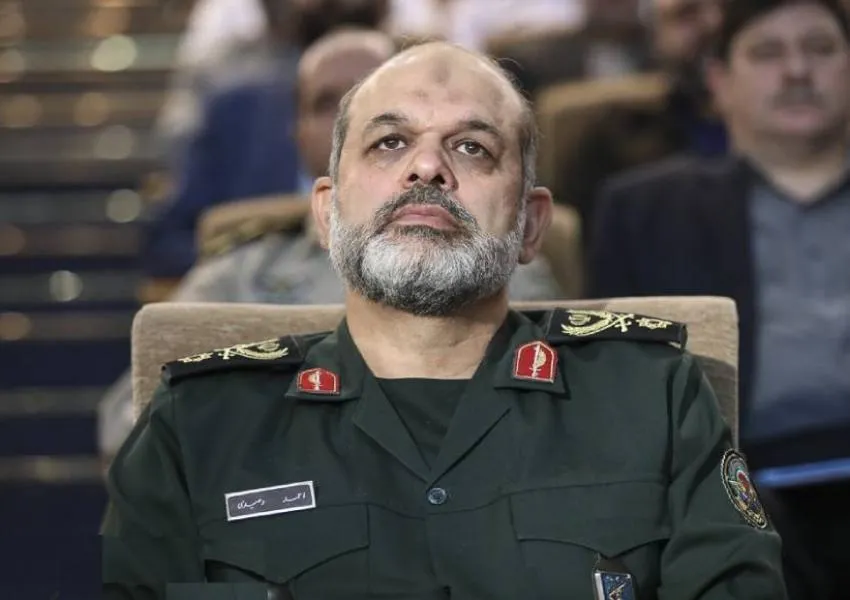
In the past 24 hours, the name Ahmad Vahidi has once again become one of the most searched names in the Persian online space. The main reason for this surge is the spread of rumors about the "assassination of Ahmad Vahidi" or the "assassination of General Vahidi."
Who is Brigadier General (Revolutionary Guard) Ahmad Vahidi?
In the past 24 hours, the name Ahmad Vahidi has once again become one of the most searched names in the Persian online space. The main reason for this surge is the spread of rumors about the "assassination of Ahmad Vahidi" or the "assassination of General Vahidi" — rumors that have not been confirmed by any official, credible source or independent international media. However, the very fact that such news has gone viral indicates that Ahmad Vahidi is no longer just an old military figure in the Islamic Republic; in the minds of a segment of the public, he has become one of the main symbols of the Islamic Republic's new security, military, and decision-making structure.
Ahmad Vahidi, whose original name is Vahid Shahcheraghi, is an old figure in the Revolutionary Guards (IRGC). He has been present in the security and military structures of the Islamic Republic since the early days of the IRGC's formation, and over the subsequent decades, he became a key figure in three areas: cross-border operations, internal security policy, and military management at the highest level. Various sources, including media reports and published biographical data, have highlighted his role in the formation and command of the IRGC's Quds Force — a force known for being responsible for cross-border operations, asymmetric warfare, and the Islamic Revolution's proxy networks in the region.
Vahidi's importance is not limited to his old record in the IRGC. He served as Minister of Defense and Armed Forces Logistics under Mahmoud Ahmadinejad, became Minister of the Interior under Ebrahim Raisi, and in recent years returned to the high command levels of the IRGC. His appointment as Deputy Commander-in-Chief of the IRGC and commander of its special headquarters was interpreted in international media as a sign of the return of hardline security figures to the center of decision-making in the Islamic Republic.
One of the most important reasons for Ahmad Vahidi's international notoriety is the connection of his name to the AMIA bombing case in Buenos Aires, Argentina. The attack occurred in 1994, killing 85 people and injuring hundreds. Argentina's judiciary has accused a number of former officials of the Islamic Republic and Hezbollah of involvement in the attack — an accusation the Islamic Republic has consistently denied. In 2009, Interpol announced that the Red Notice related to Ahmad Vahidi was issued in November 2007 at Argentina's request, based on charges of his involvement in the AMIA case. Interpol emphasized in its explanation that a Red Notice is "not an international arrest warrant" but a request for cooperation in identifying and provisionally arresting a wanted person according to member states' laws.
In 2024, the Argentine government once again called for the arrest of Ahmad Vahidi; at the time, Vahidi was the Minister of the Interior of the Islamic Republic and was on official visits to Pakistan and Sri Lanka. Argentina's Foreign Ministry announced that he is wanted by its judiciary as one of those responsible for the AMIA case and asked the governments of Pakistan and Sri Lanka to act according to Interpol mechanisms.
Besides the AMIA case, Vahidi is also a sanctioned security figure from Washington's perspective. The US Treasury has sanctioned him for his role in the security structure of the Islamic Republic and internal crackdowns. American analytical reports have also described him as one of the main IRGC figures linking internal repression, regional operations, and anti-American policies.
But why has Ahmad Vahidi's name become prominent again now?
The answer is not just the assassination rumor. In recent months, with the increase in security, military, and diplomatic crises, the role of the IRGC in the Islamic Republic's power structure has become more prominent, and Vahidi, as an old and trusted figure in this structure, has come more into focus in analyses. Some media reports in recent weeks have identified him as a key figure in organizing Tehran's military response and communicating with regional mediators. Euronews, in a recent report, wrote that Ahmad Vahidi, as the Deputy Commander of the IRGC, has been described as an influential figure in shaping Tehran's stance against the United States and one of the people close to the new inner circle of the Islamic Republic.
According to analyses presented in an analytical piece by Abdi Media about the third generation of the Islamic Republic, the operational role of command and oversight in the new power structure is distributed among several poles, including the IRGC, the Leader's office, and the circle close to Mojtaba Khamenei. In this analysis, Ahmad Vahidi is introduced as a senior military figure who has a special role in coordinating between the IRGC, the leadership sphere, and crisis management in wartime.
This position and status mean that any news about him, even if unconfirmed, quickly reflects in public opinion. In wartime or quasi-wartime conditions, rumors about the death, injury, or assassination of senior commanders are usually part of the psychological atmosphere of the crisis. Such rumors can be fueled by several sources: information warfare between the parties involved, attempts to gauge public opinion reaction, intra-structural rivalries, or even the inaccurate release of news by unofficial accounts on social media.
Regarding Ahmad Vahidi as well, we must distinguish between three levels: first, the "widespread searching by users," which is real; second, the "spread of the assassination rumor," which has occurred in cyberspace; and third, the "confirmation of the assassination news," which does not exist at this moment. Therefore, from a media perspective, it is more accurate to say: Ahmad Vahidi's name has become heated again following the spread of assassination rumors, but the news itself has not yet been confirmed.
The importance of this caution is doubled because in recent years, the Islamic Republic has repeatedly provided information about the fate of its commanders, security officials, or sensitive figures with delays, ambiguity, or multiple narratives. On the other hand, opponents of the Islamic Republic and regional media sometimes, in a competitive news environment, publish narratives that become definitive news before independent confirmation. The result of this situation is the formation of an environment where a "rumor" can move a few hours earlier than "news" and influence public opinion.
Ahmad Vahidi is an important example in this regard; because his political and military life lies at the intersection of several sensitive cases: the IRGC, the Quds Force, the AMIA case, the Ministry of Defense, the Ministry of Interior, internal repression, international sanctions, and now a potential role in the security structure following recent crises. Therefore, even if the rumor of his assassination is not confirmed, the increased searching of his name is not without reason. The public wants to know who he is, why he is important, and why his possible removal could have meaning and political consequences.
In conclusion, it can be said that Ahmad Vahidi is one of those figures where understanding his position is essential to understanding part of the Islamic Republic's security architecture. He is not just a former IRGC commander, but a link between the past and present of the Islamic Republic's security structure — from the cross-border operations of past decades to key ministries, from international cases to internal crises, and from the old IRGC to the new security order in Tehran.
The news of Ahmad Vahidi's assassination has not been confirmed by official sources or credible independent media and is not true, and cannot be considered definitive news. But the very heating up of this rumor reveals an important political reality: Ahmad Vahidi has become the focus of public attention today because, for many audiences, his name is synonymous with part of the Islamic Republic's hard, security, and military structure.
Take less than a minute, register and share your opinion under this post.
Insulting or inciting messages will be deleted.
Sign Up