
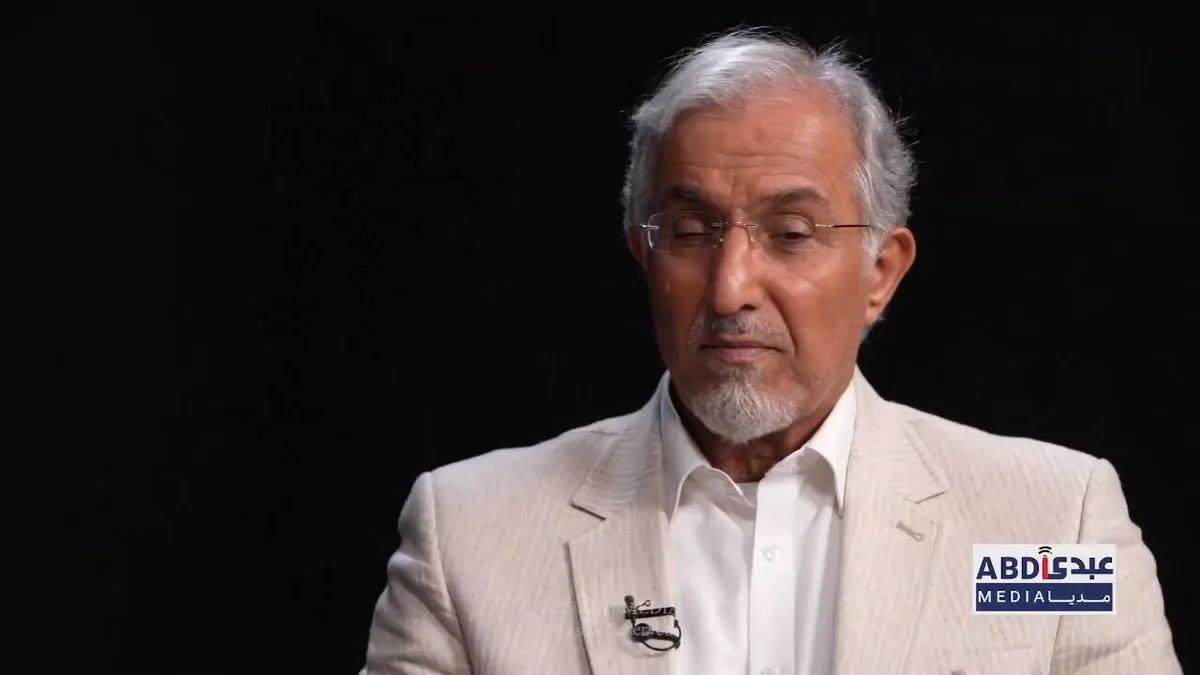
Dr. Hossein Raghfar, an institutional and reformist Iranian economist, professor in the Department of Economics and faculty member of Alzahra University, is one of the most prominent critical voices in contemporary Iran's economic discourse. Born in 1954, he received his PhD in Economics from the University of Essex in England and has been teaching at Alzahra University for nearly four decades. But what makes Hossein Raghfar unique among Iranian economists is his astonishing background in professional football: in the 1970s, he was the goalkeeper for the teams Rah Ahan, Butan, Machine Sazi, and the national youth team, and in 1981, he served for six months as the youngest president in the history of Iran's Football Federation. Raghfar, who is the translator of notable works by Amartya Sen (Nobel laureate in Economics), has been at the forefront of media attention in recent years with shocking analyses such as "42 percent of the country's population suffers from absolute poverty" and "about seven million people are below the hunger line." He has also been an exclusive guest of Abdi Media, analyzing the crisis of poverty and inequality in Iran.
Who is Hossein Raghfar?
Dr. Hossein Raghfar, an institutional and reformist Iranian economist, professor in the Department of Economics and faculty member of Alzahra University, head of the Institute for Economic Studies at this university, and one of the most prominent critical voices in contemporary Iran's economic discourse, born in 1954, is one of the most experienced and multidimensional academic-critical figures in Iran's economy over the past four decades. Raghfar, who in addition to a rich academic career has a background in professional football (as goalkeeper for the teams Rah Ahan, Butan, Machine Sazi, and the national youth team) and served as head of the Football Federation in 1981 for six months — as the youngest president in the history of this federation — in the academic arena, with focused expertise on poverty, inequality, social welfare, and institutional economics, has become one of the main reference points for structural analysis of Iran's economy.
The importance of Dr. Hossein Raghfar in Iran's economic-political sphere can be examined from several perspectives. First, his sustained academic career at Alzahra University (from 1985 to the present, approximately four decades), which has given him the ability to shape several generations of Iran's economics graduates. Second, his outstanding educational background — with a PhD in Economics from the University of Essex in England (one of Europe's most prestigious universities in the fields of social sciences and development economics) — which has given his views an international theoretical framework. Third, his position as one of the most prominent representatives of institutional economics in Iran — alongside figures such as Farshad Momeni, Mohammad Reza Vaez Mahdavi, and others — who, through activity at the Religion and Economics Institute, have pursued the formation of a discourse distinct from the dominant neoclassical economics current in Iran. Fourth, his sustained and high-profile presence in Iran's media space — particularly in analyzing the state of poverty and inequality — which has made him one of the most frequently cited economic figures in Persian-language media both inside and outside the country.
In recent months, in one of his most widely reported positions (November 2025), Raghfar stated that "42 percent of the country's population suffers from absolute poverty and about seven million people are below the hunger line" — an analysis considered one of the most frequently cited critical statistics in the tense atmosphere of the economic discourse of Pezeshkian's fourteenth administration.
Life and Background
Hossein Raghfar was born in 1954 in Iran. This generation, born in the aftermath of the August 19, 1953 coup d'état, came of age during the socio-economic transformations of the land reform era, the formation of the urban middle class, and ultimately the events of the 1979 Islamic Revolution.
Raghfar's background is one of the most unique examples among contemporary Iranian economists; because at the same time as he was pursuing his academic path, he also played professional football and was a well-known figure in Iran's professional sports arena.
Sports Background: Professional Football and Presidency of the Federation
One of the distinctive and unusual aspects of Hossein Raghfar's character is his background in Iran's professional football. In the 1970s, Raghfar was the goalkeeper for the teams Rah Ahan, Butan, Machine Sazi, and Iran's national youth team. This athletic activity, in his youth, formed the foundation of his familiarity with Iran's professional sports structure.
Presidency of the Football Federation (1981)
The turning point in Raghfar's sports-executive career was his appointment in 1981 as head of the Football Federation of the Islamic Republic of Iran for a period of six months. This appointment took place in one of the most sensitive periods after the revolution and in the midst of structural transformations in Iranian sports.
Given Raghfar's young age at that time (28 years old), he became the youngest president in the history of Iran's Football Federation — a record that remains unbroken to this day. This executive experience, in the continuation of his career, remained in the background of his main activity as an academic, but continues to be considered a notable aspect of his character in Iranian media.
Education
Raghfar's educational path involved graduate studies at one of Europe's most prestigious universities.
PhD in Economics from the University of Essex, England
Raghfar received his PhD in Economics from the University of Essex — one of England's most prestigious universities in the fields of social sciences and economics, located near Colchester in eastern England. This university is considered among the leading centers in the field of international relations and development economics internationally, and over the past decades has trained numerous prominent figures from Iran (especially in the fields of economics and social sciences).
This international educational background, combined with Raghfar's theoretical expertise in institutional economics, formed the foundation of his intellectual framework.
Academic Activity: Alzahra University (from 1985)
The turning point in Raghfar's academic career is his faculty membership in the Department of Economics at Alzahra University from 1985 to the present. This professional endurance — nearly four decades of activity at one academic institution — indicates his deep commitment to this university.
Professor and Head of the Institute for Economic Studies
Throughout his academic career, Raghfar advanced through the academic ranks to become a full professor in the Department of Economics and currently serves as the head of the Institute for Economic Studies at Alzahra University. This institute is considered among the prominent economic research centers in Iranian universities.
Expertise and Research Areas
The main axes of Raghfar's expertise and research over four decades of activity are:
Poverty and economic justice (the main focus of his research)
Social welfare
Socio-economic inequality
Economic development
Institutional economics
Political economy of development
Housing and basic needs
Resistance economy (structural analysis)
Economic futures studies
Academic and Research Works
Raghfar is the author and translator of a significant number of books and scientific-research articles that are considered reference works in the field of economics in Iran:
Notable Translations of Amartya Sen's Works
One of the distinctive aspects of Raghfar's translation activity is his translation of two notable works by Amartya Sen — the Indian-British economist and 1998 Nobel Prize winner in Economics — into Persian:
"On Economic Inequality" (Amartya Kumar Sen, Institute for Social Security Research Publications, 2002)
"Development as Freedom" (Amartya Kumar Sen, Kavir Publications, 2002) — one of the notable works on the philosophy of development
These two translations are recognized as reference works in Iran's development discourse and are taught as textbook-research materials in Iran's economics faculties.
Other Translations
"Microeconomic Theory" (Richard Bylas, Ney Publications, 1992)
"Development Strategies" (Keith Griffin, in collaboration with Mohammad Hossein Hashemi, Ney Publications, 1999)
"State, Corruption, and Social Opportunities: The Interaction of Ideas in the Political Economy of Development" (Robert Cox, Naqsh-o-Negar Publications, 2004)
Notable Authored Works
"Inequalities in the Mirror of Research" (in collaboration with Mohammad Reza Vaez Mahdavi, Farshad Momeni, Fatemeh Heydari, Shahed University Publications)
"Philosophy and Economics" (with Morteza Nosrat, Scientific and Cultural Publications Company, 1996)
"Epistemology and Methodology of Futures Studies: The Product of the First Futures Thinking Workshop" (with Ali Paya, National Research Center for Science Policy, 2004)
"Futures Thinking and Cultural Studies" (with Ali Paya)
Scientific-Research Articles
Raghfar is also the author of dozens of scientific-research articles published in reputable Iranian economics journals — including the Economic Research Quarterly, Social Welfare Quarterly, and other prominent journals. Notable topics of his recent articles include: "Investigating the Relationship between Poverty and Financial Development in Iran's Economy," "The Effect of Exchange Rate Changes and Import Tariffs on Iran's Clothing Industry," "Housing Needs in Iran and its Estimation up to 2021," and "Investigating Iran's Business Environment."
The Religion and Economics Institute and the Institutionalist Circle
One of the key aspects of Raghfar's activity is his active membership in the Religion and Economics Institute — one of the most important intellectual-research centers associated with the current of institutional economists in Iran. This institute, over the past decades, with the presence of figures such as Farshad Momeni, Mohammad Reza Vaez Mahdavi, Hossein Raghfar, and other economists associated with this current, has become one of the main centers for criticizing neoliberal economic policies in Iran.
The numerous meetings of this institute — including the meeting "The Fourteenth Administration and the Perspective of Increasing Unjust Inequalities" — are considered among the most high-profile critical gatherings regarding the economic policies of various administrations.
Political-Electoral Activities
Throughout his career, Raghfar has publicly taken supportive stances in several notable Iranian elections.
Support for Mousavi in the 2009 Election
In the 2009 presidential election, Raghfar, as part of the Religion and Economics Institute, was among the supporters and drafters of the economic program of Mir Hossein Mousavi's proposed administration. He was also, during the campaign period of this election, among the economists who signed a letter supporting Mir Hossein Mousavi.
This role in shaping the economic program of the "Green Movement" in 2009 is considered one of the notable aspects of Raghfar's political-economic activity.
Support for Rouhani in the 2017 Election
In the 2017 presidential election, Raghfar was among the 163 economists who signed a letter supporting Hassan Rouhani. This position, while indicating his connection to the moderation-reform camp, later turned into a kind of discursive tension as his criticism of Rouhani's economic policies intensified in subsequent years.
Views and Positions
Throughout his intellectual-analytical career, Dr. Hossein Raghfar has formulated a clear intellectual-economic framework that can be traced in several axes.
Criticism of Neoliberal Policies
The most central analytical position of Raghfar is his structural criticism of neoliberal policies. In his view, "neoliberal policies, such as widespread privatization and reduced government intervention in the economy, have led to increased poverty and inequality in Iranian society." This position, which has been in opposition to the dominant neoclassical economics discourse in Iran over the past decades, is one of the distinctive aspects of his intellectual identity.
Emphasis on Social Justice
An enduring feature of Raghfar's approach is his emphasis on social justice and fair distribution of resources. In his view, economic policies should be designed to benefit the low-income and underprivileged segments of society — a position aligned with the development economics tradition of Amartya Sen (whose works he has translated).
Analysis of the State of Poverty and Hunger (2025)
In one of his recent notable positions (November 2025), Raghfar stated: "Our studies show that 42 percent of the country's population suffers from absolute poverty and is deprived of the minimum standards of human life, and about seven million people in the country are below the hunger line, and their expenses do not provide the minimum calorie food basket." These statistics received widespread coverage in numerous Iranian media outlets in the tense atmosphere of the 2025 economic discourse.
In another analysis, based on official statistics, Raghfar stated: "An average family of four needs to have at least 30 million tomans in income" to escape the poverty line.
Criticism of the Fourteenth Administration (Pezeshkian)
Despite his previous support for the moderation-reform camp, Raghfar has become one of the serious critics of the economic policies of the fourteenth administration headed by Masoud Pezeshkian in recent years. In meetings of the Religion and Economics Institute, he explicitly criticized "shock therapy" as the wrong approach of the Pezeshkian administration.
In one of his notable positions, he stated: "The collapse of the national currency's value is the most important factor in the economic disorders of the country and the main cause of public dissatisfaction and the accumulated dissatisfactions of the past 37 years. Unfortunately, national interests have been sacrificed to the interests of oligarchs."
Criticism of Structural Corruption
Throughout his analytical career, Raghfar has identified structural corruption as one of the main roots of Iran's economic disorder. In one of his notable positions, he stated: "I believe that as long as the spiral of corruption growth exists in the economic system, we have no solution for improving the economy, and while maintaining the infectious centers of corruption, we cannot fight corruption."
Criticism of Ayandeh Bank
In one of his notable positions, regarding Ayandeh Bank, Raghfar stated: "With the debts of Ayandeh Bank, we could have built 120 specialized hospitals in the country" — a position that received widespread coverage in Iran's media space.
Criticism of Internet Cuts
Raghfar also, regarding internet outages in Iran, stated: "13 million people were deprived of income due to internet cuts" — an analysis indicating his view of the economic consequences of digital restrictions.
Denial of Explicit Leftist Claims
Although some critics identify Raghfar and other institutional economists as "neo-leftists" or "supporters of state-controlled economy," Raghfar himself does not claim a leftist perspective and has repeatedly defended the active presence of the private sector in the country's economy. In Raghfar's institutionalist view, in a mixed economic structure, the private sector should operate under the guidance and control of the state — a position consistent with theories of the "new left economic current."
Lifting Internet Filters
In one of Raghfar's analyses regarding the promises of the Pezeshkian administration, he noted that "one of the most important promises of the president during the election campaign was lifting internet filters, and Pezeshkian later, with this approach, took some actions and issued orders, but the steps taken in lifting internet filters are still assessed as ineffective."
The Full Recording of Abdi Media's Interview with Dr. Hossein Raghfar, Economist and University Professor
Hear without filter in the cassette box
Here is the English translation of the text, with headings formatted as Heading 3 (### in Markdown) as requested.
Defense of Iran's Deterrence Power in the 12-Day War
In connection with the 12-day war between Iran and Israel in June 2025, Raghfar took a notable position. In one of his stances, he stated: "The United States and Israel must only be dealt with through force so that they back down," and added: "Israel wanted to destroy the defense infrastructure to create a foundation for civil war; but it failed."
Connections with Figures and Currents
Dr. Hossein Raghfar is situated within a network of intellectual-organizational connections with prominent figures of institutional economics and the reformist movement in Iran. At the academic level, his relationship with Farshad Momeni (professor of economics at Allameh Tabatabai University, a prominent peer institutionalist figure), Mohammad Reza Vaez Mahdavi (collaborator on inequality research), Ali Paya (collaborator on futures studies), Fatemeh Heydari, and other institutionalist economists forms his intellectual-research network.
At the institutional level, his relationship with Alzahra University (his sustained academic workplace), the Religion and Economics Institute (the hub of his think-tank activities), Ney Publications (publisher of many of his translations), and the Institute for Economic Studies at Alzahra University (which he heads) are considered among his main connections.
At the political-electoral level, his relationship with Mir Hossein Mousavi (the 2009 candidate) and Hassan Rouhani (the 2017 candidate) has been one of supportive connections; although, in subsequent years, with the intensification of his criticism of the policies of moderation-reform administrations, his discursive distance from this current has also increased.
Conclusion
Dr. Hossein Raghfar is one of the most experienced and multidimensional academic-critical figures in Iran's economy over the past four decades. With a unique combination of an outstanding educational background (PhD in Economics from the University of Essex, England), a notable prior sports career (national team footballer, goalkeeper for Rah Ahan, Butan, Machine Sazi, the national youth team, and the youngest president of the Football Federation in 1981), sustained academic activity at Alzahra University (from 1985 to the present), focused expertise on poverty and inequality, reference translations of Amartya Sen's works, active membership in the Religion and Economics Institute, and sustained presence in Iran's media arena, he has occupied a distinctive position in the academic-analytical structure of Iran's economy. His career — from his birth in 1954, professional sports activity in the 1970s, presidency of the Football Federation in 1981, doctoral studies in economics at Essex, four decades of teaching at Alzahra University, headship of the Institute for Economic Studies, support for Mousavi in 2009 and Rouhani in 2017, and finally, serious criticism of the economic policies of Pezeshkian's fourteenth administration in 2025 — presents a picture of a multidimensional "structuralist-critical economist-former footballer."
Raghfar's distinguishing feature, at the first level, is his deep and sustained commitment to the discourse of poverty and inequality — a commitment that, over four decades of academic activity, has been organized around this axis. This focus is relatively unique among contemporary Iranian economists and has made him one of the main reference points for poverty studies in Iran. At the second level, the multidimensional combination of his character — in which an academic economist also has a background in professional football and presidency of the Football Federation — is one of the notable aspects of his personality, which is relatively rare among Iranian economists.
From an analytical perspective, Raghfar's position exemplifies the phenomenon of the "structuralist-critical institutional economist" in contemporary Iran — a phenomenon in which a researcher with expertise in development economics, using an institutionalist theoretical framework, has played a strategic role in the post-revolution decades in criticizing the dominant neoclassical economics discourse in Iran, which has accompanied the path of post-revolutionary administrations. This pattern, which has other examples among the middle-experienced generation of Iranian economists (such as Farshad Momeni, Mohammad Reza Vaez Mahdavi, Ahmad Tavakoli from the other faction, and others), has found particular reflection in Raghfar with his specific focus on poverty and inequality.
What is clear from today's perspective is that the issues Raghfar has addressed in his research and analyses — from poverty and hunger, structural inequality, criticism of economic neoliberalism, structural corruption, criticism of shock therapy, housing challenges, and the future of Iran's economy — remain among the most enduring topics of discussion in contemporary Iran's economic-political discourse. At a time when Iran's economy is in one of the most tense periods of its contemporary history — particularly after the 12-day Iran-Israel war, intensified sanctions, and growing currency and livelihood challenges — Raghfar's analytical-academic voice, combining deep institutionalist expertise and a comprehensive critical view, will remain one of the main references of contemporary Iran's economic discourse.
Frequently Asked Questions
Who is Hossein Raghfar?
Dr. Hossein Raghfar (born 1954) is an institutional and reformist economist, former footballer, professor in the Department of Economics and faculty member of Alzahra University, and head of the Institute for Economic Studies at this university. He is considered one of the most prominent Iranian researchers in the fields of poverty, inequality, and social welfare, and in the public sphere, he is a serious critic of neoliberal economic policies.
What is Hossein Raghfar's educational background?
Raghfar holds a PhD in Economics from the University of Essex in England — one of Europe's most prestigious universities in the fields of social sciences and economics, located near Colchester in eastern England. This educational background has given his views an international theoretical framework.
What is Raghfar's sports background?
One of the distinctive and unusual aspects of Hossein Raghfar's character is his background in Iran's professional football. In the 1970s, Raghfar was the goalkeeper for the teams Rah Ahan, Butan, Machine Sazi, and Iran's national youth team. In 1981, he served as head of the Football Federation for six months and is thus considered the youngest president in the history of Iran's Football Federation.
What are Hossein Raghfar's most important works?
Among Raghfar's most important works are his translations of two notable works by Amartya Sen (Nobel Prize winner in Economics): "On Economic Inequality" and "Development as Freedom." His other notable works include translations of "Microeconomic Theory" (Richard Bylas), "Development Strategies" (Keith Griffin), and "State, Corruption, and Social Opportunities" (Robert Cox), as well as authored works such as "Inequalities in the Mirror of Research," "Philosophy and Economics," and "Epistemology and Methodology of Futures Studies."
What is Raghfar's view on the state of poverty in Iran?
In one of his recent notable positions (November 2025), Raghfar stated: "Our studies show that 42 percent of the country's population suffers from absolute poverty and about seven million people are below the hunger line." He also stated in another analysis, based on official statistics, that a family of four needs to have at least 30 million tomans in income to escape the poverty line.
What is Raghfar's view on the Pezeshkian administration?
Despite his previous support for the moderation-reform current, Raghfar has become one of the serious critics of the economic policies of the fourteenth administration in recent years. He has criticized "shock therapy" as the wrong approach of the Pezeshkian administration and has stated: "The collapse of the national currency's value is the most important factor in the economic disorders of the country... Unfortunately, national interests have been sacrificed to the interests of oligarchs."
Which elections has Raghfar supported?
Throughout his political career, Raghfar has announced public support in two notable elections: in the 2009 election, he was among the supporters and drafters of the economic program of Mir Hossein Mousavi's proposed administration. In the 2017 election, he was among the 163 economists who signed a letter supporting Hassan Rouhani.
What is Raghfar's view on neoliberal policies?
The most central analytical position of Raghfar is his structural criticism of neoliberal policies. In his view, "neoliberal policies, such as widespread privatization and reduced government intervention in the economy, have led to increased poverty and inequality in Iranian society." However, he does not claim a leftist perspective and has repeatedly defended the active presence of the private sector in the country's economy.
In which institutions is Hossein Raghfar active?
Raghfar is active in several prominent academic-research institutions: Alzahra University (as professor in the Department of Economics and head of the Institute for Economic Studies), the Religion and Economics Institute (as an active member of the institutionalist economist circle, alongside Farshad Momeni and other figures). His sustained activity at these institutions, from 1985 to the present, is considered among the most enduring academic careers in Iran's economics.
Is Hossein Raghfar still active?
Yes, Raghfar, at over 70 years of age, remains one of the most prominent economic figures in Iranian media. His recent notable analyses — including his analysis of absolute poverty (42 percent) and hunger (7 million people) in November 2025, his criticism of Ayandeh Bank, his criticism of internet outages, and his notable position after the 12-day Iran-Israel war — have received widespread coverage in Persian-language media both inside and outside the country. He also regularly appears as one of the main speakers at meetings of the Religion and Economics Institute.
Take less than a minute, register and share your opinion under this post.
Insulting or inciting messages will be deleted.
Sign Up