
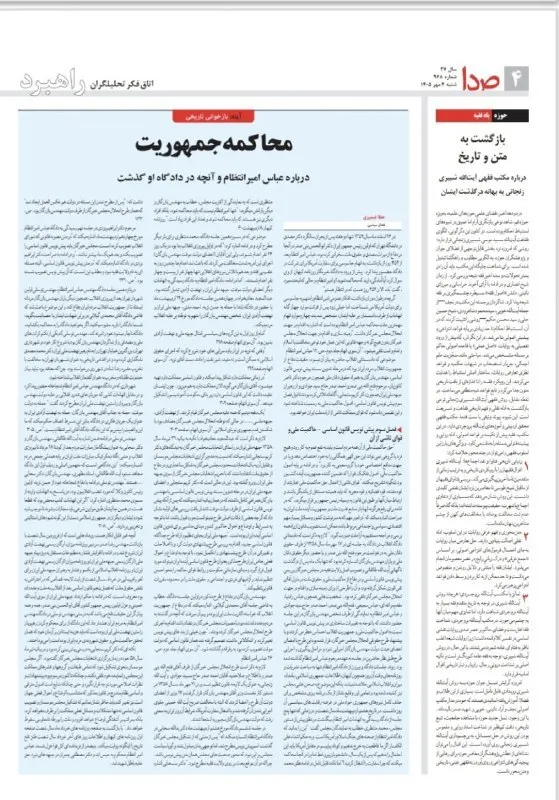
Before entering the court, a Kayhan newspaper reporter asked him: Are you ready to stand trial? And Amir-Entezam, smiling, said "Yes, I have been waiting for ۴۵۲ days now"
Ata Zamiri
Before entering the court, a reporter from Kayhan newspaper asked him: Are you ready to stand trial? And Amir-Entezam, while smiling, said "Yes, I have been waiting for ۴۵۲ days now"
Although during his detention, public opinion regarded Amir-Entezam as a spy for the US government, very soon after the prosecutor read out the four charges against him, it became clear that the fourth charge was the most important reason for Abbas Amir-Entezam's trial, referring to taking action toward the dissolution of the Assembly of Experts.
"Preparing the ground and taking action toward the dissolution of the Assembly of Experts without any legal basis, which in itself is considered a form of opposition to Islam, the Imam, and the Ummah." Beyond the Accusation, Volume Two – p.۱۲ Abbas Amir-Entezam
What the Revolutionary Prosecutor's Office was unwilling to state was the truth about defending the republican character of the Iranian people's revolution, which at the stage of drafting the draft constitution, Mehdi Bazargan, together with national jurists such as the late Dr. Nasser Katouzian, the late Fathollah Banisadr and Ahmad Sadr Haji Seyyed Javadi, and leaders of the National Front of Iran such as Dr. Karim Sanjabi, had consciously sought to ensure that under Chapter Three of the draft constitution, the principles of national sovereignty would be recognized and it would be guaranteed that the powers of the country would derive from the will of the Iranian nation.
The late Dr. Ebrahim Yazdi, in the ninth session of the hearing of Abbas Amir-Entezam's trial dated the fourteenth of Ordibehesht, points out that "in the text of the legal resolution approved by the Revolutionary Council, the Assembly of Experts must approve the draft constitution and then it must not last more than one month." And Dr. Ebrahim Yazdi explicitly states in court that "in the text of the draft constitution, of course, there was no such thing as the Guardianship of the Jurist, and the point is that that draft had been approved." p. ۲۳۱
Mohammad Tavassoli, the first mayor after the revolution, courageously appeared at the trial of Engineer Abbas Amir-Entezam and, in response to the false accusations made by radical revolutionary factions against the government of Engineer Bazargan and the true followers of Iran's national movement, said: "Attacking the provisional government, attacking Mr. Engineer Bazargan, attacking the Freedom Movement of Iran as an intellectual current in court, therefore fairness dictates that we accept this reality that this court is not Mr. Amir-Entezam's court." p. ۳۰۵
Engineer Tavassoli went on, referring to Ayatollah Taleghani, Engineer Bazargan, and Dr. Sahabi as pioneers of the people's struggles from the 28 Mordad coup until the victory of the revolution and to the democratic approach to the Iranian people's struggle based on the collective solidarity of the people: "This is a court in which the main and first-ranking defendants are the tireless fighter Ayatollah Taleghani, Professor Motahari, Engineer Bazargan, Dr. Sahabi ..."
Engineer Tavassoli then, in his courageous defense of Hassan Nazih, the first head of the Bar Association who had incurred the wrath of the revolutionaries, responded to the accusations made by Mohammad Montazeri by saying: "If these accusations were pure lies, which they certainly are, then right here he should, according to religious law, be punished so that it may serve as a lesson and so that he and others in the Islamic Republic will abandon these Stalinist and destructive methods." p. ۳۰۸
What cannot be denied are the events that began in Farvardin of the year sixty with the arrest of Engineer Reza Sadr, editor-in-chief of Mizan newspaper, the official organ of the Freedom Movement of Iran, and continued with increasing pressure on the independent press, especially Payam-e Jebhe-ye Melli (the official organ of the National Front of Iran), Mizan newspaper (the official organ of the Freedom Movement of Iran), and Enghelab-e Eslami newspaper on the one hand, and pressure on the leaders of the National Front of Iran to cancel the demonstration in Khordad of the year sixty over the Retribution Bill, which became known for protesting the violation of the rights of the nation that Chapter Five of the constitution had promised the people after the revolution, followed by Ayatollah Khomeini's apostasy ruling against the National Front of Iran and the dismissal of the country's first president, Mr. Abolhassan Banisadr, all of which together express this bitter truth: Engineer Tavassoli was right to warn the Iranian people at Engineer Amir-Entezam's trial that this court was intended to condemn the true followers of Iran's national movement, who had to pay the price for standing by their ideal, namely the realization of national sovereignty and the civil rights of the Iranian people.
Source: Seda weekly, issue 279


Take less than a minute, register and share your opinion under this post.
Insulting or inciting messages will be deleted.
Sign Up