In this article, I have tried to answer a basic question
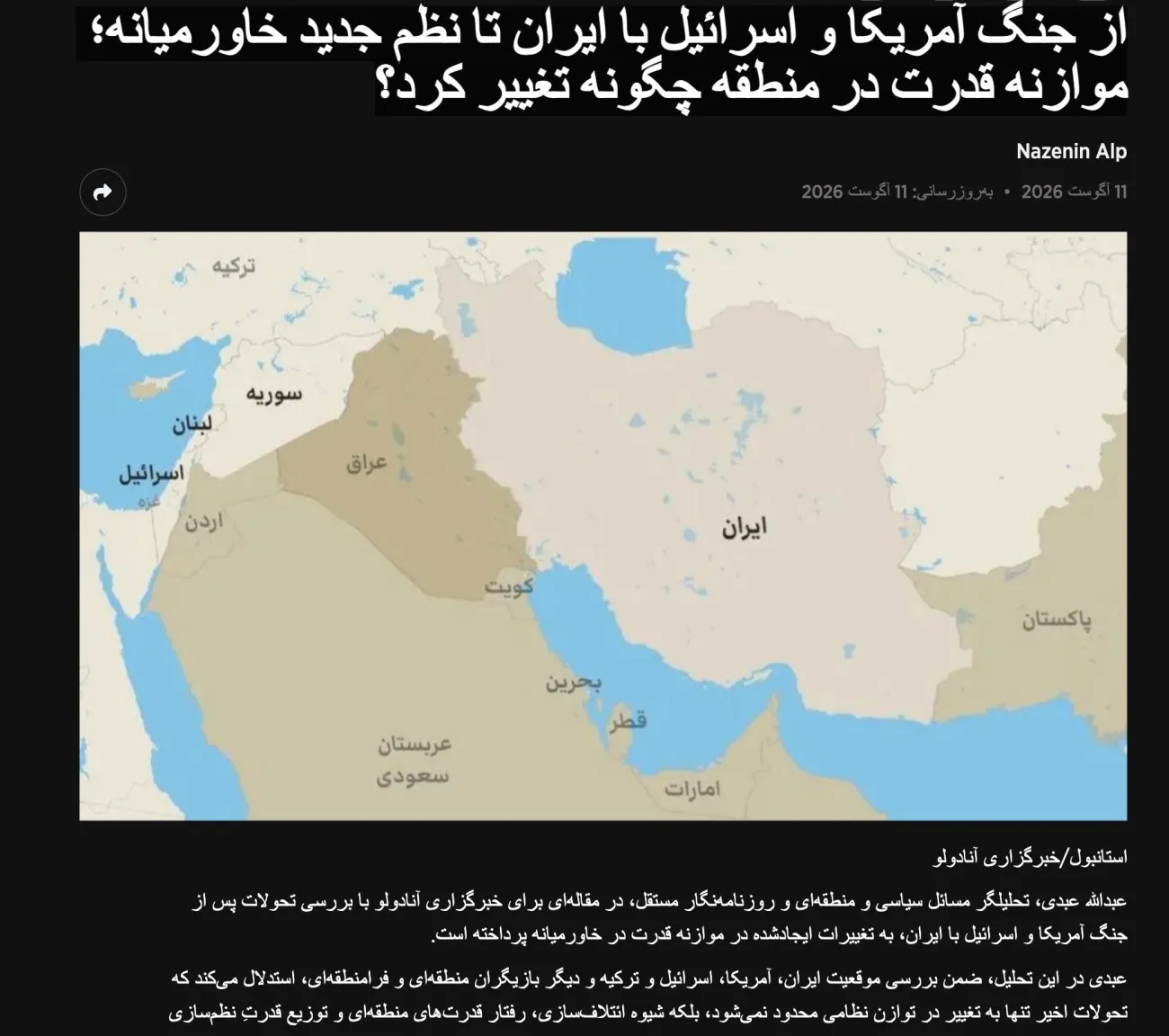
From the U.S.-Israel war with Iran to the new Middle East order; How did the balance of power in the region change?
Abdullah Abdi, in an article for Anadolu Agency, examining the situation of Iran, Israel, and the increasing role of Turkey and Arab countries, addressed the change in the structure of the balance of power and the increasing independent role of regional actors.
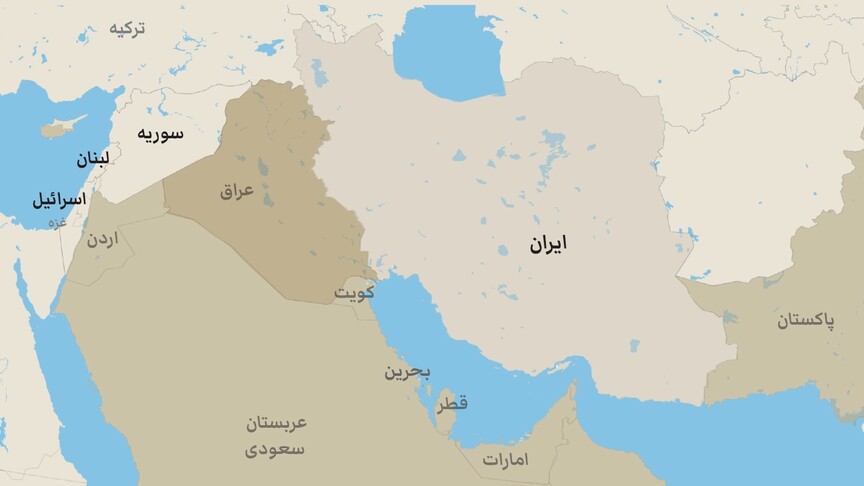
Istanbul / Anadolu Agency
Abdullah Abdi, an analyst of political and regional issues and an independent journalist, in an article for Anadolu Agency, examining the developments following the U.S.-Israel war with Iran, has addressed the changes in the balance of power in the Middle East.
In this analysis, Abdi, while examining the position of Iran, the U.S., Israel, Turkey, and other regional and extra-regional actors, argues that recent developments are not limited to a change in the military balance, but also the method of coalition-building, the behavior of regional powers, and the distribution of power in order-building have also undergone change.
He believes that the Middle East is moving toward a more multipolar and fluid order; an order in which no single actor is able to determine the rules of the game alone.
Introduction
The objective and field image of the Middle East in the first days of August 2026 is a mixture of military paradoxes and fragile diplomatic contradictions. Contrary to the simplistic and common reading in Western think tanks that analyze the post-June 2026 ceasefire developments as a sign of the linear continuation of the old conflict pattern and the complete destruction of the axis leaning toward Tehran, the Middle East has neither moved toward the establishment of absolute one-sided dominance of Israel and the U.S., nor has it stagnated in the same cycle, but has entered a new order in the balance of power; a fundamental change in which monolithic blocs have been replaced by multilateral balancing, strategic protection of Arab monarchies and Turkey, and the prominent role of Eurasian anchors.
The main feature of this new order is the dispersal of the power of order-building. Military power in the Middle East is still largely concentrated in the hands of the U.S. and Israel, but the ability to determine the political and security rules of the region has been distributed among a larger number of actors.
On August 4, 2026, the Houthi missile and drone attack on the Najran region in southern Saudi Arabia once again showed that even after months of conflict and heavy attacks, asymmetric threats against the Persian Gulf countries have not disappeared. Published reports indicated the impact or interception of projectiles and damage to some facilities in Najran; an event that highlighted the importance of the continued ability to attack from Yemeni soil for Riyadh's security equations. These destructive strikes, regardless of the extent of material damage, carried a clear message: despite suffering the heaviest military blows and the destruction of a large part of heavy equipment in recent months, the paramilitary and proxy structures in the region still have a high operational capability to destabilize and impose huge costs on neighbors.
Exactly three days before this event, on August 2, 2026, a decision was made in Washington that sent a deep shock through the world's political and military circles. Donald Trump ordered the cancellation of a new wave of massive U.S. airstrikes against remaining military targets, underground missile bases, and Iran's economic ports. The cancellation of this attack raised questions about Washington's calculations, concerns about the regional consequences of the war, and its possible costs for the energy market. The coincidence of the Najran attack and Washington's last-minute retreat are two sides of the same coin that form the fundamental question of this critical juncture in the history of the Middle East: Has the Middle East, after the successive political and military earthquakes of 2024 to 2026, truly stepped into a "new order in the balance of power," or are we merely witnessing the reproduction of the same anarchy, arms race, and past dynamics in a harsher and more aggressive guise?
There are two competing interpretations of this situation. The first is that the blows dealt to Iran and its allies have consolidated the superiority of the U.S. and Israel, and the region will sooner or later return to an order directed by Washington. The second interpretation essentially rejects the existence of any new order and considers current developments as a continuation of the same historical instability of the Middle East. But both readings fail to sufficiently distinguish between "military superiority" and "ability to build order."
Although the nature of the conflict and historical distrust have persisted, the structure of actors, methods of play, and coalition-building have fundamentally changed. To assess this change, one must look at the behavior of the actors themselves: Iran, despite military blows, still uses its asymmetric tools; Israel, despite military superiority, faces limitations in converting this superiority into a stable political order; Arab countries, instead of fully joining an anti-Iranian coalition, have simultaneously maintained their security relations with Washington and their economic and political relations with China; Turkey has also expanded its security and diplomatic role, and the "Mecca Joint Defense Pact" between Saudi Arabia, Turkey, and Pakistan on August 7, 2026, is a fresh sign of this change in the region's security architecture.
In other words, the main issue of the new Middle East is not who possesses the most power; the issue is who is able to transform their power into rules that others are forced to accept.
Iran: IRGC Sovereignty, War Economy, and Asymmetric Deterrence
Contrary to the narrative of analysts who, after the end of the May 2026 operations, spoke of the imminent collapse or weakening of Tehran, a realistic look at Iran's domestic space shows a different process. The Islamic Republic has been severely wounded and damaged, but has not experienced structural collapse. With the vacuum created in the religious power pyramid, the weight of the IRGC and other security institutions in the operational administration of the country has noticeably increased, and with the formation of a security-oriented governance council, all political, economic, and military affairs have been integrated. The leadership council's period of activity was not very long, and according to published reports, the Assembly of Experts quickly and remarkably appointed Seyyed Mojtaba Khamenei to replace the assassinated leader. The lack of public unveiling of the second Khamenei, and even the absence of audio and video files or even a live signature in his decrees, created controversies in the following months, but this situation increased the weight of military and security institutions, especially the IRGC, in the Islamic Republic's decision-making structure, and the administration of the country continued through a set of formal political, executive, and military institutions. An analysis of the official literature and domestic media also shows that the new government seeks its survival not in passive diplomacy, but in redefining deterrence through unpredictable and naked behaviors.
At the regional level, Tehran has focused its efforts on two main pressure levers. First, creating discontinuous and intelligent disruptions in international shipping in the Strait of Hormuz through tactical mining, reconnaissance drone flights, and interdiction of vessels, to keep shipping insurance rates high. Second, conducting pinpoint and small-scale attacks by suicide drones on oil facilities, refineries, and export hubs of Persian Gulf neighbors, from the UAE and Bahrain to Qatar and Oman. The goal of these actions is to send the clear message that the destruction of Iran's economic security will equal the denial of security for the entire region.
From the perspective of the social space—a special angle on the pulse of Iranian society—Iranian society is experiencing a highly complex and suspended condition. Crippling inflation, specifically the staggering rise in food prices, the collapse of the national currency's value, and extreme fatigue from years of sanctions and military pressure have put society in a state of erosion. However, the sentiments of a segment of society are strongly influenced by the fear of becoming "another Syria," civil war, or the disintegration of national borders due to direct foreign intervention. This deep fear has made society, despite the unbridgeable gap with the government, sensitive to foreign military interventions. This gap between the society's distance from the government and its opposition to foreign military intervention is one of the important complexities that must be considered in analyzing Iran's behavior.
In the international arena, Tehran's lifeline for survival is summed up in the "tripartite pact of Iran, China, and Russia," signed in January 2026, just before the start of the war. Although Beijing and Moscow refrained from entering the direct conflict during the war, after the June ceasefire, this pact has become a channel for economic breathing, the supply of dual-use parts, the reconstruction of defense systems, and the diplomatic support of Beijing and Moscow in international institutions. Relying on these levers, the IRGC has shown that a weakened Iran still has a high capacity to act as a disruptive power in the region. In fact, despite the weakening of its conventional and regional military capacities, the Islamic Republic has maintained its ability to impose costs and disrupt the security calculations of its rivals.
Therefore, Iran's new position can perhaps be better defined not as a dominant regional power, but as a "disruptive power": an actor that has lost the ability to impose its desired order but can still prevent the complete imposition of its rivals' desired order.
Israel: Technical-Military Superiority Against a Blocked Political Horizon
After the end of "Roar of Lions" operation, some Israeli political and military officials spoke of the operation's achievements and the change in the military balance against Iran, emphasizing Israel's intelligence and air superiority. The extensive destruction of ballistic sites, damage to nuclear facilities, and the elimination of Iran's leadership superficially displayed Israel's unquestionable technical-military and intelligence superiority. However, a deeper look at the actual achievements reveals a picture of an incomplete victory fraught with long-term risks.
Israel was able to deliver heavy blows to Iran's military and nuclear infrastructure, but these attacks did not lead to the collapse of the Islamic Republic's political structure, and Iran's missile and asymmetric capabilities were not completely eliminated. The survival of the IRGC structure and the continuation of scattered drone launches proved that technological superiority does not mean the absolute submission of the opponent.
On the other hand, the Gaza war and the continuation of the Palestinian crisis have seriously hindered the U.S. efforts to achieve a normalization agreement between Saudi Arabia and Israel. Especially since Saudi Arabia's official position is that normalization of relations with Israel is conditional on the establishment of a Palestinian state. The continuation of the Gaza war and the unresolved Palestinian issue remain one of the most important political and public opinion obstacles to the expansion of Israel's relations with Arab countries.
Israel still enjoys significant air, intelligence, and missile superiority after the recent wars; its ability to operate deep inside Iran, strike proxy networks, and maintain qualitative military superiority has solidified its position as the most powerful military actor in the region. However, military superiority alone does not mean the ability to build a new political order.
Israel's paradox lies precisely in this point: the gap between destructive power and the power to build order. Israel may be more capable than ever of striking its enemies, but it is still unclear how it can translate this superiority into political and security arrangements accepted by other regional powers.
Turkey: The Rise of an Independent Balancing Power
After the crises of 2026, Turkey has tried to strengthen its role as an independent regional power in Middle East decision-making; a role that, of course, is defined alongside Ankara's NATO membership and its security relations with the West. During the regional crises, Ankara has tried to use its diplomatic channels and military and economic capacities to increase Turkey's role in Middle East equations.
The clearest official manifestation of this independent role can be seen in the "Mecca Joint Defense Pact," signed on August 7, 2026, between Recep Tayyip Erdogan, Mohammed bin Salman, and Shehbaz Sharif, the Prime Minister of Pakistan, in Mecca. This pact, which considers any attack on one of the three countries as an attack on all three, is based on the previous bilateral defense agreement between Saudi Arabia and Pakistan (September 2025) and for the first time places Turkey in a formal collective defense framework with two Arab and South Asian powers; an agreement that elevates Turkey from the position of a mere NATO member to an actor with independent security commitments in the Middle East's defense architecture.
Ankara's relations with Tehran after the 2026 battles revolve around "intense competition alongside vital cooperation." The two countries compete over influence and the future of security arrangements in Syria and Iraq, but simultaneously, trade, energy, and transit routes provide powerful incentives to maintain the relationship.
Turkey's importance is not limited to Ankara's military power. Turkey is simultaneously present in three areas that have become more important in shaping the regional order after the war: Syria and Iraq as land and security corridors, energy and transit as economic tools, and diplomacy as a route of communication between rival actors. This combination places Turkey's weight beyond that of a mere NATO member and U.S. ally.
During the war from February to May 2026, Recep Tayyip Erdogan and Hakan Fidan, through continuous diplomatic contacts between Tehran, Washington, and Tel Aviv, tried to play the role of the "ultimate mediator." Turkey is a clear example of an actor that, without leaving the Western security order, has increased its freedom of action within it.
Arab Countries: Strategic Shift Toward Multidimensional Balancing
One of the most important changes in the Middle East's structure after March 2026 has occurred in the behavior of Arab monarchies. Contrary to expectations of the formation of a unified anti-Iran coalition, these countries have tried to simultaneously maintain their security relations with the U.S. and keep their communication and economic channels with Iran and China open.
Within the Arab bloc, of course, differences in tactics are visible. The UAE has expanded its influence in recent years through its presence and support for local forces in Yemen and the Horn of Africa. In contrast, Saudi Arabia is fully focused on a policy of de-escalation and protecting its major structural projects such as "Vision 2030." Riyadh's approach can be seen in the continuation of its diplomatic channel with Tehran and its efforts to prevent the spread of conflict to the territory of Arab countries neighboring Iran. Riyadh correctly realized that in a widespread insecurity, the first victims would be its multi-hundred-billion-dollar projects and the region's energy infrastructure. Subterranean rivalries between Riyadh, Abu Dhabi, and Doha for regional economic leadership also continue intensely.
To immunize themselves, Arab countries around Iran are pursuing a triple strategy: first, deepening relations with the Eastern bloc through active participation in the BRICS Plus group; second, increasing trade volumes with the Chinese yuan and attracting Chinese and Russian investors; and third, continuing heavy arms purchases from Washington without ceding strategic control of their security decisions to the U.S.
The recent attack on Najran once again showed that even after heavy military blows to Iran and the network of forces aligned with Tehran, the threat of missile and drone attacks on infrastructure and border areas of regional Arab countries has not disappeared. This has become one of the reasons for Arab countries' tendency to simultaneously maintain security relations with Washington and communication channels with Tehran. As a result, Arab countries are trying more than ever to maintain their relations with multiple centers of power simultaneously, rather than joining a fixed coalition; from the U.S. security umbrella to economic relations with China and political channels with Tehran. This is the pattern of simultaneous balancing.
These countries are not leaving America; they are reducing the cost of exclusive dependence on America.
The United States: Continuity of Military Superiority, Erosion of Monopoly over Order-Building
The role of the United States in the Middle East after the 2026 war can be summarized in a paradox: Washington still has military superiority and an extensive network of allies, but translating this military power into a stable political and security order has become more difficult. Trump's recent decision revealed the gap between America's military capability and the political, security, and economic considerations of Washington in continuing the war. The U.S. can deliver devastating blows, but it has no clear plan for the "day after" the war and the region's political structure.
Despite these limitations, the U.S. still has an extensive network of bases, forces, and security agreements in the Middle East, and Arab countries in the Persian Gulf still supply a significant part of their defense needs from the U.S. The unconditional leadership of the U.S. in security arrangements is no longer present, and the role of regional intermediaries like Qatar and Oman in conveying messages between the conflicting parties has increased. Islamabad is playing a mediating role in the recent Iran-U.S. negotiations, and sensitive messages between the U.S., Iran, and the Ansarullah are also being transmitted through Doha and Muscat; this indicates a decline in the effectiveness of America's direct diplomatic tools.
Moreover, the political weight of Arab allies in Washington's decision-making has increased significantly. The direct contacts of Mohammed bin Salman with Donald Trump and the explicit warnings of Riyadh and Abu Dhabi about the devastating consequences of an all-out war on the energy market and the global economy directly influenced the August 2 decision to cancel the attack. Trump has also personally and repeatedly spoken of his attention to the views of regional countries in decision-making about Iran.
However, the decline in order-building capacity should not be mistaken for a loss of American power.
Washington is still the most important supplier of military security for many Persian Gulf countries, possesses the most extensive network of foreign military presence in the region, and is a decisive actor in supporting Israel. The new issue is not the removal of America from the equation, but the increased ability of other actors to bargain against it.
The Trump administration views the Middle East through the lens of "big business deals." Washington's real priority is not building a democratic order or rigid pacts, but concluding major contracts in artificial intelligence, access to rare minerals, and the sale of peaceful nuclear energy equipment to Persian Gulf countries. Trump prefers to shift security costs onto regional allies and use the Middle East as a market for American technologies, rather than getting bogged down in post-war political reconstruction. As a result, Washington's main problem in the Middle East today is not a lack of military power; it is the challenge of translating this power into a stable political order. The U.S. can still escalate or stop the war, arm its allies, and influence the region's security calculations, but to shape post-war arrangements, it is forced to negotiate and coordinate more than ever with Saudi Arabia, Turkey, Qatar, and other regional actors.
China, Russia, and Pakistan: New Anchors in Multipolar Equations
The growing presence of China, Russia, and Pakistan in the region's economic and security relations shows that Middle East equations can no longer be explained solely within the framework of U.S. relations with its regional allies. The new Middle East is no longer Washington's exclusive backyard, and its equations cannot be understood without the presence of Eurasian external anchors. In this context, the roles of these three countries are not identical; China mainly enters through economics and energy, Russia relies on security and military cooperation, and Pakistan is increasing its role in Persian Gulf security.
The tripartite agreement between Iran, China, and Russia in January 2026, if the announced commitments are implemented, is one of the signs of Tehran's effort to reduce dependence on the West and deepen its ties with non-Western powers. Despite avoiding direct conflict with the U.S., Beijing and Moscow play the role of "technological, economic, and information anchors." China, through continued oil purchases and the provision of dual-use technologies, and Russia, through sharing satellite and defense data, have prevented the complete erasure of Iran's deterrence. Their goal is to erode U.S. power in the Middle East and divert Washington's focus from East Asia and Europe.
In this context, Pakistan's entry into Persian Gulf security equations is a strategic surprise. The signing of the "Mutual Defense Pact between Pakistan and Saudi Arabia" and the deployment of Pakistani military forces and specialists in Saudi facilities have added a new layer to the balance of power. By strengthening defense cooperation with Pakistan, alongside maintaining its security alliance with Washington, Riyadh creates another option for diversifying its defense arrangements. Of course, defense cooperation between Islamabad and Riyadh has a decades-long history, and Pakistani forces were present in Saudi Arabia before the new agreement; the significance of the new development lies in the level and more formal framework of the two countries' cooperation.
In conclusion, it can be said that the Middle East in the summer of 2026 has become more multi-layered and multipolar than ever; the U.S. is still the most important foreign military power in the region, but China and Russia in economics and security, and Pakistan in Persian Gulf defense arrangements, have provided regional governments with more options. However, the multipolarization of the region should not be mistaken for the formation of a cohesive anti-American bloc. China has extensive economic relations with Arab countries and Israel, Russia has simultaneously established relations with Iran and the Persian Gulf countries, and Pakistan still has important security and economic relations with the West. Therefore, what is taking shape is more a network of cross-cutting relations and multilateral balancing than an Eastern alliance.
What Has Changed in the Middle East?
The strongest argument against the hypothesis of a "new order" is that the hard power base in the Middle East has not fundamentally changed. The U.S. and Israel still have significant military superiority, and they believe that with the destruction of Iran's ballistic capability and the blow to the IRGC, the region will sooner or later return to the track of normalization with Israel and acceptance of U.S. dominance. From this perspective, what happened in 2025 and 2026 can be seen not as the emergence of a new order, but as the consolidation of the superiority of the U.S.-Israel axis after the weakening of Iran and its regional network. According to this reading, the recent changes are still insufficient to speak of a new order.
But the issue is not just the size of military power. The main question is whether this power can transform the behavior of other actors into a stable and predictable pattern. The behavior of Saudi Arabia, Turkey, and other regional actors shows that security dependence on the U.S. does not necessarily mean political subservience to Washington. This view mistakes military devastation for stable political control. A full return to the past pattern seems difficult; because Arab monarchies have chosen balancing, Turkey has become a completely independent actor, China, Russia, and Pakistan have entered security equations, and Iran has maintained its asymmetric capabilities.
Therefore, in answer to the question of whether the Middle East has entered a new order in the balance of power, the answer must be positive: the main change has occurred not in the nature of the conflict, but in the structure of actors and methods of play. The Middle East remains an insecure region full of competition, but the era of rigid bipolarities has given way to a fluid, multipolar, and complex network in which every actor plays with multiple cards simultaneously. Saudi Arabia, the UAE, Qatar, and Turkey are trying more than ever to keep themselves from having to choose between the two poles of the U.S. and Iran, and to maintain relations with multiple centers of power simultaneously. This change in the behavior of regional actors, more than the mere shift in military capability, is a sign of a change in the structure of the balance of power.
For Washington, the message of this structural change is clear: maintaining regional influence is no longer possible simply by relying on Israel's military superiority or increasing the U.S. military presence. To achieve the desired balance, Washington is forced to take specific prescriptive steps; first, it must combine security support for Israel with serious and practical pressure to create a clear political path on the Palestinian issue to ensure the regional legitimacy of the new arrangements. In the next step, the U.S. must accept the independence of action and balancing behavior of Saudi Arabia, the UAE, Qatar, and Turkey as a new regional reality, and instead of futilely trying to turn them into members of a rigid and one-dimensional coalition, accompany these multifaceted behaviors. Finally, maintaining and strengthening direct and indirect communication channels with Tehran to manage tensions in the Strait of Hormuz, nuclear diplomacy, and preventing miscalculations in regional attacks will be an undeniable necessity for Washington.
The new Middle East is not a Middle East without America; just as it will not be a region under the domination of Iran, Israel, or a new Eastern bloc. The U.S. remains the most powerful foreign actor, and Israel the most powerful military force in the region, but military power alone is no longer enough to determine the rules of the game. Iran is weakened but still capable of disruption; Arab countries are balancing between multiple centers of power; Turkey has expanded its freedom of action, and China, Russia, and Pakistan have provided regional governments with more options.
What has changed in the Middle East is not merely the distribution of power, but the distribution of the power to determine order. In the emerging order of the region, no single actor is powerful enough to determine the rules of the game; but several actors are powerful enough to prevent the imposition of others' rules.

Take less than a minute, register and share your opinion under this post.
Insulting or inciting messages will be deleted.
Sign Up