
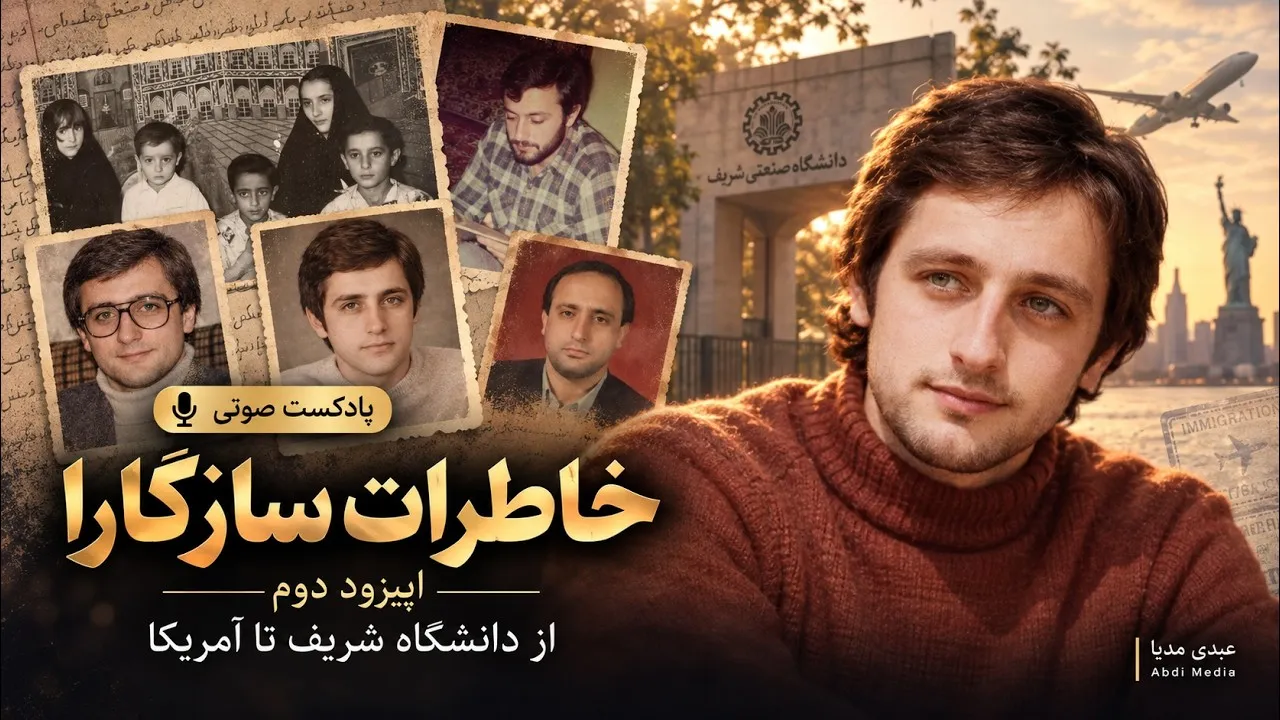
Episode 2: From Sharif University to America
Welcome to another part of the memoirs of Mohsen Sazegara. I hope I can be a good companion for you on this journey to the past and through time.
I think it was 1976. I was in America and returned to Iran in the summer. I found out and became upset. I went to visit them. As a result of the revolution that succeeded, that alley was Behesht—that was the name of our alley. What remained of Morteza—they put it as Mohammad Ebrahimi Hesari, the name by which he was called. Of course, he was Morteza, but in his birth certificate he was Mohammad. The name of the alley became Morteza, [and] Mohammad Ebrahimi Hesari. This friend of our childhood was killed by SAVAK in this way, without being political at all.
I studied very hard, very much. My six-year high school average was around 19 and a fraction. My sixth-grade elementary average, which was the final exam, was twenty. Even in composition I was twenty. And for this reason, I was able to go to a tuition-based school—Firooz Bahram, then Alborz, Kharazmi, Azar—without paying money. Even our teachers thought I would be among the top ten or twelve in the university entrance exam, because my lessons were very good. However, during the exam I had anxiety. The night before—I remember in the morning my mother came to wake me up so I would make it to the exam on time; I was already awake. She said, why are you awake? I said, I did not sleep much at night. My anxiety was not because I was afraid of the exam; I had everything memorized. I said, why must everyone's destiny be determined in four hours? At that time it was like this: you chose ten fields, you took a four-hour exam, and based on the field, the score you got determined whether you got your first through tenth choice.
For my first choice, I liked to put physics. My sister and brother said, you poor thing, what is physics? They knew I would get into my first choice. They said, what is physics? In the end you have to become a teacher. Put engineering. If you want, you can study physics yourself later. Then I looked and saw I do not like civil engineering, construction, and structures at the university. I also saw I do not like electrical engineering. I put mechanical engineering. I thought it was closer to the science of mechanics. That is how uninformed we were at that time. Later, when I went to university, I saw what a practical field mechanical engineering is. But I ranked 96th in the entrance exam—meaning if I had not felt unwell, because during the exam I felt somewhat unwell, during the physics test I felt unwell, I had some nausea. The examiner took me outside. I was outside for ten minutes or a quarter of an hour. I came back during the math test, I returned, but I took it. Perhaps if I had not missed that quarter of an hour, my rank would have been lower—I would have become single-digit, for example. But I became 96th in the math entrance exam. At that time, two hundred and some thousand people took the math entrance exam. As a result, I went to my first choice, mechanical engineering at Aryamehr University. However, in the very first and second semesters I realized I did not like the field of mechanical engineering. You have to go to the workshop and tighten bolts and do welding and casting. If I had stayed in Iran, I would probably have changed to physics.
In mechanical engineering, I was Sazegara. Alphabetically, there were 90 mechanical engineering students. The one after me, and two after me—we were together in the workshop, next to each other based on the alphabet—was Vahid Shahangian. The Shahangian family lived in Sarcheshmeh. They were very religious, much more religious than us. His father was perhaps one of the first lathe operators in Tehran. Their mother was also the daughter of an Ayatollah and was very religious. They were also political later.
If you went to the house opposite Vahid Shahangian's, a side alley led to Mirza Mahmoud Vazir; opposite their house was Nateq Nouri's house. From that very time I became acquainted with Nateq. Nateq was a political preacher who would pick up his Peykan in the morning, drive very fast, go to the north, go to the pulpit, give speeches, give political speeches. By the afternoon it would be over, and he would get in his Peykan and come to Tehran. Or sometimes he would come and give Vahid Shahangian the key to his house and say, I am going away for a while, I am not here, because SAVAK is after me.
The day I took the university entrance exam, my exam location was the University of Tehran. We came and took a bus at the Shomran bend—it was a private-hire bus—we were coming toward Qolhak. Vahid Shahangian was next to me too; he was going home. I thought his sister was in Qolhak, and their own house was in Sarcheshmeh. In the car, a conversation started between us, and it turned out he had also taken the exam and had also put his first choice as mechanical engineering at the Polytechnic University. I had done the same. I got off earlier. Two or three months later, the university started; we went. On the first day at the university, we saw Vahid Shahangian was there, and we became acquainted. Later, in workshop courses, we were together many times. This acquaintance with Vahid—his family's neighborhood was very religious, Qolhak—I did not have a friendship [there]. We had gone to the twelfth grade there. I would get up from the university and go to Sarcheshmeh. There was a circle of friends in that alley—for example, the Dadras brothers were there, Qaravi was there, Bahman Mahmoudpour was there, who was later martyred on the very day of the revolution. There was a circle of these kids. As a result, I also joined them. And we would go to two lessons there. One was we would go to the lesson of Haj Mojtaba Tehrani, who had started lessons on ethics and the Quran. He was a six-generation cleric—in his own words, seven generations of his family were clerics in Tehran. He was the Friday prayer leader of the Jame Mosque of the Bazaar. He later had a seminary at the Bazaarcheh of Nayeb al-Saltaneh. But we liked him very much. At that time it was very important for the clerics that young university students be at the master's lesson. It had become fashionable after the Shariati wave.
Welcome to another part of the memoirs of Mohsen Sazegara. I hope I can be a good companion for you on this journey to the past and through time.
I think it was 1976. I was in America and returned to Iran in the summer. I found out and became upset. I went to visit them. As a result of the revolution that succeeded, that alley was Behesht—that was the name of our alley. What remained of Morteza—they put it as Mohammad Ebrahimi Hesari, the name by which he was called. Of course, he was Morteza, but in his birth certificate he was Mohammad. The name of the alley became Morteza, [and] Mohammad Ebrahimi Hesari. This friend of our childhood was killed by SAVAK in this way, without being political at all.
I studied very hard, very much. My six-year high school average was around 19 and a fraction. My sixth-grade elementary average, which was the final exam, was twenty. Even in composition I was twenty. And for this reason, I was able to go to a tuition-based school—Firooz Bahram, then Alborz, Kharazmi, Azar—without paying money. Even our teachers thought I would be among the top ten or twelve in the university entrance exam, because my lessons were very good. However, during the exam I had anxiety. The night before—I remember in the morning my mother came to wake me up so I would make it to the exam on time; I was already awake. She said, why are you awake? I said, I did not sleep much at night. My anxiety was not because I was afraid of the exam; I had everything memorized. I said, why must everyone's destiny be determined in four hours? At that time it was like this: you chose ten fields, you took a four-hour exam, and based on the field, the score you got determined whether you got your first through tenth choice.
For my first choice, I liked to put physics. My sister and brother said, you poor thing, what is physics? They knew I would get into my first choice. They said, what is physics? In the end you have to become a teacher. Put engineering. If you want, you can study physics yourself later. Then I looked and saw I do not like civil engineering, construction, and structures at the university. I also saw I do not like electrical engineering. I put mechanical engineering. I thought it was closer to the science of mechanics. That is how uninformed we were at that time. Later, when I went to university, I saw what a practical field mechanical engineering is. But I ranked 96th in the entrance exam—meaning if I had not felt unwell, because during the exam I felt somewhat unwell, during the physics test I felt unwell, I had some nausea. The examiner took me outside. I was outside for ten minutes or a quarter of an hour. I came back during the math test, I returned, but I took it. Perhaps if I had not missed that quarter of an hour, my rank would have been lower—I would have become single-digit, for example. But I became 96th in the math entrance exam. At that time, two hundred and some thousand people took the math entrance exam. As a result, I went to my first choice, mechanical engineering at Aryamehr University. However, in the very first and second semesters I realized I did not like the field of mechanical engineering. You have to go to the workshop and tighten bolts and do welding and casting. If I had stayed in Iran, I would probably have changed to physics.
In mechanical engineering, I was Sazegara. Alphabetically, there were 90 mechanical engineering students. The one after me, and two after me—we were together in the workshop, next to each other based on the alphabet—was Vahid Shahangian. The Shahangian family lived in Sarcheshmeh. They were very religious, much more religious than us. His father was perhaps one of the first lathe operators in Tehran. Their mother was also the daughter of an Ayatollah and was very religious. They were also political later.
If you went to the house opposite Vahid Shahangian's, a side alley led to Mirza Mahmoud Vazir; opposite their house was Nateq Nouri's house. From that very time I became acquainted with Nateq. Nateq was a political preacher who would pick up his Peykan in the morning, drive very fast, go to the north, go to the pulpit, give speeches, give political speeches. By the afternoon it would be over, and he would get in his Peykan and come to Tehran. Or sometimes he would come and give Vahid Shahangian the key to his house and say, I am going away for a while, I am not here, because SAVAK is after me.
The day I took the university entrance exam, my exam location was the University of Tehran. We came and took a bus at the Shomran bend—it was a private-hire bus—we were coming toward Qolhak. Vahid Shahangian was next to me too; he was going home. I thought his sister was in Qolhak, and their own house was in Sarcheshmeh. In the car, a conversation started between us, and it turned out he had also taken the exam and had also put his first choice as mechanical engineering at the Polytechnic University. I had done the same. I got off earlier. Two or three months later, the university started; we went. On the first day at the university, we saw Vahid Shahangian was there, and we became acquainted. Later, in workshop courses, we were together many times. This acquaintance with Vahid—his family's neighborhood was very religious, Qolhak—I did not have a friendship [there]. We had gone to the twelfth grade there. I would get up from the university and go to Sarcheshmeh. There was a circle of friends in that alley—for example, the Dadras brothers were there, Qaravi was there, Bahman Mahmoudpour was there, who was later martyred on the very day of the revolution. There was a circle of these kids. As a result, I also joined them. And we would go to two lessons there. One was we would go to the lesson of Haj Mojtaba Tehrani, who had started lessons on ethics and the Quran. He was a six-generation cleric—in his own words, seven generations of his family were clerics in Tehran. He was the Friday prayer leader of the Jame Mosque of the Bazaar. He later had a seminary at the Bazaarcheh of Nayeb al-Saltaneh. But we liked him very much. At that time it was very important for the clerics that young university students be at the master's lesson. It had become fashionable after the Shariati wave.
Second, the one that had more influence on us was Haj Agha Bagheri, Mohammad Ali Bagheri. He was a student of Ayatollah Sadr in Najaf. In 1971, when Saddam expelled the Iranians driven out of Iraq, they said, including Haj Bagheri. He had a seminary in a new style, like a seminary high school. In short, Saddam wanted to arrest these people. He had also come to Iran and rented a house in that same alley of Mirza Mahmoud Vazir. But he was a person—not only was he a student of Ayatollah Sadr, at that same time I had read the book "Our Economics" and his philosophy. Unlike most clerics who do not know, he knew the Quran, he knew history. We had lessons with these two twice a week. A very small mosque, it was one room; the key was in the hands of these same kids of ours. We would open its door and go in. One room was twice, for example, four by four. But we would go there, and Haj Bagheri's good quality was that he did not only teach us; he also lived with us. On Friday mornings we would buy tea, bread, and cheese, go there, and sit in that same small mosque. Haj Bagheri would give a lesson on the history of Islam, the history of Islam and Shi'ism, and so on. His second lesson was the Quran. We would do one-on-two with him carefully. He had started the interpretation of the Quran from Surah Al-Baqarah. Then we would eat breakfast. We went on a trip to Mashhad together. He sat and rose with us a lot. He was a moral person. We had a series of activities there besides our own education—for example, at the lesson of Haj Mojtaba Tehrani, or in that same area of Mirza Mahmoud Vazir, the Saf group grew more, and they politicized the mosque and such things, and it grew more out of the neighborhoods.
But at the university, both Vahid and I and other kids we had found—besides the university prayer room, which was on the second floor, we secretly had Shariati's books. Because Vahid Shahangian's nephew—his father had a printing house—their eldest sister's husband—Shariati's books were forbidden. The printing house did not dare, but they secretly printed them, gave them guerrilla covers. We would give them to the university cooperative. The students had a cooperative near the electrical engineering faculty. There, the kids knew and sold them to students. Students from other universities would also come. I truly saw with my own eyes that Shariati's works spread in the university like gold leaf in 1973. They had closed the Hosseiniyeh, and Shariati had also gone to prison—I think he was in prison at that time—but his works were rapidly spreading. Students from other universities would come to the Polytechnic, take them five hundred, five hundred, a thousand, a thousand. They spread heavily in Elm-o-Sanat, Polytechnic, Shiraz.
Another thing we did at the university—I started from the first semester—was strikes, on any pretext. Of course, I was a first-year student; the strike decisions were made by others. We first-years were like the army of the strike. But when we reached the second year, we ourselves were among the decision-makers. We would make pretexts and strike. For example, in the university cafeteria, one day a few of us kids decided to bring it to a strike. The food was bad—I do not remember, I think it was cutlet—it smelled. "What kind of food is this?" We threw it in the middle. Because there was a guard stationed at the university—this same Captain Nowrozi, whom the Fadaiyan guerrillas later killed.
The Shah had decided that in all universities the university guard police should have a room and be stationed with helmets. If we made a commotion at the university... We made a commotion from the cafeteria to the courtyard. The guard chased us. The political atmosphere of the university was high. As soon as we did this, we would announce that it was a strike. What we did was write a declaration: "Due to yesterday's confrontation by the guard, or the bad condition of the cafeteria, today the university is on strike. Unity, struggle, victory." We would go from the Mojtahedi building—the university's administrative organizations, its second floor—in front of it was a courtyard, and because on that side was the cafeteria, there were many kids going to their classes. We would throw the bundle of declarations out the window. It would spin and come down. The kids knew not to pick up the declaration from the ground, because if you were caught, you had six months in prison. They would put their feet on the ground and read it and pass by. We would announce that the university was on strike. Then they would strike too. Everyone would listen.
Once I remember the university was on strike. We reached the end of the semester. We announced that we would not take the exams. The reason was that we sat and looked and saw the strike had started a month earlier. SAVAK had arrested [people]. We did the division: from the dormitory kids—I was not a dormitory resident—they said we calculate that from every six people, one is in prison. Meaning, why should we take the exam while kids are in prison? We announced we would not take the exam. SAVAK also knew, and on the first day they had made preparations to prevent it. They wanted the exams to be held. From the university entrance, they checked student cards, so that a non-student from elsewhere would not come. Second, when you came, throughout the entire courtyard the guard was standing. The exam location was known. Behind the Mojtahedi building there were 5 or 6 halls where large classes were held, and the exams were there. In front of each hall, for example, they were standing and checking—you must be here to go and take the exam. Outside the hall too, police were standing. The university guard with the same helmets and shields and so on. And this way the kids would be divided so there would be no gathering. You could not gather at the university; the guards were standing. Anyone who goes to take the exam, takes the exam. We went up to the class. We said, this way it does not work. We did not see the others to tell them to decide the same. You have to be together and strike. The professor came and distributed the papers, and we were to take the exam. We told the professor, the university is not holding exams. He said, I do not know; you must take the exam yourselves. You came and sat, and it started. I, with this same Vahid Shahangian, and a Hassan Sabzian, and one or two others, said this cannot be. We stood up and tore our papers and said the university is on strike, we are not taking the exam. We told the other kids, we say it is a strike, it is a strike. We broke up that exam and class. Then we said, how do we tell the others? We came outside—well, there was the guard. We came and told the guard, we want to go to the bathroom. We went there. The other kids—our rendezvous was to see each other in the bathroom. We informed them. We, the mechanical engineering kids, broke it up and said we are not taking the exam. They too, at the electrical engineering building which was below, they said, they also broke it up. It broke up. From the next day and the day after, the professors would come and see the kids sitting like this, and they would say, you do not want to take the exam? We would say no. The professor would also leave. We broke up the exams.
I remember Dr. Abbas Chamran, Mustafa Chamran's elder brother, was a religious person. He would pray in the university prayer room. Dr. Abbas came to the class—I do not remember what course it was—and said, look, in the university council they have decided that if you do not take the exam, they will dissolve the semester. We said, let them dissolve it. We very much wanted the kids to study. Our kids are in prison; what does it mean? He said, you know yourselves, but in any case know that the decisions are hard; your semester will be dissolved, one semester of study is lost. We said, okay. As a result, we broke it up. I remember that first day when we broke it up, outside they said the guards would catch you. We even exchanged our coats with each other, because they had marked that we had broken it up. In the university courtyard, so that we could get out and not be caught. But they caught some kids. I remember Atrianfar was among those. These were a bit sympathetic to the Mujahedin-e-Khalq. He went to prison, was in prison for six months. But in his own words, he said, but at that time at least we went to prison, came back, and went back to class. Of course, I was absent; it was nothing, I failed the course. But now they expel a political student. We did not have that—that they expel you. You went to prison, you came back, you went to your lesson.
We were active to the extent of student strikes and breaking things up and such. And the university library and printing Shariati's works, the mountaineering room, and such. It can be said we were active. Except that the Polytechnic at that time—we did not know that the center of the Mujahedin-e-Khalq organization, the three who were at the center at that time, were all three students of the Polytechnic. Majid Sharif Vaqefi, after whom they named the university Majid—Sharif—he was a student of the university. Bahram Aram, the same university. Vahid Afrakhteh, the same university. We did not know them; the organization was secret. But because Vahid Shahangian and I were students of Haj Bagheri, we were more of the Sadr school, and also a bit more traditional. I am speaking of myself. A group of kids were Fadaiyan. There were many Fadaiyan at our university; their center was not our university—meaning Hamid Ashraf was older, he was at the Technical Faculty of the University of Tehran. Hamid Ashraf. But at the time these were formed and Hamid Ashraf was still alive, the Technical Faculty of Tehran was the center of the revolution. But the atmosphere was of the Fadaiyan kids. Many times it would happen that, for example, in the university cafeteria—we had a tea house and such—we would go, and the declarations of the two armed organizations were on the table. The kids would not pick them up. Everyone knew. They would stand around in turn, read, and pass by. Meaning, the images of their declarations spread in the university.
We were in love with guerrilla warfare; we should have been drawn to the Mujahedin-e-Khalq. But because—I am speaking of myself—because we were more religious, more traditional than the Mujahedin-e-Khalq people. Our problem was also with the communists. The kindness they had toward the communists, we did not have. We were not of the zero and hard line-drawing. It was possible—I am speaking of myself, or this same group of ours—that we would be drawn in, fall into the net of the Mujahedin-e-Khalq and be absorbed by them. But intellectually we had a problem. Haj Bagheri even had a problem with Shariati's works. We would argue with him a lot about Shariati. He would mostly recommend Motahhari's books to us. We, in fact, our line-drawing with the communists was much sharper than the Mujahedin-e-Khalq. For this reason, the kids who, for example, in that same Sarcheshmeh went toward armed work, formed the Saf group. And now they have become one of the founders of the group that formed the Mujahedin of the Revolution. Or Mehdi Shahkarami formed the Mehdaviyoun—if I am not mistaken, they were the Abu Dhar group—but they too, I think, one of them was Shahkarami, one of them was a student of our university. Meaning, if I had not gone to America and had remained political like this, it is possible I would have become part of a guerrilla organization, gone to prison. If I had not been killed or executed, I probably would not have been absorbed by the Mujahedin-e-Khalq, but absorbed by the new groups that formed in flight from the Mujahedin-e-Khalq—I think the first of them, the Mehdaviyoun, formed in 1975, and later in 1977 the Mansouroun and Saf and others formed. That was when the Mujahedin-e-Khalq in 1976 said we became communists, and many formed their own groups. Therefore, it was possible that if I had not gone abroad, one of the other events of my life would have been ending up in armed struggle, because armed struggle was the fashion—everyone, the Vietnamese and Algerian movements.
I remember the books in front of the university. At that time, one of my activities was that in front of the University of Tehran, at the bookstore, we would buy books. Truly the showcase of the bookstores was these books: "The War of Sugar in Cuba," "The Hidden"—it has its own place like Shariati's and Al-e-Ahmad's. Films and cinema were the same. Meaning, those who knew the box office, like "The Deer" or "The Journey of the Stone" by Kimiai, or "Soil"—later, of course, I saw these films several years after the revolution. What cool, tasteless, and slogan-filled films they are! But at that time it was the fashion, and it also sold. I remember we saw "The Battle of Algiers." Well, the university—the founder of the film society of Sharif University before me was Hassan Seifi and Basir Nasibi. But in our period, the university was very revolutionary. The 1970s, the 1960s, the poor things were not even political. They really presented cinema more to students. In the 1970s, either the communists showed films like "Mother," or we brought "The Battle of Algiers."
At the university, I remember when the paradigm was revolutionary—not inside Iran, in the world. Meaning, the kids who came to study—the Germans know: if you go to university and are not leftist, you are a fool; if you come out and remain leftist, you are a fool. Meaning, the kids who came to Europe—the World Confederation of Universities, which had prestige. True, the Muslims came out. Of course, in Europe they were there for years, but the nationalists mostly fell to the communists. But it was revolutionary; it was the common coin. Meaning, in the West too, the kids who studied came out leftist and revolutionary, despite the fact that America was a capitalist country and had suppressed its communists. But we were in fact revolutionary Iranian Shiites at the university in America. In fact, we did not live in American society, and the dominant discourse was—as Dastmalchi says, at that time you would see a person studying at the best American university, at Harvard, for example, and then he is a supporter of Albania—he is a fool in every sense. He would take the trouble to go to Albania and see that this country is not even as developed as a village. Or China, for example—as Masoud Ahmadzadeh said—"the new path opened to the people" and the Soviet... Mehdi Khan Baba Tehrani's memoirs say, I went to China; in the very first month I understood what a hat has been put on our heads, despite the fact that he worked for Radio Peking and such. I told my friends, there is nothing here.
I want to say the dominant atmosphere—you were not intellectual at all if you were not revolutionary, and revolutionary fervor was boiling from the walls. It was not only that you secretly printed Shariati's works, or the book of the translator—among all these philosophers in the West, for example, so-and-so was translated who was a leftist philosopher. In fact, all these years had passed—neither had the works of so-and-so come to Iran, nor the works of so-and-so. In the world of philosophy I am speaking. If it was fiction, it was "The Boring Village" by Ali Ashraf Darvishian, and the poetry of Shamlu, and everyone. Finally, from the walls, and His Imperial Majesty himself insisted—"in fact, the real revolutionary is me." He had named his reforms the White Revolution. The Cossack had made a Green Revolution. The Cossack's Green Book was the fashion. It was anti-American, anti-capitalism and capitalism, anti-Israel, which was America's lackey. Now that I look back at the past, I see it is true—the communist East, the Chinese Revolution, and then anti-colonial revolutions like Algeria, and in our own country the nationalization of oil, and in the 1970s after the Second World War, it was influential. Many anti-colonial independence movements became leftist, as they say. But a part of it that perhaps made it fashionable was the West itself. Meaning, the 1960s, when the discourse of revolutionary fervor of the 1960s in the Iranian calendar also became dominant, and we who became students in the 1970s and came to the field—we only implemented those thoughts. Intellectually, we added nothing to it.
The 1960s in France saw the great movement of 1968, starting from the universities, in support of the workers, against de Gaulle. And in America, against the Vietnam War, all American universities. We, because from the Constitutional era onward we have always been more influenced by the West than the East. When you looked at the West—either the kids who came to study, or I who came to America in 1975. But the one who came to America in the 1960s—the atmosphere of the anti-Vietnam War and such. And Europe, especially Europe, Germany, and those who first mostly went to Germany, later to France and England, the paths opened more. The student atmosphere here.
In America we would sleep on the ground, so that we would be raised as guerrillas, for example, with one blanket. Or a friend—we would say, "brother, do not eat," therefore we must eat little food. Then they made a revolution, and an ideal became sacred—the revolution itself became sacred. Popper says, in humanity's constant effort to reach freedom and justice, Marxism was one of humanity's gross mistakes. Meaning, we had not thought this—that distributive justice, making everyone equal, brings state-ism, falls into a pit. Whereas justice must be defined as equality of chances and opportunities. If you want newer definitions—the philosopher of justice brings many other things. He says virtue is the piety of society. At the very end, Rawls ties justice to freedom. It is from freedom that equality of chances and opportunities emerges, and a free economy.
But at that time, the very thing you take from the wealthy and give to the poor, making distribution equal. Or Motahhari would narrate, for example—I remember that a date seller had put his dates at two prices. He had separated the good ones, the medium, and the bad. He said, why are you dividing God's creation? He mixed them all and sold at one price.
Something I myself am still surprised by—that from the ninth grade I discovered the sweetness of politics. In fact, I do not know where this sense of responsibility came from in me. I do not know why a 14-15-year-old kid should feel obligated to have compassion, to grieve—why do some not come and join? This feeling has remained in me until now. If something happens in Iran, I feel as if its burden is on my shoulders. This sense of responsibility is interesting to me; I do not know where it came from. Of course, later when the revolution happened and I entered responsibility, the game of power is also sweet—the desire to be god, in the end. Secondly, all kings were like this. A human being, from the morning he wakes up—this world of people, if you categorize them—or, as I say, perhaps one person does all of it—either they chase the fame of the world, or they chase the wealth of the world, or they chase the power of the world, or they chase the lust of the world. Very few are the people who chase good deeds; none of these four matter to them. Instead, they seek service to the people, silently, not wanting their names mentioned. They are very few. I think now that I look back, that sense of responsibility—I do not know where it came from—its origin was this. But the gamble of politics is also there. It is a job that has no retirement, because after a while you become addicted to this win and loss of politics. It is an impossible assumption—if I had my present reason, I would not have been drawn to Shariati like this. I would not have become ideological. I would have fought the Shah, but I would not have made the Islamic Revolution. If I had my present reason, the idea of returning to early Islam—when I read the article in Kayhan newspaper, Dr. Abdolrahman Faramarzi was the editor-in-chief of Kayhan. I was a high school student. He argued that in Saudi Arabia no thief is found because the rulings of Sharia are implemented. Later I went to Saudi Arabia and saw it is not like this. It is a police state; they do not steal out of fear of the police.
If I had my present reason, I would not have believed these words. I would have understood that maximalist and jurisprudential religion is of no use. I would not have followed Bazargan either, or Motahhari. But it is an impossible assumption. At Aryamehr University I stayed two and a half years. The reason I came out and went to America: first, I did not like my field. In reality, I preferred to study physics. Second, my elder brother was in the army. At that time he had become a first lieutenant. Army counter-intelligence had summoned him. Because of my activities at the university, they had checked on him. He also told me, what are you doing that they have summoned me? Therefore, I thought to myself that soon SAVAK would arrest me—until then they had not arrested me—therefore I would go to prison. The third reason was that from the eleventh grade my eye developed keratoconus—the cornea. One eye's vision was severely dropping, and it could only be corrected with hard contact lenses. As a result, from the eleventh grade I wore a contact lens on my right eye, and my left eye too, and on top I wore glasses. I still have it. I understood that with this eye you would be exempt from military service. I came and went to the office of Dr. Khormi, who was an army major general doctor, the head of 504 Hospital—the army eye hospital. But in the evenings he had his own private office. I took out the lens and went to Dr. Khormi's office. He examined me and said, no, my son, you need a contact lens. I said, Mr. Doctor, I know—in fact I also have a contact lens. He said, why did you come to me? I said, to be honest, I came—I am a student of Aryamehr University, it is like this—I came to see whether with this eye I would be exempt or not. He said, look, if you get your bachelor's, the army exempts you from the ranks. But if you become an engineer, they will extract work from you; you must serve two years, they will take you to do engineering work. But if you come with a diploma, you are exempt. Ultimately, the matter is certain. He said, your file comes for medical examination under my own hand; according to the law, you are exempt. These three factors helped—in fact, they joined hands. I thought to myself, I will now drop out of university, come out, go to the ready-to-serve [office], I want to go to military service, I will go to medical examination and such, I am exempt, and I am two years ahead this way.
In reality, I thought I had a plan for myself in life. This was—I do not know where I got it from—that by the age of 25 I must get a doctorate. As a result, when I was 20 years old, I came out of the university. I said, I will reach America, I will study two more years for a bachelor's in physics, and a year and a half for a master's, and get a doctorate. I will get a doctorate at 25-26. And I studied physics, and I also have an interest. There was no one to say, why are you in such a hurry? What is the rush?
I dropped out of the university and came out. I went to the ready-to-serve [office], and I went for the examination on Kennedy Square Street—which is now Tohid Square—it was the gendarmerie. I had a medical examination, and they said the medical file and the eye had a problem. It went, and two or three weeks later they gave the exemption. The exemption was a big cardboard paper; they would paste my photo on it and stamp it. Simultaneously, parallel to me, there was the American Middle East Friendship Association in Iran. I had gone through them, and the Abraham Lincoln Library—which is now the Center for the Intellectual Development of Children and Young Adults on Vozara Street—I had gotten catalogs from there. I had gotten admission from three or four American universities. And there was a language class too. Originally, the university I wanted to go to was the University of Texas at Austin. The admission was for language. I had to take it—I had to go to Washington, D.C. for a month to study language, get the exemption, then go take the student dispatch exam. I had to take a language exam. I had studied language throughout high school. In the summer I went to the Iran-America Association. During the year too, I went for an hour at noon. As a result, by the eleventh and twelfth grades, I had completed fourteen terms—meaning the first two terms, which were basic, I had not studied. From the seventh grade when I went to the Iran-America [Association], I had finished it, so my language became good. I still say I did not study language; whatever I know, I know from the Iran-America Association. I took the student dispatch exam; I had gotten a good score. Everything was ready for me to go. I had to get the exemption, and then get a passport. It slipped out of my mouth. One floor down, on the first floor, you also had to go—there was a sergeant who had to enter it in the office and give it to you. It slipped out of my mouth that one day I went and said, I am in a hurry; I have gotten a language admission, I must get the passport soon to reach the university. This sergeant understood I was in a hurry. He said, it has not come, go tomorrow. It has not come. A week later, go. No, it has not come. I went up to the colonel, the head there, on the fourth or fifth floor. At that time a student had prestige; students were very respected in society. I went to the head of his office—the colonel himself called me. "What is the matter, my son?" I said, I am in a hurry; my exemption—downstairs they say it has not come. He said, how can that be? He told his office head, call downstairs, tell the deputy, what has happened to this young man's work? Again it went to this same sergeant. He said, it has not come. And the colonel said, he is talking nonsense. For a month we were strung along. He wanted a bribe. One day even my brother, who was an officer, went with me in his uniform, so that he would be afraid. He came back flat in his face and said, "Mr. Captain, your pilot's salary is good; we have expenses in life." My brother got angry and came out. He said, "The gendarmerie, we, a thief, son of a bitch, bribe-taker." He said, "I will not give a bribe." I said, I will not give either. Religiously, I thought one should not give a bribe. He stalled us for a month. When he was sure nothing warm would come from me, one day he said, "It seems you are not a payer." I said no. He took it out of the drawer and gave it to me. He had done all its work; he had entered it in the office, entered the number, and gave it to me in the office.
That went. It caused me to arrive late in Washington. The language class was month by month. I was delayed a week until the next session. I also took the exam. It was 5 levels; all of it, grammar and conversation, all level 5, I passed. I studied there for a month and went to the University of Texas at Austin. It was quarterly—meaning ten weeks, ten weeks. That girl who was international came and picked me up from the bus station. We went. She said, you did not reach this quarter; stay, you will go the next quarter, ten weeks later. I, who you say is in a hurry, was shocked. I said, no, I cannot sit here for two and a half months and not go to university. What is this? I said, I have admission from two other places too; let me see what those are. Those started later. If it was something, I would return. She said, okay. I came and got on the bus and came to Missouri. The university was Rolla. It was an engineering university, but it was a lousy place. I saw, no, this place is of no use to me. I came and got on the bus again and went to Bloomington, Indiana. My brother had a university friend there. I saw this too was a girls' university. I got on the bus. At the very beginning, upon entry, I did a lot of bus riding. I came to the city of Chicago, where Hamid Shahangian, the elder brother of my university friend Vahid, was. I went to Hamid. I reached Chicago. It was a big city, bigger than Tehran. My heart opened. From the same bus, as it was approaching Chicago, the factories, the smokestacks. And then I went to IIT University—immediate admission. It wanted a TOEFL language exam. I went, because it had a center; every day you could go and take the TOEFL. I went and took the TOEFL.
Take less than a minute, register and share your opinion under this post.
Insulting or inciting messages will be deleted.
Sign Up