
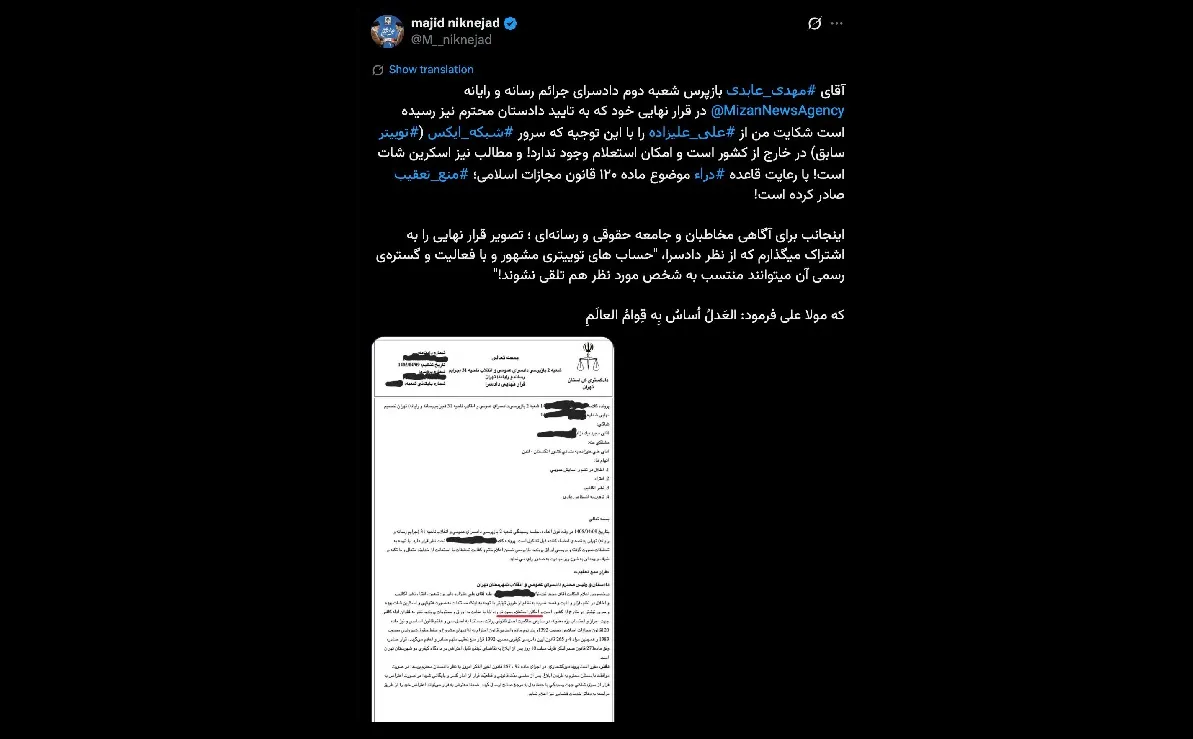
The order to dismiss charges for Ali Alizadeh following the complaint by the son-in-law of Major General Mohsen Rezaei; a verdict that could become a controversial legal precedent.
The order to dismiss charges for Ali Alizadeh following the complaint by the son-in-law of Major General Mohsen Rezaei; a verdict that could become a controversial legal precedent.
Branch 2 of the Investigation Department of the Tehran Prosecutor's Office for Media and Cyber Crimes, by issuing a dismissal order, rejected Majid Niknejad's complaint against Ali Alizadeh.
In his reasoning, the investigator stated that due to the X social media platform's servers being located outside the country, the impossibility of inquiring from this platform, and the non-attributability of screenshots to a specific person, there is insufficient evidence to establish the commission of a crime, and citing the principle of innocence and Article 120 of the Islamic Penal Code, he issued the dismissal order.
What makes this case important is not merely the issuance of the dismissal order, but the investigator's legal reasoning; a strange reasoning that could be cited and debated in similar cases.
Although this decision is not considered a precedent or a binding ruling and does not create a legal obligation for other branches, lawyers and judges may cite it in similar cases.
According to Article 270 of the Code of Criminal Procedure, the complainant has the right to object to the dismissal order within 10 days of notification in the Tehran Criminal Court 2. In case of objection, the court may confirm or annul the order and order the continuation of prosecution. Therefore, this decision is not yet final, and it remains to be seen whether the complainant will object to this ruling.
The issuance of this order also raises an important question for the judiciary: if screenshots from social media and the impossibility of inquiring from foreign platforms are not sufficient to attribute content, has this same criterion been applied and will it be applied in all similar cases?
Cases that, based on these very screenshots from international social networks whose servers are not in Iran, have led to convictions, including prison sentences or, in some cases, asset forfeiture.
It remains to be seen what ruling the judiciary of the Islamic Republic will issue in the Tehran Criminal Court 2 if the complainant objects, and whether it will seal its approval of a double standard in judgment by confirming this order.


Take less than a minute, register and share your opinion under this post.
Insulting or inciting messages will be deleted.
Sign Up