
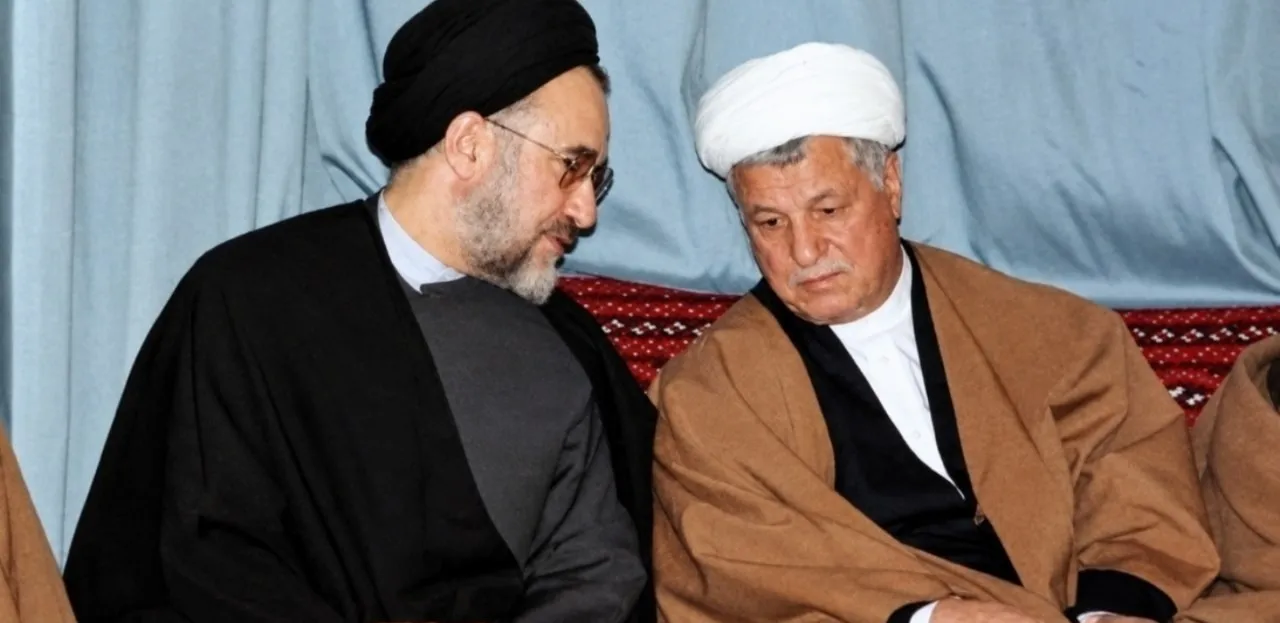
Mr. Khatami came to my office in Koushk. We also agreed regarding the nuclear issues that we should pursue the proposal of the three countries, Britain, France, and Germany. I advised him not to think about stepping down and to continue his work...
The U.S. government—both at home and abroad—is under increasing pressure. Bush's defensive speech, [the U.S. President's] at the United Nations, was met with a cold reception, and most Western media described it with phrases such as "Bush isolated," "Bush frozen," "Bush on the defensive," and so on. Even a slight moderation in his aggressive stance failed to satisfy the world. In contrast, the remarks by Chirac, [the French President] and [Kofi] Annan, [the UN Secretary-General], criticizing Bush's unilateral warmongering policy, were well received.
In the U.S. Congress as well, Bush's request for an additional $87 billion budget for Iraq, Afghanistan, and terrorism has sparked mounting opposition, with critics accusing the White House of dishonesty, deception, burdening America with enormous debt, isolating the United States, and alienating America's friends. The costs of war and security within the United States, along with the losses from September 11, the blackout, and other damages, have pushed the American economy toward weakness.
At the same time, the leak of the 21,400-page U.S. report in Iraq regarding the absence of weapons of mass destruction has intensified the problem. In Iraq, a bomb in Mosul at a cinema showing an immoral film left three dead and dozens wounded. The number of people injured in the bus explosion in Baghdad reached 40. Reports that Mullah Omar, [the Taliban leader], had ordered Taliban commanders to intensify operations against the occupiers have further increased their turmoil.
The Iraqi delegation to the United Nations, headed by Ahmad Chalabi, said that the Governing Council has no disagreements with the United States, and that the Governing Council described the remarks of Mr. [Kamel] Kilani, Iraq's Finance Minister, who had announced that foreign investment in Iraq was unrestricted except in oil, as merely his personal opinion. [The Gallup Institute], in a poll of the Iraqi people, found that 93 percent of Baghdad residents consider the security situation after the war to be extremely chaotic, 62 percent are satisfied with Saddam's fall, 47 percent believe the country's situation is worse than before, and 30 percent believe it is better than before.
A Shiite cleric announced that people should not attack Baathist forces on their own initiative and should wait for court rulings. In Mosul, several Americans were killed and eight were wounded, and in Basra, one Briton was killed. Ms. Aqila al-Hashimi, [a member of the Iraqi Governing Council], who had been wounded by gunfire, died today.
British media wrote that [Tony] Blair's, [the British Prime Minister's] popularity has fallen to 30 percent.
One of the members of the Al-Aqsa Brigades, who is among the 13 people exiled abroad, in an unprecedented move occupied the Palestinian embassy in Ireland and announced that Al-Aqsa had ordered its members to purge embassies everywhere. His name is "Jabbar."
In the afternoon, Mr. [Seyed Mohammad] Khatami, [the President], came to my office in Koushk. We agreed regarding the nuclear issues that we should pursue the proposal of the three countries—Britain, France, and Germany. I advised him not to think about resigning and to continue his work.
He said Blair had written a friendly letter, and [King Abdullah], the King of Jordan, had offered to carry a message and mediate with the United States, but this was not accepted, and we only explained our own positions, saying that if he himself wished, he could convey them. He said the Guardian Council had yesterday appointed a hardliner to oversee matters. At a meeting, he had lashed out at Messrs. [Mehdi] Karroubi, [the Speaker of Parliament], and [Mohammad Reza] Khatami. He expressed concern about the elections.
He has still not officially submitted his proposed ten-point plan to [Ayatollah Khamenei], the Leader, and has only presented it on an unsigned sheet to seek his opinion. The Leader's overall view is positive, with disagreements only on three issues—prisoners, the judiciary's affairs, and the Guardian Council.
He reported that after the principled positions he has taken since July 18, his relations with the right-wing faction have improved, while his relations with the radical Second of Khordad faction have deteriorated. In particular, because of his order preventing the publication in newspapers of the letter from 127 members of parliament to the Leader, he has effectively fallen out with his brother Reza, Behzad Nabavi, and others, and no longer sees them.
He expressed concern that the next parliament might oppose him and would probably pressure him during the remainder of his term. From this perspective, the possibility of resigning under the pretext of holding simultaneous parliamentary and presidential elections has been raised.
Take less than a minute, register and share your opinion under this post.
Insulting or inciting messages will be deleted.
Sign Up