
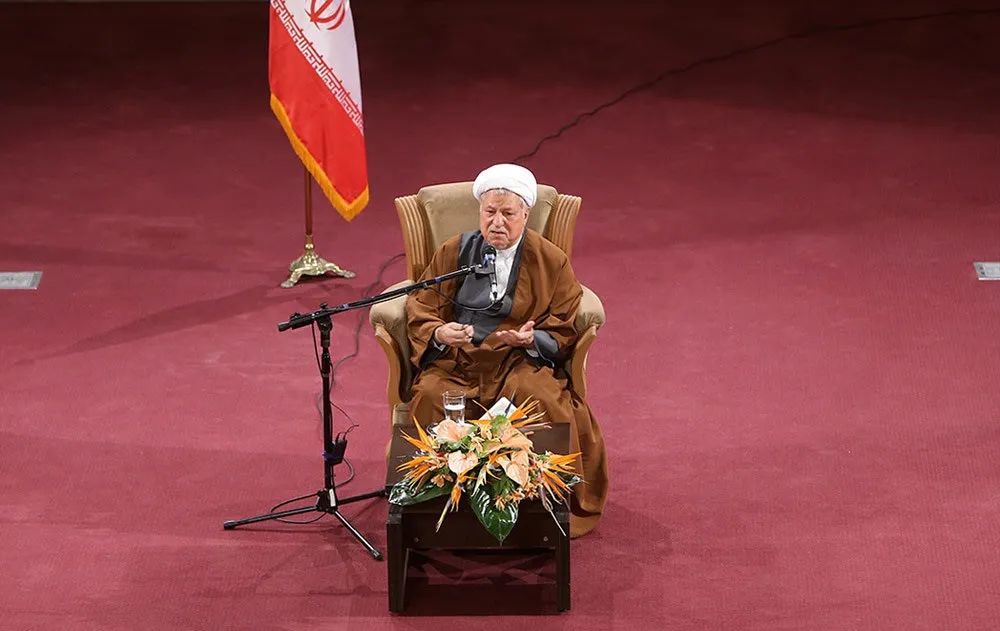
After the morning prayer, I walked a little on the balcony of the room that overlooked the sea. A cold wind was blowing. To return, I took the door to the room by mistake and woke Mehdi. After having breakfast, Mr. Nahavandian, our ambassador, came for explanations and to brief us on the program. Then Mr. Heydarali Af came, and together we...
After the morning prayer, I took a short walk on the room’s balcony, which overlooks the sea. A cold wind was blowing. Upon returning, I mistook another door for the entrance to my room and ended up waking Mehdi. After breakfast, Mr. Nahavandian, our ambassador, arrived to provide details and a briefing on the itinerary. Then, Mr. Heydar Aliyev arrived, and together we visited the Martyrs' Memorial; it is a remarkable site. Originally a cemetery, it was converted into a park during the Communist era. Following a confrontation between the Soviet authorities and the local population—which occurred prior to the collapse of the Soviet Union and resulted in the martyrdom of ninety people—the site became a memorial for martyrs, as their bodies were interred there. Later, those who fell in the Karabakh War were also laid to rest at this location. I was told that approximately two thousand martyrs are buried there. Situated on a hillside with a gentle slope, the site features dense trees and ample grounds, all arranged and organized with great care. It was mentioned that they suffered ten thousand martyrs and twenty-five thousand individuals disabled during the war against the Armenians.
After laying a wreath, reciting the *Fatiha*, walking among the graves, and engaging in an extensive exchange of questions and answers, we headed to a hospital to visit the war wounded. The Minister of Internal Affairs welcomed us, and the hospital director—who was a police officer—provided an overview. The facility belongs to the law enforcement apparatus, and most of the wounded were police personnel. We were informed that they operate twenty-five such hospitals. I spoke with nine of the wounded as they lay in their beds; a larger group was gathered in another hall. Several had suffered the amputation of their legs, and some had previously received medical treatment in Iran. They stated that, to date, 108 individuals with severe, hard-to-treat injuries had been sent to Iran, where they received medical care in Tehran, Tabriz, and Rasht; they expressed great satisfaction and gratitude.
In a basement hall, the hospital director spoke in appreciation of Iran’s support, and I delivered a brief, encouraging address to the combatants. Mr. Aliyev also spoke briefly regarding the war and expressed his thanks to us. The morale and demeanor of the fighters were not bad, though they differed significantly from the state of our own wounded combatants during the [Iran-Iraq] war; some appeared despondent. We distributed gifts, including 30,000 rubles for each individual.
We proceeded to the Presidential Headquarters for private discussions. It is an opulent building. Dr. Velayati and Mr. Hasanov were also present, and our ambassador served as the interpreter. Shortly after we sat down, the telephone rang; the ensuing conversation concerned the war. Mr. Aliyev reported that, according to incoming information, the area along the Aras River—near the Zangilan region—was under heavy Armenian fire. He explained that civilians were attempting to cross the Aras River to escape into Iran, suffering casualties in the process. He made an urgent, desperate plea for assistance. While we suspected that this might be, in part, a calculated attempt to set the stage for the main agenda of the private talks, it was not entirely devoid of truth.
Maps were brought out and explained. It became clear that if Zangilan were to fall, the Armenians would extend their presence along our border—north of the Aras River—stretching from the Armenian frontier all the way to the vicinity of Parsabad. They insistently proposed that we intervene in the war on their behalf. They explicitly stated: "We are placing the entirety of Azerbaijan at your disposal, and we are prepared for an Islamic Republic to be established in Azerbaijan. Without Iran’s assistance, we cannot defend ourselves; there is even a possibility that the Armenians could advance as far as Baku." They presented a map of a "Greater Armenia"—reportedly published by Armenians in 1980—which encompassed the territory from the Black Sea to the Caspian Sea, extending south to Urmia, and reaching from the Turkish border in the west all the way to Syria. I remarked that this was a momentous decision with profound regional and global implications, requiring a thorough assessment of all potential consequences; I noted that we would need to deliberate on this in Tehran before providing an answer. However, I emphasized that the immediate priority was to secure a ceasefire, and urged them to hold their ground to prevent the loss of Zangilan.
To this end, during the same meeting, Dr. Velayati contacted the Armenian Deputy Foreign Minister to relay a message to the President of Armenia. I reminded them that, in our previous conversation, it had been agreed that Armenian forces would not advance beyond their current positions; the operations of the past few days constituted a violation of that agreement. In a calm tone, we issued a veiled threat. They requested that the Armenian President speak with me directly by phone; I consented.
We arrived at the official negotiations with a significant delay. Reporters remained until the conclusion of the session, during which Mr. Heydar Aliyev and I discussed the importance of cooperation and the numerous potential areas for collaboration. Regarding the war, I spoke in terms favorable to Azerbaijan.
We then returned to a private session. After reviewing the outcomes of the phone calls, Mr. Aliyev and I visited the Baku branch of Bank Melli Iran, where the bank manager and Dr. Adeli provided a report. They were pleased with the large number of clients, most of whom were Iranian. Subsequently, an account was opened in the name of Mr. Aliyev. I answered a question from a reporter, and then we headed back.
As we traveled along the streets, large crowds gathered to express their sentiments—a phenomenon that surprised me, my companions, and even the Azerbaijanis themselves, as it was entirely unprecedented. We moved slowly to acknowledge their displays of affection. I had lunch with my companions. After a brief rest and prayers, accompanied by Mr. Aliyev, we visited an oil refinery, where a new unit had just been brought into production. Based on the refinery director’s report, it appeared that the project had been completed at an exceptionally low cost. I instructed Mr. Aghazadeh [the Minister of Petroleum] to immediately investigate the details. Mehdi and one of the Deputy Ministers of Petroleum remained behind to look into the matter.
Mr. Heydar Aliyev and I both delivered brief, encouraging remarks. The staff welcomed us warmly. When a woman who had brought a bouquet of flowers reached out to shake hands, I responded to her gesture of kindness in a different, appropriate manner so as not to cause any offense. We were informed that the Baku refinery, with a 125-year history, is the oldest and first of its kind in the region.
From there, we proceeded to the groundbreaking ceremony for the Iranian Cultural and Educational Complex. This complex is being constructed on a 30,000-square-meter plot in one of Baku’s prime neighborhoods, and its design is quite elaborate. We received a briefing on current educational activities and future plans. Mr. Aliyev and I both spoke, and together we performed the ceremonial groundbreaking. Mr. Aliyev wielded the shovel with a distinctive flair, drawing cheers from those present. Across all areas, regarding the development projects undertaken during his fourteen-year presidency...
Take less than a minute, register and share your opinion under this post.
Insulting or inciting messages will be deleted.
Sign Up