
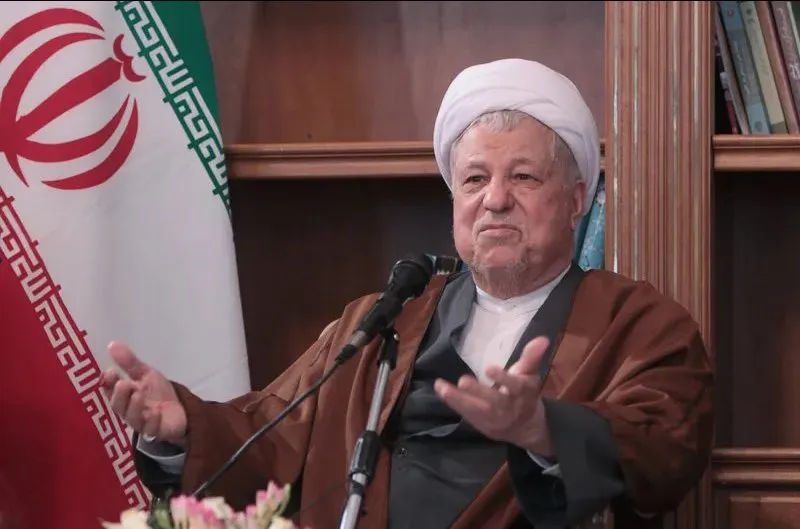
After the morning prayer, Mr. [Seyyed Mahdi] Yathrebi, the Friday Prayer Leader of Kashan, the provincial governor, Mohsen, and others also came from Kashan.
After the morning prayer, Mr. [Seyyed Mahdi] Yathrebi, the Friday Prayer Leader of Kashan, the provincial governor, Mohsen, and others also came from Kashan. Together, we went to see the natural beauty of Niasar, a beautiful, verdant valley. The area had been granted city status only a year earlier, and the mayor accompanied us. At the top of the valley, there is a plentiful spring that gushes out from beneath an old fire temple. Good facilities for tourists were being developed there. A remarkable cave had been discovered in the area, and about 700 meters of it had been restored. There are no scientific or historical records explaining how or when the cave came into existence, but it is clear that it was deliberately designed, perhaps as an organized refuge.
The purpose of the trip was to observe the rose-picking and rosewater-making ceremonies. Two traditional rosewater distilleries had been set up there, and their operators demonstrated the process. There are many rose fields in the area. Carelessly, I grabbed the pipe carrying the hot steam and burned my hand, but it was not seriously injured.
We had breakfast in an unfinished building overlooking the entire valley, a very pleasant and picturesque spot. The property had been purchased from Mrs. [Zhaleh] Zarrabi, who had been a member of parliament during the Shah’s era. We visited a small, ancient fire temple located at the top of the peak.
A little farther down, there is a very beautiful waterfall with an interesting view, fed by the same spring. We were told that, in the past, the water had powered thirteen mills along its course. One of the watermills had been restored, and we visited it. Having been familiar with watermills since my childhood in Nough, I knew how they worked better than the people showing us around. An old bathhouse had also been restored; it resembles the bathhouse in our own village of Bahraman.
On our way back, we met a group of students from Kashan University who had come to visit. We exchanged greetings, and I encouraged them. From there, we went to Mashhad-e Ardehal to pay our respects at the shrine. Mr. Yathrebi explained that after the people of Kashan embraced Islam and came to favor Shiism, they asked Imam Muhammad al-Baqir (peace be upon him) to send them a representative. The Imam sent his son Ali, accompanied by another of his brothers. They remained here and were later martyred. The annual Carpet-Washing Ceremony, which draws a huge crowd, commemorates the washing of the carpet on which the martyr’s bloodied body was carried to the burial site.
There, the shrine’s board of trustees and local residents welcomed us and reported on plans to expand the shrine complex, which would include three courtyards and a mosque. The residents requested that water and gas supplies be provided to the area and that the dispute between the Isfahan prosecutor and the central authorities over control of the area be resolved. They said that large numbers of people visit this shrine every year and that miracles also occur there.
From there, we set off for Badroud, north of Natanz. Dr. [Ali] Baghbanian, the representative for Natanz and Badroud, provided explanations along the way. He is a university-educated and knowledgeable man. We went straight to visit the tombs of two Imamzadehs, Aqa Ali Abbas and Shahzadeh Mohammad. The local people gave us a magnificent welcome, similar to the reception I had received during my presidency. Although no public event had been scheduled, the large turnout prompted us to hold a public gathering and deliver speeches. The Friday Prayer Leader and the town’s representative welcomed me, both offering excessively lavish praise and emphasizing the development projects whose achievements were also considerable in Badroud. I, too, delivered a short speech.
We visited the shrine and listened to explanations about it. A magnificent dome and shrine complex had been built, and we were told that the dome was one of the largest in Iran. Colonel Zahedi, head of SAVAK in Isfahan, had initiated the project, which was completed after the Revolution. Four hundred rooms had been built around the courtyards to accommodate visitors and pilgrims, and beautiful boulevards and squares had been constructed. The complex was continuing to expand. One million pilgrims visit it each year.
It is believed that both Imamzadehs were brothers of Imam Reza (peace be upon him) and were traveling from Medina to Khorasan during Imam Reza’s time as crown prince when they stopped here and were martyred. No substantial documentary evidence was presented to support this claim. However, the late Ayatollah [Seyyed Ali] Yathrebi was quoted as saying that although these Imamzadehs lack reliable documentation, they remain popular with the people because they provide financial assistance and grant healing.
From there, we headed toward the village of Abyaneh. Along the way, we passed through Natanz and visited its Martyrs’ Cemetery. A large crowd of Natanz residents had gathered to welcome us. Since there is rivalry between Natanz and Badroud, a public event was held here as well, just as in Badroud. The Friday Prayer Leaders of Natanz and Tarq Rud, along with the governor of Natanz, welcomed us, and I gave a brief speech. Both places had requests, including the establishment of an Islamic Azad University campus. Natanz had fallen into decline, and its residents were migrating elsewhere. Badroud, however, had prospered since the Revolution thanks to agricultural development on the edge of the desert and the drilling of 150 wells.
We continued toward the village of Abyaneh, located at the far end of the Karkas Valley. The governor of Natanz provided useful information along the way. Residents of some villages had gathered along the route to present their requests, including measures to prevent disturbances caused by wild animals. We arrived in Abyaneh at noon. It is an exceptionally beautiful village and one of Iran’s rare historical treasures, resembling the small town of Masuleh, with its red earth, very old buildings, beautiful scenery, and pleasant climate. Most of the villagers had migrated elsewhere, and those who remained were mainly women and men of the older generations. However, many people had traveled from Tehran after hearing news of our visit. They gave us a warm welcome, and a child recited a poem clearly and expressively.
After lunch and a rest, we toured the village’s lanes, houses, and historical sites. Many buildings and artifacts dating back to the fourth century of the Solar Hijri calendar had survived, including pulpits, mosques, and doors bearing dated inscriptions. We spoke with the residents. In the town square, Mr. [Mohammad Hassan] Ghadiri Abyaneh welcomed me, and I gave a short speech about ways to restore the village’s prosperity and enable its residents to remain there. These included extending the road through the highlands to connect with the roads to Qom and Tehran, thereby linking the routes and ending the village’s isolation.
We also held a meeting with officials from Isfahan Province, who reported on major development projects in Isfahan that we had launched during the Reconstruction Government, including the Kashan–Isfahan expressway, the Third Kouhrang Tunnel, and the Cheshmeh Langan Tunnel. It became clear that, thanks to the authorization they had received to collect levies from major industries in the province to fund these projects, they had been able to use the resulting revenue to continue the work. We set off for Tehran. At ten o’clock that night, thoroughly exhausted, we arrived home.
Take less than a minute, register and share your opinion under this post.
Insulting or inciting messages will be deleted.
Sign Up