
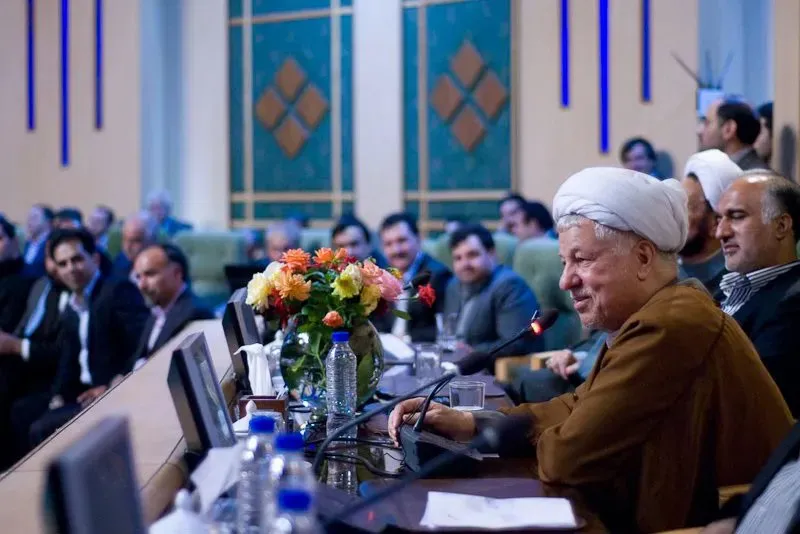
Mr. Ebrahim Amini, [Deputy Chairman of the Assembly of Experts], came to see me. He said he had heard that Ayatollah Seyyed Mahmoud Hashemi Shahroudi was to replace Mr. [Mohammad] Yazdi as head of the judiciary.
Mr. Ebrahim Amini, [Deputy Chairman of the Assembly of Experts], came to see me. He said he had heard that Ayatollah Seyyed Mahmoud Hashemi Shahroudi was to replace Mr. [Mohammad] Yazdi as head of the judiciary. He said this would not be appropriate because Shahroudi belonged to the Iraqi Dawa Party, had no judicial experience, was not accepted by government supporters, and faced considerable opposition in Qom as well.
The Expediency Discernment Council held a meeting. The general policies concerning forests, rangelands, and the environment were approved.
Mr. Dr. [Hassan] Rouhani, [Secretary of the Supreme National Security Council], came to report on his trip to Saudi Arabia. He said that he had received a warm welcome and generous hospitality. During discussions about the visit's agenda, before his meeting with Mr. Nayef [bin Abdulaziz, the Saudi interior minister], the Saudis had said that if no agreement was reached on security issues, everything else would be affected.
A lengthy meeting with Nayef followed, lasting from eleven at night until four in the morning, during which all the issues were discussed. Regarding the Dhahran bombing, Rouhani said the Saudis had evidence from the confessions of certain individuals and reports from Syria indicating that those responsible for the bombing had been in Tehran and had been directed from Lebanon. They also alleged that Iran's ambassador in Damascus, Mr. [Mohammad Hassan] Akhtari, had given them $100,000 and that Hezbollah in Lebanon had supplied them with explosives.
Mr. Rouhani provided adequate responses, and eventually a memorandum of understanding was signed concerning future cooperation. His assessment was that the Saudis were raising these issues to obtain reassurance about the future and that the past could be overlooked. He thought they might largely know that Iran had played no role in these incidents but were raising the allegations to secure guarantees for the future.
He also said that Prince Abdullah, [the Saudi crown prince], had remarked that the good relations between the two countries were the result of Mr. Hashemi's efforts, given his enthusiasm for a united Islamic world. Dr. Rouhani added that Prince Abdullah had expressed concern about Iran's situation and its internal divisions, describing them as dangerous.
In the afternoon, Faezeh came and complained about remarks made by Mr. Reza Khatami in the Salam newspaper concerning the Foundation for Special Diseases. I told her to respond to the remarks.
Mr. [Mohsen] Qomi, the Supreme Leader's representative at the universities, and his deputy, Mr. [Ahmad] Torabi, came to see me. They reported on conditions at the universities, saying that most students and professors were focused on the issue of freedom and had become indifferent to other values of the Revolution. They asked me to give a general lecture at a university. I said I would consider the request.
Mr. Taha Hashemi, [representative of Qom and director of the Entekhab newspaper], came and complained about the pressure being exerted on him by the right-wing faction because of the independent positions taken by his newspaper, particularly during the impeachment proceedings against Mr. [Ataollah] Mohajerani. He broke down in tears and said he felt desperate because he was being accused of hypocrisy and apostasy, while his family was also being harassed.
He explained that the newspaper had been launched with a 300-million-toman loan from the Office of the Supreme Leader and had been registered under the name of the Qom Islamic Propagation Office. He said that after the Supreme Leader read the first two issues, he became displeased and made harsh remarks about them. Taha Hashemi asked me for help.
Regarding the impeachment of Mr. Mohajerani, he said he had previously told Mr. [Ali Akbar] Nateq-Nouri, [Speaker of Parliament], and Mr. [Mohammad Reza] Bahonar, [Tehran representative], that the impeachment would fail. They had also agreed that it should be withdrawn through the mediation of Mr. [Seyyed Mohammad] Khatami. However, some of the parliamentarians pursuing the impeachment had refused to withdraw it.
I told him that if he intended to maintain an independent course, he would have to be prepared to endure this kind of harassment.
Mr. [Hamid] Mirzadeh came, and we discussed the operations and work methods of the Strategic Research Center [of the Expediency Discernment Council].
Among the major international news items were the defeat of the impeachment motion against Mr. [Boris] Yeltsin, [the Russian president], despite the Communists' confidence that they would succeed; Mr. [Bill] Clinton's, [the U.S. president's], success in arranging a telephone conversation with Chinese President [Jiang Zemin], who had refused to speak with him by telephone following the bombing of the Chinese Embassy; and Mr. [Seyyed Mohammad] Khatami's arrival in Saudi Arabia, where he received a warm welcome.


Take less than a minute, register and share your opinion under this post.
Insulting or inciting messages will be deleted.
Sign Up