
I woke up at half past three in the morning. After the prayer, Mr. [Mohammed Ismail] Kothari, the commander of Hazrat Rasool's (PBUH) army, came and said about his observations in the Abbas plain area and the actions of the battalion sent by him; It is decided to put three battalions under the command of the army to act against the advance of the Iraqis. with
I woke up at half past three in the morning. After the prayer, Mr. [Mohammed Ismail] Kothari, the commander of Hazrat Rasool's (PBUH) army, came and said about his observations in the Abbas plain area and the actions of the battalion sent by him; It is decided to put three battalions under the command of the army to act against the advance of the Iraqis.
We talked with Mr. Shamkhani about the necessary future measures to gather and send fugitives to the region.
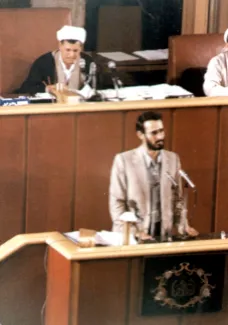
We moved to the Omidiya base. We went the wrong way and arrived at the base late. At six o'clock we flew to Tehran with Falcon and Jetstar. I went home. The MPs insisted that I go to the parliament and explain to them about the issues of war. This work was postponed to Saturday.
I asked the heads of forces to come home in the evening to discuss the future of the war, considering the recent issues of the front. Mr. [Syed Mohammad] Khatami announced that our forces have retreated from the Haj Imran region as planned; We decided to announce it ourselves. I was in frequent contact with the front about the situation. At five o'clock in the afternoon, the heads of the forces and Ahmad Agha came. I told the situation of the front and the recent events.
After a little discussion, the policy of ending the war was agreed upon and we went to the Imam to propose an end to the war. We prayed Maghrib and Isha prayers with Imam and sat down to negotiate. The meeting lasted more than an hour.
We explained in detail the problems of the war and the weakness of morale and facilities, the number of insiders, the power and facilities of the enemy, and the problem of defense from Khuzestan, for which the IRGC has requested 450 infantry battalions, 60 armored battalions, and 120 artillery battalions, and by allocating two-thirds of this amount, the rest of the lines will become extremely vulnerable, and even now, even though we have not brought such a force to Khuzestan, I explained the details of the failures.
He said what is the solution? We all said the end of the war by accepting Resolution 598 or another form. The Imam was worried about the enemy's disloyalty and the displeasure of the people of Hezbollah, which we considered the first possibility to be weak and the second possibility tolerable in view of the happiness of a large part of the people and the positive effects of peace, and in addition, the prediction of being forced to accept peace in the future, after suffering more losses due to the small number of volunteers and the ineffectiveness of the forced forces.
Finally, they agreed and said that a decision should be made with the presence of a group of clergy, managers and officials. We returned home and prepared a list of Friday imams, representatives, ministers, and clerics of the Madrasin community [Qom theology and members of the Guardian Council, etc.] and sent it to the Imam for approval, and they approved it.
At the end of the night [Mr. Mohtashmipour], the Minister of the Interior informed that the enemy had captured Nausud, which was later denied. He asked for the treatment of a new cholera-like disease that was seen in Zahedan. The Prime Minister ordered the Minister of Health to take action.

Take less than a minute, register and share your opinion under this post.
Insulting or inciting messages will be deleted.
Sign Up