
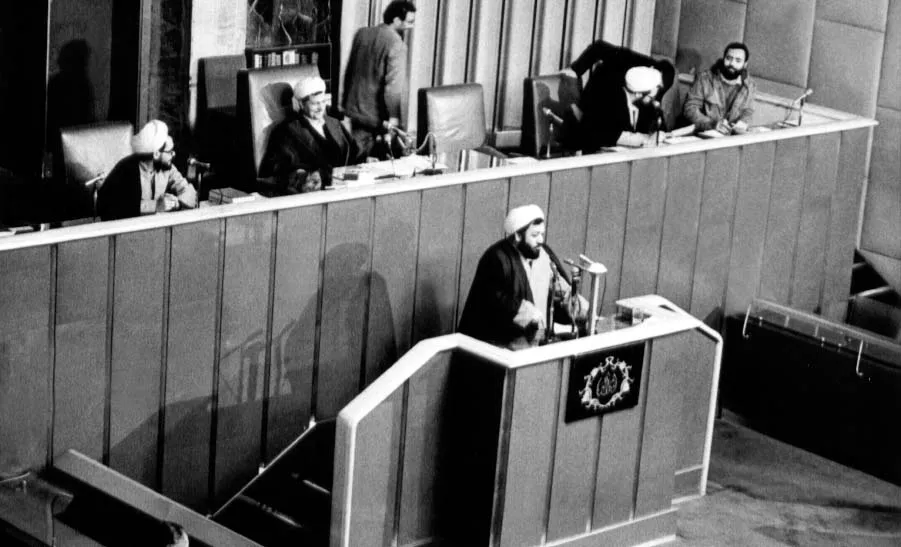
At seven thirty in the morning, we arrived at Mehrabad Airport with the family. We are setting off on a trip to Syria. I gave a short interview explaining the objectives of the trip. The farewell ceremony was official. Effat, Fati, Faezeh, Saeed [Lahouti], Fereshteh and the grandchildren were with us. Yaser, Mehdi, Azam and Mohsen did not come. The gentlemen
At 7:30 AM, we arrived at Mehrabad Airport with the family. We are setting off on a trip to Syria. I gave a brief interview explaining the objectives of the visit. It was a formal send-off. Effat, Fati, Faezeh, Saeed [Lahouti], Fereshteh, and the grandchildren accompanied us. Yasser, Mehdi, Azam, and Mohsen did not come. Dr. Rouhani, Dr. Velayati, Aghazadeh [Minister of Petroleum], and Vahaji [Minister of Commerce] are also part of the delegation.
During the flight, we held discussions. While in Turkish airspace, fighter jets escorted us as a gesture of respect, and we transmitted a message of friendship to Mr. [Turgut] Özal [Prime Minister of Turkey].
We landed at Damascus Airport on schedule. We received a warm welcome. Both Mr. Hafez al-Assad and I gave brief interviews. [Mrs. Anisa Makhlouf], Hafez al-Assad’s wife, also welcomed the women in our delegation. On the way, Hafez al-Assad provided an overview of the situation in Syria, Damascus, and the Golan, and answered my questions.
On the street next to our embassy, a group of Iranians and Arabs had gathered to welcome us. We stopped for a moment; I stepped out of the car to acknowledge their warm sentiments. The crowd became very animated and gathered around me. Out of consideration for Hafez al-Assad, we quickly returned to the car. We proceeded to the Tishreen Palace, located on the slopes of Mount Qasioun, which stretches along the western side of Damascus. It is an impressive palace. We spent a considerable amount of time in the palace hall, engaging in standard discussions with Hafez al-Assad, with our respective delegations present. All members of the Syrian government had come to welcome us. We went to our rooms to rest. The ministers are staying with us in this palace. Mr. [Abdolhossein] Vahaji, the head of the Joint Commission, arrived and explained the negotiations regarding the modalities for collecting our outstanding claims from Syria. We also discussed the agenda with Mr. [Mohammad Kazem] Khansari [Director-General for the Arab East and North Africa at the Ministry of Foreign Affairs] and Mr. [Mohammad Hassan] Akhtari [Iran’s Ambassador to Syria]. We had lunch with family members. The staff were all women—generally unveiled or wearing the hijab improperly, yet polite.
After a brief rest, we attended a ceremony to pay respects to Syrian martyrs who fell in the war against Israel; we recited the *Fatiha* and laid a wreath. Two thousand martyrs—mostly from the October 1967 war—are buried there. I received a brief explanation from the official in charge of the site. On the way, we passed through the Zeinabiyah district, where people had gathered on both sides of the street.
We proceeded to Assad’s office for negotiations. Present were [Ali Akbar] Velayati [Minister of Foreign Affairs], [Hassan] Rouhani [Secretary of the Supreme National Security Council], the interpreter [Javad] Torkabadi, and Farouk al-Sharaa [Syrian Minister of Foreign Affairs]. We held talks from 5:30 PM until 9:00 PM, with a fifteen-minute break to perform the Maghrib and Isha prayers.
The discussions were very friendly and cordial. We focused primarily on the situation in Iraq and the Persian Gulf crisis. Mr. Assad believes that the United States wants to remove Saddam, but does not wish for the future government of Iraq to be Islamic or under Iranian influence.
For this reason, he does not support the current opposition groups taking power; instead, he seeks a military coup that would install a regime favorably inclined toward the United States.
The Syrians were displeased with the negotiations between Kurdish leaders and Saddam, as these had taken place without their knowledge. We delved further into the Palestinian issue and the objectives of U.S. Secretary of State [James] Baker regarding the negotiations; however, the discussion was deferred to the next session. We proceeded to the Qasr al-Qa'a for a dinner reception—it is a remarkable palace, adorned with Syrian-style architecture and featuring beautiful halls and ceremonial chambers. The speeches delivered by both sides were warm and friendly. A large number of prominent Syrian figures were in attendance.
A delegation of Lebanese scholars—comprising both Sunni and Shiite figures [including the Scholars' Assembly of Jabal Amil, the Scholars' Assembly of the Bekaa, the Muslim Scholars' Gathering, and the Beirut Scholars' Forum]—arrived; I inquired about their situation. They recited a poem in our honor and expressed gratitude for the contributions the Iranian Revolution has made to Islam, both globally and within Lebanon.
Mr. Ahmed Jibril [Secretary-General of the Popular Front for the Liberation of Palestine – General Command] and his associates arrived. They expressed concern regarding their own situation; having spoken in favor of Saddam during the Persian Gulf crisis, they have incurred the anger and hostility of the Syrians. They are anxious about their own future and that of Palestine. I spoke with Hafez al-Assad, who agreed to treat them with kindness.
Representatives from the Palestinian front also arrived. They voiced concerns regarding the future of the Palestinians and requested assistance in forming a comprehensive front encompassing all Palestinians, as well as in preserving the Palestine Liberation Organization (PLO). I assured them of our support; they left satisfied.
Sheikh Saeed Shaaban [leader of the Islamic Tawhid Movement] arrived. He expressed regret over the positions he had taken in favor of Saddam during the Persian Gulf crisis and complained about the pressure exerted on him by the Syrians. I interceded on his behalf with Assad, who agreed [to overlook it]. Sheikh Mahdi Shamseddine [head of the Supreme Islamic Shia Council of Lebanon] also arrived; he, too, expressed regret regarding his past stances toward our policy in Lebanon. He pledged his loyalty, requested assistance in resolving the hostage issue, and voiced his satisfaction with the current developments in Lebanon.
Our Chargé d’Affaires in Lebanon arrived, bringing a message from the President of Lebanon requesting that we work directly with him; we agreed. Mr. [Mohammad Hossein] Rezaei, the official in charge of the Hajj Organization, arrived from Saudi Arabia. He is pleased with the progress of preparations. King Fahd has promised to provide a suitable location for holding the *Bara’at* [Disavowal of Polytheists] ceremony.
We performed congregational prayers with the embassy staff, and I delivered a brief address to them. I joined them at the dinner table, though I did not eat, as I had a scheduled working dinner with Hafez al-Assad.
True to Syrian custom, the dinner was quite lengthy, lasting until 12:30 AM. During the meal, I held a productive private discussion with Hafez al-Assad. Regarding the nature and extent of aid provided to Syria by the Persian Gulf oil-producing states during the Gulf crisis, he claimed that—contrary to rumors—the assistance has been minimal. They have fulfilled their previous commitments regarding aid to the frontline states bordering Israel—commitments that had been suspended during the Iran-Iraq War—and have also provided small sums recently; they have, however, agreed to contribute more in the future. I asked why they do not deny the rumors. He replied that perhaps they would make amends later. I suggested that the United States might be preventing them from doing so; he did not rule that out.

Take less than a minute, register and share your opinion under this post.
Insulting or inciting messages will be deleted.
Sign Up