

When I woke up for the morning prayer, I saw that the door of the room had been locked from the outside. I didn't want to wake others, but there was no choice. I knocked, Sheikh Mohammad came and opened it. Efat also woke up. I didn't sleep anymore. I got the foreign news. We had breakfast with the family and left an hour late.
When I woke up for the morning prayer, I saw that they had locked the room door from the outside. I did not want to wake others, but there was no other way. I knocked, and Ashaykh Mohammad came and opened it. Effat also woke up. I did not sleep again.
I followed the foreign news. We had breakfast with the family and, with a one-hour delay, flew toward Noug. We landed next to the Golzar-e Shohada shrine. People had gathered right there. They had good order. During the last trip, they had been as crowded as Rafsanjan was yesterday.
I visited the graves of the martyrs and the tomb of the shrine. They are rebuilding the shrine building with a good plan. It is unfinished; I promised help. The trustee of the shrine is one of the peers from the time of residence in Bahreman and is now the father of two martyrs; he asked for help to complete the building.
A young girl had composed a very good poem and read it well, except for one sentence which she read poorly. Ashaykh Mohammad and Mr. Ansari gave flattering welcoming speeches. I also gave an informal speech and told stories: the memory of the first trip and migration to Qom.
From there, we went to our own house. They have recently repaired the house. They have installed doors for the porch and the hall which it did not have before, and they have whitewashed what used to be mud-brick. At the house, we had a short meeting with relatives. We went to the rooftop. I showed my companions the windcatcher that I had built there with my own hands during my adolescence at the age of 13 and which had remained half-finished. It was interesting for me as well how I was able to build such a structure at that age.
A group of men and women from the village came to the house. We greeted each other warmly. I was interested in staying longer, but we had a schedule in Bam city and it was getting late. Our stay in Bahreman lasted about two hours. I went to my sister Tayyebeh's house, who is the mother of a martyr, and gave a brief greeting. There, Mr. Ahmad Alaei, one of my peers and classmates from the traditional school era, had composed a good poem in my praise and recited it.
I told Mr. [Gholamreza] Forouzesh, [the Minister of Jihad-e Sazandegi], to visit the desert pistachios and see how the hardworking people harvest pistachios from salty land? I told them to resolve the village's water supply problem. The traditional water cistern at our doorstep had caught the companions' attention. Journalists also had some interviews with me.
We flew toward Rafsanjan. At the unfinished Rafsanjan airport, we boarded the plane. The C130 plane that was bringing the companions had a problem. We were delayed for a while, and finally they came with Chinook helicopters and arrived shortly after us.
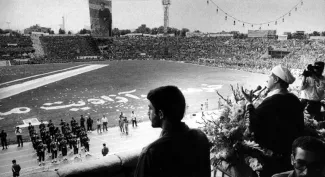
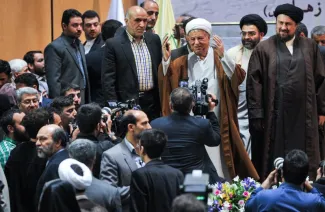
Near noon, we landed at the unfinished Bam airport. With a long delay and after the welcoming ceremony, we moved toward the city. On the way, we passed through the city of Baravat with 15,000 people. There was a good and enthusiastic gathering of people in the streets. We passed through and went to the city of Bam. The people of the city welcomed us very magnificently and enthusiastically in the streets and at the stadium.
The excessive sacrificing of sheep, cows, and camels here and in other cities pained me. I decided, in some way, to ban the custom of public sacrifice during future trips. A bit of blood also splashed onto my turban. In the streets, people, and especially women, had plucked a large amount of flower petals and were scattering them on the car. Some had carpeted the street floor with flowers so that the car carrying me would pass over the flowers. In general, it seemed that the welcoming ceremonies during the trips are being accompanied by new initiatives and refinements. Furthermore, artists have entered a competition to compose poems, anthems, and perform original music and interesting writings and create new paintings and placards by the residents with poetic themes, and I think IRIB plays an important role.
In the gathering of people at the city's large stadium, the Friday Imam and the representative gave welcoming speeches and expressed the demands. I also gave a detailed speech, offered condolences for the martyrdom of Imam Sadiq (AS), and recounted the Feyziyeh incident in the year 42.
We went to see the Arg-e Bam. It is a very important ancient monument. It dates back to centuries before Islam. They say it was built during the time of Bahman Esfandiyar, which is apparently a legend. Its area is more than 60 hectares, with buildings of sun-dried brick and mud. The guide was a tasteful teacher who explained very well.
In the Arg fortress, at the highest point of the building which is about 60 meters high, they had carpeted the Char-Fasl building. We prayed in its vast mosque, heard explanations, and ate lunch. A large group was also at the party. I ordered them to reconstruct quickly and to carry out more advertisements to attract tourists.
We moved toward the village of Dowlatabad in the deprived district of Narmashir. Many people still remained in the street. There was a ceremony for the start of construction work for a health center.We prioritized it because it is a link in the chain of a thousand centers we intend to build with the help of a World Bank loan. I spoke to the people about the importance of healthcare.
From there, I went for the groundbreaking ceremony of the Kerman Khodro factory. It is being built with the participation of a Korean company. Then we flew toward Kerman. We went from the airport to Mahan by helicopters.
For the start of the executive work of the University Town and the International Center for Science and High Technology of the Third World, which is being implemented in cooperation with Abdus Salam of Pakistan.
The people of Mahan had traveled kilometers and formed a massive gathering. It was near sunset. The Friday Imam delivered a welcome address, and I gave a short speech regarding the significant effects of this center on the development of Mahan. Then the ceremony for the center took place. Dr. Mansouri and Dr. [Mostafa] Moein, [Minister of Culture and Higher Education], gave reports. We held the unveiling in the presence of a group of medical and academic figures, and I gave an encouraging speech and broke ground; contrary to my personal taste, we did a lot of groundbreaking on this trip.
From there, we went for the inauguration of the 100,000-ton silo on the Mahan-Kerman road. On the way, I saw the people of Mahan returning from the gathering site on foot with their women and children in the dark night; I was moved and questioned the program officials.
We prayed at the silo site. After the explanations from Mr. Forouzesh [Minister of Jihad-e Sazandegi] and the executive director, we toured the silo and the mill; it is a great work that Jihad-e Sazandegi has done. Before the revolution, all silos were built by foreigners, and this same silo had also been assigned to Italy, which had taken a lot of foreign currency and done nothing, which we are now disputing. Now, Jihad-e Sazandegi is completely in charge of the design and implementation of silos. I heartened them with encouraging remarks.
For dinner, we went to Shazdeh Garden in Mahan; it is very magnificent, perhaps unique in Iran. With towering trees, waterfalls, fountains, and excellent weather. During dinner, the Friday Imam of Kerman shared some criticisms of the Governor and told me privately. I gave a reminder to Reza, my cousin, regarding the strictness in environmental issues that is being complained about. We came to Kerman for rest. I went to sleep at 12:30 midnight, exhausted and worn out.
Take less than a minute, register and share your opinion under this post.
Insulting or inciting messages will be deleted.
Sign Up