
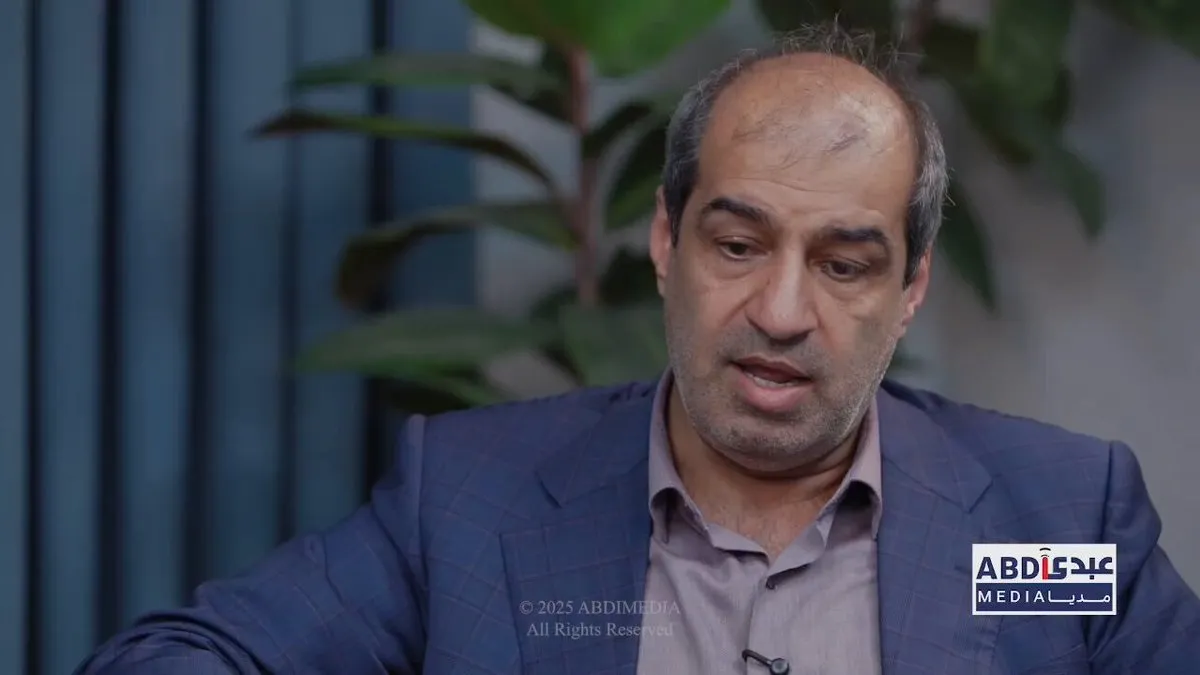
Dr. Isa Bozorgzadeh, the country's water industry spokesperson and the Director General of the Macro Planning Office for Water Resources and Budget Consolidation at Iran Water Resources Management Company (affiliated with the Ministry of Energy), is one of the most well-known executive-specialized figures in Iran's water industry over the past two years. Within the tense climate of the country's water crisis, holding a dual position in the sphere of strategic planning for water resources and serving as the official spokesperson for the water industry, he has become one of the most widely covered official voices of the sovereignty in the public discourse surrounding the water crisis. By proposing concepts such as the "water saving certificate market" and "delegating operational management to public associations," he maintains a structural-market approach to the management of the country's water resources.
Who is Isa Bozorgzadeh?
Dr. Isa Bozorgzadeh, the country's water industry spokesperson and the Director General of the Macro Planning Office for Water Resources and Budget Consolidation at Iran Water Resources Management Company (affiliated with the Ministry of Energy), is one of the most well-known executive-specialized figures in Iran's water industry over the past two years. Within the tense climate of the country's water crisis, he has become one of the most widely covered official voices of water sovereignty in the Iranian media. Standing at the intersection of the macro management of the country's water resources (at the planning and budget consolidation level) and serving as the official spokesperson for the water industry (as the primary liaison between this sector, the media, and public opinion), Bozorgzadeh has played a strategic role in the public discourse surrounding the challenging water crisis of the capital and other metropolises in 2025 and 2026.
The importance of Dr. Isa Bozorgzadeh in the executive-analytical sphere of Iran's water industry can be analyzed from several aspects:
First, his dual position in the official structure—serving as the Director General of the Macro Planning Office for Water Resources and Budget Consolidation (a technical-executive role focused on strategic water resource planning at the national level) and as the water industry spokesperson (a media-communication role focused on bridging the Ministry of Energy and public opinion)—has granted him a wide scope of influence.
Second, his widely covered media presence in recent months—particularly following the intensification of Tehran's water crisis in the autumn of 2025 and the onset of severe low rainfall—has made him one of the most frequently cited official voices in the discourse on Iran's water crisis.
Third, his distinct analytical framework regarding the water governance structure—in which he does not consider the Ministry of Energy to be the sole water ruler of the country by identifying the differing roles of the three branches of government, the market, and society in managing water resources—is considered one of the most widely discussed recent stances within the official water industry discourse.
Fourth, his architecture of prominent strategic initiatives—such as the "water saving certificate market" and the "program for delegating operational management of the water sector to public associations"—indicates his structural-market approach to water resource management.
In recent months, in one of his highly covered stances (November 2025), Bozorgzadeh declared: "We are worried about Tehran"—a position that indicates the official acknowledgment of the severity of the capital's water crisis within the Ministry of Energy structure.
Life and Background
Detailed information regarding Dr. Isa Bozorgzadeh's date of birth, place of birth, and family background remains limited in open media sources—a trait that is relatively common among technical-executive managers in Iran's specialized ministries, who primarily focus on their executive-specialized activities and maintain a more limited media-political presence. What is clear from his professional trajectory in the media landscape is that Bozorgzadeh is categorized among the technical-specialized managers focused on Iran's water industry and has maintained continuous activity within the structure of Iran Water Resources Management Company—one of the subsidiary companies of the Ministry of Energy—over the past years.
Education and Specialized Backing
The title of "Doctor" in his identification across official media indicates his advanced academic backing in fields related to water resource management, water engineering, or similar areas. Within the structure of Iran Water Resources Management Company, which is considered among the prominent technical-specialized companies of the Ministry of Energy, advanced academic expertise is one of the key prerequisites for operating at the director-general level.
Iran Water Resources Management Company
The turning point in Dr. Bozorgzadeh's executive-specialized record is his sustainable presence within the structure of Iran Water Resources Management Company, a prominent specialized company under the Ministry of Energy that plays a strategic role in managing the country's surface and groundwater resources. Operating under the Ministry of Energy, this company is considered one of the most important sovereign institutions focused on the management of the country's water resources and holds a decisive role in strategic policymaking for this sector.
Director General of the Macro Planning Office for Water Resources and Budget Consolidation
Bozorgzadeh's most central technical-executive position is serving as the Director General of the Macro Planning Office for Water Resources and Budget Consolidation at Iran Water Resources Management Company. This office, which is one of the most important specialized units in the company's organizational structure, covers two strategic areas:
Macro planning for water resources: Including the formulation of strategic plans for water resource management at the national level, the allocation of water among consumption sectors (drinking, industry, agriculture), and the regulation of the country's macro water policies.
Budget consolidation: Including the financial and budgetary planning of water projects and schemes, the allocation of credits, and coordination between different budgets of the water industry.
This position, which integrates technical-planning expertise with financial-budgetary expertise, is considered one of the most important managerial roles within the structure of Iran Water Resources Management Company.
Water Industry Spokesperson
In addition to his executive-specialized role, Bozorgzadeh also serves as the spokesperson for the country's water industry, a position in which he operates as the primary liaison between this sector, the media, and public opinion. This role, officially delegated by the Ministry of Energy, is considered one of the most sensitive media positions within Iran's executive structure—particularly in the current water crisis environment where any official stance faces widespread media coverage.
Press Conferences and Highly Covered Media Presence
One of the prominent facets of Bozorgzadeh's activity is holding periodic press conferences at Iran Water Resources Management Company, during which official statistics and analyses of the country's water industry are presented.
Press Conference on May 10, 2026
One of Bozorgzadeh's most widely covered recent briefings was the press conference held on Monday, May 10, 2026, at the headquarters of Iran Water Resources Management Company. During this session, he presented several key analytical positions:
Rejecting the Claim of a Wet Period
In one of his prominent stances, Bozorgzadeh declared: "The claim that the country has entered a wet period (Tarsali) is absolutely incorrect, and such an interpretation should not be derived from the current situation." Pointing out that "the country's precipitation index currently stands at around 226 mm," he added: "This number is considered a normal index; it indicates neither drought nor a wet period. Therefore, it can by no means be said that the country has entered a wet period." This position was one of the most widely covered official stances in the Iranian media landscape, where certain sources were claiming that the country had entered a wet cycle.
Dam Filling Status
During the same briefing, Bozorgzadeh announced the average filling capacity of the country's dams to be around 65 percent, adding: "Some dams have reached the overflow stage, but several others still face unfavorable conditions."
Emphasis on Local Water Management
One of Bozorgzadeh's prominent theoretical stances during this briefing was his emphasis on the necessity of local water management. In his view: "The issue is, how does high rainfall in Bushehr help supply Tehran's water needs? What relation does the overflow of a dam in a specific region have to resolving the water needs of Mashhad? Therefore, water management in the country must be viewed completely locally." This position stands in contrast to the common discourse of "centralized national water management" and indicates his specialized view on the necessity of separating water basins.
Tehran's Water Crisis
Bozorgzadeh's most widely covered analytical topic in recent months has been Tehran's water crisis, a matter that peaked in the autumn of 2025 and turned the water industry spokesperson into one of the most frequently present official figures in the Iranian media.
Key Statistics on Tehran's Water Consumption
In a widely covered interview with Ham-Mihan Online (May 2026), Bozorgzadeh presented the precise statistics of Tehran's water consumption:
Consumption of Tehran's 22 districts: Around 1.2 billion cubic meters annually.
Consumption of the entire "Blue Tehran": 1.8 billion cubic meters annually.
"Blue Tehran," in Bozorgzadeh's definition, includes Abyek in Qazvin, the entire Alborz province and Karaj, the 22 districts of Tehran, Varamin, Pakdasht, Boumehen, Roodehen, and Pardis. This entire complex "uses a single source, meaning Tehran's limited groundwater resources and five dams."
Warning About Fragile Conditions
In one of his alarming stances, he declared: "Conditions are fragile; anyone who says Tehran does not have a water problem is unaware of the issue. I tell you this and I repeat it again: anyone who says Tehran does not have a water problem, even in a normal year and even in a wet year, is unaware of Tehran's issues."
42 Cities Across 22 Provinces
In the same interview, Bozorgzadeh provided the list of critical cities: "Tehran is the first priority; currently, 42 cities in the country across 22 provinces face serious water problems, but among them, Tehran, Mashhad, Isfahan, Bandar Abbas, Arak, and Saveh hold a higher priority." In one of his subsequent stances, the cities of Tabriz and Baneh were also added to this list.
Need for a 10 Percent Reduction in Consumption
In one of his strategic stances, Bozorgzadeh declared: "If we cannot achieve a 10 percent reduction in consumption through demand management via public cooperation, we will be forced to apply restrictions regarding the amount of water consumption for citizens." This position was one of the most widely covered official warnings amid the capital's water crisis.
Water Pressure Management
Regarding the crisis management approach, Bozorgzadeh announced: "Water pressure management across Tehran is being carried out with greater precision than in the past... The policy of the Ministry of Energy is that pressure management is applied with higher precision from midnight until morning." He also emphasized that any water cuts would take place with prior notice.
Severe Autumn Low Rainfall
In November 2025, regarding the severe low rainfall during autumn, Bozorgzadeh declared: "Unfortunately, as had been predicted, we are facing severe low rainfall in most regions of the country, and almost zero rainfall in Tehran."
Key Strategic Initiatives
Beyond analyzing the existing status, Bozorgzadeh has also played a role in designing several key strategic initiatives.
The Water Saving Certificate Market Initiative
One of the prominent initiatives proposed by Bozorgzadeh is the establishment of a water saving certificate market. In explaining this initiative, he declared: "In this scheme, consumers can secure a portion of their water needs by purchasing water saving certificates. This initiative is specifically designed for high-volume consumers, allowing them to control their consumption level by purchasing various certificates and to reduce the pressure on water resources." This scheme, which operates similarly to carbon markets in international environmental economics literature, is considered one of the innovative initiatives in the field of Iran's water resource management.
See: The water crisis in Iran, a conversation between Mohammad Darwish, an environmental activist, and Issa Bozarzadeh, the spokesperson for the country's water industry
**Delegating Operational Management to Public Associations**
During a meeting of the Water Committee of the Parliament's Article 90 Commission, Bozorgzadeh announced the Ministry of Energy's plan to delegate part of its operational responsibilities to public associations. In his view: "In past decades, the state alone held the primary responsibility for running society, virtually occupying the entire decision-making space. This management approach has not yielded positive results and is indefensible from a sustainable development perspective." He emphasized that under the Seventh Development Plan, the Ministry of Energy is legally mandated to transfer a portion of its duties to these associations through public participation frameworks.
**Controlling High-Volume Consumers**
Another of Bozorgzadeh's strategic initiatives involves identifying and regulating high-volume water consumers. Explaining this plan, he stated: "One of the most important measures the Ministry of Energy intends to implement is the identification and control of high-volume consumers. This step aims to achieve higher efficiency across the country's water resources and to prevent water waste."
**Streamlining and Data-Driven Governance**
In one of his strategic positions, Bozorgzadeh stressed: "For these reforms to succeed, streamlining, data-driven governance, and greater coordination among various sectors are absolutely essential."
### Perspectives and Analytical Stances
Dr. Isa Bozorgzadeh has formulated a clear intellectual framework throughout his media and analytical career, which can be tracked across several key themes.
**Critique of the Water Governance Structure**
One of Bozorgzadeh's prominent stances is his structural critique of limiting the concept of "water governance" solely to the Ministry of Energy. In his view: "If we restrict the concept of water sovereignty exclusively to the Ministry of Energy, we have fundamentally misunderstood the decision-making landscape in the water sector." He further added: "The legislative branch also plays a role as part of water sovereignty, and its impact on water resource management cannot be ignored... The judiciary, macro policies, laws, and the country's overall governance structure all influence water management."
**The Tripartite Management Model**
Within his signature theoretical framework, Bozorgzadeh introduced the tripartite model of water management. In his view: "In all successful governance systems worldwide, managing critical sectors such as water, healthcare, education, and transportation requires the simultaneous interaction of three institutions: the State (encompassing the three branches of government and ruling bodies), the Market (which manages economic tools and pricing), and Society (which represents public participation and civil society). These three institutions must operate concurrently and in harmony."
This theoretical framework, well-recognized in international modern governance literature, is what he believes must be applied to Iran's water industry.
**Rejecting the Claim of the "Ministry of Energy as the Water Ruler"**
In one of his highly covered stances, Bozorgzadeh declared: "The Ministry of Energy is not the water ruler of the country." This position, which at first glance might seem to contradict the official expectations of a water industry spokesperson, reflects his realistic view of the structural limitations faced by the Ministry of Energy within the broader landscape of the country's water sovereignty.
**Acknowledging Project Deviations, Rejecting the "Water Mafia" Claim**
Addressing the widely discussed concept of a "water mafia" in Iran, Bozorgzadeh stated: "The water mafia has no objective existence." However, he openly acknowledged "deviations and errors in certain projects." In a key stance, he added: "If you claim that in five specific projects, five contractors or consultants reaped illegitimate benefits, I accept that. Yes, such a possibility exists." This explicit stance was widely covered in the Iranian media landscape, where the discourse surrounding the "water mafia" has gained significant traction in recent years.
**Support for Bottled Water**
In another recent prominent stance, Bozorgzadeh defended the Ministry of Energy's policy of supporting the supply of bottled water, offering two main reasons: "First, because it preserves water; when you buy a half-liter bottle of mineral water, you use it drop by drop. Second, we support it because it generates employment."
**Acknowledging Delayed Payments to Contractors**
Addressing the financial bottlenecks facing industry partners, Bozorgzadeh recently stated: "There are times when we are truly embarrassed before our dear contractors and consultants because we are unable to pay for their services on time." This candid acknowledgment—where an official takes direct responsibility for an ongoing issue—is considered a rare and unprecedented stance in the Iranian media environment.
**Acknowledging the Urban Water Stress Crisis**
In his recent positions, Bozorgzadeh explicitly pointed to the ongoing water stress in cities such as Tehran, Mashhad, Isfahan, Arak, Saveh, Bandar Abbas, Tabriz, and Baneh, categorizing these urban centers as the top priorities for the water industry during this crisis period.
Relationships with Figures and Factions
Dr. Isa Bozorgzadeh operates within a network of executive and technical ties with key figures across Iran's water industry structure. At the ministerial level, his relationship with the Minister of Energy and the ministry's deputies (under the fourteenth administration of President Pezeshkian) shapes his executive network.
Within the organizational structure of Iran Water Resources Management Company, his interaction with other top executives—including the CEO and corporate deputies—constitutes his professional and specialized network.
At the inter-sectoral level, his ties with the Parliament's Article 90 Commission (before whose Water Committee he testified) and references to his stances within the public discourse involving President Masoud Pezeshkian map out his institutional network.
---
> **Listen | The Water Crisis in Iran:** A dialogue between environmental activist Mohammad Darvish and Dr. Isa Bozorgzadeh, the country's water industry spokesperson.
Conclusion
Dr. Isa Bozorgzadeh is one of the most prominent executive-specialized figures in Iran's water industry over the past two years. He occupies a distinct position in the executive-analytical structure of the country's water sector through a unique combination of his dual role in the official structure (as the Director General of the Macro Planning Office for Water Resources and Budget Consolidation at Iran Water Resources Management Company, and the country's water industry spokesperson), his highly covered media presence amid the tense climate of the nation's water crisis, a distinct analytical framework regarding the water governance structure (emphasizing the tripartite State-Market-Society model and rejecting the claim of the "Ministry of Energy as the water ruler"), and his architecture of innovative strategic initiatives (such as the water saving certificate market and delegating operational management to public associations). His career—encompassing sustained activity at Iran Water Resources Management Company, a pivotal role in the Macro Planning Office for Water Resources and Budget Consolidation, a highly visible presence as the water industry spokesperson during key press briefings (such as the May 10, 2026 session), analysis of the water crisis in Tehran and other metropolises, attendance at the Parliament's Article 90 Commission Water Committee meeting, and the design of prominent initiatives—presents a multi-dimensional picture of a "technical-executive manager and spokesperson."
The distinguishing feature of Bozorgzadeh, at the primary level, is his exceptional ability to bridge specialized-technical language with media-public language; a trait whereby complex technical concepts of water resource management are translated into a language accessible to the general public. This connection is relatively rare among specialized managers within Iran's executive structure. At the secondary level, his candor in acknowledging the structural limitations of the Ministry of Energy—whereby his official declaration that "the Ministry of Energy is not the water ruler of the country" stands in contrast to the official expectations of a ministry spokesperson—is considered a remarkable aspect of his character. At the tertiary level, his distinct theoretical framework regarding water sovereignty—in which the tripartite State-Market-Society model is identified as the reference paradigm—indicates his institutionalist approach to water resource management.
From an analytical standpoint, Bozorgzadeh's position is an example of the "technical manager and spokesperson" phenomenon in the contemporary Iranian executive structure; a phenomenon where a technical specialist simultaneously plays a role at the strategic planning and policymaking level while operating in a media-spokesperson capacity. This dual model, which faces specific challenges within Iran's executive framework, finds a unique reflection in Bozorgzadeh due to his analytical candor and distinct theoretical framework.
What is clear from today's perspective is that the subjects Bozorgzadeh addressed in his executive-analytical stances—ranging from the capital's water crisis, local water resource management, the saving certificate market, delegating operational management to public associations, the tripartite water governance model, the critique of limiting "water governance" to the Ministry of Energy, and the acknowledgment of structural issues—have remained among the most sustainable topics of debate in the developmental-environmental discourse of contemporary Iran. In conditions where Iran is in one of the most tense periods of water crisis in its history—particularly with the increasing dryness of the capital's dams, the intensification of the autumn 2025 low rainfall, and mounting challenges in 42 critical cities—Bozorgzadeh's official voice, combining technical-planning expertise and media capability, will be one of the main references for this conversation within the official sphere.
FAQ
Who is Isa Bozorgzadeh?
Dr. Isa Bozorgzadeh is the country's water industry spokesperson and the Director General of the Macro Planning Office for Water Resources and Budget Consolidation at Iran Water Resources Management Company (affiliated with the Ministry of Energy). Within the tense climate of the country's water crisis in 2025 and 2026, he has become one of the most widely covered official voices of water sovereignty in the Iranian media.
What are the executive positions of Isa Bozorgzadeh?
Bozorgzadeh holds two key positions: "Director General of the Macro Planning Office for Water Resources and Budget Consolidation" at Iran Water Resources Management Company (a technical-executive role focused on strategic water resource planning at the national level), and "Water Industry Spokesperson" (a media-communication role focused on bridging the Ministry of Energy and public opinion).
What is Bozorgzadeh's view on the country's precipitation status?
During the press conference on May 10, 2026, Bozorgzadeh declared: "The claim that the country has entered a wet period is absolutely incorrect... the country's precipitation index currently stands at around 226 mm... this number is considered a normal index; it indicates neither drought nor a wet period." During the same briefing, he announced the average filling capacity of the country's dams to be around 65 percent.
What is Bozorgzadeh's view on Tehran's water crisis?
Regarding Tehran's water crisis, Bozorgzadeh has stated: "We are worried about Tehran" and "conditions are fragile; anyone who says Tehran does not have a water problem is unaware of the issue." He has provided precise statistics: the consumption of Tehran's 22 districts stands at 1.2 billion cubic meters annually, and the total consumption of "Blue Tehran" (including Abyek in Qazvin, Alborz, Karaj, the 22 districts, Varamin, Pakdasht, Boumehen, Roodehen, and Pardis) is 1.8 billion cubic meters annually.
How many cities in Iran face serious water problems?
According to Bozorgzadeh: "Currently, 42 cities in the country across 22 provinces face serious water problems." Among these cities, Tehran, Mashhad, Isfahan, Bandar Abbas, Arak, Saveh, Tabriz, and Baneh hold a higher priority.
What is Bozorgzadeh's view on water management?
Bozorgzadeh's most central theoretical stance is his emphasis on the necessity of local water management. In his view: "How does high rainfall in Bushehr help supply Tehran's water needs?... Water management in the country must be viewed completely locally." Within his signature theoretical framework, he also proposes the tripartite State-Market-Society model for water sovereignty.
What is the water saving certificate market initiative?
The water saving certificate market is one of the prominent initiatives proposed by Bozorgzadeh. According to his explanation: "In this scheme, consumers can secure a portion of their water needs by purchasing water saving certificates. This initiative is specifically designed for high-volume consumers." This scheme operates similarly to carbon markets in international environmental economics literature.
What is Bozorgzadeh's view on the "water mafia"?
In one of his highly covered stances, Bozorgzadeh declared: "The water mafia has no objective existence." However, he openly acknowledged "deviations and errors in certain projects," stating: "If you claim that in five specific projects, five contractors or consultants reaped illegitimate benefits, I accept that. Yes, such a possibility exists."
Is the Ministry of Energy the water ruler of the country?
According to Bozorgzadeh's view, the answer is negative. In one of his prominent stances, he declared: "The Ministry of Energy is not the water ruler of the country... the judiciary, macro policies, laws, and the country's overall governance structure all influence water management." In his theoretical outlook, he proposes the tripartite model of the State, the Market, and Society for optimal water management.
Is Isa Bozorgzadeh still active?
Yes, Dr. Isa Bozorgzadeh, as the current spokesperson for the water industry and the Director General of the Macro Planning Office for Water Resources and Budget Consolidation at Iran Water Resources Management Company, remains one of the most frequently present official figures in the contemporary Iranian media regarding the water sector. His latest key stances—including the press conference on May 10, 2026, the analysis of the autumn 2025 low rainfall, warnings about Tehran's water crisis, attendance at the Parliament's Article 90 Commission Water Committee meeting, and the design of prominent strategic initiatives—have been widely covered in the Iranian media.
Take less than a minute, register and share your opinion under this post.
Insulting or inciting messages will be deleted.
Sign Up