
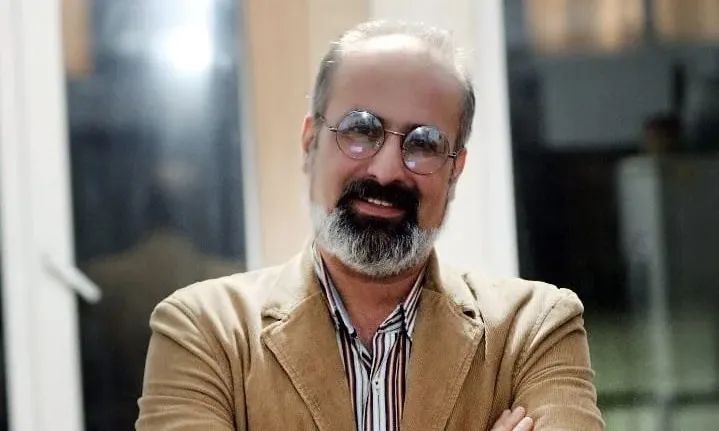
**Abdolreza Davari**, a political activist, journalist, social media analyst, former media advisor to Mahmoud Ahmadinejad, former deputy head of the IRNA news agency, and former head of the Strategic Studies Center at the Ministry of Interior, ranks among the most high-profile and controversial figures in Iran’s contemporary media and political landscape. Having held key positions in the ninth and tenth governments and long been a staunch defender of Ahmadinejad, he underwent a fundamental shift in recent years and emerged as one of the most prominent critics of both Ahmadinejad and the ruling power structure. In a candid confession, Davari stated: “I was one of the pillars of Ahmadinejad’s propaganda apparatus,” and apologized to the Iranian people. Through an open letter to Ebrahim Raisi concerning the 1988 executions, a controversial tweet about a “500-billion-toman house,” and the claim that “Ahmadinejad is a secret Jew,” he has become one of the most widely discussed figures in the Iranian virtual space. In July–August 2025, Davari was sentenced to six months in prison, flogging, and a ban on social media activity.
Abdolreza Davari (born 20 April 1973 in Damghan) is a political activist, journalist, social media analyst, former media advisor to Mahmoud Ahmadinejad, former deputy head of the IRNA news agency, former managing director of the newspaper Shahrvand, former advisor to the Minister of Interior, and former head of the Strategic Studies and Training Center of the Ministry of Interior. He ranks among the most high-profile, controversial, and unique figures who have undergone a fundamental intellectual-political shift in contemporary Iran.
Davari followed a distinctive path—from his origins in Damghan and obtaining a mathematics diploma from Hashtroudi High School in 1991, through a series of prominent positions in Mahmoud Ahmadinejad’s ninth and tenth governments (including managing director of the Iran Copper Industries Pension Fund in 2010, media advisor to the president, deputy head of IRNA—the official Iranian news agency, managing director of the newspaper Shahrvand, advisor to the Minister of Interior, and head of the Strategic Studies and Training Center of the Ministry of Interior)—to a string of high-profile judicial cases (an arrest warrant in May–June 2014 on charges of spreading falsehoods, from which he was ultimately acquitted; a complaint by Ayatollah Akbar Nateq-Nouri in July–August 2014 leading to a three-year prison sentence from Branch 15 of the Revolutionary Court in August–September 2015; arrest on 31 May 2017—three days after publishing his landmark open letter to Ebrahim Raisi concerning the summer 1988 executions—to serve the previous sentence; re-arrest in November–December 2019 on charges of links to the Amadnews channel, confirmed by Gholam-Hossein Esmaeili, then spokesman of the judiciary; and finally a new case filed in September–October 2024 resulting in a sentence in July–August 2025 of six months’ imprisonment, flogging, a fine, confiscation of his mobile phone, and a ban on activity on Twitter/X and Instagram for false claims about Yahya Sinwar)—culminating in a major intellectual-political turn from staunch defender of Ahmadinejad to his fierce critic. This shift was reflected in his widely noted confession: “I personally apologize to the Iranian people for that sectarian conduct and years of blind support for Mr. Ahmadinejad.” He has ultimately become one of the most influential critical media voices in the Persian-language sphere during the thirteenth and fourteenth governments through his high-profile activity on social networks (especially Twitter/X), making him one of the most discussed and contentious figures in contemporary Persian-language media and politics.
The significance of Abdolreza Davari in Iran’s contemporary media-political sphere can be examined from several angles. First, his prior institutional backing within the power structure of the ninth and tenth governments—including high-profile roles such as media advisor to the president, deputy head of IRNA, managing director of Shahrvand, and advisor to the Minister of Interior—provides him with distinctive insider knowledge of the system. Second, his fundamental intellectual-political shift, in which a figure who was a staunch defender of Ahmadinejad became one of his most prominent critics, is reflected in his widely publicized confession about having been “one of the pillars of Ahmadinejad’s propaganda.” Third, his exceptional ability to shape media discourse through social networks has made him one of the most high-profile Persian-language users of Twitter/X. Fourth, his pioneering role in raising controversial issues surrounding the summer 1988 executions, highlighted in his landmark open letter to Ebrahim Raisi on 28 May 2017, ranks among the most widely discussed open letters on this taboo subject in Persian-language discourse. Fifth, the series of high-profile arrests and judicial convictions places him among the most notable Persian-language social media figures with multiple media-related legal cases.
Important note: There is disagreement regarding Abdolreza Davari’s claimed academic credentials. While media outlets of the ninth and tenth governments repeatedly referred to him as a graduate with bachelor’s and master’s degrees in mechanical engineering from the University of Tehran and a PhD in development economics, repeated inquiries by journalists to the Faculty of Engineering at the University of Tehran and searches of the university’s graduate lists have yielded no results for his name. This remains one of the most contested aspects of his background. Additionally, Ali Akbar Javanfekr (Ahmadinejad’s prominent media advisor) has declared Davari’s claim of having been Ahmadinejad’s advisor to be untrue—an assertion that Davari continues to reject. This profile reports the narrative published in media sources; evaluation of these disagreements is left to the reader.
In one of his notable recent positions, Davari stated: “I personally apologize to the Iranian people for that sectarian conduct and years of blind support for Mr. Ahmadinejad. We drove away every critic of Mr. Ahmadinejad with the stick of connection to Zionism and Israel and did not carefully listen to the critics’ words. I was one of the pillars of Ahmadinejad’s propaganda.” This stance, which explicitly acknowledges his role in the propaganda of the ninth and tenth governments, is among his most widely noted positions of the recent period.
Life and Background
Abdolreza Davari was born on 20 April 1973 in the city of Damghan, in Semnan Province. Born in the early 1970s, he belongs to a generation that experienced the victory of the 1979 Islamic Revolution and the outbreak of the Iran-Iraq War in childhood, and began his notable activities in the post-war environment as a young adult.
Interestingly, Davari was born in Damghan—the same city where Mehdi Nasiri (another high-profile figure known for a significant intellectual shift) was also born—indicating the distinctive cultural-social background of this city.
Education
Abdolreza Davari’s educational path is one of the most contested aspects of his background.
Mathematics diploma (1991)
Davari received his mathematics diploma from Hashtroudi High School in 1991. This is the only academic credential of his that has been confirmed in official sources.
Claims of higher degrees
In published sources, Davari has claimed a bachelor’s and master’s degree in mechanical engineering from the University of Tehran and a PhD in development economics (on his personal blog). Media outlets of the ninth and tenth governments also repeatedly referred to him as a PhD in mechanics from the University of Tehran.
However, repeated inquiries by journalists from other media outlets to the Faculty of Engineering at the University of Tehran and searches of the university’s graduate lists for a graduate named Abdolreza Davari have been unsuccessful. This issue, which has been discussed among Persian-language media activists, is considered one of the most contested aspects of his personal and professional background.
Professional Record in the Ninth and Tenth Governments
The central chapter of Davari’s professional career was a series of prominent positions in Mahmoud Ahmadinejad’s ninth and tenth governments.
Managing director of the Iran Copper Industries Pension Fund (2010)
In 2010, Davari was appointed managing director of the Iran Copper Industries Pension Fund—one of his earliest high-profile economic-social positions within the Ahmadinejad government structure.
Media advisor to Mahmoud Ahmadinejad
During Mahmoud Ahmadinejad’s presidency, Davari served as media advisor to the president. According to his own claim: “Before I joined Mr. Ahmadinejad’s team, many media outlets were unwilling to interview Ahmadinejad. How did Fox News come to interview Mr. Ahmadinejad? These cases stemmed from my personal capacities.”
However, Ali Akbar Javanfekr (Ahmadinejad’s prominent media advisor) has declared Davari’s claim of having been Ahmadinejad’s advisor to be untrue. This disagreement remains one of the most contested aspects of Davari’s background.
Deputy head of IRNA
Davari served for a period as deputy head of IRNA, the official Iranian news agency. This position, among the most high-profile state media roles in Iran, formed the foundation of his lasting media credibility.
Managing director of the newspaper Shahrvand
Davari also served for a period as managing director of the newspaper Shahrvand.
Advisor to the Minister of Interior and head of the Strategic Studies and Training Center of the Ministry of Interior
Davari was also advisor to the Minister of Interior and head of the Strategic Studies and Training Center of the Ministry of Interior—high-profile positions indicating his significant institutional standing within the Ministry of Interior structure of the ninth and tenth governments.
Judicial Cases
The most high-profile chapter of Davari’s judicial record is a series of multiple arrests and convictions.
First arrest: May–June 2014
In May–June 2014, an arrest warrant was issued for Davari. The charges were spreading falsehoods and falsely attributing statements to officials. Abdolreza Davari was ultimately acquitted of the charges.
Nateq-Nouri complaint (July–August 2014)
In July–August 2014, Davari attributed accusations to Ayatollah Akbar Nateq-Nouri (former Speaker of the Islamic Consultative Assembly) and some members of his family on his Facebook page, which led to a complaint by Nateq-Nouri. This case formed the basis of his subsequent high-profile conviction.
Three-year prison sentence (August–September 2015)
In August–September 2015, Branch 15 of the Revolutionary Court sentenced Davari to three years in prison after hearing the case. According to Davari’s Telegram channel: “Davari was sentenced in Branch 15 of the Revolutionary Court in Shahrivar 1394 on the pretext of three ‘comments’ that ‘anonymous individuals’ had posted on a Facebook page attributed to him.”
Open letter to Raisi and arrest on 31 May 2017
In one of the most high-profile events in Davari’s judicial-political record, on Sunday 28 May 2017 he published an open letter addressed to Ebrahim Raisi—custodian of Astan Quds and one of the candidates in the twelfth presidential election. In the letter, he raised two questions that he himself described as “research-oriented” regarding the “summer 1988 executions”:
- “According to reports, the process of the summer 1988 executions begins with two texts attributed to Ayatollah Khomeini; however, the two texts cited are not only absent from Ayatollah Khomeini’s collected works—neither in Sahifeh-ye Nur nor in Sahifeh-ye Imam—but the ‘Office for the Preservation and Publication of the Works of the Late Leader of the Revolution’ has also not commented on their authenticity.”
Three days after the publication of this letter, on Wednesday 31 May 2017, Davari was arrested to serve his previous three-year prison sentence. This timing was interpreted in the Persian-language media space as a judicial response to his tense open letter.
Arrest in November–December 2019: charges of links to Amadnews
In November–December 2019, Gholam-Hossein Esmaeili, spokesman of the judiciary, announced at a press conference: “We confirm the arrest of this individual and he faces multiple charges. The issue of links to this network [Amadnews] is one of the matters raised regarding him. The case is under preliminary investigation.” Amadnews was a prominent Telegram channel that played a high-profile role during the December 2017–January 2018 protests.
Case of September–October 2024 and conviction in July–August 2025
In September–October 2024, the judiciary opened a new case against Abdolreza Davari. The charge was false claims about “Martyr Sinwar” (Yahya Sinwar, a prominent Hamas leader). In July–August 2025, Davari was sentenced in court to six months’ imprisonment, a fine, flogging, confiscation of his mobile phone, and a ban on activity on Twitter/X and Instagram. The issued verdict is currently under appeal.
Intellectual Shift: From Defender to Critic of Ahmadinejad
The most high-profile chapter in the evolution of Davari’s intellectual-political record is his major shift from staunch defender of Mahmoud Ahmadinejad to his fierce critic.
Widely noted confession
In one of his notable positions, Davari stated: “I personally apologize to the Iranian people for that sectarian conduct and years of blind support for Mr. Ahmadinejad. We drove away every critic of Mr. Ahmadinejad with the stick of connection to Zionism and Israel and did not carefully listen to the critics’ words. I was one of the pillars of Ahmadinejad’s propaganda.”
Controversial claim that “Ahmadinejad is a secret Jew”
In one of his most widely noted controversial positions, Davari claimed that “Ahmadinejad is a secret Jew”—a claim that received extensive coverage in the Persian-language media space.
Analyses regarding Ahmadinejad
In a series of analyses, Davari offered notable positions on Ahmadinejad:
- “Ahmadinejad suffers from the delusion of the system’s collapse.”
- “Esfandiar Rahim Mashaei and Baghaei have instilled this thinking in him.”
- “Ahmadinejad wants to present himself as different from the ruling current of the Islamic Republic because he believes the Islamic Republic system is not durable.”
- “Ahmadinejad’s noisy presence at Expo 2021 in the UAE showed that he is no longer a ‘political figure’ and has now become a ‘celebrity’.”
- “Ahmadinejad’s fame no longer arises from his thoughts, positions, and actions—from the Holocaust to subsidy targeting; today Ahmadinejad’s fame is constructed from the noise, controversy, and cameras of others who take selfies with him.”
Criticism of the Thirteenth Government (Raisi)
With the coming to power of Ebrahim Raisi’s thirteenth government, Davari raised severe criticisms of this government.
High-profile tweet about the “500-billion-toman house”
One of Davari’s most widely noted controversial tweets was the claim that Ebrahim Raisi’s house was worth 500 billion tomans. Ahmad Alavi (a member of the Tehran City Council) responded to this tweet in a city council session: “All the assets of Martyr Raisi during his tenure as head of the judiciary and the presidency have been registered and recorded and are monitorable.”
Open letter regarding the 1988 executions
The landmark open letter of 28 May 2017 to Ebrahim Raisi concerning the summer 1988 executions ranks among the most widely discussed critical letters on this taboo subject in Persian-language discourse.
Positions on the Fourteenth Government (Pezeshkian)
With the coming to power of Masoud Pezeshkian’s fourteenth government, Davari has raised multiple positions regarding this government.
Praise for Pezeshkian (July 2024)
On 12 July 2024, Davari wrote: “Dr. Pezeshkian visited the home of Martyr Raisi, met with his family, and appreciated the services of the head of the thirteenth government. When we know that this meeting took place under circumstances in which Raisi’s family had supported Pezeshkian’s rival in the election and did not even congratulate him on his victory, we better understand Pezeshkian’s chivalry and magnanimity.”
Prediction regarding Pezeshkian (August 2025)
However, on 19 August 2025, Davari predicted in a critical tone: “Pezeshkian has come to implement a project and leave!”—an indication of his critical stance on the continuation of the fourteenth government’s activities.
High-Profile Activity on Social Networks
The central chapter of Davari’s media activity in recent years has been his high-profile presence on social networks—especially Twitter/X.
High-profile conflicts
Davari has engaged in high-profile conflicts on Twitter/X with prominent figures. In one of his notable positions he stated: “The ranting of Amirhossein Sabeti and Saeed Jalili’s circle against me is not strange at all.” This position indicates the continuity of his Twitter wars with prominent Principlist figures.
Suicide rumor
In one of the most widely noted recent events, a rumor of Davari’s suicide circulated on social networks. The Capital Police Information Center responded: “Based on investigations conducted so far, no news has been received in this regard.”
Views and Intellectual-Analytical Framework
Throughout his media-political career, Abdolreza Davari has formulated a distinctive analytical framework.
First period: Defense of Ahmadinejad
In the first period of Davari’s intellectual-political career (until the early 2010s), prominent defense of Mahmoud Ahmadinejad and the discourse of the ninth and tenth governments formed the foundation of his positions.
Second period: Fundamental criticism of Ahmadinejad and the power structure
In the second period of Davari’s intellectual-political career (from the mid-2010s onward), fundamental criticism of Mahmoud Ahmadinejad, criticism of prominent Principlist currents (especially Saeed Jalili), criticism of the Raisi government, and in recent years critical analysis of the Pezeshkian fourteenth government have formed the foundation of his positions.
Active approach on social networks
A distinctive feature of Davari’s current approach is his persistent presence on social networks (especially Twitter/X) and production of high-profile critical content. This approach, in which a former political activist becomes one of the most high-profile users of the Persian-language virtual space, is one of the notable aspects of his media personality.
Connections with Figures and Currents
Abdolreza Davari operates within a complex network of political-media links with prominent Persian-language figures.
Circle of Ahmadinejad’s ninth and tenth governments
Davari’s most central prior institutional network was the circle of Ahmadinejad’s ninth and tenth governments, which included Mahmoud Ahmadinejad (president), Ali Akbar Javanfekr (prominent media advisor), Esfandiar Rahim Mashaei, and Hamid Baghaei—although in the second period Davari criticized all these figures.
Reformist and moderate figures
At the new political level, Davari’s relationship with prominent reformist and moderate figures—including Akbar Ganji (a widely noted writer)—forms his new close intellectual-media network.
Prominent media outlets
At the media level, Davari’s relationship with prominent outlets such as Ensaf News, Khabar Online, Fararu, Didban Iran, Tabnak, and other active virtual media forms his extensive media network.
Media adversaries
At the level of media conflicts, Davari’s relationship with prominent Principlist figures—including Saeed Jalili (a prominent Principlist candidate), Amirhossein Sabeti (a prominent Principlist representative), and Hamid Rasaee (a Principlist journalist)—forms his current network of conflicts.
Pezeshkian and the fourteenth government
At the current level, Davari’s relationship with Masoud Pezeshkian’s fourteenth government—characterized by contradictory positions oscillating between praise and criticism—forms his complex current network.
Summary
Abdolreza Davari is one of the most high-profile and at the same time most controversial figures in the contemporary Persian-language media-political space. With a unique combination of Damghani origins, a 1991 mathematics diploma from Hashtroudi High School (with claims of higher academic credentials that have been questioned by the media), a series of prominent positions in Mahmoud Ahmadinejad’s ninth and tenth governments (managing director of the Iran Copper Industries Pension Fund in 2010, media advisor to the president, deputy head of IRNA, managing director of the newspaper Shahrvand, advisor to the Minister of Interior, and head of the Strategic Studies and Training Center of the Ministry of Interior), a series of high-profile judicial cases (arrest warrant in May–June 2014 on charges of spreading falsehoods and subsequent acquittal; Nateq-Nouri complaint in July–August 2014 and three-year prison sentence from Branch 15 of the Revolutionary Court in August–September 2015; arrest on 31 May 2017 three days after the landmark open letter to Ebrahim Raisi concerning the summer 1988 executions; arrest in November–December 2019 on charges of links to the Amadnews channel; and conviction in July–August 2025 to six months’ imprisonment, flogging, a fine, confiscation of his phone, and a ban on Twitter/X and Instagram activity for false claims about Yahya Sinwar), a major intellectual-political shift from staunch defender of Mahmoud Ahmadinejad to his fierce critic (with a widely noted confession about having been “one of the pillars of Ahmadinejad’s propaganda” and the controversial claim that “Ahmadinejad is a secret Jew”), severe criticisms of Raisi’s thirteenth government (with the high-profile “500-billion-toman house” tweet and the open letter concerning the 1988 executions), contradictory positions on Pezeshkian’s fourteenth government (oscillating between praise and criticism), and ultimately high-profile activity on social networks (especially Twitter/X) as one of the most influential critical media voices against the power structure, he occupies a unique place in the contemporary Persian-language media-political structure.
Davari’s distinctive feature is, first, his fundamental intellectual-political shift—a shift in which a figure who was a staunch defender of Ahmadinejad and inside the power structure of the ninth and tenth governments became one of the most high-profile critics of that same structure. This shift, which has other examples among prominent figures of the ninth and tenth governments, has found special reflection in Davari through his explicit confession of a role in the propaganda of those governments. Second, his exceptional ability to shape media discourse through social networks—which has made him one of the most high-profile Persian-language users of Twitter/X—is one of the notable aspects of his media personality. Third, his pioneering contribution to raising high-profile controversial issues (especially regarding the summer 1988 executions) is one of the most widely noted aspects of his media legacy.
From an analytical perspective, Davari’s position is an example of the “insider-turned-critical-breakaway” phenomenon in contemporary Iran—a phenomenon in which a figure with significant prior institutional backing within the power structure, over decades, plays a sustained role across multiple media, political, and judicial arenas—even though, as a result of the intellectual shift, he ultimately stands in opposition to his original backing. This pattern, which has other examples among prominent figures of the ninth and tenth governments, has found special reflection in Davari through the high-profile nature of his media shift and series of judicial cases.
What is clear from today’s perspective is that the topics Davari has addressed in his positions—criticism of Mahmoud Ahmadinejad and the discourse of the ninth and tenth governments, criticism of Ebrahim Raisi and the thirteenth government, high-profile questions regarding the summer 1988 executions, analysis of Pezeshkian’s fourteenth government, criticism of prominent Principlist currents (especially Saeed Jalili), and media discourse-making through social networks—remain among the most debated topics in contemporary Persian-language media-political discourse. In a situation in which Iran is in one of its most tense periods of political-media discourse—especially after the 2022 uprising, the 12-day Iran-Israel war in May–June 2025, and the growing challenges of the virtual space—Davari’s critical voice, combining prior institutional credibility, long media experience, and a bold (albeit highly contested) stance, is considered one of the main references in this conversation within the Persian-language media space.
Frequently Asked Questions
Who is Abdolreza Davari?
Abdolreza Davari (born 20 April 1973 in Damghan) is a political activist, journalist, social media analyst, former media advisor to Mahmoud Ahmadinejad, former deputy head of the IRNA news agency, former managing director of the newspaper Shahrvand, former advisor to the Minister of Interior, and former head of the Strategic Studies and Training Center of the Ministry of Interior. He ranks among the most high-profile figures who have undergone a fundamental intellectual-political shift in contemporary Iran.
What is Abdolreza Davari’s education?
Davari received a mathematics diploma from Hashtroudi High School in 1991. He claims a bachelor’s and master’s degree in mechanical engineering from the University of Tehran and a PhD in development economics, but repeated inquiries by journalists to the Faculty of Engineering at the University of Tehran to find his name on the graduate lists have been unsuccessful.
What was Davari’s record in the Ahmadinejad government?
In the ninth and tenth governments, Davari held prominent positions: managing director of the Iran Copper Industries Pension Fund (2010), media advisor to Mahmoud Ahmadinejad, deputy head of IRNA, managing director of the newspaper Shahrvand, advisor to the Minister of Interior, and head of the Strategic Studies and Training Center of the Ministry of Interior.
What is the disagreement regarding Davari having been Ahmadinejad’s advisor?
Ali Akbar Javanfekr (Ahmadinejad’s prominent media advisor) declared Davari’s claim of having been Ahmadinejad’s advisor to be untrue—an assertion that Davari continues to reject. This is one of the most contested aspects of his background.
What are Davari’s judicial cases?
Among the most important of Davari’s judicial cases are: an arrest warrant in May–June 2014 on charges of spreading falsehoods and subsequent acquittal; a complaint by Nateq-Nouri in July–August 2014 and a three-year prison sentence in August–September 2015; arrest on 31 May 2017 three days after the open letter to Raisi concerning the 1988 executions; arrest in November–December 2019 on charges of links to the Amadnews channel; and conviction in July–August 2025 to six months’ imprisonment, flogging, a fine, confiscation of his phone, and a ban on Twitter/X and Instagram activity for false claims about Yahya Sinwar.
What was Davari’s open letter to Ebrahim Raisi?
On 28 May 2017, Davari published an open letter to Ebrahim Raisi—a candidate in the twelfth presidential election—raising two research-oriented questions regarding the summer 1988 executions, including a question about the authenticity of two texts attributed to Ayatollah Khomeini that are absent from Sahifeh-ye Nur and Sahifeh-ye Imam. Three days after the publication of this letter, Davari was arrested.
When did Davari turn from defender to critic of Ahmadinejad?
In his notable statements, Davari declared: “I personally apologize to the Iranian people for that sectarian conduct and years of blind support for Mr. Ahmadinejad.” He also claimed that “Ahmadinejad is a secret Jew” and that “Ahmadinejad is no longer a political figure; he has now become a celebrity.”
What is Davari’s view of the Raisi government?
Davari leveled severe criticisms at the thirteenth government. His most high-profile positions included the tweet about “Ebrahim Raisi’s 500-billion-toman house” and the open letter concerning the summer 1988 executions.
What is Davari’s view of the Pezeshkian government?
Davari has taken contradictory positions regarding Masoud Pezeshkian’s fourteenth government. In July 2024 he wrote in praise of Pezeshkian: “We better understand Pezeshkian’s chivalry and magnanimity.” But in August 2025 he predicted: “Pezeshkian has come to implement a project and leave!”
What was Davari’s most recent conviction?
In July–August 2025, Davari was sentenced to six months’ imprisonment, flogging, a fine, confiscation of his mobile phone, and a ban on activity on Twitter/X and Instagram—for false claims about Yahya Sinwar (a prominent Hamas leader). This verdict is currently under appeal.
Is Abdolreza Davari still active?
Yes, Abdolreza Davari remains active as one of the most high-profile virtual-space activists and Persian-language political analysts. His persistent presence on Twitter/X (despite the recent ban on activity), pursuit of the appeal case, and continuous commentary on Iran’s political-social challenges indicate his ongoing activity. His analytical positions on challenges to the power structure, criticism of Principlist currents, analysis of Pezeshkian’s fourteenth government, and tense media events continue to receive extensive coverage in the Persian-language media space.
Take less than a minute, register and share your opinion under this post.
Insulting or inciting messages will be deleted.
Sign Up