
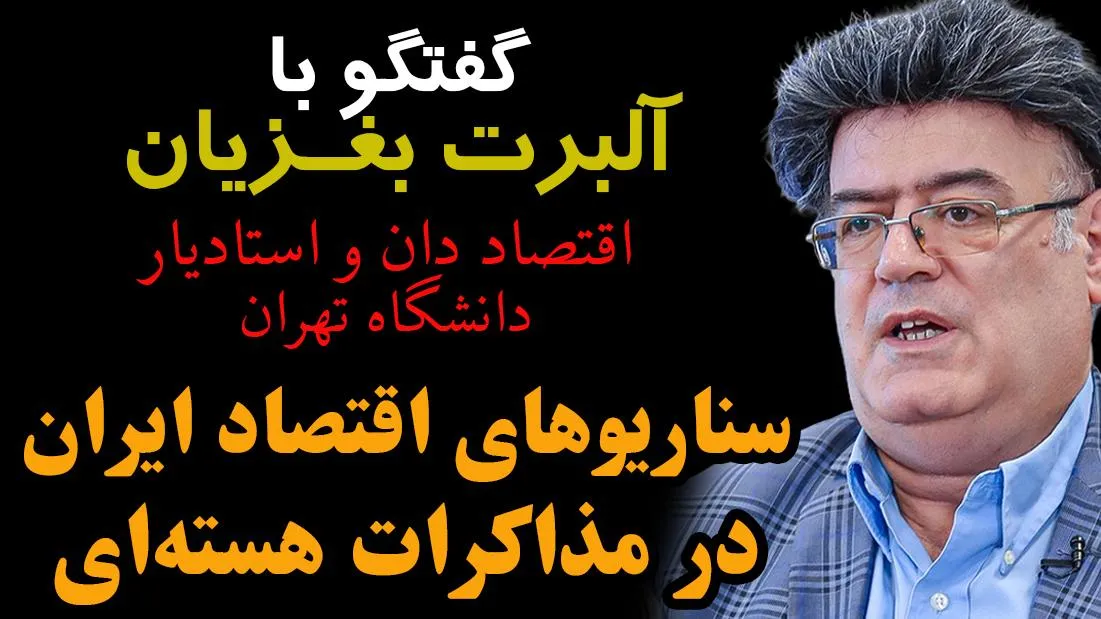
Today all eyes are fixed on one point: the closed-door negotiations between Iran and the United States. The market has fallen silent. The dollar and gold are rising and falling, investors are watching, and people are waiting. We have neither definitive news nor a future that is clear. In such a situation, we must ask: if an agreement is reached, how will Iran's economy react? If it is not, what scenarios should we expect? Does Iran's economy have the capacity to withstand more pressure, or is it in a gradual collapse? Does the government really have a plan for the conditions ahead? We are talking about the people—people who have become desperate and are left asking, "What should we do?" They are looking for information so they do not lose their modest savings in the gamble of politics and the market. Today I will discuss these very scenarios with you.
Abdi Media: In this program, I step away from the noise and together we get closer to the heart of the issues. We talk neither about baseless hope nor endless despair. Only reality, analysis, and perspective.
Today, all eyes are fixed on one point: the closed-door negotiations between Iran and the United States. The market has fallen silent. The dollar and gold are rising and falling, investors are watching, and people are waiting. We have neither definitive news nor a future that is clear. In such a situation, we have to ask: if an agreement is reached, how will Iran's economy react? If it is not, what scenarios should we expect? Does Iran's economy have the capacity for greater resilience, or is it in gradual collapse? Does the government really have a plan for the conditions ahead? We are talking about the people—people who have become desperate and are left asking, "What should I do?" They are looking for information so they do not lose their modest assets in the gamble of politics and the market. Today, I will discuss these very scenarios with you. I have the honor of being joined today by someone who has monitored and taught Iran's economy for years: Dr. Albert Baghzian, economist and assistant professor at the University of Tehran, so that we can share the realities with you in clear language and through analysis.
Albert Baghzian: It reminds me of a joke. They said, why does astronomy seem like a more exact science than economics? Even though we still don't know many galaxies. They said, well, stars don't experience shocks, so we're not in much of a hurry to understand them. Even if we get there a year later, the conditions are still the same. But I think even astronomers have come to help with our economy. I saw a clip where some people from astronomy were predicting Iran's economy for the year 1404, and they even took a jab at economists, saying their models don't work, so we turned to divination and astrolabes and things like that. Unfortunately, Iran's economy can be predictable, but I ask, why do we like to make it so ambiguous? In any case, my phone keeps ringing with friends asking that same question: what should we do, buy or sell? Not because they want to speculate. Even the Supreme Leader, at the beginning of the year and in the year's slogan, said that people should move away from speculation and not hold foreign currency and gold, but instead direct their money toward production. We ask: who pushed people in this direction? Our governments did. They created so much anxiety that people are worried even that today's salary will lose its value. So this current commotion, and even the silence, has created a series of concerns for those who have assets and those who do not. In my view, with this downward trend in the exchange rate—which we'll discuss, and I'll explain why I see it this way and others can share their opinions—will Iran's economy move toward improvement in 1404? Is there hope or not? I watch Iranian television programs, and the subtitles you see are all about price increases, imbalances, talk of introducing better support packages, and price increases that continue despite perhaps a 20 percent drop in the exchange rate and gold prices. This shows that this situation is not seen as permanent. So for now, let's ignore this recent period caused by the fluctuations and decline in the exchange rate. To me, it's like that series Bitter Coffee—let's pretend we don't have this part of the tape and just splice the two ends together. Iran's economy is facing imbalances, and this word "imbalance" shows itself in every issue. We either have undesirable surpluses or undesirable deficits, and we're supposed to fix them. Your question about Iran's economy is very broad, but by the end of the year we will certainly have last year's inflation rate, because I see no action whatsoever toward improvement or reducing prices or lowering production costs. The official exchange rate increased. The free-market exchange rate, which may represent only ten percent of the market, still casts a shadow over many goods displayed in shop windows and creates obstacles for sellers who want to raise prices. And the government itself, with what it has done regarding the negotiations and the ambiguity we see in these discussions—apparently no news is leaking out—we seem to be in a dark room, like in that famous poem, feeling the elephant, not knowing whether it's a giraffe or something else, and everyone is making a guess.
Abdi Media: Hopefully it's a cat.
Albert Baghzian: Yes.
Abdi Media: The point we touched on at the beginning is where Iran's economy stands now, and you gave us the overall outlook. The claim that the economy has collapsed—or whether an economy like Iran's can even collapse—is itself a discussion. If it can, let's unpack that, and then move on to the negotiations to see how much negotiations, as negotiations in themselves, affect the economy. How are they connected? How much of it has practical effects, and how much is psychological? First, let's see: when people say Iran's economy is collapsing, is that actually possible? What would have to happen before we say the economy has truly collapsed? Can it get even worse than this?
Albert Baghzian: I believe our economy is settling into lower levels of equilibrium. It's as if we're being pulled down to lower floors, and income distribution is becoming more unequal. The upper groups—the eighth, ninth, and tenth deciles—are the winners under these conditions. In an inflationary environment, we say this from the very first semester of introductory macroeconomics: inflation benefits these people. So they move toward luxury lifestyles, and we see that happening. On the other hand, the first, second, and third deciles—the lower classes—their lives are multiplied by a number smaller than one, becoming weaker, and with the slightest push they fall even lower. As a result, the middle is emptied out. The economy becomes split into two phases.
Some people say it's collapse. Some foreign channels portray Iran's economic deterioration as extremely severe and talk about collapse, disintegration, or destruction. But I think we're in a lower-level situation. What we're saying is that the weaker segments of society—the ones who bear the brunt of the issue—become even poorer, while the rich become richer. This leads to crimes ranging from snatching a mobile phone to major thefts and embezzlement. When there is embezzlement in a country, it means there is money. That distribution of money, well, we should really define some characteristics for it. It may be worrying for some people, but not collapse. What we're experiencing is moving toward lower welfare, and this lower welfare is somewhat softened by support packages—packages that Parliament usually insists the government provide. The pressure becomes somewhat lighter, people get used to it, and we will never reach collapse in the sense that the word actually means. Because we adapt, and with support measures conditions improve. With rising incomes and the trickle-down of benefits from the upper classes—after all, they have housekeepers, drivers, gardeners—they benefit, and some of those benefits flow downward. So no, in my opinion, not collapse in the sense that one day we suddenly see a building literally collapse and cause casualties. But inflation—at least if we view these negotiations for now as merely negotiations about negotiations—and given the current conditions, I haven't seen any improvement in any market except for the decline in the exchange rate, and that's become very obvious. Gold has also followed it downward. We might say the currency has fallen. But for now, this hasn't appeared as a sign of improvement, and our country will at least this year face inflationary conditions resulting from what we might call inflationary policies. I'm not saying they're wrong policies, but when everyone is focused on letting the market go and believes prices should reach equilibrium—the equilibrium rate that Dr. Hemmati referred to, which led to a twenty-toman gap from the official rate—it seems that with this decline from 68 tomans to 78 tomans, that gap was established. In other words, making the exchange rate unified solved nothing, and the rise to 105 tomans was due to intensified wartime conditions. Now there's talk of Sunday negotiations, and markets fell. I also have my own conclusion about how the decline happened and through what channel, but for now none of this has had a positive effect on physical markets.
Abdi Media: We've reached an interesting point regarding the exchange rate. But first let me ask something, because it's a specific issue, and I hope to include viewers' questions within these questions. You said there won't be a collapse. But perhaps collapse happens not when the economy suddenly changes overnight, but through the existing trend and economic policies—like the frog on the stove that's heated gradually. At some point the frog becomes paralyzed. At first it feels good, swimming in warm water, then it thinks it's in a jacuzzi and everything is fine, until suddenly it realizes it's being cooked. It seems the economy isn't exempt from this. Even though economics is the science of numbers, we can't ignore the possibility that something which is kept under control so society gets used to it might suddenly be rejected by society. Given the current trends and policies, especially this year, since everyone talks about it being a difficult year, do you think things could reach a point where people suddenly say they've had enough?
Albert Baghzian: Actually, another joke came to mind. Let's present it in the form of humor. They say there was an airplane, and people were ready for takeoff, but they noticed the captain and co-pilot hadn't arrived yet. Then a minibus stopped, and two people dressed as pilots got out, carrying canes and wearing dark glasses. People asked, "What's this?" They said, "That's the pilot." They asked, "Why does he have a cane?" They replied, "Well, he just does." Then they started tapping on the metal and the ground as they climbed the stairs. "How could the captain be blind? And the co-pilot too? They're both wearing dark glasses." People got worried, but then they thought, "No, that can't be. These are the same people who've landed planes before and worked this route. It must be a hidden-camera prank trying to scare us." They relaxed. The pilots boarded, and a couple of times the captain bumped his head into things. People became seriously worried. "They're actually blind! How could they let a blind person fly a plane full of passengers?" Meanwhile, the flight attendants calmly guided them into the cockpit, the door closed, and people reassured themselves that they'd worried for nothing. The plane started moving, and everyone relaxed, thinking it had all been a prank. The plane accelerated down the runway, but there was no takeoff. It kept speeding up. They were reaching the end of the runway, and there was a wall ahead. They were about to hit it. People panicked. This is the collapse we're talking about—they thought they'd crash and be destroyed. Then they reassured themselves again: "How could that happen? With all these airport systems, the runway, the control tower—surely it wouldn't just be abandoned." But the plane kept getting closer and closer to the wall. Finally, everyone screamed. At that exact moment, the plane lifted off and avoided the wall. Then people said, "Thank goodness. We really thought the pilots were blind, but no—they were just trying to scare us. Still, it wasn't nice. We almost had heart attacks." The plane continued on its route.
Now, what happened inside the cockpit? The co-pilot said to the captain, "Sir, today the passengers screamed right on time. Otherwise, we wouldn't have realized we were about to hit the wall." In other words, they really were blind, but the passengers' screams alerted them.
In my opinion, that's what we're talking about with collapse. As long as people don't protest somehow, as long as they don't express their concern by shouting and making noise, the economy just keeps going like this. Potatoes become more expensive, a thousand tomans at a time, until they reach 60,000 tomans. Then it becomes headline news: "What's happening with potatoes?" The government bans exports, grants import permits, the Central Bank has to approve them, and suddenly the market is flooded with potatoes. Then potatoes stay at 60,000 tomans. Next it's sugar. It keeps getting more expensive until people scream. Then the policymaker, the government, or the economy minister appears on television in a special report and says, "Yes, we became concerned too. You screamed at the right time." I say, isn't the economy minister supposed to have all the indicators on his desk? If prices rise by ten or twenty percent, he himself should tell people, "We've noticed this is happening. Don't worry." Instead of waiting until people reach the point of panic and protest before making corrections. That's how all these events have unfolded—they only become visible once they've reached a critical stage.
I was reading somewhere on Abdi Media that it said the Islamic Republic and its officials believe that no government has understood the people of Iran like the governments of the Islamic Republic have, and therefore no other government can interact with the people of Iran in this way, or, to put it another way, play this game. In other words, this understanding of the threshold of tolerance—the belief within the government that "we won't do anything until people start screaming"—may be one of the factors that has brought us to where we are today, and we can see where the economic situation has ended up.
Let's talk about the negotiations. Before getting into the negotiations themselves, I want to refer to the exchange rate you mentioned. From your perspective as an economist, I'd like to ask: what happened that after the news of negotiations, it went down by ten thousand tomans, fifteen thousand tomans, twelve thousand tomans, more or less—which is a lot. Fifteen thousand tomans means 150,000 rials. Has Iran's currency become stronger? Is that how we should see it, or has the dollar weakened? What place does this have in economics?
Albert Baghzian: We need to go back a few weeks and see that when the exchange rate stayed at 60 tomans for a long time—well, it had found itself—whether 60 tomans was the equilibrium, real exchange rate is itself debatable, because what does the word "real" mean? I believe there should be an exchange rate for the country—that is, the relationship between the rial and foreign currency, with the dollar as the benchmark—that can sustain a low inflation rate, say single-digit inflation, a desirable economic growth rate of around 6 percent, and appropriate wage growth. These all have to be maintained. As one of our colleagues says, that rate could be twenty thousand tomans or 150 thousand tomans. Has there been a study to determine which direction we should move it?
When we check body temperature, they say 37 degrees is good, or suppose blood pressure between 8 and 12 is good. For the country's economy, have we found an exchange rate within a certain range that should be maintained? I say yes. Let's go back to the time when I, Baghzian, or our respected listeners and viewers felt that with reasonable savings and decent consumption, they could change their house and car and move up to a better neighborhood every day. I think when it was between 4 and 5 thousand tomans, I had that feeling. With my salary and my expenses, I could imagine a good future. But now I can't. My salary has increased, but prices are such that if I want to move or improve my home's welfare, it's not possible, and even a small shock to my income pushes me down a step. So this isn't the right exchange rate.
Now let's say it stabilized around 60 tomans. When Dr. Farzin and his colleagues—although they didn't consider us worthy of collaborating—we had a few informal sessions at the Central Bank. They managed it. Many people said it was "currency dumping." Many congratulated them. I remember all our newspapers and news outlets were full of congratulations and expressions of satisfaction from many members of parliament. "Congratulations, the Central Bank's management was excellent. It's been at 60 tomans for a long time." Gradually, the currency market lost its appeal. People stopped thinking about keeping foreign currency at home or holding something to preserve the purchasing power of their money and, so to speak, getting rid of rials. They gradually started using the car parked in their garage instead of treating it as an investment asset.
Then what happened? There was talk of unifying the exchange rate. We saw capability in Dr. Hemmati and his team, and they said this decision had been studied and expert work had been done. The idea of a unified exchange rate was that we wanted to eliminate rent-seeking, so we moved the NIMA rate toward a new phrase called the "agreed exchange market." It's as if a group of Persian literature specialists were looking for a new word to popularize. Is "agreed" really different from "equilibrium" or "competitive"? No. Everyone wanted to say that the free market should get closer to the government exchange market. They were very confident that this would bring them closer together, but instead they drifted apart. It reached 80 thousand tomans, then 85 thousand tomans. From what we saw on the surface, this led to the impeachment of the Minister of Economy, and he was removed. Even during the period when we had no minister, it started to decline somewhat. But then what happened? The wartime situation and Israel's threats emerged, and the exchange rate rose to 105 thousand tomans. So from that starting point of 60 and then 80—now it's around 80—the thing that pushed it from 80 to over 100 was that event and those threats. Now those threats have faded. So around 80 or 78 thousand tomans, it has found itself—that is, around the time the agreed exchange market was introduced, it settled in this range.
Abdi Media: What's the connection?
Albert Baghzian: I want to connect it to this. The argument is getting a bit long. It reached 105 or 104, and the country's economic officials became concerned for the people. They started saying, "What should people do? What should we show them?" Before, we had pointed them toward the stock market, and after that stock market crash, people said, "Go buy gold." Then the Central Bank governor said, "Buy gold to preserve the value of your money," and I remember Americans saying, "Buy dollars." People thought, "If that's the case, let's go for that." Then we saw that gold imports were counted as imports. It was very interesting. When we discussed the trade balance, gold was counted as a commodity, which was interesting. For example, we had 8 billion dollars in gold imports. Gold imports are different from soybean meal. If we exclude that, we actually had a surplus. That became very concerning for us—that we imported gold so that at least people would have something valuable as backing for their money and for what they converted it into.
Abdi Media: Can we say that when the government imported gold, it knew negotiations were going to happen? Doesn't that count as market manipulation? After all, the government has access to insider information. The government knew negotiations were going to take place. It was obvious to everyone. If negotiations happened, what would happen to those who bought gold at those prices in the futures market? The pre-sales that took place, the rates announced for coins in futures contracts at that time—they were astonishing. I don't know how you interpret that. How does economics interpret it?
Albert Baghzian: In economics, I wish its principles had been observed in this area. What you're saying is like a weather reporter who says, "I'll tell you yesterday's weather because that's definitely correct." Until today arrives, I can't speak definitively about yesterday, and for tomorrow I have to wait. When it reached 105 thousand tomans because of the Trump issue—which also completely disrupted the trade front and involved threats against China and others—and on this side there was the issue of ending the Gaza war and the groups attributed to Iran supposedly being dismantled, the narrative became that Iran was isolated and supposedly ready for an attack. As usual, that pushed the exchange rate up.
But I have another issue: where exactly is this free market? We need to discuss that alongside everything else as a complete package. Where is this free market that one day the Central Bank finds on Instagram, or it's attributed to a Telegram site, or it's in Herat or Sulaymaniyah, or the rate comes out at 11 in the morning, or the dirham is announced, and the Central Bank just sits there as a plaything of this free market's supply and demand? I believe the Central Bank is actually fueling the fire. The Central Bank is like the local police station that knows who the neighborhood thief is. Fighting those thieves has a cost, but the thieves themselves can eliminate new thieves, and eventually it reaches an equilibrium. You can't reduce theft to zero, but you also can't just let it go.
The Central Bank itself manages things quite well through Tether. Maybe if this had been two weeks ago, I wouldn't have reached this conclusion myself, but when it talks about its Tether holdings and says, for example, "Tonight Tether is 83 tomans, and tomorrow the Iranian market will open at 83 tomans," that itself raises questions. Who determines Tether? The same goes for gold. When the metro walls, websites, and everything else are full of "Come buy gold," some people engaged in what they call selling nonexistent gold, and gold funds on the stock exchange also started attracting money into this. That became somewhat suspicious. It's like when people were told, "Go invest your money in the stock market—but don't sell your own house; sell your second house or extra property." Then the retreat from the stock market happened, and the government really should answer for the devastation suffered by non-professional investors.
No brokerage firm or major shareholder complained. None of them announced losses or destruction of their capital. The only people blamed were ordinary people. Ordinary people supposedly drove the stock market up, and then those same ordinary people supposedly brought it down and harmed themselves. It's worth discussing. As I said, the algorithms and the market makers in the stock market did their own work. That's why this rush of gold imports, combined with all the advertising and the Central Bank governor saying "Buy gold," really seemed like compassion if the negotiations hadn't happened. But now it has revealed itself. The very next day they're explaining why yesterday's sunny weather turned rainy and cloudy, and I can predict it with precision.
Listen to "Without Filter" on Castbox.
We were talking about this a month ago; we were laying the groundwork. Then Trump suddenly announced that starting Saturday we were going to negotiate with Iran. Then Iran announced that yes—although there was still some hesitation—yes, we were going to. Why did we have to hear it from Trump? Why didn't our officials announce it? If it had been in the works for a month, then this whole issue of 105 and gold coins above one hundred tomans—it's exactly what you're saying, like the stock market issue: sell it to the people, and people buy it hoping that the situation is dire and warlike, and the coin that the Central Bank is selling now is being calculated with a dollar at 150 tomans, 130 tomans. How much was this in the news? Well, that showed that the dollar still had room to rise. Some people also shared that famous table that went viral: with sanctions or without sanctions, the dollar would reach 250 tomans. Look, it was right: by the end of 1404, the dollar would be 120 tomans. Well, who prepared this table? What's its source? What model was it based on? But because the numbers matched the figures in the table, it was as if someone had put a prophecy, something based on the state of the universe and the planets, onto paper. Now it shows that the Central Bank knew. In my opinion, the government knew that we were going to sit down for negotiations and, in any case, reach a win-win result. But because it knew a month earlier, the uproar over currency and gold became exactly what drew people toward gold. As soon as negotiations were mentioned, that bubble deflated. That is, it artificially went from 80 tomans to 105 tomans. Therefore, the drop from 105 to 80 happened with this steep slope. And I believe that in the third and fourth rounds, what will happen is that this rate will fluctuate around this level, because if it goes any lower, the government's budget deficit will become acute, and capital outflows will occur. Right now, it's actually the best time for people who buy outside the country to convert rials and do it with a dollar that's 30 percent cheaper, which is dangerous. It's like a saw that wounds the country's economy no matter which direction it moves. When negotiations were mentioned, this rate declined. Why did it decline? Was it because people sold their gold and foreign currency? We blame the people. But why does Tether's rate fall at night, and then in the morning that same rate appears on the wall, for example on websites where the exchange rate became 83 or 85 tomans? Who determines Tether's price? Tether, which started falling from over one hundred and something until now? The Central Bank. This downward slope isn't because people are selling foreign currency or gold. Where did people suddenly rush? Did we suddenly see everyone flooding Republic Street? And does anyone know that now that it's declining, people are buying? This also deserves reflection. We should think about how that's possible. Is it supply and demand? Are people's concerns still there? Someone says thirty billion dollars is hoarded in homes. Recently, a scholar said one hundred thousand—one hundred billion dollars is in homes.
Abdi Media: Everyone says whatever they want; there's no meter for it.
Albert Baghzian: Where does that number come from? Unless we ourselves sold it and therefore know. So this decline didn't happen because of something in the country's economy. Electricity and the budget are imbalanced. Companies' liquidity is the same. The banks themselves are imbalanced. But they made their profits. We should discuss sometime how the banks became the winners of this collapse. How did exporters who had foreign exchange commitments sell their currency at over one hundred and something and come out ahead, then settle their debt to the Central Bank at 80 tomans? It's worth discussing. How did they know? Did they know negotiations were about to begin? Well, in my opinion, it's somewhat unfair that the government knew this was going to happen and pushed things to the brink, as if we were crashing into a wall, while people were screaming, and then the first round of indirect negotiations began. Nothing has really happened in the markets yet. Believe me, if you go looking for a particular brand, you'll see it's not available in the market because they're sure this is temporary. And if negotiations continue just for the sake of negotiations, meeting after meeting, with all this secrecy about what's actually being discussed, then after people suddenly formed non-inflationary expectations, inflationary expectations will form again. We hope it reaches a result, that the warlike situation disappears, that sanctions are gradually lifted, that Iran's money returns while preserving missile deterrence, because Iran needs military power; otherwise, its neighbors in the meantime—
Abdi Media: Our discussion isn't political; it's economic. Politicians make those deals with each other. They sit at the negotiating table, give 60 percent, give 40 percent, give missiles, don't give missiles, give up this place or that place. Let's not leave the economic discussion. Your remarks are respected as someone who loves his homeland. Everyone wants to preserve the integrity of their country.
Every negotiation has groundwork. I've written many times that negotiations that have been lubricated and moved from one level to the level of political negotiations definitely have a prelude. When a guest comes to your house, you have to do some shopping. These things are obvious. They don't reveal themselves during the gathering itself; the preparations for that gathering have been made by both sides for a long time, perhaps even before Trump became President of the United States. These are political discussions. What I wrote in my analysis was that intelligence-level negotiations had taken place, they were satisfactory to the leaders of both sides, and that satisfaction led them to turn to public direct and indirect negotiations, though there's debate over that. This itself shows that senior officials were aware of the negotiations, and the results of the negotiations—I say these signals show themselves. Who owns foreign currency in the Islamic Republic?
Albert Baghzian: The biggest holder of foreign currency, and the institution that has the continuous flow of foreign currency coming to it and distributes it, is the Central Bank. So we'd have to be very naive to think that a group called the free market, supposedly made up of supply and demand—we studied this for years, took exams on it, and say yes, the market determined it—but then at eleven o'clock on a holiday, Tether's price changes because of the Central Bank. When you say the Central Bank—if the Central Bank doesn't know what's happening, then heaven help that country. The Central Bank is responsible for the domestic and foreign value of the currency. But for some time now, our Central Bank has effectively been following fiscal policy. Whenever there's a budget deficit, they create scenarios for the people, raise the exchange rate, sell, cover the deficit, then bring it back down and accumulate again. This is because of distrust in the government. I'm an economist who distrusts my fellow economists. The same person who was teaching in a classroom yesterday is today a president or a minister.
Abdi Media: I will present a document to you so that the viewers can also be informed. Mr. Sheikh Hassan Rouhani, the then President, in a cabinet meeting speech dated June 24, 2020, made a statement. I'll quote it exactly for accuracy. Mr. Rouhani said: "At the same time, exporters should know that this foreign currency belongs to the government. Those who sent foreign currency abroad did so with engineers and workers who were trained by our schools and universities, with subsidized energy, with transportation that received subsidies, and with workers whose salaries are paid by the government. Therefore, a large part of the work was carried out by the government. The late Imam's fatwa was also that foreign currency belongs to the government, and its price also belongs to the government. Therefore, we are the owners of the foreign currency."
I will also present another document. In the book *Imam Khomeini as Narrated by Ayatollah Hashemi Rafsanjani*, on page 313, it says: "The main source of foreign currency is the oil currency that we earn by selling oil and receiving its payment, and this foreign currency belongs to the government. Of course, this is also the Imam's opinion." In other words, there is a fatwa based on which the government, regardless of economic theories and considering that it holds most of the foreign currency, regards itself as the owner of the exchange rate. Naturally, an owner can do whatever they want with their property, including manipulating it by increasing or decreasing it. I don't know if you have any thoughts on this theory and fatwa; I'd be happy to hear them.
Albert Baghzian: There is no doubt that central banks manage exchange rates. The world's exchange rate systems initially, when the discussion was about the gold standard, defined an exchange relationship. Later, for example, America said 35 dollars, and England said one ounce of gold was 14 pounds. Therefore, one pound was two and a half dollars. There, the exchange rate was derived from gold backing. Later, the backing became the country's economy. Therefore, a country that has production can inject more money into circulation because circulation has not been properly established. Now America increased dollars, Iran increased rials. What is the exchange rate between the rial and the dollar? The central bank determines it. Therefore, central banks are responsible for exchange rates.
As for owning the foreign currency, if a country is an oil exporter, most of its foreign currency inflow comes through oil sales. The foreign currency comes in, but the government itself has no direct use for foreign currency; it wants to spend for its budget. So it has to convert it into rials. It sells it at a certain rate, takes rials from the people, and gives the foreign currency to importers to carry out imports. In other words, in the world, if there is supply and demand for foreign currency—not gold—it is because importers need the other country's currency to buy goods from there, and exporters provide their own country's currency to that country. Now this currency may be the dollar as the dominant global currency. For a long time there was discussion about the euro, then the euro faded, and now the yuan has become a topic.
Therefore, saying that foreign currency belongs to the government—well, when it exports oil, the foreign currency belongs to it. But ultimately it is for the people. It should reach me in the form of subsidies, salaries, and so on. Even the U.S. government and the French government do not say, "This euro or dollar belongs to me." But yes, they can set the exchange rate in a way that serves those three goals: economic growth, price stability, and inflation control.
Someone asks why the Saudi riyal is worth more than the Iranian rial. It's different. Don't look at it as if the Iranian rial is weak. They have defined a relationship, and that relationship still works. For example, if you withdraw three or four hundred thousand tomans from an ATM there, you've ultimately withdrawn about 4 dollars, whereas a hundred-dollar bill circulates there. This shows that we've been very unfair to our own rial.
There was even a booklet that the Central Bank had produced as a planner or calendar. They had said, "Give this to your friends as a gift." It contained every banknote from the 100-rial note up to what I think was our highest denomination, the 10,000-rial note. As a joke, I added them all up, and it came to around 27 or 28 thousand tomans. Then I told my friend at the Central Bank, "It's still not even one dollar. All these banknotes together don't make one dollar." Now it's not even one-third of a dollar—that booklet containing all the country's banknotes. Well, this shows we've been very unfair. The Central Bank is indeed responsible for the exchange rate—let's say for that amount—
Abdi Media: It's shameful.
Albert Baghzian: The language of economics in the world is different from these kinds of expressions.
Abdi Media: As an Iranian, I feel ashamed. It gives me a bad feeling. This money in my hand—I don't know—you put a picture on it because you wanted to give it credibility, but this is the money people hold. I don't know how someone at the Central Bank feels when printing money. I truly understand that it must be very difficult to print money whose paper is worth more than the money itself.
Albert Baghzian: I have no doubt that sanctions have had an impact. They have had their effect, and this devaluation of money, this inflation, and the fact that one share of a single cucumber is more expensive than one share of Iran Khodro all show the direction in which we've taken both the domestic value and the external value of our currency.
You and I are subsidizing the government. Some people say, for example, that a university faculty member earns 40 million tomans—
Abdi Media: You mean taxes?
Albert Baghzian: While we're talking about why my salary as a faculty member in Iran should now be only 400 dollars and then taxes are deducted, whereas if you told someone outside Iran that they earn 400 dollars, they'd laugh. Then they say, "Look at their living costs; they're proportionally lower." I say, fine, but don't say the government is subsidizing us. You and I are serving the government for just a few dollars an hour. We are the ones providing the subsidy. In fact, we have a negative subsidy; the net subsidy is negative.
But whenever we say this, they respond that electricity is subsidized, water is subsidized, gasoline is subsidized. Then why should I have to buy a car at twice the price of the UAE, but not be allowed to have cheap gasoline? Because with my salary I'm already paying for that subsidy.
So no, in my opinion, regarding your question about who owns the foreign currency: whoever sells something and brings in foreign currency owns it. The government sells oil, but oil is public wealth; it belongs to the people. The government manages it, the Planning Organization allocates it, but the Central Bank determines the exchange rate—not the free market.
Find me a place in the world, apart from two or three countries, where there is a free market operating alongside an official market. Well, yes, go to Venezuela and you'll see a huge gap. Some people prefer to sell dollars on the free market rather than obtain them from the government and then profit from the rent-seeking opportunity. But in the world, the free market doesn't work in such a way that the exchange rate has to come from Herat, and then the Central Bank says, "I shut down a Telegram channel, and that's why the exchange rate stayed at 50 or 60." That's an oversimplification.
As for what goes on inside the Mirdamad building, I myself would very much like to know, because I'm teaching something in class, and we're teaching students in a way that may not reflect what actually happens in the country. But what they teach in European and American classrooms is the same thing that actually happens.
The Fed says, "I'll move interest rates in this direction." Trump says, "No, you should move them in that direction." The concern is whether he can interfere. That is what central bank independence from government policy means.
But in our case, we say the government raises the exchange rate to cover its budget deficit. That means distrust. Is there any country where people distrust government policies this much and refuse to accept them? There are very few examples.
Abdi Media: If negotiations happen, what scenario lies ahead? Which direction will the economy and prices go? And if they fail to reach an agreement? If the negotiations continue, in any case, it's not as though the next meeting will be at the expert level and then the following meeting they'll say we've reached an agreement and this is how the nuclear issue will be handled. It will take some time. What scenario lies ahead for the people of Iran? Let's explain it for the people.
Albert Baghzian: If we assume that these negotiations benefit both countries, meaning they've come to the table with their national interests in mind, even if indirectly, then the U.S. has realized it needs to reach some kind of agreement with Iran because its global interests are tied to that, and Iran has also reached the point where we're hitting a wall. So the pilot carries out the flight. The fact that we're already seeing effects from just this one round of indirect talks, without any news, without even a single photo from these meetings, with the dollar falling from 105 tomans to 80 tomans, is a good sign that part of our problems, especially our exchange rate, is tied to sanctions and negotiations. And if this continues, it probably won't keep falling at the same pace, but I think there's room for about another 5 tomans around this 80-toman level.
Abdi Media: Come down lower.
Albert Baghzian: It's the exporters whose voices are being heard. There is the government's budget deficit. If the sanctions gradually ease and the blocked funds are returned, we need to think of a solution for the imbalances.
Abdi Media: Under positive conditions, what is the floor for the exchange rate?
Albert Baghzian: If the agreed currency market, which still hasn't reacted, remains in place but the free-market rate has fallen, it's as if I'm saying the free-market rate accounts for ten percent of the economy's foreign currency needs, and that's for smuggling. But for constructive and productive things, we allocate foreign currency. It may happen sooner or later, but it gets done. We also allocate currency for mobile phones and car imports. So it's there for medicine too, but a balance has been established where we allocate one billion dollars for it. Therefore, I believe that if the negotiations end well, don't disappoint us, and don't fall into a vicious cycle where by the fifth or tenth round most countries' foreign ministers are involved, and Oman is present there too, if they reach a promising outcome and this becomes a starting point for future meetings and then bargaining over figures and numbers, I think the exchange rate will ultimately come down by at most 5 tomans because on the other side we have obstacles preventing further declines. Now prices have to show themselves. Nothing has happened to prices yet. Apples are still 50 or 60 tomans at the produce market, and bananas are now 200 tomans. We never had these numbers before. But if that happens, it shows that our production sector, let's say our merchants, have become convinced that this exchange rate is lasting. Not yet. I really hope this happens and people don't become discouraged. But if it reaches a deadlock, we don't know what will happen on the other side.
There was a historical incident. They said they wanted to test-fire a cannon during the Qajar era. The cannon was fired and exploded right there, killing 4 or 5 artillerymen. Then the commander said, "The place where people were killed, what's happening over there?" Meaning, we lost 4 people here, so what happened where the cannonball landed? Even though the explosion happened right here, nothing happened on the other side. In fact, the point they were making is that politicians can give hope about this.
Abdi Media: How far could the dollar go?
Albert Baghzian: It has no boundary. It moves step by step. It pauses, then a chart appears, a chart whose source is unknown. Somehow, some people—this is interesting too—like that famous artist who said, "If the dollar goes from, say, eight tomans to ten tomans, would you be happy if it fell from twenty tomans to eighteen?" Right now we're happy even though eighty tomans is a high number. But the dollar and gold are lagging behind. The dollar and gold are much further behind than wheat and the coffee used for espresso, for example. The cheapest things are still the dollar and gold. If goods stay where they are, furniture and chandeliers have grown much more than these. What has happened to rice? Other than exporters wanting to export potatoes and bring back those dollars, they even sell them more cheaply but then turn the dollar into one hundred tomans or eighty tomans. Why should people here have to buy potatoes for twenty tomans? We have something in economics called imports. Yes, he wants to export, let him export. Never ban it. We should allow imports to open up. There is a solution. We never ban a commodity; instead, we use tariffs. We banned many goods, including car imports. In the free trade zones, where I'm actually based, do you know how many applicants are waiting in line if imports are opened? When Trump imposes a one-hundred-percent tariff on Chinese goods or others, he says let them become expensive; he doesn't ban them. Let's see how people react to that price. We call it price elasticity. We should work with that. That's why our exchange rate has no boundary. It keeps rising until it reaches a certain number, then people start complaining, then the Central Bank intervenes, it comes down by 5 tomans, then we allocate foreign currency for things like medicine again, it catches its breath until the next round. It's like a staircase with a landing where it rests, then it rises again. If the situation becomes severe and reaches a wartime stage, no number can be imagined. The housing recession itself shows that such a thing could have happened, meaning converting housing into foreign currency. But when everything rises, including housing, it shows there is no collapse underway. In other words, the exchange rate and everything else all benefit together. Anyone who owns anything has profited. But the concern is capital flight. If the exchange rate falls, some people leave. Neighboring countries have plenty of advertising saying, "Come buy a house," and they even make their houses more expensive than before. It doesn't allow it.
Abdi Media: Come a little lower.
Albert Baghzian: It's the exporters whose voices are heard. There is a government budget deficit. If sanctions gradually ease and the blocked funds are returned, we must think of a solution for these imbalances.
Abdi Media: Under positive conditions, what is the lowest the exchange rate could reach?
Albert Baghzian: If the agreement-based foreign exchange market—which still hasn't really reacted—remains in place while the free-market rate falls, it's as if I'm saying that the free-market rate represents only about ten percent of the economy's foreign currency needs, and even that is mainly for smuggling. For productive and manufacturing activities, we allocate foreign currency. It may happen sooner or later, but it does happen. We also allocate currency for mobile phones and car imports. The same goes for medicine. A balance has been established, for example by allocating one billion dollars for that purpose.
So I believe that if the negotiations reach a good outcome, don't disappoint us, and don't fall into another endless cycle—whether it's a fifth or tenth round where foreign ministers of various countries meet with Oman also present—and if they produce an encouraging result that serves as a starting point for future meetings and bargaining over figures and numbers, then I think the exchange rate could ultimately fall by about five thousand tomans at most. On the other hand, we also have obstacles preventing a larger decline.
Prices themselves still have to react. Nothing has happened to prices yet. Apples are still fifty or sixty thousand tomans in the wholesale market. Bananas are around two hundred thousand tomans. We had never seen such numbers before. But if that positive outcome happens, it will show that producers and merchants have become convinced that this exchange rate is durable. Right now they are not. I sincerely hope that happens and people are not disappointed. But if negotiations reach a dead end, we don't know what will happen on the other side.
There is a historical story from the Qajar era. They wanted to test-fire a cannon. When they fired it, it exploded immediately where it stood, killing four or five artillerymen. The commander said, "The place where it hit—what happened there?" even though the explosion had happened right where they were standing. The point is that politicians are the ones who can create hope.
Abdi Media: How high could the dollar go?
Albert Baghzian: It has no limit. It moves step by step. It pauses, then those anonymous tables appear—the ones nobody knows the source of. Interestingly, some people react just like that famous actor joked: "If the dollar goes from eight to ten thousand tomans, are you happy? But if it falls from twenty to eighteen thousand, are you happy?" Today we're happy even though eighty thousand tomans is already a very high number.
In reality, the dollar and gold are lagging behind other goods. They're still cheaper than products like wheat or coffee used for espresso. Furniture, chandeliers, and many other goods have risen much more. Look at rice. Why did this happen? Because exporters prefer to export potatoes, bring back dollars, and even sell abroad more cheaply because they can convert those dollars at eighty or a hundred thousand tomans. Why should people here pay twenty thousand tomans for potatoes?
Economics has something called imports. Yes, let exporters export—we should never prohibit them. But we should also allow imports. There is a solution. We never need to ban goods outright; instead, we regulate them with tariffs. We banned car imports. I'm based in a free-trade zone, and do you know how many people are waiting if imports were opened? When Trump imposes one-hundred-percent tariffs on Chinese goods, he lets them become expensive—he doesn't ban them. He wants to test consumers' price sensitivity.
That's why our exchange rate has no ceiling. It rises until people protest, then the Central Bank intervenes, brings it down by five thousand tomans, allocates currency for medicine and similar needs, and then it catches its breath before the next round. It rises in steps with resting points.
If the situation becomes severe and reaches a wartime stage, no number can be imagined. The housing market recession shows such a scenario could happen—people converting property into foreign currency. But when everything rises together, including housing, it means there is no collapse; all asset holders benefit. The real concern is capital flight. If the currency falls, many people will move money abroad. Neighboring countries heavily advertise buying homes there, and they've even raised their own prices compared with before.
Abdi Media: Demand naturally increases.
Albert Baghzian: There is no limit. The free market is managed through Tether alongside the steps set by the Central Bank. There are even new discussions claiming the Central Bank is increasing its Tether reserves and may gradually introduce a new currency. They're only rumors for now, but the Central Bank is managing the market.
Abdi Media: Since we've had one or two lighter conversations, I created an AI-generated image of Mr. Araghchi and Mr. Witkoff. I doubt you've seen it. It's on the screen now—they both have white hair, Mr. Witkoff looks much older, and they're still negotiating.
I wrote that although I said "the economy is being held hostage until next week," the psychological deadlock in society caused by political uncertainty and endlessly postponing decisions until "next week" has affected the economy and every market. There is stagnation everywhere. People who bought dollars and gold just to preserve their savings are now even more anxious.
I emphasized that this image of Mr. Araghchi was created by artificial intelligence. I wanted to draw officials' attention and ask them to think about these struggling people.
My suggestion to the public? Every day I receive hundreds of messages asking: "Should we buy gold? Sell it? Buy later? Will prices rise or fall?" The situation is truly unusual.
You mentioned earlier that economics and journalism are different from fortune-telling. We're not prophets. We can't predict everything. Many things are beyond our control. Economics is a science of numbers: if this happens, then that happens. But what political leaders decide is beyond us.
Given today's risky conditions, what do you recommend people do?
Albert Baghzian: The question has an answer, but it requires speaking to two different audiences—the government and the people.
When people ask where they should invest, there's a difference between investing for national interests and investing simply to protect yourself. Ordinary people aren't speculators trying to profit from exchange-rate swings. They're trying to protect the value of money they earned through a month's hard work.
Someone wonders, "What should I do so my family won't blame me later? What if my wife or child says I should have converted my savings into gold or dollars when I had the chance?" That's emotionally painful.
Some say, "If I buy, and everyone else buys, won't that weaken our currency?" I say: Were you the main cause? No. You're only one part of a larger picture.
Did people rushing to buy currency really raise the exchange rate? I say no. Did people rushing to sell over the past few days bring it down? I also say no. Look at exchange shops and gold dealers. Their price boards update constantly. Where do those prices come from? They say the union. Where does the union get them? They say supply and demand. I'm in business myself—even I don't believe supply and demand explains prices changing in the middle of the night or Tether suddenly moving.
So my advice to people is to spend, save, and invest in ways that preserve the value of their money. One person may stock up on detergent. Another may buy rice. People simply don't want to pay more next week than they could pay today. They understand their situation. They're not causing the crisis—they're reacting to it.
My first recommendation is actually to the government. I say to the future Economy Minister, the Central Bank governor, and the head of the Planning Organization: you're pushing people in this direction. You've created distrust.
You told people to invest in the stock market—that happened. Then gold—that happened. You've made the economy unpredictable. I can't trust the Central Bank to preserve my money's domestic and international value, so I'm forced to protect myself.
It's like losing confidence in the neighborhood police. You install your own cameras and stand guard yourself. Otherwise, if they were doing their job properly, why would you worry?
The government should solve problems before people even notice. In Germany there's a saying: although relatively few Germans are religious, all Germans believe in their Central Bank. They went forty years without inflation. During COVID prices rose only three or four percent. That wasn't simply divine intervention—it was competent management.
Until the government creates stability, negotiates, circumvents sanctions where necessary, manages scarce foreign currency wisely, and brings inflation, growth, unemployment, and the exchange rate into reasonable balance, people will continue acting rationally from their own perspective.
Even though the Supreme Leader has encouraged people to direct money toward production instead of gold and foreign currency, as long as inflation and exchange-rate volatility exist, you can't realistically expect them to do that.
Right now people think buying gold is the correct decision because they expect prices to rise. Those selling think prices will fall. Everyone has their own expectations. Any decision to buy isn't necessarily wrong. It's late, but there's still an opportunity. Ironically, when prices fall, people immediately call asking whether they should sell or buy—as if they're unhappy even when prices decline.
When I served on the Competition Council, we managed car prices so that factory and market prices became nearly identical. People actually complained because they had expected to profit after waiting a year. Carmakers worried buyers would cancel their pre-orders. But once prices started rising again, everyone became quiet. Now pricing has largely been liberalized.
So I believe people's attempts to preserve the value of their money are understandable. They are consequences of distrust and poor economic policymaking.
Abdi Media: I received a repeated question from a fifteen-year-old girl. She has twenty million tomans. Imagine your own niece asking you: "Uncle, this happened."
She says: "I have twenty million tomans and I want to buy an iPhone. With twenty million I can't buy one outright. Should I buy it in installments now, or save more money? I'm afraid my savings will lose value."
What should Diana do?
Albert Baghzian: Recently I've repeatedly mentioned something called the "lipstick effect." People can search for it.
When inflation exists and you can't buy a better car or add another square meter to your home, you buy something smaller instead—cosmetics, a larger television, or a dishwasher for a tiny apartment. It's something you can still afford.
Today the closest equivalent is a mobile phone.
I'm not very optimistic that negotiations will quickly produce results. We keep hearing sudden announcements from the White House one day, then optimistic news from both sides the next.
Since exchange-rate declines haven't significantly reduced market prices—not even for phones—I would tell my niece Diana: if you have someone abroad who can bring the phone, do that. Prices there are calculated using an exchange rate of around twenty-two thousand tomans per dirham, while merchants in Aladdin Commercial Center calculate around twenty-eight thousand.
So if she can buy it now, my recommendation is to buy it.
Abdi Media: Thank you for your generous time. You're an economist and assistant professor at the University of Tehran.
I think this discussion became very deep and very precise. I encourage viewers to watch it again. Pay attention to Dr. Baghzian's underlying points—you'll find useful insights that can help clear away confusion and make better decisions.
I'd be happy to hear your closing remarks.
Albert Baghzian: I have a strong sense of patriotism. Sometimes people tell me that, as a minority, I could easily move to another country. I say: "I'm Iranian."
In my classes I've always tried not to be excessively strict. My first goal is that students become decent, ethical human beings.
My advice to people is this: these are difficult times for everyone, whether they're in income deciles eight, nine, and ten or in one, two, and three. Wealthier people may become unfair and put pressure on poorer people. Those under pressure shouldn't lose their humanity.
Someone may be tempted to commit theft or scratch someone's car just to feel better. Don't lose your ethics.
Unfortunately, many people now justify overcharging by saying, "I'm just taking my share from the economy because the government doesn't care about me."
I recommend that people first look after their families' interests. If they genuinely think buying something now benefits them, they shouldn't deprive themselves. Whether it's gold, foreign currency, or something else, they should make the decision they believe protects them.
At the same time, officials should think about national interests. When Trump acts against China, he says it's for America's national interest.
But above all, people should not lose their moral values.
Abdi Media: Thank you, Doctor.
Today we tried to better understand one of Iran's most complex and sensitive economic periods—an economy living under the shadow of nuclear negotiations.
I hope this conversation has helped you gain a clearer analysis of current events and monitor developments more effectively.
Complete interview between Abdi Media and Dr. Albert Baghzian, economist and assistant professor at the University of Tehran.


Take less than a minute, register and share your opinion under this post.
Insulting or inciting messages will be deleted.
Sign Up