
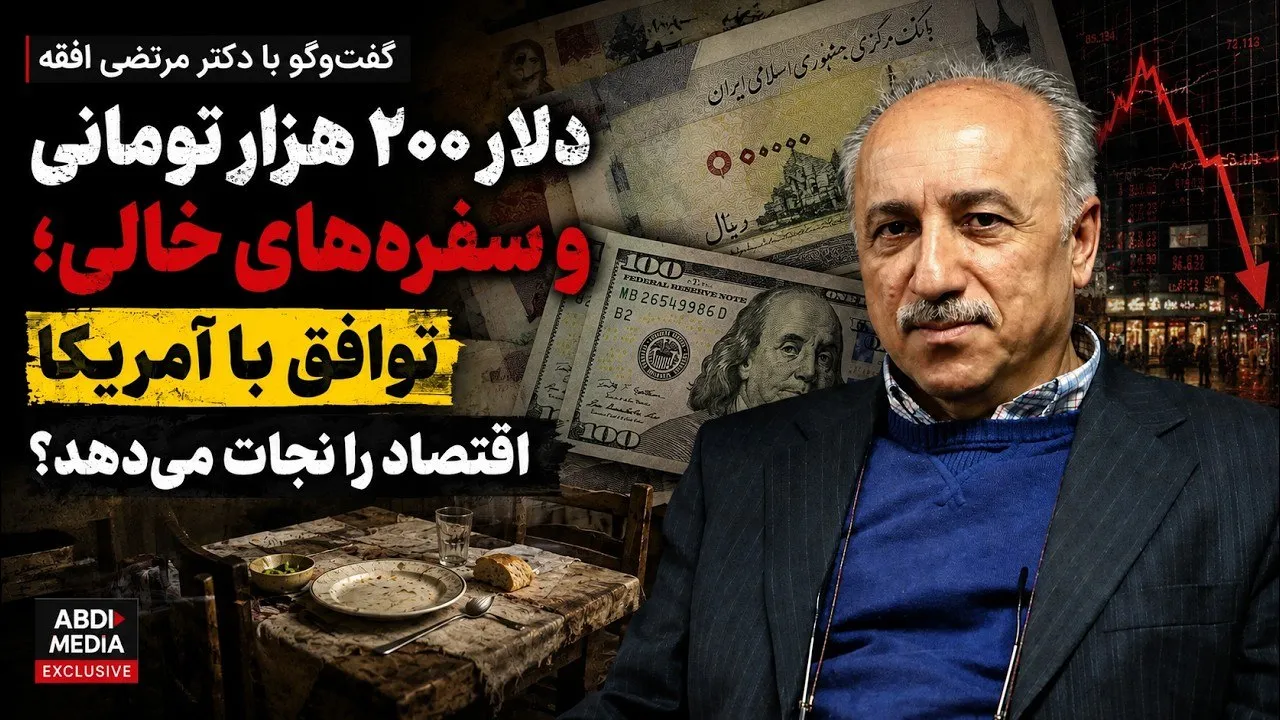
Our subject is the economy. The economy is not just numbers; sometimes numbers are the narrative of a nation's life. When the dollar crosses the 200,000-toman threshold, the issue is no longer merely the fall in the value of the rial. The issue is how many days a salary can buy life, what things a family must go without, and how much poorer a society can become and still endure. But one question may be more important than all: is what we see today the product of sanctions, or the product of a style of governance whose weaknesses sanctions have merely exposed in some way? If tomorrow Iran and America reach an agreement, what will happen?
Abdi Media: Our subject is the economy. The economy is not just numbers; sometimes numbers are the narrative of a nation's life. When the dollar crosses the 200,000-toman threshold, the issue is no longer merely the fall in the value of the rial. The issue is how many days a salary can buy life, what things a family must go without, and how much poorer a society can become and still endure. But one question may be more important than all: is what we see today the product of sanctions, or the product of a style of governance whose weaknesses sanctions have merely exposed in some way? If tomorrow Iran and America reach an agreement, what will happen? If sanctions are reduced, more oil is sold, and the dollar re-enters Iran's economy, will this country emerge from this economic crisis? Or will we just buy a few more years of time until we return to this same point again? On the other side of the coin, if there is no agreement, America's economic pressure intensifies, the shadow of war—what am I saying—war itself, attacks return, and people's purchasing power falls again, where is the endpoint of the Iranian society's economic tolerance?
This conversation is not about tomorrow's dollar price; it is about a bigger question: where is Iran's economy going? I am Abdollah Abdi. You are watching Abdi Media. If you find this kind of independent, frank, and unembellished conversation—of course without selling dreams, without addressing marginal issues—useful, subscribe to the Abdi Media channel on YouTube right now, ring the bell, and you can be informed of the conversations. Your support helps these conversations continue and the independent voice continue to extend, and we do not fear other directions, because we are together.
You are certainly aware of my guest tonight. My guest tonight needs no introduction; you see his face. He is one of the well-known figures of Iran's economy, Dr. Seyyed Morteza Afghah, an economist, professor of economics at Shahid Chamran University of Ahvaz, a researcher who for years has sought an important part of Iran's economic problems not merely in economic variables but in decision-making structures, the quality of governance, and non-economic factors. He has both management and executive experience and years of teaching and research experience at the university. And tonight I, Abdollah Abdi, have this opportunity to seek answers to my questions like a student in the presence of a professor, and through this, I hope these answers help you as well.
Let me start from today. The dollar has crossed the 200,000-toman threshold. Let me start the question simply: is today's economy merely in crisis, or has it entered a stage from which returning becomes more difficult every day?
Seyyed Morteza Afghah: The starting point of this program is today's situation, which is a good start. However, in order for the process—what happened that brought us here—I will first say a few preliminary remarks about the basis of my analyses in the forthcoming discussions. The definition of terms has an effect on the performance of officials, managers, and decision-makers. Therefore, if the definition is wrong, their policymaking will also be wrong and will diverge from the goals they have set. The first warning that the development path has traversed was the wrong definition. The definition of development—in any case, we want the country to reach development, the term that is known in current literature and everyone resorts to it. Development in the minds of our policymakers was limited to growth, meaning an increase in national income. Because when the decision-maker, the policymaker said we want to reach eight percent economic growth, what has been repeated in almost the Fourth through Seventh Plans that we are now in—and incidentally we have not reached it—and interestingly, we are repeatedly unsuccessful in achieving this goal, yet they again target the same thing. And it does not seem to me that they go after why this goal was set, despite the fact that many tools have been available.
Development, in my view, is an ethical, educational process whose one of its products becomes economic growth, economic welfare; its other aspects are also social, cultural, and political. Therefore, if development is an ethical and educational process, and as I define it, it is a process that transforms the undeveloped human being into a developed human being—then it is the developed human being who can be the driver of development. I said this preliminary remark to later say why, for example, after 2018 when the oil sanctions began, we returned to previous points. So the first point is that the definitions are wrong.
Another common mistake is one that, unfortunately, I must mainly say some of our experts, some of our educated people, especially our economics graduates, make: that we use the experiences of other countries. This is certainly necessary, needed, and desirable, but it does not mean that whatever other countries did, whatever path they took and succeeded on, if we take that path blindly, we will certainly reach the goal. Unfortunately, many of the imitations of the past three or four decades—I say many of my analyses after the end of the Iran-Iraq war, because the first decade of the revolution is not very analyzable—many of the goal-settings have been influenced by imitations that our experts or some economics graduates made from other countries.
For years, due to the political relations we have with other countries, especially Western countries and America, and especially after 2018 when we faced intensified sanctions, the active variable is the psychological-political variable, the economic variable. For this reason, here too some of our economics graduates give wrong prescriptions; they go about manipulating economic variables to reach the goal. It is natural that when the main and active variable is something other than economic variables, the effectiveness of economic policymaking will be low—which has unfortunately had these atmospheres over these three decades. Let us remember that economics is a human science, a social science, a subcategory of humanities and social sciences. One cannot analyze economics in a vacuum and prescribe. One must see economics in the social sphere and prescribe based on that. Unfortunately, again some of our economics graduates—whom I call superficial economics graduates—see economics in a vacuum, and many of the prescriptions they have presented until now and have not reached results, and this failure has led to extensive wasted opportunities and vast waste of resources, stems from this same seeing economics in a vacuum and merely giving economic formulas.
Another point that is again very common in the literature of some of these economics graduate friends is that they insist we must carry out economic reforms, and unfortunately by economic reforms they mean only price increases. Whereas in my view—which I will explain more in the forthcoming discussions—no economic reform will succeed without reforms in the non-economic sectors. Just as from Mr. Rafsanjani's era until today, there have been almost several rounds of these reforms in the view of the economic gentlemen, or the same price shocks, but the result has become worse and it has been unsuccessful. But unfortunately, friends still insist on this point. Development, as I said, is an educational and ethical process, therefore it is time-consuming. That is, there must be a series of measures to change attitudes and insights, especially among rulers, decision-makers, and decision-shapers. Therefore, changing attitude, changing insight, or education is time-consuming. Time cannot be removed from the development process, but it can be shortened, including through this very interview that you and I are having. And therefore, in my view, media can play a pivotal and vital role in the development process.
With these explanations, I will mention three prerequisites for a society to reach development, and then I will enter into answering your questions. A society—it makes no difference which society—in order to reach development must have these three prerequisites: 1- The society must want it. That is, we must bring society to a point where human beings do not have the concern of meeting their material and non-material needs at the level of society's custom, at the customary level that exists—I mean technology and available resources. This becomes the will for development. So the first prerequisite is—we said from the very beginning—that some views attributed to religious views say the world is not worth it. Well, this can be an obstacle to development. We do not have this in religious literature either, but in any case, unfortunately, in the view of some thinkers and even influencers, in the view of non-decision-makers, this view exists that the world is not worth it and one should not try too hard for it. If it is a decision-maker, it is not a problem. If the individual is a decision-maker, that thinking has its effect on resource allocation and policymaking. Unfortunately, we have had and still have this part in the country—I am speaking of resource allocation and budgeting, not of sermons and speeches and tribunes. 2- The society, and of course the decision-makers and decision-shapers, must be ready to pay the cost of reaching that goal, meaning the same goal of development. Here, by cost I do not mean money; I mean preventing or eliminating many beliefs, traditions, and views that are obstacles to development. It requires a series of trainings, patience, perseverance, and indefatigability. These are the costs of development that society must be ready for. And in the last point, which in my view is the most important prerequisite, is that in order to reach development, in addition to having the will for development and being willing to pay its cost, we must use the appropriate tool. This axis will be the entirety of my discussion throughout this interview. In my view, development means mastery over nature, meaning putting nature into service to reach goals—of course, putting it into service has another side too. Right now, humanity puts nature into service for destruction and war and so on. But development speaks of its positive aspect, meaning putting nature into service. Right now, this device that has connected you and me from two points in the world—people have known this nature, known materials, and made this device so that you and I can discuss together and send our discussions to all parts of the world. If we accept that development means this, or the tool of development is this, then we have only one tool, and that is human force, which through research, study, investigation, and reason and thought can know nature and put nature into service. Therefore, we have only one tool for development, and that is human force. This is one of those things that we have been neglectful of during these three or four times—not in speeches; in speeches they praise it a lot. What has happened in practice is disregard for human force. And this same disregard has caused them to inevitably turn to the non-human, and that is nature, because we had oil. During this time, we have made all economic variables reliant on oil and have been neglectful of human forces. Therefore, if we want to reach development, we must also cultivate human forces, give them developmental cultivation, give them training and expertise. In the area of training and expertise, in these past three or four decades, much good work has been done, but unfortunately, we have been neglectful in preserving and maintaining these human forces. And this is one of the weaknesses that, unfortunately, I must say the country has still not taken the path of development, because we have forced part of our human forces to emigrate abroad with narrow-mindedness. Incidentally, we have placed them at the disposal of other countries. Sometimes we call them the enemy. This does not mean these forces are not patriotic. Patriotism cannot be taken from anyone. Human forces, wherever they are in the world, are ready to serve their country, because patriotism and sacrifice for the homeland are part of human nature. Those who have remained inside, unfortunately, again the same narrow-mindedness, the same short-sightedness—we have either set them aside, eliminated them, or do not use them in the appropriate position.
Abdi Media: In any case, this dollar rate always somehow changes the balance—this piece of paper—this balance in Iran, and worries people. And now it has reached 200,000 tomans. It is a very large number. Perhaps just a year ago, if you told someone the dollar would become 200,000 tomans, they might have looked at it with a pessimistic lens. Now anything is expectable. Perhaps now if we say the dollar will become 500,000 tomans, we might pass by it with a smirk. This has become normalized. But in your opinion, considering this dollar of 200 and one thousand tomans, two thousand tomans—this banknote that is now traded in the market—in your opinion, has the economy entered a stage from which it cannot return? Is this economy returnable or not?
Seyyed Morteza Afghah: In general, yes, in my opinion, the country—both in terms of human force, which I emphasized a lot, and in terms of resources, the extent and diversity of climate, which can be said to be rare—whenever those structures are ready for change, they can return. Therefore, from this aspect I am not hopeless. The important thing is that attitudes and structures change, which is time-consuming. But in the short term, I will mention three prerequisites. But the fact that we are now facing a dollar of 200 and one thousand tomans was, in my opinion, not very unexpected; it was predictable, given the conditions we had. As I said, despite the fact that during the years of the revolution we chanted that we want to reduce dependence on oil, the movement and path we chose was not in this direction. That is, if we count after the Iraq war, all our policies have been reliance on oil revenues, neglect of human force—which of course has fluctuated, sometimes better, sometimes worse—but the trend has been disregard for elite force and resort to oil. When an economy is so dependent on oil sales on one hand, and on the other hand its production requires imports—a significant part of our production is dependent on imports from other countries, meaning about 80 percent of imports are capital or intermediate goods. This means that domestic production, although it is domestic, is still dependent on abroad. So when the economy has taken such a structure that on one hand it must sell oil to have the necessary foreign currency to meet consumption and production needs, then any factor that has a negative or positive effect on our foreign relations—immediately, I emphasize immediately—we can see its effect on economic variables. If the friends who are the audience of this program right now refer to economic indicators and their fluctuations—for example, if the dollar has been high and has come down, or the inflation rate, investment, whenever it has been high—these indicators, the positive indicators I am talking about, were certainly in that period either political relations with the outside world were good or the oil price increased. And whenever it was negative, it was the opposite. Therefore, we had this dependence until 2018, but because we could sell oil and compensate for the shortages, until 2018 these mismanagements and incompetences in policymaking were concealed. With oil sales and the import of goods or intermediate goods, we tried to almost preserve the variables. From 2018 onward, in my view, because oil sales decreased due to intensified sanctions, practically from this date the curtains were pulled back and many of the past mismanagements and incompetences were exposed. Therefore, it is natural that from 2018 our oil sales decreased. The governments—from Rouhani's era and then Raisi's, and now Pezeshkian's—it can be said that during this period under sanctions, either the treasury reached its end, or the government, in order to fund its budget in previous periods, especially resorted to selling state properties, state companies, borrowing from the Central Bank, withdrawals from the National Development Fund, until I think the beginning of Pezeshkian's term, almost in this order and in the hope that negotiations would happen and sanctions would be lifted. The hope was that the policymakers themselves certainly knew that in the long term it is very difficult for a country so dependent on foreign relations to continue its economy in equilibrium conditions. Therefore, in the hope that sanctions would end, either through negotiation or a change, for example, Republicans to Democrats, which happened but yielded no result, in this hope they used other resources and replaced oil. But with the beginning of Pezeshkian's term, it can almost be said that there was nothing left to sell, sanctions had not been lifted, and two or three devastating wars were also added in these 1404 and 1405. It is natural that an economy so dependent on foreign relations, especially advanced Western countries—our country of production, due to its historical background, was more dependent on Western countries. Therefore, the problems that occurred in our relations with Western countries naturally caused this trend. The war created devastations, the psychological effects of the war and sanctions were also added. Therefore, now the fact that it suddenly went from 190, 185 to two hundred thousand tomans is currently psychological effects. That is, Trump's new threat caused this price increase. How Iran will act—can it circumvent these sanctions like the oil sanctions, if anything has been added, because the understanding is that there are no new sanctions that America has not already imposed. But if there are new sanctions and more pressure, if Iran cannot circumvent these like previous cases, naturally we will have this trend of worsening economic indicators.
Abdi Media: A few minutes ago, news came that Scott, the US Treasury official, said we have taken a grinding process. Let us turn to people's tables. If we distance ourselves from macro statistics, let us turn to people's lives. Today, in your opinion, what is the greater danger? Is it inflation? Is it poverty? Or even the gradual destruction of the middle class? Which do you see as the danger?
Seyyed Morteza Afghah: Naturally, poverty is the most important, and the trend that has particularly occurred in these seven or eight years is the increase in the number of the poor, or the slide of the middle class below the poverty line, or their entry into the poor class. Poverty also crosses the economic boundary and has social effects and consequences.
One or two weeks ago, I was interviewing one of the journalists. He mentioned that now some petty thefts are committed not by professional individuals or those with a record, but by respectable individuals who are inevitably forced—for their family—to go to a store and take a package of cheese or other items. These are the destructive effects of inflation and, consequently, poverty. Poverty gradually has social effects, and social effects are also very difficult to return to normal conditions. In that interview, I said all human beings have a price of moral collapse. This does not mean there are individuals whose price is infinite and who under no circumstances have moral collapse. But the average tolerance of society has a limit. Therefore, the establishment must not let individuals reach that price, reach that level of moral collapse. If they fall, it is very difficult to bring them back. Therefore, the main danger now, in my opinion, is the spread of poverty. Alongside it is the spread of unemployment, which have a mutual effect on each other. Therefore, this is a serious danger and can have social consequences and political consequences as well.
Abdi Media: In your opinion, where is the endpoint of this livelihood resilience of the people? In terms of livelihood, is it possible that the people's patience overflows or ends?
Seyyed Morteza Afghah: It very much depends on the establishment's behavior toward the people, in my opinion. During the eight-year war, as far as we ourselves witnessed, we had almost one hundred percent social capital. That is, it was war, the hardships were much more difficult than today, but because the people were alongside, they endured all those hardships. But as we have reached today, the treatments, behaviors, discriminations—these have caused significant segments of society to be dissatisfied. If the people are alongside, they will endure more than this. Especially when their country is invaded by a foreign enemy, they participate. But if in these same conditions we do not have appropriate behavior toward the people, in my opinion, resilience will come down much lower. In the war period, the conditions were much more severe, but the people endured.
Therefore, my address is to the policymakers and decision-makers: in these conditions, especially regarding cultural and social issues that are sometimes again raised by some extremists—at least do not be strict on these for now, and of course do not be strict later either. The people themselves have enough economic problems; let us not add new problems. Besides, in any case, the people do not need education and propaganda either; they themselves are educated. They observe cultural and social matters based on Iranian upbringing. There is no need for this kind of laws and pressures. In my opinion, if the establishment balances its cultural and political behavior toward the people a bit, this level of acceptance and tolerance will increase.
Abdi Media: In your opinion, is the middle class becoming poorer or disappearing, from your perspective?
Seyyed Morteza Afghah: For now, it is becoming poorer, in my opinion. But if this same trend continues, the middle class can, in my opinion, also be in the process of disappearing. That is, this potential exists.
Abdi Media: This news I had mentioned from Scott Bessent—the US Treasury Secretary had said that America has begun an economic exclusion operation to cut off all financial arteries of the Islamic Republic, and he announced the beginning of a new campaign called this same economic exclusion operation against the Islamic Republic, and said the goal of this campaign is to cut off all economic arteries of the Iranian government and force other countries to choose between economic cooperation with Tehran or access to the American financial system. Today Scott Bessent gave a speech and said this operation has begun by Trump's order; its goal is the complete isolation of the Islamic Republic, and he said our goal is to cut off every economic artery that has kept this authoritarian regime standing, until Tehran is left alone. He said the Trump administration is no longer seeking to manage the threat of the Iranian government but intends to end it—in a way, Scott Bessent again speaks of regime change. According to him, the power of the American economy has provided the possibility of carrying out a long-term financial operation against the Islamic Republic, and he said the Islamic Republic faces two options: complete global isolation and an economy at the level of mere subsistence, or return to normal conditions and regaining access to the global economy. He said this economic exclusion operation is designed to eliminate the other options of the Iranian government, and warned that countries that continue to finance the Islamic Republic can no longer operate in the gray space, and said countries that side with the United States will enjoy the benefits of cooperation with America, and if countries that work with the Islamic Republic should expect to share in the isolation of the Islamic Republic.
An important part of America's new measures includes expanding sanctions against the Islamic Republic's activities in other countries. He said there are 5 areas: digital assets, technology, gold, aviation, and shipping. And he gave a specific warning to banks, companies, and financial institutions around the world. He said any entity that facilitates money laundering for the Islamic Republic—according to him—will be removed from the American dollar-based system, and he said the countdown has begun right now. How practical are these threats? Does this remaining capacity of this listless Iranian economy exist for these things to become objective, or should we again put it down to political statements? Can this threat take practical form? We witnessed much of the digital asset during these same attacks being closed. If you want to explain about this.
Seyyed Morteza Afghah: How much possibility there is of this threat materializing—well, this is not my expertise. Friends who have worked in political science and international relations can say. But a part is naturally psychological warfare, and this too is part of that same war. In my opinion, Trump, considering that he was not successful in military operations and is considered unsuccessful at least in his own country, has now turned to an action that I think is perhaps less costly than military operations. Well, he had expressed this same threat two or three [months/years] ago, and its psychological effects were the 200-toman dollar. But how much it will materialize, what reactions Iran can carry out against this, what capacities it has—I do not have much information about this. But the experience of past sanctions has shown that Iran also finds ways to confront these actions. How much these actions are, first, operational, how much other countries cooperate, especially countries like China and Russia or some other countries closer to Iran, how much they cooperate, and how much Iran can use them—it very much depends on what happens in practice. In any case, we are not now in a very favorable economic situation, and if these threats become more serious, it is natural that the pressures will be much greater. But I think Iran still has capacities to confront these.
Abdi Media: You use the expression "oil doping." You believe oil money covered up the existing inefficiencies for years. Exactly what was hidden behind the oil money?
Seyyed Morteza Afghah: Let me refer to the discussion I started with at the beginning. I think the root of the current problems is mainly internal, and external pressures—whether war or sanctions—have only intensified these matters. That is, we have a value system in the outlook of decision-makers and decision-shapers in which the priority of livelihood, welfare, development, and progress does not rank high, or at least is not first. A country that wants to reach development—as I said—the first rank is that society must reach all its needs, needs at the customary commercial level, as I said. In our value system, this priority belongs to political and ideological tendencies. This value system has shown itself in a system of selection and appointment. That is, the appointment and selection of managers and officials of the establishment—not only in the government sector but in all dimensions—again its criterion is the same political and ideological tendencies, which do not necessarily mean the necessary competencies for moving the country toward development. Therefore, when the officials of the establishment have their first priority as something other than development, or it has a low priority, the development path will practically not be smooth. Forces are selected that do not have high productivity. And this structure—meaning a structure based on livelihood and welfare being second or third or umpteenth rank, and then the forces selected for governance being selected on this same basis—an inefficient bureaucracy, a set of contradictory laws, directives, and circulars are passed. And its result is that during this time—if what happened in 2018 had happened years earlier, we would have had this same situation we have today minus the war issue. In other words, that inefficiency resulting from selection and appointment based on non-meritocracy, or better to say meritocracy based on ideological and political tendencies rather than competencies based on expertise and progress and development—therefore the conditions we have today have existed for years. But as I said, the doping of oil revenues prevented these inefficiencies and failures from appearing sooner than this. In 2018, when oil exports reached nearly zero, then increased somewhat through circumvention, those inefficiencies appeared. And practically from that same day, the severe increases in the exchange rate, or the severe decrease in investment, the increase in periodic inflation—this structure had existed before, but oil had prevented it. Oil was removed; practically that structure appeared.
In my opinion, as long as this structure exists, even if sanctions are lifted and the war ends, we will have these conditions, because structures are the main cause of these failures.
Abdi Media: We have witnessed that Iran experienced good economic growth during periods of oil revenue abundance. I want to know why we should consider it merely doping. Before the revolution, in the 1960s and especially the early 1970s, we experienced exceptional economic growth due to oil sales and oil revenues. How can this be analyzed?
Seyyed Morteza Afghah: As I said, you incidentally made a good point. As an economics graduate who studies economic structures, when I see economic growth, I go to see what the source of this growth is. If the source of growth is oil sales, it has no value. Not that it has no value—in any case you have an income increase, you import goods, you produce goods—but this is not permanent. Development is a permanent process. If it is to be permanent, development becomes a permanent process when it is connected to a permanent factor. Oil is not permanent, unless you use oil for investing in human force. Then you can use a non-permanent factor to make development permanent. Therefore, if growth was 11 percent or more before the revolution, we must know its source. It is no problem if it is oil too. We sell oil, spend part of it on production and buying goods, spend part of it on investing in human force so that it remains and participates in the development process. If this trend continues—we always sell oil, import goods or intermediate goods, produce the goods domestically—it remains temporary. Development is sustainable and durable and not exhaustible when it relies on human force, when its driver is human force, when its driver is reason and thought, when its driver is research that leads to knowing and putting nature into service. That you sell oil and import goods produced by others' thoughts—if you guarantee that this oil is permanent, one, and second, always has a buyer, and third, its price is always high—well, then I will tell you it is no problem.
Abdi Media: A contradiction has formed in my mind. I do not know how to answer this. Well, we experienced double-digit growth before the revolution in the early 1970s during Hoveyda's premiership, and this double-digit growth never happened after the revolution. The further we got from the early days of the revolution, from 1978 onward, the economic conditions got worse, worse, and worse. A slogan was given at that time during the 1978 revolution—which becomes somewhat merged because there is ambiguity in my mind; let me raise it with you. The slogan was: they said who took the oil? America. Who took the gas? The Soviet Union. Death to the Pahlavi regime. This slogan existed at that time. Now who took the oil? What happened to this oil money? Where did it go? This same thing—this same oil—for all the same problems you mentioned, why could we not again experience that growth?
Seyyed Morteza Afghah: The very thing I mentioned—incidentally, our slogan was that we want to eliminate our dependence on oil revenues, but we strictly did not move in that direction, because the thinking was something else. If your definition of development was that we want to train developed human beings, and then that developed human being becomes the driver of production and progress, then those double-digit growths would certainly have been repeated. You know, double-digit growth also has a capacity. Like today's advanced countries—growth is mainly three percent, four percent. Incidentally, this three or four percent is mainly from that same thought and intellect, not from nature. We have empty capacities. China also became double-digit despite its high population; India became double-digit at times; Malaysia became double-digit. But part of theirs in the early stages was from nature, not from the productivity of human force. Development or growth is valuable when its root is productivity, when its productivity is rooted in the human brain and thought.
Let me correct this point—this statement of yours: after the revolution we had two double-digit stages. In Rafsanjani's era we experienced 14 percent, which I criticized at that time and said this high growth is not something to boast about, because the capacities existed. The capacities had remained empty during the war period; we filled the capacities; we did not create new capacity. Two years after 14 percent, when the capacities were completed and we could not build capacity, the 14 percent growth suddenly fell to half a percent and one percent, because we were again reliant on something other than the human. Or Rouhani's era reached 12 percent after the JCPOA, which was also due to a temporary return. As I said, both before and after the revolution, as long as our growth is sourced merely from oil revenues or anything else—meaning anything other than the human—even if it becomes twenty percent or thirty percent, but is reliant on a factor other than the human, it is temporary.
Abdi Media: Does Iran's economy, without oil money, have the ability to continue this same model of governance?
Seyyed Morteza Afghah: No.
Abdi Media: I want to speak about this same challenge of yours and ask: regarding sanctions or governance, if you had to name one as the more fundamental cause of today's crisis, would you consider it sanctions or governance?
Seyyed Morteza Afghah: The main root is the manner of governance, but sanctions intensified it. For this reason, when they ask me what we should do to solve these problems, to solve the current problem, I propose a short-term solution: first, ending the war in whatever form is in the country's interest; second, the complete lifting of sanctions; and third, the resolution of regional and extra-regional tensions. Because there is no investment in conditions of regional or extra-regional tension—even if there is no sanction or war, but there is tension and threat—neither domestic nor foreign investment will invest. However, these are short-term. If tomorrow all three of these things happen, but if we do not accept that change of structures, we will still again sell oil and hang on it. In my opinion, our economy and the behaviors of our officials and even our people are addicted to oil, not dependent—we have gone beyond dependence. If we do not go after this dependence, we will repeat it for about two decades. In some media where I interview, I say this process is long; give a short-term solution. I said structural transformations are not short-term. If we had started two decades ago, until today the path would have been somewhat smoother. In my opinion, there is a short-term solution: war, sanctions, and tensions should be eliminated. The policymakers must determine how. But even if those things happen tomorrow, we will still be the same as we were before 2018 and in the past three decades—still dependent on oil—unless there is a change of method and insight in the rulers.
Abdi Media: In your opinion, is the main problem of Iran's economy Washington or Tehran?
Seyyed Morteza Afghah: Right now it is Washington in the current conditions, but I said that in the short term, even if that is resolved, we still have the main problem internally.
Abdi Media: Defenders of a single exchange rate say that a multi-rate exchange rate is a factory for producing rent and corruption. Why do you oppose the prescription of exchange rate liberalization?
Seyyed Morteza Afghah: Liberalization does not happen. Not that I oppose it—I had a meeting with Hemmati and I told him frankly: in the current conditions, you can never have exchange rate unification. Exchange rate unification is when the variable is not in the Central Bank's control, or policymaking is not in the Central Bank's control, or the domestic policymaker is not in control and it is outside their authority. That is, you see, when, for example, the American president says something positive or negative, the exchange rate changes. The policymaker cannot do anything, especially in conditions where there are restrictions.
Yes, if we have enough foreign currency to maneuver, the policymaker can intervene and be somewhat influential. You saw this happen, and in their own words they made it single-rate—it did not become single-rate. Last night I saw an interview with Hemmati; he said we will not increase the Nima rate for now, it is psychological and it will come back. At that very moment it was clear that liberalization means you fall into following the free market price trend. Liberalization can be positive when the domestic policymaker can bring the free market down toward the equilibrium rate desired by the economy. Right now, that situation, those conditions, do not exist. The friends who advocate the free market are unfortunately, in my opinion, among the main causes of a significant part of today's problems. From Rafsanjani's era, this group of policymakers—the same point I think I did not mention, another of the preliminaries I forgot—is that imitation of other countries has never yielded results. This does not mean we should not use the positive experiences of others, but it does not mean that whatever any country did, in very different conditions with very different structures, we too will certainly reach the same if we take that path. These same gentlemen said if we create free zones, free ports, we will become like such-and-such a country. We saw it did not happen. They said if you free prices—in the same Rafsanjani era they freed prices, inflation reached 50 percent, they were forced to retreat. Again in Ahmadinejad's, Rouhani's, Raisi's eras they did the same thing; they never reached the goals they stated. As I said, these gentlemen seem to recognize only price among economic variables, whereas in economics, price is one of the factors influencing demand. The first lesson we teach an economics student is that demand is a function of these factors—we mention several factors: price, income, the price of substitute goods, and so on. But then we want to say the relationship between price and demand is inverse; we say assuming other factors are constant. We have taken this "being constant" from Western macroeconomics textbooks. The one who saw and presented this theory—in their country, the other variables were either constant or near-constant. In other advanced countries that are stable, other factors like income are almost constant, the price of other goods is constant, expectations—most importantly—are constant. But when you are in a country where expectations are not constant—that is, you saw this same new threat from Trump, how much it influenced. Therefore, in such conditions, should we say raise the price and the economy reaches equilibrium? Besides, in crisis and war conditions, you will not find a country where the government has not intervened, where the government has not taken charge of all affairs. That the government is inefficient is another discussion. But in war conditions, which country did you see—in World War II, look, the government closes the borders so capital does not leave, it rations, it gives food vouchers, it does not allow prices to increase. Precisely in these same conditions where we should come and implement a series of supportive policies, these gentlemen say economic reforms. By economic reforms they mean price increases. No reform takes place at all. Take gasoline—right now it is 78 tomans.
Abdi Media: If we do not liberalize the exchange rate, how should we eliminate the rent from cheap currency?
Seyyed Morteza Afghah: I have said many times, in itself it is not negative. Right now, the same subsidy we give is a rent. At junctures, when there is inequality in the country, this policy has existed for years. All countries have had it; we too have taken it from other countries. To a deprived region, no investment will go—it will not invest unless we say you are tax-exempt for ten years, or we give you cheap currency. This is a rent, but it is a policy of reducing inequality. If someone misuses the rent, takes this money and does not invest it in such-and-such a region or place, but goes and builds houses—I have had this experience in the executive period in Khuzestan—then should we eliminate the rent? Or should we punish that individual? Right now, those who, in the gentlemen's view, misuse this rent and do not deliver it to the people are two or three hundred people; apparently they are known. If you cannot confront them and are forced to come and fine 80 million [people] with a price increase—because you do not want to confront those few—this is one point. Another point: the gentlemen say we will take this rent from the importer and give it to the people, with the same food voucher—which did not happen. You give this rent to the exporter who does not return the money. What difference does it make? The importer took the rent, sold the goods at the free price. The exporter—petrochemicals, steel—their sectors are private sectors, or even government managers, but you know we have statistics [showing] they did not bring the currency into the country at all. So you have taken the rent from one and given it to another. The problem is not the rent; the problem is that you could not use this good policy well.
Abdi Media: I want to enter the gasoline issue. In conditions where the dollar has become 200,000 tomans and we have severe livelihood pressure, in your opinion, is increasing the gasoline price an economic reform? Or in your opinion is it a dangerous shock?
Seyyed Morteza Afghah: It is a very, very dangerous shock, especially in the current conditions. And it does not seem to me that they can make this decision, or if they do, it is not advisable at all in the current conditions. Gasoline is not a commodity—gasoline is a commodity that, both due to the precedent we had in 2019 and because it has a psychological effect, also has a very large economic impact on the inflation of other goods.
This argument that the gentlemen make—I said somewhere—the gentlemen say we are giving hidden subsidies to the people with this cheap gasoline. Or it makes no difference; they bring up cheap currency in their view, or electricity, or other things. It is not only gasoline. In my opinion, it is the people who are giving subsidies because of the inefficiency of governance. That is, in my opinion, this inefficiency has caused the price of gasoline to rise. It is no problem—some gentlemen say the price of gasoline must become global. I say, very well, make it global, but on the condition that the dollar price becomes the same 4,200 tomans. Tell them—right now in America, for example, it is one dollar, one and a half dollars—calculate with 4,200. With your inefficiency, you have brought the currency to two hundred [thousand]. You say make the gasoline price equivalent to global at two hundred [thousand]. So it is the people who are paying the cost of inefficiency for this increase. Suppose gasoline became 78 tomans, the currency goes up. If it becomes two hundred and fifty [thousand], again you will not say the gasoline price must increase because we are giving rent? The endpoint of the gentlemen's talk is where? Where do they want to stop? They do not want to touch the roots, or they do not raise it. Unfortunately, they keep prescribing inefficient policies. Until now, you have seen its name three times—they have called it economic surgery. The first time, Rafsanjani proposed economic surgery. At that time, the same repetitive, tedious argument was that this surgery has pain but its effects are good; let the people endure its pain. Inflation in 1995 became 50 percent. Again in Ahmadinejad's era, when he wanted to carry out that price liberalization, he again said we have surgery—he said the exact same sentence: surgery has pain. Inflation reached 40 percent, and again we were forced...
Abdi Media: It has cancer. No matter how much you operate, it does not work.
Seyyed Morteza Afghah: Again in Raisi's era they operated with this same argument. Now Pezeshkian, instead of surgery, said it is bitter medicine but its effects are good. Its effects are never good. When a patient whose problem is at the root, you are giving another treatment that makes his condition worse.
Abdi Media: If they do not raise the rate, with this enormous energy imbalance they face, where should they supply it from?
Seyyed Morteza Afghah: They must do it in a way that gasoline is distributed among those who are in need. Right now it is very difficult for me to answer. Imbalance means perhaps no one can answer in the current conditions. I say the individuals must be—if you look economically, those who have the ability to buy gasoline at 78 tomans or 80 are identifiable. They should be sold to them. The best way is price discrimination. In microeconomics literature there is also price discrimination, meaning that one who has the ability and readiness to buy such-and-such a good at a high price, we sell it to him at that price. Right now this happens: in the north of the city, the same good that is in the south of the city at a cheaper rate is elsewhere at a higher price. Therefore, one way is that those who, for example, have expensive cars, [sell] them at the same free rate—of course, I said the free rate that stems from inefficiency also has a problem—but in the short term, for the problem to be solved, part of it, in my opinion, must be at a high price, provided they are correctly identified. But the vast impoverished masses who work on Snapp, the multitude of individuals who have become unemployed and work—right now the same car depreciation, with the price that has increased. One or two weeks ago I gave an interview; I said we are facing a phenomenon where the middle class has become—we are facing the poor rich. That is, his car has become expensive, but his salary and income are not enough to replace a part. He has an expensive but severely worn-out car; he works with it, and with the fare he gets, people do not have money. The poor Snapp [driver] who delivers goods by motorcycle—if one car part breaks, they cannot repair it with the money they earned. Raise the gasoline price—see what happens.
Listen unfiltered on Castbox.
Abdi Media: If gasoline becomes expensive, do you give the probability—this is not a very economic question—do you give the probability of social revolt, or do you think it has reached that stage? If the gasoline price increases—I read in many Telegram channels—in any case they say, given this economic blockade and the impossibility of importing gasoline, they predict that next month, after Shahrivar or early Mehr, the economic conditions, especially the energy conditions, will somehow become such that the situation becomes disordered and people somehow revolt. How much does this probability exist?
Seyyed Morteza Afghah: In the war conditions that exist, people may sometimes—at least their middle segment—consider the conditions. But yes, unfortunately this potential exists. The potential for political tension, social tension exists. Not only because of gasoline, because even right now if gasoline does not become expensive, unfortunately this potential exists, because the economic conditions of the people have become severely aggravating, social deviations have occurred. If gasoline also becomes expensive, as I said, its inflationary impact waves reach other goods, and this potential exists. But in any case, it is war conditions, and I cannot predict what will happen. In any case, the policymaker must have this consideration. In the current conditions, the potential for political and social tension exists.
Abdi Media: We spoke about the imbalance—energy, budget, banks, pension funds, and many other things are simultaneously facing imbalance. Which of these, in your view, can sooner turn into a bigger crisis?
Seyyed Morteza Afghah: All of them, in my opinion, have the potential to burst. Unfortunately, again this same word "imbalance" has become the code word for price increases—the same gentlemen. The friends who say—let me note here—the gentlemen, when we say prices should not increase in the current conditions, say economics says this. You will not find any scientific proposition that if such-and-such is not the case—meaning if there are conditions—then, for example, a price increase leads to increased production. I have also written in an article that the supply curve—for friends who are familiar with supply and demand curves—the supply curve, like many developing countries, has a very steep slope, nearly vertical. That is, production does not react much to price. Therefore, a price increase leads only and only to increased inflation. I am making this point. But all imbalances have the readiness to leave destructive effects. They will not disappear unless in the short term we solve the war problem, get through the period, the war ends, and [meet] the three prerequisites. Otherwise, we will face a serious problem.
Abdi Media: We are caught in a loop. In any case, every path, every path that wants to be reformed, has a cost. If this cost is not to be paid from the people's pocket—well, the people do not have the ability to pay—who should pay it? The government also has no money left.
Seyyed Morteza Afghah: I noted in one of my writings that the government truly has no money; its revenue sources have severely declined, both with the economic blockade and with the destruction that has occurred in some mother industries. But in any case, we have about three hundred billion dollars of national income. Until before these new events, I had not seen it. In my opinion, part of it—the government can cover part of the shortage from the ultra-wealthy who exist and usually have tax evasion. If it can—the inefficient structure of governance has also troubled the oversight bodies, the judicial body, the executive body, which are incapable, and the institutions and bodies that until now, due to legal provisions, were tax-exempt and had high revenues—if we also remove their exemption, part of this revenue shortage can be temporarily supplied. But I said, in the long term, if the conditions continue, the government will also face a serious problem.
Abdi Media: About subsidies and food vouchers, I want to ask: in your opinion, how much power do subsidies and this food voucher coupon actually have to support people's tables against continuous inflation?
Seyyed Morteza Afghah: None. The first experience of subsidy happened in Ahmadinejad's era. At that very time, the gentlemen economics graduates said let us take the subsidy from the importer, or from wheat and so on, take it from the bakery, give it directly to the people, let them go and buy at the free rate. I do not know why these gentlemen—although most of them are literate individuals—think in a vacuum. In my opinion, they are either superficial, or they have not paid attention to this: that inflation is partly from economic variables, domestic inflation, partly from inefficiency, partly from the inefficient selection and appointment system. Therefore, because that has not been eliminated, the inflation that is created is partly from the price increase that has occurred. These said let us, for example, make bread expensive, not give the subsidy to the baker, give it to the person. Bread became expensive; that subsidy lasted for one or two years, because inflation is growing at a rate higher than the purchasing power that the subsidy created. Then we keep the subsidy fixed, while inflation is increasing. Its result becomes—in Ahmadinejad's era it took one, two, three more years for that subsidy-created purchasing power to be erased. And unfortunately, because that subsidy in that Ahmadinejad era made many individuals with large households and high incomes [benefit], and he did not stay to see how destructive the negative results of his work were, many low-income individuals still imagine that Ahmadinejad, for example, if he were here, would work miracles. In Raisi's era, too, we saw that they removed the 4,200 currency with the same advice of the gentlemen, brought it to 28,500. Some even said 28,500 was low. They said let us give its difference to the people, and they did. You saw the subsidy became tenfold, but again it was completely clear to me as an economics graduate that this increase, with the inflation it creates—whose inflation is partly from outside the country, partly outside the government's control—therefore that purchasing power does not provide the necessary sufficiency to cover the created inflation. In Pezeshkian's era, too, we saw that again, unfortunately, the same friends came and said we will give the currency difference to the people, and you saw they compiled a relatively good food voucher, but it was erased from people's tables much sooner than previous times and practically had little effect.
Abdi Media: In your opinion, does the government still have the ability to support the poor? Or is it only managing poverty?
Seyyed Morteza Afghah: To this same extent. I said this at that very time. Later, friends said in the future we will increase the subsidy in proportion to inflation. I immediately said in my interviews: unfortunately, the government does not have the ability. Incidentally, there was no war yet. Before the war, I said the government does not have the ability to increase the subsidy, because eight years had passed since the sanctions, the government's treasury had run into trouble. Therefore, it had no money to be able to increase the subsidies or the food voucher. Now you saw that they practically reached the same conclusion that we cannot increase it.
Abdi Media: Let us go to the main question of the program—the subject of an Iran-US agreement. Let us assume, in any case—an impossible assumption is not impossible—assume tomorrow Iran and America became buddies, set aside the problems, reached an agreement, the oil and banking sanctions were reduced, foreign exchange resources entered the country. In your opinion, will Iran's economy be saved?
Seyyed Morteza Afghah: The root of the problems has nothing to do with this blockade at all. It was influential, it intensified it, but we did not have a resistance economy that could resist these inflammations, let alone war. Therefore, I said in the short term we do not have the opportunity to change the structures—if the establishment accepts that it is the cause and begins to change—because it is a gradual process. But from tomorrow, if those things you mentioned happen, yes, temporarily, in the first place, its psychological effect causes the exchange rate to decrease and inflation to stop for a while, until it turns into performance, turns into production—that also takes time. But its psychological effect can immediately lead to a ten to twenty percent decrease in prices. But after a while, production of goods may take place. This period I am talking about is at least one or two years, with these destructions that have occurred after the war and the problems that have been created. But the main problem, if it is not solved, we will still continue that addiction to oil. Again oil becomes a cover for inefficiency, and again we remain waiting for another event to happen. Two events may happen again: either the oil price severely decreases, like 1986 and 1998, or our political relations with the buyers of our needs and sellers run into trouble. Again we return to the point we are at, if the change of structures does not occur.
Therefore, in my opinion, the problems have non-economic roots but have an economic manifestation. This sentence is the preferred clause of many of my remarks. Many problems have only an economic manifestation—inflation, unemployment, low investment, low growth or negative growth. But because they have non-economic roots, they cannot be solved with purely economic formulas, or their scope of influence is limited—ten percent, twenty percent.
Abdi Media: Therefore, do you see the agreement as a cure for Iran's economy, or a painkiller?
Seyyed Morteza Afghah: A painkiller.
Abdi Media: Given that, in any case, simultaneously with the war, a change of macro management also occurred in the Islamic Republic—we have a new Leadership, although we have still not seen or heard any audio or image of him—how much do you think the governance structure may change?
Seyyed Morteza Afghah: It seems to me that the compulsions created after the war—meaning the problems created after the war—I guess the ground has been provided for that change of procedure and behaviors. Let me note here—again I noted before—when Mr. Pezeshkian took office, I published a letter addressed to him in the media and told him: given the conditions at that time, meaning eight years after the sanctions and even before the war, the country is not in a position to maneuver much on the economy with these inefficient structures. Therefore, try to at least remove those cultural, political, and social pressures that severely intensify economic dissatisfactions—internet restrictions, the hijab issue, the concert issue, and so on—other matters that unfortunately still exist. At least keep part of the social capital satisfied—that group of the middle class who have a voice and have access to media. We have two dissatisfied groups in the current conditions. One group is the economically dissatisfied, whose number has increased, but the lower three or four deciles are severely in trouble. They are dissatisfied and have the ground for tension, or the same blind riot of the poor—its ground is provided, and if it flares up, that too is dangerous. We have another group that also has an economic problem, but it is not very prominent. It is mainly problems arising from these cultural, social, and sometimes religious restrictions. These both have a voice and, unfortunately, have more space. If these restrictions are not removed, these two together, alongside each other, can create serious problems. Therefore, it seems to me that given the current conditions, the possibility that a change of procedure occurs both in cultural and social insights and attitudes and in economic policies—the ground may be somewhat provided. If, of course, that short-term—meaning the lifting of sanctions—happens. In my opinion, some of the things that happened in the past decade after the sanctions have provided this ground for a change of procedure to occur. And I hope this happens.
Abdi Media: Let us look at the opposite scenario. If no agreement is reached and the Trump administration, as we see, intensifies economic pressure, how much capacity does Iran's economy have to tolerate more pressure?
Seyyed Morteza Afghah: We do not have much capacity left. We have capabilities—we have good human force both inside and outside; everyone is ready to participate; we still have good resources inside. Of course, I have a caveat because of that same issue of the definition of wealth that I mentioned. Let me say that we also have resources, but we only have human force. I emphasize this: in the literature we only say we have one wealth, and that is only and only human force. Oil is not wealth; oil is wealth when human force turns it into goods. We have potential capacity, not with this manner of governance and management. Therefore, if this manner of management and governance continues, I almost doubt we can endure more than a few months. I guess our policymakers also hope that in the next elections the two American houses change and provide the ground for a compromise to occur.
Abdi Media: In short, Iran has also lived with sanctions for years and has somehow developed ways to circumvent them. We see in the officials' remarks in their interviews—while security officials also say these things. What can be different this time? Can Scott Bessent's remarks be different? Can these pressures actually increase, or has it already been released at its peak?
Seyyed Morteza Afghah: I say this quoting others, because I said this is not my expertise. But until now, what has been in America's power regarding sanctions it has done. Of course, these points it has stated force other countries not to cooperate. How much other countries—even countries other than China and Russia—comply, and how much they can secretly cooperate with Iran or not, very much depends on the policies Iran has toward this. Iran has gained experiences during this time to confront this type of pressure. Probably now too it is pursuing policies to neutralize or reduce its effects. For now we have seen its psychological effect in the market, but in the future it will become clear how much these threats have become operational and how much Iran has been able to confront them.
Abdi Media: Many speak about this—they predict that in the next month or two, meaning late Shahrivar and early Mehr, military tension will flare up again and America will again attack Iran. They raise this scenario very seriously. If the war scenario is added to this economic pressure—another war or another military attack is added to our country's conditions—where do you think the first serious blow to Iran's economy will be struck?
Seyyed Morteza Afghah: It very much depends on what those military targets are.
Abdi Media: The discussion of infrastructure is much raised.
Seyyed Morteza Afghah: If it is infrastructure, because the infrastructure is somewhat worn out—although in any case we are a vast country, the infrastructure is extensive in the country, and this is somewhat positive—but if those threats materialize to the extent that is raised, unfortunately we must say very, very serious problems will be created for the people and people's tables and people's welfare, and an unknown future will lie ahead for the rulers.
Abdi Media: There is also a dangerous scenario. In any case, they say Trump somehow found the hole, understood that these sanctions can perhaps be a more deterring factor, as they put it, for the Islamic Republic, and can somehow strike a blow from war, or stop them, or manage them, or whatever they interpret from it. Is it possible that this economic erosion continues for several years, and a situation of uncertainty for society—perhaps much more erosive—continues? Do you predict this?
Seyyed Morteza Afghah: It very much depends on the future of our relations with America itself—whether Trump continues or not—and the events that are to happen in November in American domestic politics. If it is to Trump's detriment... But in any case, if this trend continues—meaning Trump stays and this same trend continues—the resilience of the country and our infrastructure has become very, very low. And I said: from the very first day the sanctions were intensified, even when there was no war, my conception was that our policymakers from Rouhani's era assumed they could endure until Trump ended, and then the Democrats would come. And that happened, and unfortunately they did not use that opportunity either, due to these same internal disputes and, in my opinion, the preference of group and partisan interests over our national interests. We did not use that opportunity; we again got caught by a Trump who was unpredictable for the entire world and has also troubled many countries. Therefore, if Trump continues, in these two or three years the problems will become very serious. And if our policies cannot keep the Pakistan agreement or continue it, or the two sides return again—if we cannot—in my opinion we will face serious problems.
Abdi Media: If the agreement option is removed from in front of you, for Iran's economy today which is more dangerous: the continuation of the war or the continuation of this same situation?
Seyyed Morteza Afghah: In my opinion, both are the same length; war only intensifies it.
Abdi Media: I mean, if war takes shape, is it more dangerous for Iran's economy, or if this same situation continues—the sanctions and these same stories that exist?
Seyyed Morteza Afghah: Right now we are on the downward slope of serious crises of the country's economy and even the country's social conditions. War can intensify the end, or the endpoint, speed it up. Otherwise, if this trend does not change, in my opinion it will not reach a favorable point. War can push it forward.
Abdi Media: In your remarks you noted that you doubt the people can tolerate more pressure. What exactly do you mean by the end of the people's tolerance? From where do economists understand that the livelihood crisis is turning into social instability? Where is their interdisciplinary place, in fact? How can the link be made?
Seyyed Morteza Afghah: Right now many of those conditions have been provided. But perhaps this war has also convinced part of the people and convinced the policymakers to at least justify this—they justify many inefficiencies with the war and by convincing the people that it is war that has created these problems. But overall, right now, in my opinion, we are in that same fragile condition. Probably society still has this tolerance. I said there are signs that many of the middle class have been forced into some actions they were not willing to take—the media have said this. Therefore, right now that path is being provided. But I doubt that very soon, in the next year, that economic collapse will be provided. What happens after that, I do not know. I hope society does not reach that point.
Abdi Media: In Dey 2017 and Aban 2019, an important part of the economic protests formed from the less privileged regions or classes. This time we see that economic pressure is now breaking the back of the middle class and the lower class simultaneously, and is simultaneously involving them. In your opinion, this time will we face a different phenomenon compared to previous experiences?
Seyyed Morteza Afghah: Yes, this time, in my opinion, it is purely economic. As I said, the previous tensions, although both started with an economic shock, the participation was of both dissatisfied groups that I mentioned—both the social-cultural dissatisfied and the economic dissatisfied. But now it seems the grounds are purely economic. That is, the people are, in any case, at a stage where for now social-cultural needs are their next priority. For now they are seeking to be able to have a healthy life, to have good livelihood conditions. Now, in my opinion, if a tension occurs, its roots are purely economic, and those cultural roots will not currently have much pressure. But unfortunately, part of these extremists, in these same conditions where they should help solve the economic problems, are again laying the groundwork for social pressures. But it seems to me the policymakers are not very cooperative; they have realized that for now the danger is from the aspect of economic pressures.
Abdi Media: Next year, if neither an agreement is reached nor serious structural reform is carried out, where do you think Iran's economy will be in another year?
Seyyed Morteza Afghah: It is very difficult if this same trend we are currently facing continues.
Abdi Media: In your opinion, we reach the peak of the explosion?
Seyyed Morteza Afghah: Yes, unfortunately, we are getting there.
Abdi Media: In another year, in what direction do you think inflation, recession, poverty, and especially the value of the national currency will be?
Seyyed Morteza Afghah: Because the currency itself is a variable that is very influential on inflation and other variables. When we lose our foreign exchange resources—whether through blockade or the inability to sell oil, if we cannot circumvent—despite these matters, we have no source for the policymaker to be able to influence the exchange market. When the currency increases, as I said, imported goods will become very expensive—setting aside the psychological aspect, I am stating the practical aspect—domestic goods too, because 80 percent of imports are intermediate and capital goods. Therefore, domestic production will be directly affected by this exchange rate. Assuming the psychological effect is removed, I am stating its real effect. Therefore, the exchange rate trend will severely increase. But this increase also very much depends on the amount of liquidity—meaning what the government or the monetary policymaker can do to influence slowing the acceleration, not reducing it. It can control liquidity. Later, there must be liquidity for there to be demand for currency and for prices to rise. Prices may rise, but there may be no money in people's pockets to buy—as goods are in stores, in chain stores, but many people do not have the ability to buy them. Therefore, we potentially have an exchange rate increase, depending on whether the policymaker can control liquidity to reduce its acceleration. But the trend will be toward deterioration.
Abdi Media: If the broth is the same and the bowl is the same, in another year people's lives will be harder than today.
Seyyed Morteza Afghah: It will be much harder. More people will fall below the poverty line. The middle classes will step by step come lower among the deciles, if we consider it. Until now, six to seven deciles of society are at least in need of government support. At one time I discussed in my classes and said subsidies should not be distributed at all. In Ahmadinejad's era they gave to everyone. I said it is ridiculous to give subsidies to everyone; they should be given to the needy. After a while I saw that the needy are at least seven, eight, ten deciles. Practically its name is not subsidy. The meaning of subsidy is that you identify the needy and help to increase their purchasing power and prevent their poverty, and its source and origin must be taxes from the wealthy. Now, when—except for the top decile, which itself, in my opinion, is divided into ten other deciles, or if we consider percentiles, that top percentage of the wealthy decile has turned into ultra-wealthy whose distance from ordinary wealthy has also become very astronomical—therefore perhaps now eight or nine deciles are in need of supportive policies, still with differences in assistance.
Abdi Media: Let us assume tomorrow morning you have the authority to propose three economic and non-economic decisions to the establishment to change Iran's economic path—three decisions that in your opinion can no longer be postponed. What are those three decisions?
Seyyed Morteza Afghah: In my opinion, it is perhaps not complicated. In any case, I assume the government is a head of household. My salary has decreased, has severely decreased. Well, it is natural that in the first place I go toward saving. In my opinion, many sectors and budget-receiving bodies dependent on the budget—I have called them the "budget eaters"—still have extravagance and expenses. They still have unnecessary expenses. These we must, in the first place, naturally eliminate. In my opinion, many producers still have the possibility of production. Much of their production is not dependent on currency and abroad—meaning their raw materials are domestic. But the pressures of legal bureaucracy have reduced their production. Identifying these is not very difficult. For years I have been saying: many producers, especially small and medium producers or enterprises—if their production is lower than their production capacity, it is mainly internal problems, internal inefficiency and corruption. We cannot, in normal conditions, treat these as force majeure and stand by until the parliament passes laws. In the same way, in Raisi's era, they appointed a three-member group for the sale of goods—although it was criticized. Now too, for solving the problems of domestic producers, especially small and medium enterprises, if a group, in my opinion, outside the production-slowing bureaucracy, makes decisions and solves these problems outside the normal procedure, perhaps twenty to thirty percent of their production will increase and employment will also increase. This can be a painkiller until conditions become normal. I do not think the government can do anything else.
Abdi Media: Let us address the last question from another perspective that I have not brought into this conversation. If we want to look from, for example, a personal perspective like that of Leon Trotsky—because I am very interested in this Russian communist atmosphere—in your opinion, these wars, these attacks, meaning that 12-day war, then the 40-day war, this war atmosphere that has been created, has it been able to help the Islamic Republic manage the economic crisis?
Seyyed Morteza Afghah: It has not yet become clear. We still do not know whether our policymaker has been admonished.
Abdi Media: I do not mean from that aspect. In any case, the economic conditions in the country were not very favorable. The Dey 2017 events—their starting point was the livelihood and economic protests that the shopkeepers had, and it gradually turned into larger protests and other discussions. Has the Islamic Republic—let me ask this question a bit more clearly—needed this war to manage its own crises? Sometimes wars can help governments manage crises. Has this war been able to help the Islamic Republic?
Seyyed Morteza Afghah: Certainly this war has been able to help, and that it manages or eliminates the grounds for the Dey 2017 riots—certainly war can be justified. Except, well, other things also happened—both in the foreign opposition and the problems that arose. Many internal individuals who participated in those tensions also came to understand many realities that perhaps eliminated the ground for their protests from that political perspective. On the other hand, as you noted, this war became a ground or a pretext to be able to manage this crisis. But I said again, this is short-term. The problems must be resolved.
Abdi Media: That is, if an economist with a very unpatriotic or anti-people spirit wanted to advise, for example, the rulers of a country with Iran's economic conditions, and say that in any case the economic conditions are like this, the social conditions are also like this, the only thing that can be—the option that can be on the table and, as an extension of the war conditions, can be salvific—can it be an option, in terms of those perhaps transcendental perspectives through which one can look at it? In the backrooms, do such perspectives exist? Because the gentlemen always talk about surgery, and surgery involves a blade, pus, and blood—is it not so? Surgery does not happen with cooing and caressing. Surgery has anesthesia and blood. Can one, on a larger scale, see this war, this military conflict, as part of a larger surgery?
Seyyed Morteza Afghah: I have not thought much about this. I have not looked at the matter from this angle. You took me into this thought, to see whether it is this way or not. Even if this is also behind the scenes of the continuation of the war, in any case we have not been in conditions that could endure. This war ends, or if it continues this way, it creates more dangerous grounds. I consider its probability somewhat weak—that from this perspective the war continues.
Abdi Media: My last question is for those who watch this conversation these days, live or later on social networks or in the podcast: Do you smell the scent of improvement in the world's situation? Are you hopeful that things will get better?
Seyyed Morteza Afghah: The world's situation or Iran's?
Abdi Media: Iran's situation is important for us.
Seyyed Morteza Afghah: It seems to me that if these events of the past one or two years—in the first place the war and the developments that have occurred in the international system—of course if they do not cause—because in any case Iran has also had successes in this war, America's retreat from those goals, all of these—if this does not cause pride and does not continue the past procedures, but on the contrary causes the past wrong policies, especially in the economic, social, and cultural spheres, to be reformed—yes, the scent of improvement can be felt.
Abdi Media: Is there a neglected point you would like to mention?
Seyyed Morteza Afghah: It seems to me you covered all the questions and discussions as far as I knew. I hope the future moves in a direction where both our people and our homeland are the victors of these events.
Abdi Media: I hope so. Iran has always been victorious. In any case, it is possible that moments arise due to the compulsion of time, the compulsion of circumstances. But Iran is not a country of today and yesterday. It has existed since long ago. It has been among the oldest civilizations of humanity. Everywhere, we take pride in being Iranian, in Iran, in every corner of this beautiful land. I hope we always witness the victory of Iran and the people of Iran, because I believe governments have come and gone throughout history; it is Iran that must remain. It is the people of Iran who must be content. And I think the most important path for a better future is the awareness of our generation and the generations ahead.
The economy can be measured with numbers—with the exchange rate, inflation, growth, and budget deficit. But the cost of an inefficient economy cannot be seen in tables. It must be seen in the table that has become smaller, in the middle class that is gradually losing its ability to stand, in the capital that is being lost, in the future that for many people of my country, Iran, is becoming more ambiguous every day than yesterday. And this ambiguity may be more grinding. In this conversation, I pursued one question: where is the problem of Iran's economy? In sanctions, in foreign policies, in inefficient structures, or in the collection of decisions whose cost has been transferred to the future for years, and today the time of payment has arrived. I am very grateful to Seyyed Morteza Afghah, university professor, for attending this conversation and answering the questions I tried to ask frankly on Abdi Media. We do not stop the question, because sometimes the future begins from the very question we have the courage to ask today.
The full file of Abdi Media's conversation with Seyyed Morteza Afghah, economist, author, economic activist, and university professor.
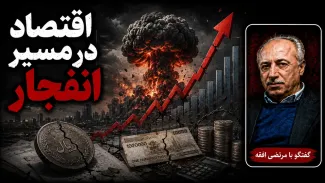
Take less than a minute, register and share your opinion under this post.
Insulting or inciting messages will be deleted.
Sign Up