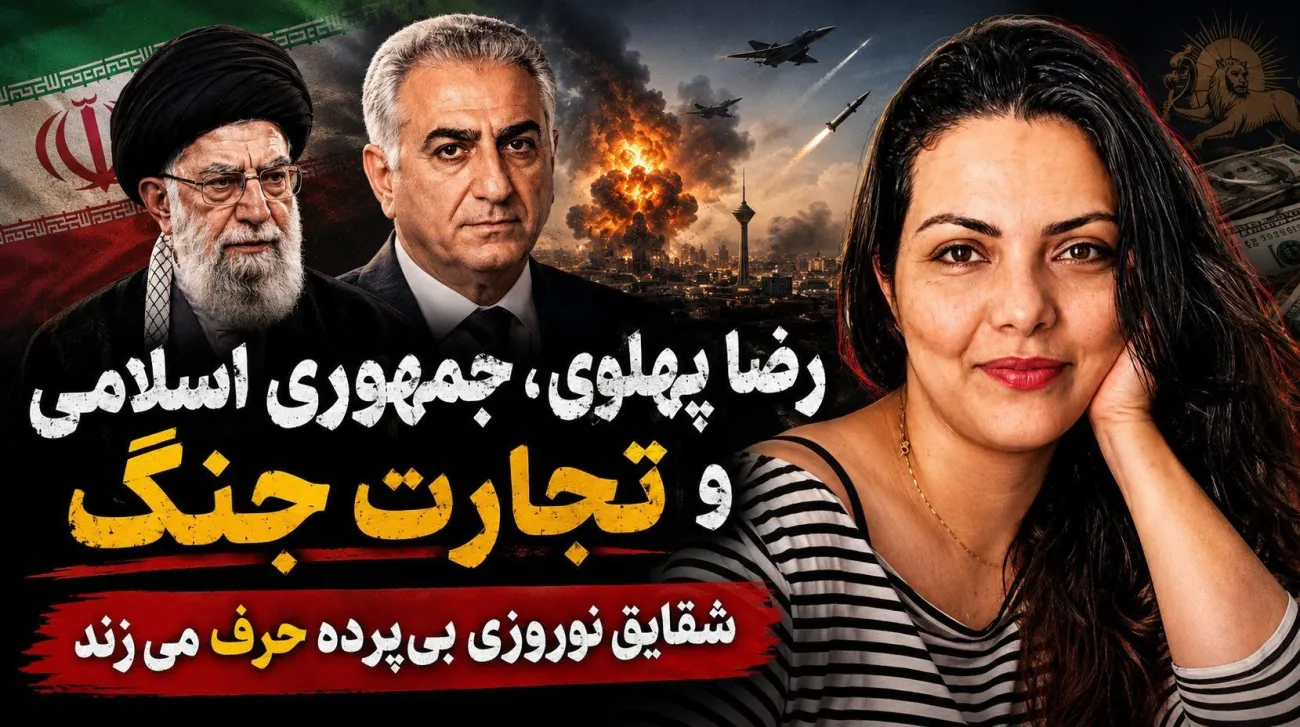
I want to speak on Abdi Media about one of the most complex and tense arenas of Iranian politics — a space between war and freedom, between the opposition and power, and between truth and the politics of commerce; about a society that has for years been suspended between anger, fear, hope, revenge, freedom, and collapse, and now stands at a point where it is simultaneously afraid of war, afraid of the continuation of the status quo, and afraid of a future of which it still has no clear image. In years when Iran is simultaneously entangled in internal crisis, external pressure, the threat of war, and the collapse of public trust, great questions remain — questions whose answers many might find important to know: Who truly speaks for Iran?
**Abdi Media:** I hope my voice and video reach you clearly and with good quality. I am still trying to have this live conversation broadcast live on Telegram as well, while it is simultaneously being streamed live on YouTube. Unfortunately, I haven't been able to make the necessary settings yet, but I am with you on YouTube and Twitter. I know that dear followers still follow the conversations on these two platforms. I would greatly appreciate it if you could write to me in the chat room on YouTube that you are receiving my voice and video clearly, so that I can be sure my audio and video quality are reaching you well.
Tonight, I want to speak on Abdi Media about one of the most complex and tense arenas of Iranian politics — a space between war and freedom, between the opposition and power, and between truth and the politics of commerce; about a society that has for years been suspended between anger, fear, hope, revenge, freedom, and collapse, and now stands at a point where it is simultaneously afraid of war, afraid of the continuation of the status quo, and afraid of a future of which it still has no clear image. In years when Iran is simultaneously entangled in internal crisis, external pressure, the threat of war, and the collapse of public trust, great questions remain — questions that many might find important to know the answers to: Who truly speaks for Iran? Has Iranian politics become an arena for competition between projects and brands? Has the opposition itself fallen into the same tyranny it preaches against? And have independent women come under more pressure from politics and violence than ever before? Are we still talking about saving Iran? Or have we entered an era where war, hatred, elimination, and even destruction have become part of our political literature? Why has Iran's political space become so nervous, violent, and tribal? And why does even the struggle for freedom sometimes lead to the reproduction of violence and elimination?
If this is your first time watching Abdi Media, be sure to subscribe to the Abdi Media YouTube channel, hit the bell icon, and follow Abdi Media on YouTube, X, Telegram, and Instagram. Greetings to you; you will later hear the audio of this conversation through all podcast platforms. Here, I try to go beyond the noise, slogans, and fantasy-peddling that has become fashionable in the media community these days, and enter deeper layers of Iranian society and politics.
My guest tonight needs no introduction — you all know Shaghayegh Norouzi, an anti-war political activist and social activist who in recent months has become one of the most controversial voices in the Persian-language political and media space. If not controversial, we can say that her statements — or the statements about her — have attracted a great deal of attention. We want to talk with her about war, the Islamic Republic, Reza Pahlavi, the opposition, political violence, women, insults, the boundaries of ethics in struggle, and this fundamental question: Does Iranian society still have the capacity to coexist with the other?
Dear Shaghayegh, welcome to Abdi Media. I am honored to be speaking with you.
**Shaghayegh Norouzi:** I am glad you invited me. I am happy to be present in independent media. I hope we have a good conversation.
**Abdi Media:** It is an honor for me as well. As I said, in recent months your voice has become very prominent, especially your voice regarding your activities against the war, and on the other hand, your activities against a certain political faction — namely, those who support the monarchy. These two stances of yours have made your clips go viral. What made you become anti-war? Wouldn't it have been better, in line with your activities and struggles, to try to bring down the Islamic Republic through war or disgrace? What happened?
**Shaghayegh Norouzi:** The conversations I have had that went viral, in opposition to the campaign that has been launched regarding Reza Pahlavi — I think the important reason is that these voices exist but are not heard. Because there is simply no possibility for them to have space. Why? Because there is no security for a space where voices can be heard. For this reason, I believe one of the important issues we can discuss is what has happened to Iranian society, to the foundations and principles we thought we were fighting for. The issue of freedom of speech is an issue we can talk about. In the absence of freedom of speech, perhaps when someone like me or other friends even say a few lines about these issues, it gets reflected.
Why? I think we must stand against this cult that has emerged, this strange, violent, male-centered campaign that has formed and is connected to war — these two cannot be separated. We are not in a position where we can say we should stand for the Islamic Republic to fall, whether in name or in disgrace. I can say simply that perhaps for me, and I think for many activists who have worked on issues of structural and historical discrimination — such as discrimination based on sex and gender, discriminations that affect the entire lifeworld of those within them — understanding the issue of collective liberation, and that ultimately nothing is more important than preserving the principles that can guarantee equality and freedom, and that in this path, the end never justifies the means. For such activists, because of the nature of the harms of discrimination that they experience up close — harms that can persist and later be justified — perhaps the danger is most evident to us: that we cannot under any circumstances close our eyes to all principles for the sake of a goal, because it is very clear to us that the goal for which the most fundamental principles of civic and social life are compromised will never be the goal we dreamed of.
I think, to put it more simply, my entire experience of grappling with different forms of oppression in the gender sphere has given me this ability, and I know it has also given many equality activists who stand on issues of gaps and discriminations and strive — perhaps that same activism has given us the ability to realize that we cannot grant legitimacy and weight to a game where, in order to oppose a political system, and for the dream and fantasy of changing the form of the political system, we ignore all our criteria and overlook warning a society that is having very fundamental and principled things violated. This path is not the path of liberation at all.
**Abdi Media:** I see a fighting spirit in you, and I sense that you have paid a price for it. That is to say, someone who enters the struggle in this way — I don't want to be in a position of judgment about whether your actions and record in the field of gender equality have been good or bad, that is not the topic of my program — but I know that when a woman enters certain areas in the social sphere that may not align with the main currents, whether opposing currents, because you express your opposition to the war, on the other hand you also express your opposition to the Islamic Republic, on the other hand you challenge policies, and on the other hand you also fight against certain other opponents. That is to say, you seek your ideals somewhere that is not necessarily aligned with the main current of society. What costs have you paid during this time?
**Shaghayegh Norouzi:** You see me as someone who stands against the currents — I am happy about that. I consider myself conservative, and I think I weigh expediency a bit here. Of course, after a certain age, one does become wiser, and being able to protect oneself a little is not at all a bad thing. But yes, I am among those who have many objections to the methods, approaches, forms, and structures that were supposed to be otherwise but inwardly are not at all consistent with their claims and outward form. I repeat again, and I think that people who have experienced living under discrimination for any reason — such as for reasons of identity — are predisposed to protest, firstly to recognize where a flaw exists, to protest, and to show courage in order to be someone who stands against the situation. We need such people in society. All the wonders that human society has created were important for this reason — there were people who said, "This way is not right," and "This is not suitable for our collective well-being."
**That I have paid a price, without a doubt — like all of you, even yourself. On the other hand, we are a challenged and suffering society. All of us, wherever we stand in this gender-identity formation, have gone through a painful history. Every generation that comes hopes to reduce that suffering. We all pay a price to reduce suffering. I am the same way.**
**Abdi Media:** I don't keep count; I see part of it myself. Though it is very important. These days, a portion of the opposition — not just these days, it started months ago — has openly supported the idea of a military attack, and attack equals destruction. Like you, I am opposed to war. Not only opposed to war, but opposed to any kind of violence. I oppose any violence-centered change. My feeling is that somewhere, we must break the cycle of violence — the cycle of violence that has existed in past centuries, that exists in all kinds of revolutions. Many also ask, what is the model? They want an alternative model when we say we oppose war or attack. I ask from your perspective: after all, they share a language with us; we have a common language. Presumably, many of them are Iranian, born in Iran's geography, and they have also become a loud voice due to the media support they receive. Setting aside exceptions, why has a portion of Iranian politics reached a point where it accepts war or destruction as a path to change? This is a very important issue. Why has this happened?
**Shaghayegh Norouzi:** The issue of suppression inside the country is certainly not without effect — the feeling of deadlock that Iranian society has fallen into. But these days, when I look at the issue of suppression inside, I cannot overlook the issue of media campaigns outside Iran. Like every other country in the Middle East, we have specifically had tyranny after tyranny, inefficiency after inefficiency. It has certainly penetrated every bit of life and the administrative, governmental, state, and service structures. Sometimes we say it's complicated — is it really solvable or not? The evidence is that many people stayed in the country and tried hard to impose themselves on the system, with the motivation that ultimately we have to rebuild this ruin. The evidence of what they have done has been successful on various fronts and aspects, and the fact that Iran excels in certain areas is the result of their work. I cannot accept this mental deadlock that we have bought into these days. Meaning: the situation is difficult — that is completely true — the system is corrupt, it is tyrannical. But that you say there is no solution at all, whether you want to bomb the country or not, is completely unacceptable. Foreign media work is a policy — it is an arm of the policy of controlling the region. Every country that had an interest in influencing Iran — Western countries, even Iran's neighbors — used this policy: how to translate problems into absolute deadlocks, or even existing deadlocks, as unsolvable situations for the Iranian people through media, mental, and cultural work. When we come out of that geography, we realize that Iran was all "flowers and nightingales," but many times, the distance we can take and the experience we gain from living in other societies gives us a different perspective. We say, okay, there are different conditions in different parts of the world — many of them are not acceptable. Meaning, the conditions inside Iran are not acceptable either, but that does not mean that many of them are impossible to solve. So, regarding the first part of your statement: no, war has never been a solution. That is, those who propose war and say it is the solution — first and foremost, the solution is not to be bombed. Against war, the most important solution is that cluster bombs, bunker busters, or God forbid more dangerous bombs, do not tear apart the land.
**All this massive, complex media campaign — this campaign outside Iran — ultimately said that there is no solution other than bombing. After two full-scale attacks on Iran, we say the bombs dropped on Iran were said to be equivalent to the bombing that Iraq experienced with that volume of bombs dropped. They did such a terrible thing to that country within thirty days and achieved no solution. Therefore, we must return to the issue of taking care of the possibilities for transformative change within our country, the civil movements that are spoken of. This means we must not destroy the possibilities for change. That country is poor; we must not make it poorer. Poverty takes away from us the possibility of social transformation. Whenever we reach this point, they say, "You are advocating for reform from within." Necessarily, trying to build change by relying on civil and social institutions does not mean being content with reform; it can lead to fundamental and radical changes. But after all these things that were sold to us as solutions, we can look at this: we must again rely on the historical experience of all societies and observe that there is no way to achieve something called freedom except through changes in which the agency of the people is fully in their own hands and is not violated.**
**Abdi Media:** Regardless of the numbers — and strange numbers have been thrown around — personally, as a simple journalist, I find it regrettable that numbers have been played with. A precious soul named Mahsa passed away and was killed. A transformation, and perhaps a revolution — not in the sense of a political revolution, but a transformation of hearts — occurred. Many people's hearts burned because a girl had to be taken to a police station for her clothing or something else. She was one person. If we say "one" as a number, what difference does it make if it is thousands? Numbers are important, but exaggerating numbers seems strange to me. It does not diminish the crime — whether it is one person or any number. That is true; the dimensions may become more horrifying, but regardless of the numbers, I myself wrote something every day about the bloody December (Dey) and wept for it, and started with tears. After that, the December affair extended into war and military attack, and we arrived at funeral ceremonies and horrifying images of Behesht-e Zahra, and then the mourning dances of mothers over the graves of their loved ones. Every day we were confronted with such things that collided with war. That is, the fortieth-day commemorations of the dead of Iran's bloody December coincided with the beginning of attacks on Iran, and attention, attacks, and the issue of war took over. The killings and the targets that were hit were important issues. Many people, when confronted with it, know: if you speak of December, do you speak of December? Can these be compared? You who speak of war — have you passed through December?
**Shaghayegh Norouzi:** December was one of the saddest events in contemporary history. For each of us who lived through that period, it was the saddest event. What happened in December was that a layer was added to the issue of suppression and massacre by the regime. That was the disruption and, in fact, the role played by the Pahlavi group outside Iran, and in addition, the foreign government that executed it. Regarding the innocence of the dead of December, I cannot say anything other than this — at least in previous uprisings, our dead were not shields between two fields of fire. It was clear for what purpose they had gone out. When the behind-the-scenes came onto the stage, those who embraced their bodies all belonged to one ideal and one intellectual current, and one could speak loudly and clearly about the entirety of the uprisings' bodies. To expect an economic uprising in a situation between two wars, and as soon as an economic uprising happens, to want to use its potential to issue a statement in a situation between two wars — I do not recall any political group during the revolution, even when groups were carrying out guerrilla activities, having this level of political irresponsibility. If you want to carry out an operation, issue a statement without any concern about how much the security situation in that inter-war situation is, how much issuing a statement by this gentleman can increase the risk of massacre. Not only does he issue that statement, but a foreign government that is at war — its defense minister tweets, he himself speaks, Trump, less than a month after dropping bunker-buster bombs on the country, also speaks and says, "We are in the streets." And this Pahlavi man who issued the statement does not even worry enough to say, "At least let me issue a statement and if any of my supporters want to come out because of my statement, I will stop them," because when two governments at war say, "We are in the streets," what is going to happen in the streets will be an exchange of fire between two fronts. Two fronts that, in order to carry out street fighting, I must protect the people.
**Abdi Media:** In December (Dey), some people in the streets of Iran shouted the name of Reza Pahlavi.
**Shaghayegh Norouzi:** Your supporters who shout your name have not necessarily prepared for an operation. Your supporters are, in fact, precisely the most innocent victims of December. Your supporter is not necessarily someone who is ready to take responsibility for Netanyahu's tweet — that is not necessarily the case. He is a protester who is critical of you and went out empty-handed. When the defense minister of a hostile country tweets and says, "I am in the streets," it is your duty to pull ordinary people off the streets and into their homes. I do not know of any irresponsible political group that would take such a risk with empty-handed people, with its supporters — I am sure they were its supporters — but with its empty-handed supporters. The reason the numbers of dead are being played with — this number also has to become fodder for the story — is that his supporters, not at the time when those two nights were exploited by Netanyahu to arrange a military attack, it seems their lives were not important to this gentleman and his campaign; to get them home and warn them that this event is dangerous, that a government at war has said "I am in the streets," that all my supporters should be at home. Not then were their lives important, nor when these dear ones lost their lives. The majority of them were adolescents and young people. They were angry because they had accepted that this was the last resort. We have no problem with individuals; they can certainly go into the streets for him and shout his name. The issue is what does this gentleman himself do with his supporters? You do not even allow them to remain respected. You throw this number of dead into a dirty game, one end of which Trump picks up to go from 45 to 100,000, and another end of which someone else picks up to go from 12 to 35,000. This gentleman showed no respect for the most believing popular forces who truly believed in this man.
Regarding what happened to Pouya Bakhtiari's father — that he was insulted — the only thing I wanted to say about this incident is: look at this incident and see how he consumes this person. This incident is not exceptional. This man did this before, in December, exactly where there was a certain number of believing supporters who could come into the streets and did come into the streets for him. And this being, and the entire campaign, and the support behind this consumerist campaign, look at the existence of the Iranian human being with no concern for what would happen. They were consumed, and then Netanyahu consumed them. A few days later, the war started. A popular uprising turned into a bridge between two wars. December was the saddest event in our contemporary history. We had the saddest, most innocent dead. It turned into a bridge between two wars. It was truly a dirty act. You turned the dead who believed — who had come into the streets because of you, because of your cause — into a bridge for a military attack to happen. You consumed all the faith, beliefs, and suffering of these people who had come into the streets for you, so that a hostile government could use it to say, "They killed so many people, I will drop bombs," and then again escape from this disaster empty-handed. Just look at all this suffering of the families, these mothers and fathers and teenage children. The question now is: we want to talk about this issue. The names of these dead cannot be separated from being linked to a military attack. They consumed them until the very last moment and used this terrible crime. I truly hope that this campaign of Reza Pahlavi, if for no other reason, will be held accountable for the events of December. What they did broke the back of our social movements, broke the back of the independence of social movements. We used to say with our heads held high: in "Woman, Life, Freedom," they wanted to accuse that there was a foreign force behind you. They themselves had no evidence. They would announce in parliament that they had seen no trace of direct foreign interference. You broke the back of our movements and toyed with their credibility, like all the other values and principles that are so easy for you to play with.
**Abdi Media:** In a critical comment, they said, "You didn't become anything in acting, and now you're presenting these arguments."
**Shaghayegh Norouzi:** I think there are more capable actors than me who do political work. If you think they have more artistic skill — that they have done better work artistically — then they are also better in politics. They exist. I do not necessarily see a connection between artistic ability and political-social argumentation. Of course, I consider myself a very good artist. I am really very good at acting, and the work I did was among those works that I did alone, completely independently, with all the deprivations and limitations. But in any case, there is no connection between the two. As for my political views, I would also say: do not limit yourselves too much, thinking that you must have studied international relations. Political engagement and political curiosity are part of our existence, especially if you have suffered from the Middle East. So, do not deprive yourselves of entering this realm, of having theories, of challenging your own views, and of giving yourselves the confidence to speak about them.
The December uprising was honorable, and I never think we should question that critical and pained part — those who were there for a cause, whether it was economy, freedom, or Reza Pahlavi, and were sacrificed, and the purity of their intentions was not protected.
**Listen without filter on Castbox.**
Abdi Media: You see the perpetrators of the massacre as innocent. When you talk about the December (Dey) issue and criticize Pahlavi as someone who issued a call, immediately the point is raised that those who opened fire were in the right.
Shaghayegh Norouzi: Without a doubt, they were not in the right. The issue is that we had experience with the regime; we knew this would happen, and for that very reason, Pahlavi's responsibility increases at that time. They fired unjustly; a massacre was taking place, and that increases Pahlavi's responsibility. If he didn't come from Mars, if he wasn't even raised in that country — in any case, if he looks at the past years and the years behind, he knows what has happened. He created a doubly dangerous situation — it is doubly dangerous. That is, if "Woman, Life, Freedom" — the regime started killing after a few months, and its hand was trembling, and I don't know how many there were, but I think under a thousand, and on TV they were explaining, "We don't want to do anything, please don't do anything" — they were trying to find a way out. You turned this situation from a confrontation between society in the real sense and the regime into a multi-layered, doubly dangerous situation. I repeat again: in the midst of two wars, in a situation that is completely security-oriented, under no circumstances can Pahlavi shirk responsibility. He had no concern about tweeting. Any political leader with at least a sense of responsibility protects his supporters; he does not send his supporters into the middle of this battlefield. This act that Reza Pahlavi did was an exceptional act. In no movement was there such facilitation of massacre — facilitation that sends people to the slaughterhouse. And that too not with internal ideals, but by connecting the entire set to Trump's help — it is absolutely unbelievable. With what confidence does he take such a risk for a people? If your media has been working for months and the people have accepted it, for whatever reason, with whatever shortcomings — "help is on the way" — we call him a political leader. A political leader is precisely the one who, at this critical juncture, stands and says, "People, protect yourselves, people fall back." A political leader is precisely the one who rises above a certain level of populism, recognizes the danger. Here, the political leader was the very facilitator who was the hook for the entire project. And for this reason, the issue of that uprising and its dead — whatever you do — will never be separated from this individual's name. Never. This was a historical event that will be recorded in his name, whether they like it or not.
Abdi Media: Do you think we are facing a kind of war trade in the political and media space? Business and economics have always been important.
Shaghayegh Norouzi: This whole affair is a business for all parties, even for the domestic side. The group whose survival is at risk — but you see, they find interests in this affair, even economic ones. I don't even mean at the level of geopolitics, positioning, and macro-policy. Even in the crisis-ridden economic situation itself, you see they can define interests for themselves from a state of war. Our world is engaged in the trade of war.
Abdi Media: You think we are facing a kind of war trade in the political and media space? Business and economics have always been important.
Shaghayegh Norouzi: This whole affair is a business for all parties, even for the domestic side. The group whose survival is at risk — but you see, they find interests in this affair, even economic ones. I don't even mean at the level of geopolitics, positioning, and macro-policy. Even in the crisis-ridden economic situation itself, you see they can define interests for themselves from a state of war. Our world is engaged in the trade of war.
Abdi Media: Some of the talk about fans — or not just fans of propaganda for war, but perhaps even taking fees and expenses as experts on television programs — is also part of this business. How you speak, what you say to present yourself as an expert and analyst to the people — it seems parts of this are business. Evidence of this might sometimes be the issues discussed on social media. Sometimes figures have been created who felt that the more extreme they spoke and the more they normalized war, the more demand they would have. Where do these issues originate? We cannot ignore that they have many followers. We are this society; everyone appropriates the people for their own benefit. Part of the violent literature has an audience, and audiences follow it. How do you see these issues?
Shaghayegh Norouzi: If you agree, let's place it under the title of psychological operations of war — how media advances psychological operations. Completely, the root and foundation of the media: where was the budget supplied from? They did their work according to the wishes of the investor. Many experts came; suddenly we saw everyone became pro-war. Regarding myself, as you pointed out, I am under pressure from the other side. With one sentence I say, I have to measure twenty times and see who might do what after I say this. After I say this, you easily see that the hosts of major media — those who were fully advancing the war room in the media — their hosts also work outside, they have YouTube channels, they've gotten views, their Instagram is seen, and they have no obstacles.
Abdi Media: They've gotten views. In this kind of space, we don't have an audience; we have selectors. The issue of psychological operations — media — is talked about a lot, but I think a deeper layer should also be considered: the selectors who either follow these networks or select these individuals to refer to.
Shaghayegh Norouzi: We don't have much access. If someone chooses to see content that sanitizes war, the project is done. In various discussions that arise here, I think it's a waste of time to stand and ask why people choose these networks. If they choose, the work is done.
Abdi Media: Because the mission was done correctly, it found an audience — is that what you mean?
Shaghayegh Norouzi: Exactly. That is, an audience that has the idea that an expert tells them "the infrastructure must be hit" — "there is no choice" — they don't smash the television. It's done. The psychological operation is done. And let's return again: it wasn't just a matter of foreign investment. Good investment was made. We must also say they were patient. And it wasn't just for our society. This issue has been done in many societies that, due to colonialism, their privileges, and their resources — from South America to many Middle Eastern countries — Syria, Lebanon, Iraq — where part of society danced under American planes — the media also worked for them. So, fundamental work for our society as well — it's not one or two years; it's been done for years. There is also a domestic issue. This is a place where, I think, if we want to solve the problem, all the shouting we have must be directed at domestic issues. That is, your totalitarianism, your one-dimensionality, your being completely suppressive — emptied the field and crushed independent activists and thinkers. All the resources went to funds and rents. These rent-seeking systems were in these domestic fund and rent systems — to throw the media of a country under sanctions into a rent-seeking and dominated situation so that no form of alternative could emerge from it to stop this onslaught of foreign media operations. The field has truly been conceded. You say people choose. I say again: the one who chooses — your work is done. You cannot ask why.
Abdi Media: I will follow up on this issue. It might be good for you to follow it too, and it's important to me, because I truly see it as a somewhat more complex layer — that this society of ours, from its history, from the days when people perhaps liked to watch fights at the street corner — there are certain hot points. I am not an expert; I might say something wrong. I think sociologists should speak on these matters — why it finds followers.
Shaghayegh Norouzi: All societies.
Abdi Media: Perhaps not all societies, but I want to say.
Shaghayegh Norouzi: Look at Hollywood, the populist, mainstream content; look at European televisions — it's universal.
Abdi Media: You spoke about Farrokhzad — the films she acted in were funded by intelligence and security institutions. "The Color of Purple" was made by the Ministry of Intelligence. Another film of theirs was made by Owj Organization, whose budget was directly paid by the Sepah. Many of those in that space — some speculate that even those around Pahlavi have in some way been set up by the Islamic Republic. And many of those who pursue the struggle against the Islamic Republic in another way — either seeking freedom or democracy or such issues — raise these points. Alongside that, I want to ask you: why is every independent voice that wants to speak labeled as a traitor and an infiltrator? Especially to women — I want to make a bridge from this question to the issue of women, which you have worked on — with the worst and most obscene expressions, which I am ashamed to even refer to, let alone utter — very misogynistic expressions. Those who seek freedom — at least the supporters of Mr. Pahlavi, who are the nannies of Iran's freedom and want to bring freedom — speak with the bitterest literature, or the harshest literature. Insults — we will certainly address them. But why has this literature emerged that Shaghayegh Norouzi herself is a Sepah agent, that she used to act in films — is it possible for someone to act in a film and not be like that? While there are many examples of individuals who are close to Mr. Pahlavi and have immunity. There were people in broadcasting, radio, television, and cinema. The same people who acted in the most security-related films — there are many. They had political activities in political factions; their images, photos, and records exist and cannot be denied. Where do these issues originate, and why is an independent voice labeled as an infiltrator or traitor?
Shaghayegh Norouzi: On the contrary, I think we can speak with society through the media sector. Why? Regarding media choice — I don't think about it because my emphasis is that media is the frame we live in and penetrates the depths of our minds. If we have chosen a media, the media has done its job by shaping us. So, there is no place to tell society, "Don't you have responsibility? Why do you choose Iran International?" If we gave them the opportunity to choose something else, they certainly wouldn't choose Iran International.
But regarding this part, I frame it as follows: either our principles of choice or our idealistic principles — the principles we think we are going to realize in the dreamed future, and we fight for these principles. Freedom is one of them, justice is one of them. True, there are different interpretations; we should check our interpretations — it's interesting and must be done. But at least we think it's a set of principles. Is freedom of speech one of these principles or not? For this reason, here society should actually speak for itself and think about what happens that our behaviors are categorized in violation of all these principles. That is, we speak, someone speaks with us, we can easily use labels. For example, our friends had said "Islamic Republic," and someone said "that" — these are labels. Unfortunately, the opposition outside Iran has also played a role in this affair; it has not protected a culture worthy of Iran's future in which freedom of speech is always respected. Labeling is a factor that distorts freedom of speech. Without concern, it itself has been part of this cycle. On these issues, we can look at ourselves and give warnings. This person is speaking; I must respond to the speech — hear the speech, understand it, and then respond to the speech itself. Why is it important? So that someone's voice is not silenced, their speech is heard, I have given the opportunity for that speech to be understood, and then I respond to the speech itself. Why is it important? So that individuals can express their opinions in security. Freedom of speech lives in security. If there is no security, freedom of speech is a joke. Therefore, if I want to protect freedom of speech, I must protect security. So, if I look at it this way, as one of the important principles we want to realize someday for the children and the future of that country and society, I try to be very sensitive to labeling. I understand what this tool does; I avoid it and do not use it; I advise the surrounding society. I think we can work on these things. The opportunity for dialogue has been taken from society. As someone who has fundamental problems with this entire patriarchal, monarchist system — can I not understand someone who says "this is the final battle," "so-and-so will return," "this is the last resort"? I cannot say I don't understand it. I would have to be stupid not to understand it; I would have to be removed from society. I can certainly understand it. Can I say "we're just having a media discussion" but that's not all? I would have to be stupid not to understand my friends or colleagues who believe in this idea. I allow myself to limit or violate their expression? We argue with these friends; we say, "You are not paying attention to media justice." Your monarchist friends — you should be sensitive to media issues. The media works entirely in your interest; it is not media justice. If those on the other side are people who are sensitive to freedom of speech, one of the believers in the monarchy should have done something about media justice. They should have said, "Television is at the service of a particular intellectual current; a number of campaigns with specific budgets are in the direction of this current; this number of YouTube channels is at the service of this current." It seems that when activists speak outside, they are safe — no problem — but the children on the other side are being crushed. This situation is unjust.
**There was a time when you are advancing the battlefield in such a way that you want to suppress and defeat a side.**
**Abdi Media:** Why do you not see the path to overcoming the Islamic Republic in the return of Pahlavi? Why do you not choose Pahlavi?
**Shaghayegh Norouzi:** If the discussion is about the form of the system — which he represents, and his father and he claim they want to return to that form — if it's about the form, it is the same patriarchal form, the same form in which power is centralized. What virtue does it have? For what reason should I do this? I understand — many stories have been heard and told — "the grandfather brought modernization." That is not a completely correct narrative. His grandfather and father tried to impose a certain form of authoritarian modernity on Iran, and it was rejected. They were very far from the real society, the real culture, and the lifeworld of the Iranian human being.
Abdi Media: Many believe that Reza Shah provided services to Iran during that dark era.
Shaghayegh Norouzi: Every government has provided services. The issue is the authoritarian view and the authoritarian form that he established through a coup — which I consider a particular kind of tyranny, and previous monarchies in Iran did not have this level of despotism. I consider the authoritarian form more destructive than building a railway. The authoritarian form you create is destructive; it undermines the railway, undermines authoritarian modernity — it is said to have been done by someone's order.
The issue is form. If we want to talk about form, I have a problem with form for all the reasons I stated. But the truth is, as we speak now, the issue is bigger than that. Do we like the monarchical form or not? Do we consider the Pahlavi monarchical form a useful form for Iran's tomorrow? What has happened is that we see a group that has acted — they had full funding, entered the field, and what they have shown of themselves is far more terrible than what currently exists in Iran. The question is: why should we want such a thing? Why should I want a group that has no sensitivity about promising that our tomorrow is the same tomorrow that SAVAK created in the time of this gentleman's father? Why should I want such a thing? I understand why some people want this absolute power that comes and controls everything with a boot — I understand it — but I don't want it to decide for my country's future. I understand from which side this happens; I understand fascism. We are now talking about something beyond whether a return to monarchy is good or not. They have implemented it and have even come into conflict with many of the positive aspects of even their own dynasty. His father at least understood the issue of independence and worked for it. I think it happened late. He was a coward, and his cowardice had a reason — he had seen his father's fate. That regime was dependent to the bone marrow, and I understand what could have happened. At least we had a clear vision when he speaks in parliament about it being the last time.
Abdi Media: There is one; there is not two.
Shaghayegh Norouzi: There is not two — not while we are alive. There is not two. If there becomes two, they have passed over our corpses.
Abdi Media: These words are admirable.
Shaghayegh Norouzi: He has also betrayed him. This person — neither does he say with his father's and dynasty's ideals "I want to return to that form" — it is not appropriate — nor is he close to what Iranian society needs and has fought for. Clearly, the issue of independence, freedom, and welfare — there is a very important thing in this person: his political judgments. This person and the entire group around him, the main circles — you don't seem to have any understanding of this important thing: that there is a difference between fighting, opposing, and even disabling a political system, and fighting, opposing, and destroying national interests. These are two different things. It is very important. As a leader who wants to present propositions, this contradiction is a disaster. When you ask me this question, the issue of opposing the Pahlavi system is something else. We are facing a phenomenon that is politically absurd and dangerous.
Abdi Media: You indicated in a way that the government of Mohammad Reza Shah Pahlavi was also not independent. This narrative you mentioned — that at the end he wanted to become somewhat independent and his government didn't suffice — do you consider the Islamic Republic independent?
Shaghayegh Norouzi: That is a very challenging question. The revolutionary ideal that happened was independence. Yes, I can say that at least the intention, when the framework of this government was being built in those early years, was for that government to be able to form a government in the Middle East that could make its own political decisions independently. Specifically, the issue of resources and foreign relations was raised — that decisions be made inside Tehran. Examples such that it doesn't happen that the Allies suddenly hold a meeting without the head of the country knowing; such that our plane doesn't circle around Vietnam and get turned back, handed a letter. Other obligations followed it, like it doesn't happen that if France doesn't supply the bolts and screws of the petrochemical industry, we can no longer keep the equipment running. Because that was the ideal of that revolution. And that revolution betrayed and was betrayed. The issue of independence has been overshadowed. It is not easy to talk about this — whether it was truly committed or not. If you want my opinion, with the education and knowledge I have today regarding Iran's industries, the efforts made in various fields, I can say that Iran's development and industry are independent to an acceptable degree. This is very important, that we can talk about it a little away from labeling and fear of attack. Because this independence — part of Iranian society, whether they believed it or not, maintained it — those who believed in independence and truly worked hard for it — that work is respectable. One of the problems I have with this new Pahlavi group and this affair of wanting to take power is that they are moving with the same method that the 1979 revolution had to show everything from the time of his father as black — it wasn't that way. For this reason, bombing the country was easy for them. They do not respect even that petrochemical industry I mentioned. I read their memoirs — how engineers thought that one day we could stand on our own feet without worry. These are the achievements of the people of that country, not limited to any time or period. You do not respect these achievements. You have a craving for power transfer, so much that you cannot calmly look at the fact that these people did this under sanctions — it is amazing, it is respectable.
Abdi Media: I asked this question of Mr. Sazegaran; I wanted to know your opinion as well. I think you have good studies on the 1979 revolution. Mr. Reza Pahlavi also refers to himself as the leader of the current revolution — the Lion and Sun Revolution. Of course, he himself has said "call me father" — these are things I have seen as media facts from him and reliable sources. I have this question from you: What similarities and differences do you see between the leaders of two revolutions in Iran? If you recognize this Lion and Sun Revolution — one revolution was led by Ruhollah Khomeini, and there is a revolution that has a television called Reza Pahlavi — what differences do these two have in your view? What is your assessment?
Shaghayegh Norouzi: It might be pleasing to say they are both authoritarian, but no, it's not like that. I really see a difference, and it is among those things that is not very pleasant. I have been asked before, but I stand. There is an onslaught of protest; I try to say what I see and distance myself from prejudice. I do not consider the Reza Pahlavi current a revolution. It has no revolutionary authenticity or revolutionary factors. It also does not have a revolutionary idea — one of the most important things. There is no liberating idea beyond power transfer in this current. This current has no idea as brilliant and great as the things they talked about in the 1979 revolution. Independence was a great idea; independence was not a small thing. You see Khomeini — you may not like his speech, but he knew what he was saying. He represented an idea for a humiliated people. The people of a land who have been humiliated — humiliated by foreigners. They considered their king a representative of that foreigner. At that time, Ruhollah Khomeini placed his finger on that wound. The country suffered famine, built with famine, as they say, by foreign English — we cannot remove these memories from society. What exists in the "Sun" current is not a revolution. I consider it a coup — because it is dependent on foreigners, and its only issue is power transfer. That is a coup, not a revolution. The revolution back then had ideas. The issue of independence, freedom of speech — look at all the leaders of the revolution back then, from left and right, religious and non-religious — many of whom we don't like — I was searching; the least of them had 10 volumes of books. Khomeini himself had many books. Thought was being produced; the revolution runs on ideas. If you claim the Lion and Sun is a revolution, tell me what ideas were produced in it, what came to life, what was added to it? A half-freedom of speech — outside, we were all crushed. I don't know what kind of revolution you are talking about.
Abdi Media: Let's also talk about sanctification. Do you think the opposition has become sanctified?
Shaghayegh Norouzi: A portion of the Iranian people — and a considerable portion — without any doubt, are desperate to escape the current situation inside Iran. You can understand — yes, someone like Reza Pahlavi can also become sanctified. Someone like so-and-so can also become a national hero. You are desperate to get out of this situation. And the reactionary forces — I consider the Pahlavi current, which last year tied itself to war — I can address and categorize it with this title. They know that in this state of desperation, civil forces must be crushed. Things like parties, organizing, collective efforts, etc., must be crushed. Everything must be summarized in a reactionary transition. The best time for that to happen is during a time of desperation, and desperation must be strengthened. I cannot simply say yes. I can say that the Iranian people have become very desperate.
**Abdi Media:** Do you think the Pahlavi current — the monarchist current or this group — will result in the reproduction of tyranny?
**Shaghayegh Norouzi:** I don't think it's a reproduction of tyranny. The result is that they are tyrannical right now. Right now, there is an authoritarian current outside Iran's borders that hasn't reached the inside yet, but it has become a movement. And it's not just about verbal assassination, character assassination, insults, etc. Someone in Canada was stabbed; no one talked about it — "I dissociate myself, we didn't do it." The level of violence has risen so high that those who speak against war do not dare to feel safe. One by one, they go after people anywhere on the anti-war spectrum — whether you say close to or far from Iran's government, anywhere far — but only opposing anti-war. They go after them one by one, wherever they find them. They attack them. They have no security at work, at home. They have no security in a simple interview. There is no tyranny being reproduced. What do you call tyranny? The fascism they talk about — this is it. A widespread, continuous terror. The fact that a figure becomes sanctified is a sign of this current — that it cultivates fascism within itself, becomes more concentrated around this idea and affair, and sees itself less and less. It's not that tyranny is being reproduced; what is happening right now is one of the most terrifying experiences of Iranian society. We will pass through this, and books will be written and talk about how it is possible that an Iranian society that emigrated from its country longing for freedom of speech, leaving everything behind, itself turned into someone who goes one by one to see who is opposed — how can I silence their voice? This affair and the Pahlavi story have intensified. There was the Green Movement; other freedom-seeking currents happened; "Woman, Life, Freedom" was very pluralistic and had many intellectual figures — we set that aside. Where was this intensity of suppression by supporters seen? This is the first time it has happened. And it is the answer to your question: tyranny is not going to come in the future; it exists right now, and it shows itself without shame. It says, "I am here." Reza Pahlavi does not have a problem with this; he is okay with these events. This means that my supporters are also okay with this affair. That the father of a political activist is unfollowed — and many other things — is not accidental. He got angry; his hand slipped. I believe that. In anything that he is not good at — honestly expressing the idea of the future — both he and his main circle of supporters are very good at that.
**Abdi Media:** I want to ask about war. You are anti-war. On the other hand, the Islamic Republic in Iran is the one that fights. How did you see the Islamic Republic in this war? What is your view of the Islamic Republic?
**Shaghayegh Norouzi:** I myself did not think the current system's capacity to resist would be this much. A country in the Middle East — there is not supposed to be a country that can have this level of resistance — with anything, with missiles, with water heaters, with spears, etc. — against the decision to enter foreign forces. It was not supposed to happen at all, and it is not acceptable or pleasing for countries in the region that have previously accepted this form of relationship. In any case, it's not a good feeling. It seems that it was able to resist, but there are many ifs and buts. Should it have been better? Was it right for the system to be so oppressive that there is popular dissatisfaction — so oppressive that the people do not stand fully behind the military force? All these debates were and are. But in any case, we can say at least one fact: Iran resisted a foreign attack. I think it might not be bad to look beyond the form of government that exists, at the event itself. It happened in this region; historically, it was possible.
**Abdi Media:** I want to know, as an anti-war activist and an Iranian, what was your view and feeling about this war?
**Shaghayegh Norouzi:** I am glad America could not enter Iranian soil. Very glad. In the first attack, a woman sitting near me said, "Now..." that they didn't... and in any case, right before my eyes, the entire experience of the Middle East passed by. Sometimes you can't put into words how they look at us. Now you have to say, "Be glad that they didn't..." How much I wish I had a country where you wouldn't dare open your mouth to say such a thing about it. I am glad they did not dare to... us. I think they did not dare because, in any case, Iran had some missiles; it could say, "I will retaliate." "I am not Gaza. I am not a disarmed Iraq." In any case, "If you strike, I will strike." If we want to look beyond the level of government to the level of people and society, and speak as an Iranian citizen about my country, I thank God that they could not enter Iran.
**Abdi Media:** To ask more clearly: do you praise the Islamic Republic in its military position?
**Shaghayegh Norouzi:** I don't think it's dangerous to connect defense forces to the Islamic Republic.
**Abdi Media:** In any case, the management of this war by Iran — it was done by both the Sepah and the regular military.
**Shaghayegh Norouzi:** That's like saying the management of the oil industry is done by the Islamic Republic. Do you consider a country's defense forces to be part of national interests or not?
**Abdi Media:** My feeling is that everything a country has — from its defense forces to its opposition forces — is the capital of that country. Everything in Iran is its capital.
**Shaghayegh Norouzi:** We consider defense forces — yes — we consider popular forces as part of our capital. We can look at defense forces as national interests, on par with resources. I do not consider the management of the Islamic Republic to be good management, and I think Iran, with this many people who are infatuated with independence...
**Abdi Media:** These individuals who were targeted in the pinpoint strikes — as was pointed out — who were assassinated or killed, were high-ranking Sepah commanders, commanders of the General Staff of the Armed Forces, etc. Many leaders were killed on the first day. How do you interpret this event? They are armed forces within a structure. There is a contradiction. I want to say that this is the same bottleneck that gets justified, and many consider it as their own reason to legitimize this war. I want to present those views in contrast to you. They say: war happened. Those who, until yesterday, were killing our children in December, were targeted by Israel.
**Shaghayegh Norouzi:** People might be happy that forces wearing Sepah uniforms — who previously, in those same uniforms, suppressed people in the streets — were killed. But should they be happy that this happened at the hands of a foreign force? That is a point we need to talk about. The issue of assassination by a foreign force is a serious issue. Why? Because when you say, "Those forces who suppressed us were killed, and we should be happy," you cannot escape the question: why were they killed? Why did a foreign force strike the leaders? There is a difference between whether the project is a military occupation — and these assassinations are carried out to open the country's borders more easily — or whether a popular revolution takes shape and people can bring down the repressive forces and their commanders by their own hands. And I suspect that a society that has launched an anti-execution campaign wants to hold trials; it hasn't fantasized the issue of execution for itself. There are two big differences. At the hands of a foreign force — that is the point. You cannot separate the path from the goal. These happen in completion of one another. And in this sense, let's return to the issue of our defense industries — or defense forces. A country's defense forces are part of the national interests and must remain standing, specifically when the target of these forces is a foreign force.
Those who are in these mechanisms — it's not a zero-sum issue. Perhaps we should reconsider. Can we say that all those who, at the time of a foreign attack, are in the country's defense mechanism are the same ones who suppressed people in the streets — or are even regime supporters or close to the regime? I think this is also a confusion and a fallacy. In all the sensitive mechanisms that provide for collective interests, people from this land have been employed, many of whom have only one important motivation, and that is our collective well-being. We cannot — I understand that our defense mechanisms are military — but within them, you must be able to see the traces of people whose concern went beyond the establishment of a government. Their responsibility was the integrity of a country, that at a critical moment, this society has the ability to defend itself.
Abdi Media: I will give a specific example. A clip was published that made a lot of noise — an image of a soldier whose hand was cut off at the launcher. On one of the TV channels, that person was mocked, and they said, "We enjoyed it; his hands were cut off."
Shaghayegh Norouzi: That is wrong. The issue is that when we only have the binary of "people vs. government," it can lead to war, and we don't see this gray area in between. That people live in this society. These soldiers come out of people's homes. That soldier at the launcher.
Abdi Media: Did you see the soldier's video? What was your feeling?
Shaghayegh Norouzi: I became very sad, for two reasons. First, fundamentally, who filmed this soldier? The way the Islamic Republic consumes it — the purity of certain individuals — a person who has lost his hands and feet, who is standing, who is speaking in any case — I cannot not see a trace of the fact that this person has his own values and went for them, made a great sacrifice, paid a heavy price. And you consume this; you go into his hospital room with a camera — unbelievable. Boundaries must be respected. On the other side, we see many similarities. Where you wanted to see similarities between the opposition current and the current inside Iran, here their similarities are very visible: their media strategies, the form of consumptive view they may have toward their popular forces. It was a very sad video from both directions.
The issue is that you don't see the gray areas in between. People live in that land. The engineer who works in the electricity industry, with strong motivation, tries to prevent the electricity from being cut off — he came out of my house and your house. He was a young person who did not leave that country and said, "I will stay." Some also came with privileges — they are not mutually exclusive; they are a collection.
**Abdi Media:** Do you think they have come closer together? That is, did the war cause this military spectrum — perhaps even the radical spectrum — to see some level of popular support? Or do you think after this war, everyone will go back to the default factory settings?
**Shaghayegh Norouzi:** There is a high probability they will go back to factory settings. War is a serious social and political pressure. We used to say — we told these monarchist friends — don't do this. Let us do our work and use these existing spaces to make some changes using these possibilities. Suddenly, these gaps close. Without any politeness: there is war; the internet is cut; satellite signals are jammed; bombs fall in the middle of people's homes; everything changes. Many times I heard from friends that "my mom, who used to watch Iran International, has turned it off for a few weeks." "They hit the corner of the street; such and such happened; now she comes out every night." For this reason, friends who say, "You have no right to talk about these gatherings, they are entirely regime-run" — I have an argument with them. Yes, it is certainly regime-run. But does that mean that no other part of society wanted to participate in it? Why do you make the exceptional situation that war creates invisible? Making it invisible does not detract from its reality. War creates an exceptional situation. Some things disappear; new definitions are created. People are forced into realism. They can no longer easily say, "Every form of police and Sepah must be killed." They can no longer say that the police behind the launcher get bombed. The situation changes. Afterwards, we might return to factory settings. Especially because the regime is not making any effort to leave any room for reform. If it could and would, now is really the time to do it. People are in the streets for seventy nights. Regime or not regime — some people are out for seventy nights. I do not agree with their slogans and noise pollution, but they are out for seventy nights. How is it possible that the same person who is at the gathering, in the morning when they want to buy bread, pays double? It's completely unbelievable — the system's inefficiency. If it reconsiders — yes, the war has given this opportunity.
**Abdi Media:** If you wanted to give advice to Pahlavi, what would you say?
**Shaghayegh Norouzi:** I wouldn't even advise him to step aside and get on with his life. If I could really give advice and have it be effective, I would like to say: You never really knew your father. Not that you didn't know him — you never even understood what happened to your father and grandfather. I hope one day you realize how far removed you are from this society. I cannot hope that you will be able to have a close experience of their real historical lifeworld. But if you could, your life would change. Those two people — I think their lives had many dimensions. If you had understood them, you would never, ever, ever have relied one bit on a foreign government. You understood nothing of what happened to your father and grandfather.
**Abdi Media:** If you had two choices — between Mr. Mojtaba Khamenei and Mr. Pahlavi — which one would you choose?
**Shaghayegh Norouzi:** I am an expert at choosing none and staying in the middle.
**Abdi Media:** Then they tell you, "Middle again."
**Shaghayegh Norouzi:** The middle is not a bad place. The middle has a series of gray areas — neither black nor white — and it's important to preserve them.
**Abdi Media:** In your statements, you said that part of the civil struggle has been destroyed?
**Shaghayegh Norouzi:** The solution that friends presented seemed like a quick fix. It resulted in us staying put for another twenty years to rebuild the petrochemical industry — we were at least twenty years ahead. So I really think you should avoid any overnight solutions. Suddenly you find we have fallen forty years behind. It's not necessarily the case. If you don't drop bombs on our heads again, we might be able to achieve lasting gains quickly, like what we achieved from "Woman, Life, Freedom."
**Abdi Media:** The people's protests in December were confiscated.
**Shaghayegh Norouzi:** Yes, to some extent it seems they were confiscated. Suddenly a call was issued and they said, "Under the Lion and Sun flag, in anticipation of help from Trump and Netanyahu, they must be."
**Abdi Media:** Abbas Goharzad wrote that "the Islamic Republic's suppression over these 47 years is the main reason for the growth of the right-wing Pahlavi current, and of course, conspiracy is also at play." Wherever you are, comment. He said: In all countries of the world, even the greatest democracies, if armed individuals engage in terror and attack the police, without a doubt the riot police and security forces will suppress them at any cost, even death. In America, if the slightest threat is directed at the police, the threat is neutralized in a fraction of a second. This is the duty of the police as a social institution that protects security. The depth of the tragedy of the march of those who in Germany had uniforms and flags of SAVAK — who consider themselves continuers of SAVAK's path — that is, whitewashing one of the most terrifying security organizations in history, which was actually one of the causes of the 1979 revolution.
**Shaghayegh Norouzi:** Yes, you are right. Armed forces do shoot. But if you are talking about Iran, the real question is: how were the armed forces in the streets? That is, a system that has a nanny for security — and all this time and our lives have been spent on this issue that security is important — how is it possible that this amount, whatever it was — you say armed forces existed in the streets — came about? How did it happen?
The full recording of Abdi Media's conversation with Shaghayegh Norouzi
Take less than a minute, register and share your opinion under this post.
Insulting or inciting messages will be deleted.
Sign Up