
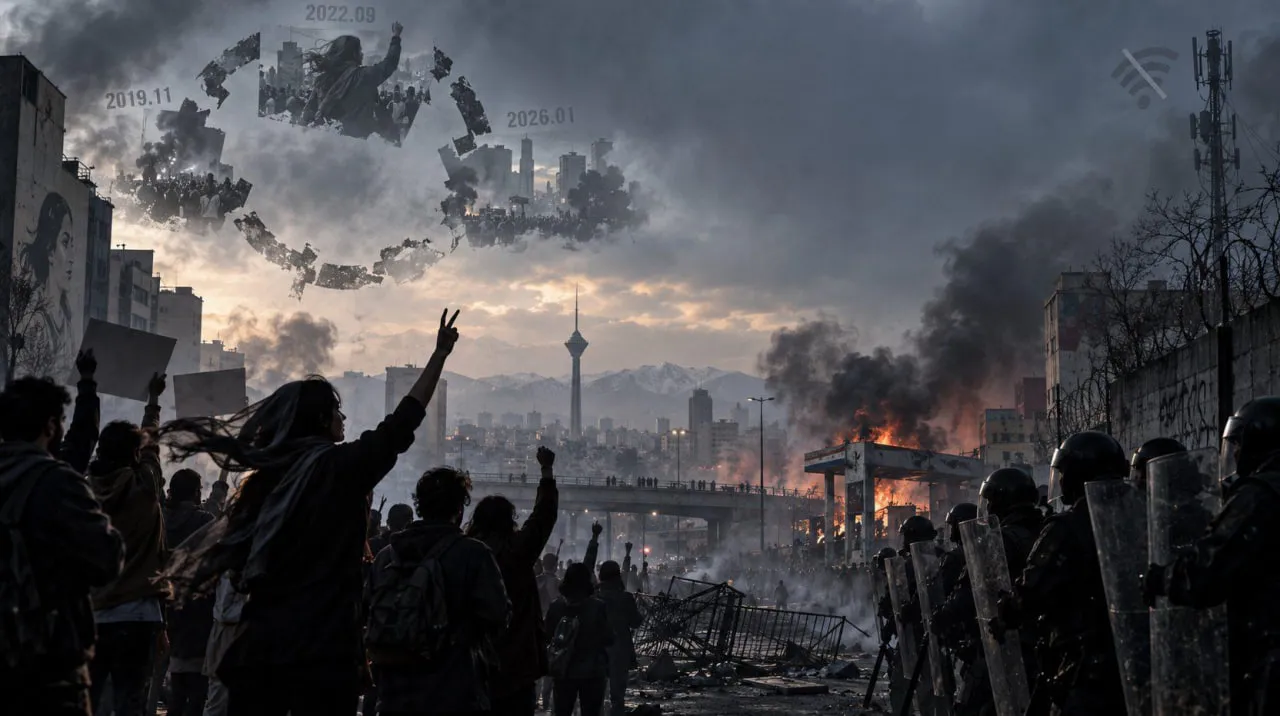
Four years have passed since the killing of Mahsa (Jina) Amini, the daughter of Iran. On this sorrowful anniversary, Iran once again faces a profound question.
Four Years After Mahsa (Jina) Amini: Why Has the Cycle of Violence Still Not Been Broken?
Abdollah Abdi – Abdi Media
Four years have passed since the killing of Mahsa (Jina) Amini, the daughter of Iran. On this sorrowful anniversary, Iran once again faces a profound question: if protests return to the streets, how will the government respond? And have the security and law enforcement forces learned anything from November 2019, the Woman, Life, Freedom movement of September 2022, and the bloody events of December 2025–January 2026?
Answering that question requires acknowledging two realities at once. Not every protester can be labeled a "rioter," yet it is equally impossible to deny that some protests involved violence, the destruction of public property, and even attacks on security forces.
Peaceful protest is one thing; attacking people and destroying property is another. Likewise, maintaining public order is one thing; the unnecessary or disproportionate use of lethal force is another. The problem begins when these boundaries disappear.
November 2019: An Economic Protest, a Political Crisis
The events of November 2019 began with the sudden increase in gasoline prices, but the demonstrations quickly expanded beyond fuel prices in many cities and became an outlet for broader economic and political grievances.
At the same time, banks, gas stations, and government buildings were vandalized or set on fire in some areas, and attacks on government forces were also reported. That part of reality should not be erased—just as those incidents do not mean that all protesters participated in them.
In response to the November 2019 unrest, Ayatollah Ali Khamenei described what he called "violent protesters" as "thugs" and said, "No one should help these thugs." He also condemned the destruction and burning of property and framed the unrest as part of organized actions against national security.
His remarks show that the Islamic Republic's official narrative of November 2019 was not simply that of an economic protest; part of the state viewed those events as a serious security threat.
Yet another narrative also existed. Amnesty International and Human Rights Watch documented the security forces' use of lethal force against protesters and reported extensively on the scale of the crackdown.
That conflict of narratives is itself part of the problem.
A government may see a gathering as a riot, protesters may see it as a demonstration, and human rights organizations may speak of violations of protesters' rights. Reaching the truth requires that none of these labels replace an investigation into what actually happened on the streets.
One of the most widely discussed accounts of November 2019 concerns remarks attributed to the interior minister under President Hassan Rouhani. According to former MP Mahmoud Sadeghi, Abdolreza Rahmani Fazli allegedly said that security forces aimed at protesters' legs, but when they fell, they were struck in the head.
Later, however, several figures—including Rouhollah Jomei—rejected those accounts entirely, including the reported death toll.
From Mahsa to "Woman, Life, Freedom"
Three years later, Mahsa Amini's death following her detention by Tehran's Morality Police became one of the defining turning points in contemporary Iranian protests.
Officials presented the government's official account of the cause of her death, and then-President Ebrahim Raisi said he was awaiting the final forensic report. In contrast, Amini's family, protesters, and human rights organizations raised serious questions about what happened after her detention.
In the early days of the protests, I wrote, as an ordinary journalist, to General Mohammad Shirazi, then chief of staff to the commander-in-chief, proposing that the government pursue a transparent and independent investigation into Mahsa Amini's death to prevent the case from turning into a much broader crisis. The proposal went unanswered, even though subsequent events demonstrated just how much potential the case had to become exactly such a crisis.
The UN Human Rights Office likewise called from the outset for a prompt, independent, impartial, and effective investigation into her death and the allegations of mistreatment.
But the protests quickly grew beyond the case of one young woman. "Woman, Life, Freedom" became a broad political and social demand.
The response was not limited to opposition figures abroad. Individuals from within or on the margins of the Islamic Republic's political establishment also criticized the government's handling of the protests. Mir-Hossein Mousavi later described "Woman, Life, Freedom" as evidence of the need for a "fundamental transformation" and proposed a referendum and a new constitution. Mehdi Karroubi also responded, though with greater emphasis on the heavy costs this style of governance had imposed on the country and its people rather than presenting a clearly defined alternative political vision.
The 2022 movement also revealed another reality: a movement's enormous capacity for social mobilization does not necessarily mean it has unified leadership, a shared political program, or consensus about what comes after change.
This is neither a rejection of the movement nor an attempt to diminish protesters' demands. Every major movement eventually faces difficult questions: Who represents it? How are decisions made? How are disagreements resolved? And if an existing structure is to be replaced, what comes next?
The street may be the beginning of transformation, but it is not, by itself, the answer to everything that follows.
December 2025–January 2026: Did the Same Cycle Repeat?
If November 2019 and September 2022 were supposed to provide lessons in responding to protests, then December 2025–January 2026 became the next test.
The protests began on December 28, 2025, following the collapse of the rial, rising inflation, and worsening economic pressure, and quickly spread from Tehran to cities across the country. During the first days, Amnesty International and Human Rights Watch reported that at least 28 protesters and bystanders had been killed in eight provinces, saying that the evidence they collected pointed to unlawful use of firearms.
That initial figure did not remain unchanged.
On the nights of January 8 and 9, 2026, a significant portion of the casualties occurred within a short and concentrated period—a feature that distinguished this episode from the previous two.
In the following days, Iran's Supreme National Security Council announced an official death toll of 3,117.
Meanwhile, on January 16, 2026, Mai Sato, the UN Special Rapporteur on the situation of human rights in Iran, said in an interview that at least 5,000 people had been killed and that, based on information she had received from medical sources, the number could be as high as 20,000. She emphasized that the higher figure had not yet been officially verified by the United Nations.
Other human rights organizations and independent media later published substantially higher estimates. Because of internet shutdowns, restricted access, and the absence of an independent investigation, however, there remains significant disagreement over the precise number of victims.
I must emphasize that I feel ashamed to treat human lives as a matter of counting or playing with numbers.
At the same time, government officials once again described protesters as "rioters" and "terrorists" and called for their rapid prosecution and punishment "without any leniency." According to Amnesty International, at least thirty detainees—including two teenagers—faced the risk of execution following expedited judicial proceedings.
As in November 2019 and September 2022, widespread internet shutdowns made independent investigations into the true scale of events even more difficult.
What December 2025–January 2026 revealed is that this is not simply a series of isolated incidents. It is the repetition of a pattern—a pattern in which an economic trigger becomes a broader protest movement, the security response exceeds proportionality, communications are cut off, and society is ultimately left with two entirely different accounts of what actually happened.
Repression Did Not Resolve the Crisis
Even if the initial objective of security forces in all three episodes was to restore order, the widespread or disproportionate use of lethal force carried consequences that extended far beyond short-term control of the streets.
The issue is not choosing between the right to protest and the right to security. A healthy society should be able to protect both simultaneously.
The red line should be clear: using lethal force against a citizen who poses no real and immediate threat to others' lives should never become a routine tool of protest management.
Conversely, if an armed individual poses an immediate and serious threat to others' lives, responsible security forces cannot simply refrain from protecting people because that person happens to be present at a demonstration.
The central issue is the careful identification of such situations and adherence to the principles of necessity and proportionality—and those principles must be applied fairly to everyone.
Truth Is the Precondition for Peace
Four years after Mahsa Amini's death, nearly seven years after November 2019, and only months after the bloody events of December 2025–January 2026, different parts of Iranian society still hold fundamentally different narratives about what happened.
Each narrative may contain elements of truth, but none of them alone contains the whole truth.
Secrecy and communication blackouts made uncovering that truth more difficult in all three periods.
Yet beyond those disagreements, preventing another cycle of killing and violence can still become common ground.
If the next test also unfolds in the streets, the best outcome will not be one side defeating the other. It will be breaking the cycle in which protest, violence, repression, death, and distrust continually reproduce one another.
Take less than a minute, register and share your opinion under this post.
Insulting or inciting messages will be deleted.
Sign Up