
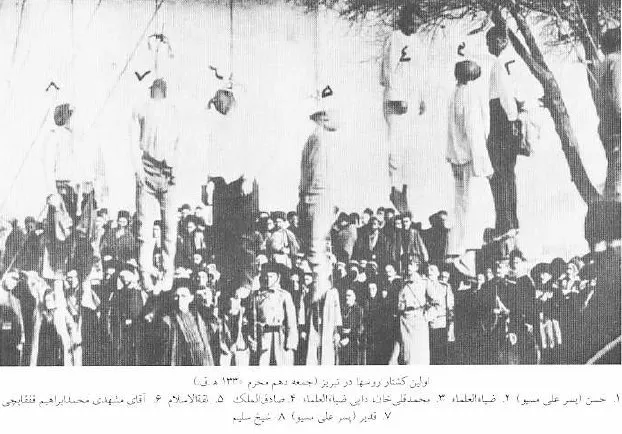
But there is also an Ashura that few people remember, and that is the Ashura of Tabriz, the black Ashura of 1911. At dawn, Russian soldiers erected wooden gallows to hang the freedom fighters of Tabriz.
But there is also an Ashura that few people remember, and that is the Ashura of Tabriz, the black Ashura of 1911. At dawn, Russian soldiers erected wooden gallows to hang the freedom fighters of Tabriz and proudly adorned their gallows with the Russian flag... On that Ashura, in the Tabriz garrison, the occupying Russians hanged nine people, and this was just a glimpse of their brutality in Tabriz. Let us begin twelve days earlier, from December 19...
The original pretext for the Russian aggression began with the affair of Morgan Shuster, which we have previously discussed. After the Constitutional Revolution, Iranians brought an American financial advisor to organize the country's finances. After a few months, the Russians' patience ran out and they issued an ultimatum demanding Shuster's expulsion from Iran. The Second Majlis resisted, but the government, or rather the regent, Naser al-Molk, dissolved the parliament and accepted the ultimatum (it should be remembered that this villainy by the Russians was worse than the affair of Liakhov). Naser al-Molk had correctly judged that no aggression from the Russians was unlikely... Despite accepting the ultimatum and expelling Shuster, the Russians marched troops into the cities of Tabriz, Anzali, and Rasht. This was a pretext to dismantle the Constitutional movement. This brings us to that December 19, which we were to begin our account of Tabriz from...
The Russians began their aggression on December 19 in Tabriz by killing several police officers. The constitutionalist mujahideen resorted to armed resistance, because in the face of such aggression there was no choice but to resist. They gave a crushing response to the Russians until December 23, and they were on the verge of completely uprooting the Russians from the city. But the Russian consul resorted to a trick, and following the horrific massacre of civilians, a group of people, fearing for the lives of their families, criticized the mujahideen, suggesting it was better to end this war. On the other side, Tehran also advised against continuing the war.
The Tabriz mujahideen had a major weakness: in this battle, women, children, and civilians were present. The Russians were all soldiers and Cossacks; if they were killed, they were all military, but they cowardly exploited this weakness of the mujahideen and attacked ordinary people. They would enter homes, tie people together with wire, and throw them into the house ovens. "Intimidation"... Intimidation was the Russians' constant weapon, whether under the Tsarist regime or when the Bolsheviks established a new government in the name of freedom. Just a decade after Russia's freedom-loving revolution, Stalin seized power and sent friend and foe, comrade and non-comrade, to firing squads. The Russian intimidation worked in Tabriz, and the hearts of the people and the mujahideen trembled. They had the right to be afraid. They were facing an enemy that was fighting them in their own homes and was bound by no moral principle.
But the city was not unanimous. Many still hated the constitution and the constitutionalists, and their protest rose with this intimidation. Eventually, the leaders of the fighters made peace with the Russian consul. It was agreed that the mujahideen would leave the city or lay down their arms and return to their daily lives. The Russians also promised to forget the matter. Thus, on December 24, the city calmed down; a small group of fighters left the city, and another group also settled down. But on the snowy evening of December 25, the roar of cannons suddenly began over the city, and this ominous evening showed what a great catastrophe would soon occur in the city. Fresh Russian troops had arrived, and it was time for the Russians to vent their grudges and seek revenge. Russian troops with heavy artillery arrived one by one from Yerevan and Tbilisi to Tabriz.
Thus, on December 26, 1911, Tabriz fell to the Russians. For five years, Tabriz had been a bastion of freedom. But now Tabriz had fallen into the hands of the main supporter of despotism, and unfortunately, the supporters of despotism had an unwritten alliance with the Russians. The Russians' main goal was to dismantle the constitution in Tabriz and seize the city with their Iranian collaborators. Who was that collaborator? "Samad Khan," a man who was no less brutal than his Russian masters, and who a few days later entered the city with the welcome of the anti-constitutionalists. From December 28, the Russians began searching for those who had fought them. On December 30, they arrested Thiqat al-Islam, the main figure of the Tabriz resistance, along with a number of others.
And on that heartbreaking Ashura, the Russians hanged the freedom fighters of Tabriz, including Thiqat al-Islam, simply for defending their city. In the appendix, you will see the bitterest scene of the execution. It is unpleasant, but if we do not see it, how will we understand what a heavy price we have paid for freedom and the fight against the aggressors?



Take less than a minute, register and share your opinion under this post.
Insulting or inciting messages will be deleted.
Sign Up