
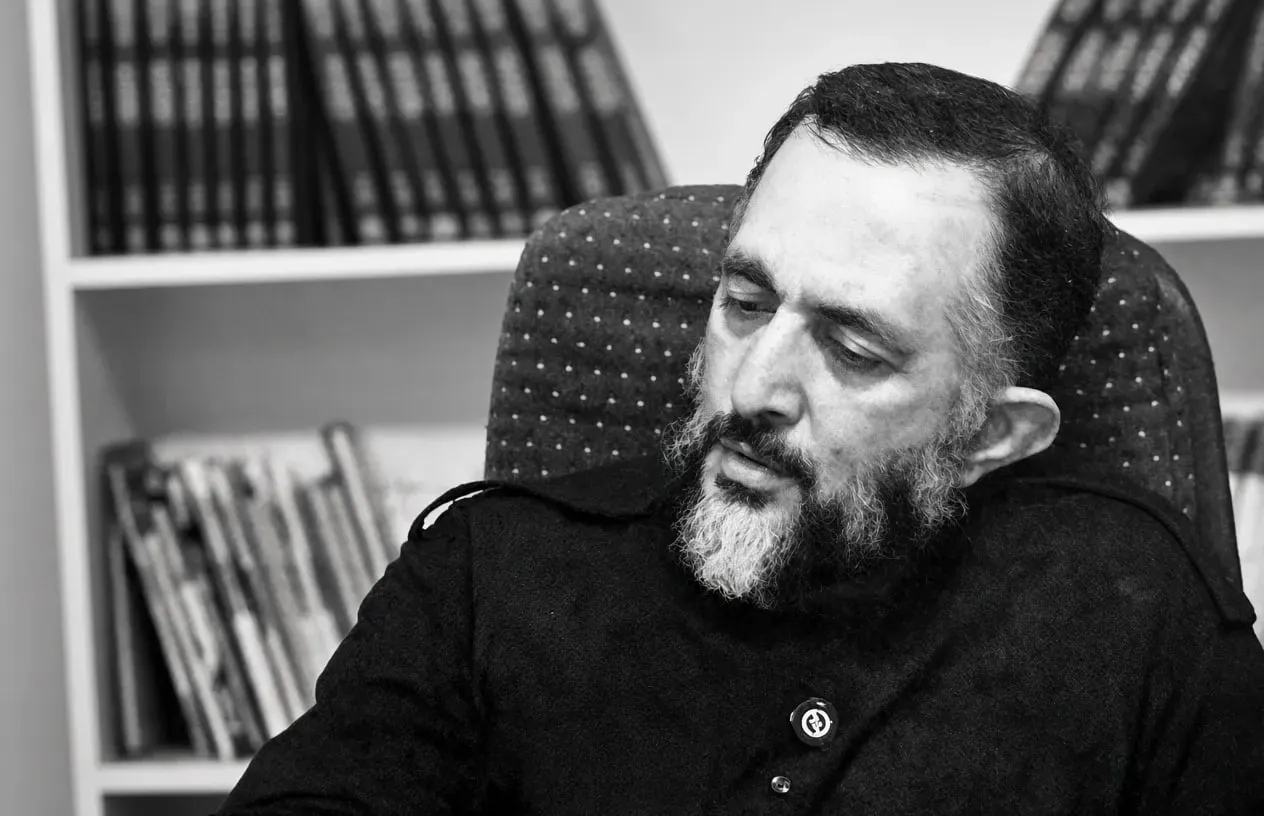
Their daughter seriously played football, and they themselves watch a lot of movies. They had special connections with military personnel.
Fekrshahr: Asr-e Iran wrote: What you are reading is the full text of the conversation of Farid al-Din Haddad Adel with the Khat magazine, belonging to the House of Young Clergy:
Farid al-Din Haddad Adel is the brother of Agha Mojtaba's wife, meaning the brother of the martyred lady, Zahra Haddad Adel; the uncle of their children. For nearly 29 years, he has been closely observing Agha Mojtaba's life. His account of Agha Mojtaba's life and personality comes from both his private life and his more public and professional spheres. From this perspective, he has painted a fairly comprehensive picture of his personality and life.
Simple-living, simply-dressed, and well-mannered
Our martyred uncle was deeply devoted to Mr. Khamenei. Our father also knew Agha, but our uncle, due to his responsibilities during the war in Kermanshah, had become very close and friendly with Mr. Khamenei. Because of this friendship, in the summer of '86, he invited Agha and his family to our grandfather's garden in Karaj. It was there that I first saw the teenage Agha Mojtaba.
Time passed until years later, one day my father told me: "There is something that I think it's better no one knows about for now. A while ago, a woman came to the school without introducing herself, asking for Zahra's hand in marriage. We are opposed to Zahra marrying while she is still studying and we said no. But recently I've found out that that woman was the wife of the Leader."
I said: "Zahra doesn't like to marry a cleric." My father said: "Yes, she says that, but let's go ahead now, say they should come after the university entrance exam and see what happens."
He was not a cleric at the time of the proposal and was very simple-living and simply-dressed, as well as well-mannered and not very prone to joking.
A Short Stay in Qom
My sister really disliked the security protection. During the engagement, she said: "What should we do about this problem? Lucky you who can come and go freely..." Once I said: "When you go out, look for a passage that has two doors, get out there and say we're going for a walk and will be back; then leave through the other door." They had done this two or three times but it hadn't worked.
At the beginning of the marriage, my sister told Agha Mojtaba: "I don't want to come to Qom." Agha Mojtaba said: "I am a seminary student and I study and teach; if possible, come for a few months and then we'll decide."
My sister's opposition had two or three reasons: first, she was a student in Tehran; second, her work was also in Tehran; and third, her family was also here.
In short, they spent a few months in Qom, and because my sister was not satisfied with living there, Haj Agha returned to Tehran and chose another way. He would spend three or four days in Qom and the weekends in Tehran. Later, when the children were born, he would go to Qom in the morning and return at night; but out of respect for his wife, he did not move their home to Qom.
The Life of the Leader's Son
Agha Mojtaba's life is very scholarly and simple. When they were in Qom, they had a simple house and limited belongings. The floor was only covered with a carpet. When they returned to Tehran, they moved into a 70-80 square meter house. My sister worked at a school and little by little bought a machine-made carpet and a comfortable sofa. It was a green sofa. I used to joke with my sister: "What kind of color is this that you've chosen?!" and tease her like that. One time my older sister said: "Farid! Don't talk about that sofa! Zahra saved up for a long time to buy that sofa and you keep criticizing its color, it bothers her." I agreed.
Now, after the bombing, that sofa is the biggest thing that remains from that house!
We, however, are "Shimiran" kids. We had a house in Pasdaran in 1971. Our grandfather was well-off financially; so the hardships of this life were multiplied for my sister. Believe me, if Haj Agha didn't have his wife's salary at the end of the month, their life wouldn't function; while they say he has a horse, a villa, and his children were born in England!
Overall, the hardships and limitations of their life were many. To be the Leader's son and not be able to go to a juice bar with your wife and children! When you travel, to be so restricted! I remember once we went to the north. We were somewhere near the beach. I said: "Haj Agha, let's go into the water." But he didn't agree.
I said: "Okay, let's go into the water with our clothes on." Anyway, we went and afterwards the children jumped into the water and Haj Agha thoroughly soaked the young men of the family. We were in the water for two or three hours.
That day, Haj Agha's glasses were lost; only one lens was found. He would hold that lens in front of him and read a book. He said: "Why did I give my brains to you?! For three days I've been holding this lens like this to read a book."
There, Haj Agha said something that reflects the hardship and limitation I'm talking about. He said: "Agha Farid, I don't remember ever swimming in the sea." Their little child was so thrilled that his father had come to the seaside that he talked about it for a while.
As he grew more prominent, the troubles and complex tasks of the office were added to his work. Differences among high-ranking officials and similar tasks were entrusted to him.
Jegarki (Grilled Liver)
One night I went to their house and said: "Get up, let's go out." I knew Haj Agha wouldn't come. I said: "Zahra Khanom, you come, let's go." I know a jegarki place that is my hangout; I go there with my own family too; come tonight let's go there." She said: "I won't go without my husband." I insisted but she didn't agree.
I really wonder why Zahra became a martyr; I truly envy her. I feel one of the reasons was that she never left Haj Agha alone.
Anyway, that night I took the children to the jegarki place. The next morning, Haj Agha called. He said: "Agha Farid, you went to a lot of trouble last night!" He had just called to thank me. I said: "Man, I'm the uncle of your children!" He was committed to thanking.
Another of their limitations was that they couldn't be with their children on occasions. We took the first-grade children to play football, and then it was decided that each father should come with his child. He said: "Agha Farid, I can't take off this robe and turban and play football with the other fathers." I said: "I'll go instead of you and play."
I remember our grandmother passed away and he couldn't attend the memorial service. After the ceremony, he wrote separate letters in his own handwriting to each of my grandmother's children and apologized. Because she was the mother of a martyr, he wrote: "I was deprived of attending this ceremony; may she take our hands in the afterlife."
For the birth of their first child in Rasalat Hospital, because he wasn't dressed in clerical clothes, he wore a jacket that my mother had brought for us, and our outfits looked alike. When he walked around the hospital, the staff realized he was the Leader's son. He went out to do something and I came inside. Suddenly, a guard said: "Haj Agha, we respect you, congratulations, what a blessing!" He had mistaken me for him. I didn't say anything because I knew he would be bothered if a crowd gathered around him.
At that moment, he came from the side and smiled, meaning 'you're caught,' and went upstairs to the ward.
Housework
If Haj Agha had time, he would do almost all the housework. He had become a serious issue in the family! He would change the baby's diaper, bathe the baby, take the baby to the bathroom, even though he was a cleric, he would carry the baby's bag, hold the stroller, feed the baby—he did everything. My wife would say to me: "He's the Leader's son, a mujtahid, and teaches advanced jurisprudence (kharij), and he changes diapers, but you've never once changed your children's diapers!"
There is truly no trace of arrogance or conceit in his behavior. For example, he sits by the large family kettle and makes tea. When he holds the tray to offer tea, except in front of non-mahram (where there is a restriction), he never gives the tray to anyone. After tea, he would collect and wash the teacups.
Let me tell you this so you understand this point. When he came out wounded from under the rubble, he said: "I won't go until I know my wife's fate." Eventually, under the pretext of security risks and the possibility of another bombing, they took him away.
Keep Your Eyes on Your Mother
Haj Agha set strict rules for himself in worship and life, but he never extended them to his family; meaning, this personal strictness was never imposed on the family at all; never.
For example, his daughter played football at school. Whenever we were together and there were no non-mahram, his daughter would seriously play football; meaning he gave them that much freedom of action. He himself stayed up at night praying and observed long fasts, but his family was not pressured. He also took great care that the children, as much as possible, did not understand what it meant that their grandfather was the Leader.
Haj Agha Mojtaba had a friendly relationship with his children. Regarding his son, I saw that he would slowly and gradually teach him an important matter, lest he be too strict. Overall, he had and has a gentle and mild religious upbringing.
The part that was interesting to me concerned religious etiquette. Once, it was my mother's birthday party and he was there too. He said: "Do you want me to tell you the best thing you can do at this gathering?" I said: "Yes." He said: "Keep your eyes on your mother."
Eyes, Ready!
He was strangely devoted to the Leader. He reacted to him in an almost reverential way. For example, once he stood with his hands folded in front of the Leader and said: "Eyes, ready!" The Leader said: "Don't act like this." Haj Agha Mojtaba said: "This is my belief and my view."
He is also legendarily devoted to his mother. Haj Khanom is now ill. About 2 years ago, I saw he was very worried.
I asked: "Haj Agha, what's wrong?"
He said: "My mother is sick, I'm very worried, very!"
Sometimes he would go to her home and provide any service a sick person needs. Of course, the Leader's daughters were more present, but he didn't hesitate either.
Because I work with my mother, sometimes we argue. My sister said: "Agha Mojtaba shows such reverence, respect, kindness, and affection towards his mother that it's simply unimaginable. He kisses his mother's hands and feet, and if his mother is upset, he won't leave the gathering until he finds out why she is upset." Zahra was advising me!
Agha's wife was very much a wronged figure. She was enamoredly in love with Agha. She was devoted to this life and had fully accepted this lifestyle. She was anxious about Agha, and they were also very comfortable with each other.
Once, my father was invited to Agha's home. Agha said: "Farid should also come." As a result, at that gathering, I was there along with Agha Mojtaba, Dr. Haddad, and the Leader himself. We were invited for lunch. There was little food on the table. The Leader said: "Forgive me, I forgot to say I had guests. There's enough food for two and a half people; let's share it."
Haj Agha Mojtaba brought some food from somewhere else, equivalent to one and a half portions more. The Leader said: "There was no need for you to do this; we could have eaten what was there together."
Then the discussion turned to how women suffer when men have guests and don't inform them. The Leader said: "There was a period in their lives when such things would happen. He said: "We had agreed that when we cook, if there are six of us, we would cook for eight so that if we had guests, there would be food; so, we always had last night's food at mealtimes, and the good thing about it was that we no longer had the problem of uninvited guests. The family also got used to this routine and didn't get upset."
Haj Khanom stood very firmly by Agha in the struggle. Agha's bond with his wife's family was no less than with his own family; especially with Haj Mohammad Agha Khojasteh, he had a great time.
Friend of the Children
Haj Agha Mojtaba quickly becomes friends with children. I remember we were standing and one of the women in the family came in with a baby in her arms. We made all sorts of faces to make the baby laugh, but we couldn't. When I held the baby, he started crying. Haj Agha said: "Look, he's innocent and understands; he's recognized you!"
I said: "Do you want to hold him?" He said: "You know that if I hold him, he'll become my friend." I said: "Come on, hold him." He said: "No, I won't hold him now." During the party, he went to check on the baby once or twice, but he didn't smile. He said: "Look, both I and Agha have a great relationship with children; I'll eventually make him laugh."
Finally, he took him from his parents' arms and made him laugh, and even threw a jab at me, saying "Do you want to hold him again and make him cry?"
Once, in a family gathering, a teenager said to his mother: "You're always nagging! I don't want to do this!" I saw him pull the teenager aside and say: "It's none of my business, but if you don't want to do something, you shouldn't speak harshly to your mother; disobeying your mother is rebellion, but speaking harshly is much worse."
The Leader's Robe
In December 2024, we visited the Leader. On the way back, I said to my father: "Did you see the sleeves of the Leader's robe? They were frayed; it was really bad. Hopefully, the Leader won't appear like that in front of the cameras; it's not good."
My father said: "Mr. Hejazi and the household staff are careful about that." Then my father said: "Farid, I had an appointment with Mr. Hejazi last Monday and we went and prayed with the Leader. I noticed his ankle was visible from under his sock; his sock was torn. I was thinking about that sock throughout the eight rak'ahs of prayer. When I looked up from the prayer, I saw Mr. Nateq next to me, crying. He said: 'Did you see the Leader's socks? Where are we and where is he?'"
Four or five days later, I told Haj Agha Mojtaba: "Can I make a suggestion?" I recounted the story and said: "I know the Leader wants it this way, but at least buy good Iranian socks so they don't wear out so easily."
My sister was listening to our conversation and smiled. That smile meant there's something you don't know. She said: "The Leader doesn't allow anyone to help him put on his socks. Because he has to put on his sock alone with one hand, he has to pull it, and as it is pulled, the fabric gradually gets damaged. But he also doesn't allow anyone to hold the sock for him."
In simplicity, Haj Agha Mojtaba is very much like the Leader. Once, we were at his home and talking. He said: "I have a meeting and I have to go." I noticed that when he was buttoning his robe, he was struggling; I mean, I felt it was difficult for him.
I said: "The button is a bit low." He said: "I know!" I couldn't control my curiosity and said: "Isn't this outfit strange?" He said: "No, there's no problem," and said goodbye and left.
I said to Zahra: "This outfit seems poorly tailored. Haj Agha was trying to button it, but it was very difficult for him." She said: "Because the button is sewn differently; our own shirts are tailored for right-handed people; but this was the Leader's outfit."
I said: "Why does he wear the Leader's clothes?" She said: "The Leader uses his clothes so much that the sleeves wear out and sometimes tear, and he wants to mend them. Agha Mojtaba says: 'Don't wear this, it doesn't look good in meetings, let me wear it.' With begging and pleading, he takes the Leader's clothes away so the Leader is forced to order new clothes, and then he himself wears the Leader's clothes."
He is very simple-living, very! Our mother had brought two jackets from a trip, one for me and one for him. I've now changed several jackets, but he still uses that same one.
I remember years ago, he spoke in a small gathering about the virtues of Ayatollah Meshkini. He was very fond of him. He said: "Once, the Leader had a meeting with Mr. Meshkini. The Leader came to see him off and asked: 'Which are Mr. Meshkini's shoes?' Then he took them and said: 'Children, go and bring new shoes for Mr. Meshkini.'"
After seeing Haj Agha Mojtaba's worn-out shoes, I said: "With this situation, your shoes have become like Mr. Meshkini's; change them." He said: "They're fine; they'll become new with a bit of polish."
The Documentary That Was Never Made
It's hard for there to be gossip about you and you can't defend yourself. I used to tell him: "Don't let Makhmalbaf make slanderous accusations and produce films saying that so-and-so's child was born in England. Let me make a documentary from Rasalat Hospital and show that your children were born there." He didn't agree, saying: "It's not necessary."
He defined himself during the leadership years. He strongly refrained from allowing any trace of self-interest to appear in his statements. He proposed many things, including giving speeches, but he didn't accept. For example, he has a large mosque, or two or three seminaries with specific functions, but he strongly insists that everyone should be careful not to say this is Agha Mojtaba's seminary.
This has resulted in us not having a collection of his statements. I used to ask my sister: "Why are you so reserved?" She said: "He doesn't want his ego to be tempted."
His students had compiled his jurisprudence lessons, but they didn't go towards publishing them. My request led to them being compiled, but anyway, he absolutely did not allow them to be printed.
At the Assembly of Experts conference, he had said that the Supreme Jurist must be a comprehensive mujtahid. Mr. Jazayeri had worked hard to justify this and had printed one or two pamphlets, one hundred copies, and distributed them to the attendees. I told his students: "You didn't do this enough, and this is the result." They said: "Haj Agha Mojtaba himself didn't allow it."
Everything about him is hidden. He has a very strong instinct for secrecy... for example, the taxi story mentioned in his message—I don't think anyone knew about it until then.
The Office's Accounts and Reckoning
He absolutely would not let these accounts slip from his hands. For example, because my son is the same age as his son, they are very close friends. Once they were somewhere together. I told the head of the security team: "If possible, drop off our Yahya at home, then go to the household." And the head of the team said: "Certainly, Agha Farid! Yes!"
After a while, my sister told me: "Forgive me, Farid, don't do this." I said: "Okay, I understand your concern, but I was really stuck." She said: "Haj Agha Mojtaba calculates the Snapp taxi fare for that route and pays it. I'm telling you this so that he doesn't get into trouble because of me and your children and have to do this."
Once, on the eve of Nowruz, one of our friends sent two boxes of sweets and said one box is for Agha Mojtaba. He said: "I won't accept it, because I don't know the giver."
We had a colleague who sent us mulberries every year. He would accept these mulberries because he said: "I know him; he pays his religious dues."
Once, someone from my father's friends brought a food gift. He asked my father: "How is his business?" My father said: "I don't know." He asked: "Does he pay religious dues?" My father said: "I don't know." I saw him take some of that food but didn't eat it.
Once, we had to go to a place for iftar out of social obligation. He first made excuses, but we insisted and he eventually came. He was also very uncomfortable; it was a fancy house. Zahra Khanom said: "That night he calculated how much food he had eaten and gave that amount to the Rad-e Mazalem."
In short, he was very careful about what is forbidden and what is lawful. Once, due to my sister's illness, they had to get ten servings of rice and stew from the office kitchen for their guests. Haj Agha went and calculated the cost of the food and paid it right away.
Precision in Words
He strongly prevents people from entering others' personal spheres. Once, someone took a second wife and fell into disagreement with his first wife, and the matter became complicated among the family. Later, the women of the family brought up and discussed the issue. He didn't comment at all. Later, when we were alone, I told him: "You're very clever; you didn't say anything that would upset the ladies."
He said: "No, really, until we know all the facts and are in a position to judge, we can't comment on others. Why incur a debt to people? Whether he has done something good or bad, it's his own affair."
I said: "Then why did the Leader say that whoever takes a second wife should not work in my office?" He said: "That's because of the social and work consequences; and also because the Leader's office is a role model."
The Leader was very harsh regarding permanent and temporary second marriages. It's the same with Haj Agha. A person who worked in his office said: "He is stricter than his father. He has said: 'Whoever enters into a permanent or temporary second marriage should not come to my office again.'" He wouldn't even allow joking about it.
Another point is that he is very precise in his use of qualifications. He doesn't say: "He's a very bad person." He says: "This person has this problem from this aspect; he has made a mistake in this regard." He is very careful in his choice of words.
Regret Over Unconscious Prayer Following
He is very devoted to worship and prays at great length. If you follow him in prayer without knowing, you'll definitely regret it. Once, I went to their house and saw him praying, so I quickly started following. Until the prayer was over, it took about twenty minutes. I went through every spiritual and non-spiritual memory I had during the prayer; I recited every prayer I knew until it was over.
After the prayer, he said: "Why didn't you say you were here?" I said: "I'm definitely not going to follow him next time!" He said: "If I had known you were following, I would have prayed shorter."
Once, we were somewhere and we had run late. He told me: "Let me pray one of my prayers." When he finished the prayer, I said: "That took a while." He said: "Praying on time is incomparable; God must be pleased with us. The Leader himself also embodies this more and more every day. He is like that too."
We lived on the ground floor of my father's building for a few years. One night, we had a party. After the party, we went to our own unit. Haj Agha had stayed at my father's place, and I didn't know. I had left my phone in my father's reception room. Before the morning call to prayer, I got up and went upstairs to get my phone from the reception room. I came to the door of the room in the dark and bumped hard into something. I looked and saw Haj Agha was in prostration. I was a bit scared. He also got up, glanced at me, and continued; he was engrossed in worship.
Pocket Quran
He reads the Quran a lot. On a trip together, I saw that whenever he had free time, he would open his Quran, read two pages, move his bookmark, and close it again. He has a special Quran that he never parts with.
He strongly emphasizes familiarity with the Quran. Once, I asked: "What if we don't have time to read the Quran?" He said: "You should get used to reading the Quran continuously, but if you can't, at least read Surah Yasin this way, Surah Rahman that way, Surah Mulk this way, and these verses in your prayer like this."
He pays attention to memorizing the Quran, but he emphasizes reflection on the Quran more. He himself is not a memorizer, but he is very familiar with it.
Once, he told me: "Come, let's talk about school matters." He explained: "A Muslim who is not familiar with the Quran is not a true Muslim. How much Quranic work are you doing in your program? Children should constantly read the Quran and be familiar with it."
He understood the Quran very well. When someone read the Quran, he would easily say the meaning and concept of it.
Six Months of the Year
Haj Agha lived a hard life and was strict with himself. He would fast for six months of the year. The last time we had lunch together, he called and said to come. The security team had changed and they were very strict. It took half an hour from the "Keshvar-e Dust" gate to reach him. He said: "I missed you." We said we missed you too. I said: "What a surprise, you're not fasting!" He laughed. Right there, I asked: "Do you think there will be war?" He said: "Until the Leader is assassinated, there will be no war."
The Evening of Ashura
His mourning has a special quality. We were together on an evening of Ashura. I saw he was very upset. I asked: "What's wrong?" He said: "The real sorrow of the Ahl al-Bayt begins here." A little later, he got up and left, and we didn't see him again that day. He is very devoted to remembrance (dhikr). He finds authentic prayers and is constant in them.
People of Spirit
Ayatollah Bahjat had recommendations for him, the details of which I don't know. He had seen many people of spiritual status and had even tested some to see how connected they were. Once, at home, a living person was being discussed, and everyone was praising him. I looked at his face and saw him smiling, the kind of smile that says, 'What am I supposed to say now?' When we were alone, I asked: "You didn't say anything about so-and-so?!" He said: "Be careful that people don't become devotees of someone without reason; sometimes it has irreparable consequences."
The Leader also had connections with many people and knew all about their lives and what would happen. There was a person called Mr. "Nour" in Mashhad. I insisted and asked the Leader: "What was the story of Mr. Nour?" He said: "I'll tell you on condition that you don't ask too many questions. He was a person relatively connected to the spiritual world. In 1974 or 1975, he told me: 'Agha Seyyed Ali, you will face great difficulties but you will reach high places.'"
I said: "Meaning I will become a source of emulation?" He said: "No, you will reach high places in worldly terms."
I said: "Meaning, for example, I will become Prime Minister?" He said: "You will become the highest figure in the country. A bad thing will happen to you, but if you survive that incident, you will reach the highest position in the country."
The Leader said: "I told this servant of God: 'You really have patience! Now that they've suspended our classes, closed our mosques, and SAVAK keeps summoning us for interrogation and prison, you tell me I will become Shah?' He said: 'Ah, yes, you might become Shah!'"
Let me add a parenthetical note. My father used to recount that the Leader once said in Friday prayers: "God, make my beard dye with the blood of my head." I asked someone who had seen the Leader's face, and they confirmed it was true.
Agha Mojtaba also knows people in Mashhad and has connections with some in Qom and Isfahan. There is a person called Mr. Nasseri in Isfahan, who I think is Sheikh Jafar's brother. Our uncle passed away a few months ago. I asked Mr. Nasseri: "Haj Agha, how is my uncle's condition?" He said: "He is among the Friends of God." I said: "He was a very ordinary person!" He said: "His soul was very free; what did your uncle possess?" I said: "He was secluded." He said: "Probably that's the reason." Then I asked: "How do you see Haj Agha Mojtaba?" He said: "He is the hope for the future of Islam; wait and you will see."
The Right of a Teacher
Haj Agha strongly believes in seminary knowledge and greatly respects his teachers. Once, in his presence, I criticized one of the scholars. He said: "Don't speak ill of that scholar! He is my teacher, and I must honor the right of a teacher. You shouldn't speak ill of my teacher to me."
Scope of Studies
Haj Agha is not interested in literature like the Leader, but he watches a lot of movies. He is very fluent in modern sciences and technology; he is well-versed in new financial literacy; and he is very strong in the field of startups and understands them well. Once, a discussion came up and someone mentioned a person who is apparently one of the top figures in startups in the field of financial literacy. Then he said: "I know him very well."
It's the same in the field of agriculture and water. He used to say: "If the country wants to become independent, its agriculture must be on its feet." Perhaps this level of information and knowledge has been gleaned from the thick trunk of the Leader's issues.
Once, I had gone with one of the IRGC commanders to the "Mahroomiat-Zadaei" (Deprivation Relief) Jihad. A person who worked alongside this commander said: "We have worked a lot on the issue of water and low-water-consuming industries." He said: "We have reported all our work to Agha Mojtaba."
In short, Haj Agha has very precise knowledge regarding financial literacy, financing funds, gold funds, etc. His knowledge is also at the frontier of knowledge! He once did a detailed project on cultural industries, perhaps reading two or three thousand pages of material. My sister said: "He has read all the Persian texts in this field, and some important texts have also been translated for him and he has studied them."
He has read a lot of psychology, and I don't know the reason. Its level and depth are beyond just studying psychology. We didn't have work-related contact, but sometimes he would use certain techniques of counseling, psychoanalysis, and cognitive sciences. Once, one of the teenagers in the family was upset, and I was talking to him. When that teenager went out, Haj Agha Mojtaba told me: "Agha Farid, truly embrace him," and he explained the important effects of a hug; or for example, he would say, "Hold his hand; this has this effect."
He listens very well, like a counselor. He also knows some counseling techniques very well and has a high capacity for persuasion.
At one point, I researched hydroponic cultivation. I spoke to him about it enthusiastically for a quarter of an hour. I saw that sometimes a smile would appear and disappear on his lips. When I finished, he said: "Have you heard this point too?" I said: "Yes, I forgot to mention it." I said: "Why didn't you say you'd heard all this?" He said: "I thought to myself maybe you'd have something new; go to such and such a place, in so-and-so's farm, all these things you're saying, he has done."
Haj Agha had even taken several books in the field of communication from my sister and had read them.
Debate with Dr. Haddad
Once, he had a discussion with my father about the history of Islamic sciences that was interesting. Another time, they were discussing the Akhbari school of thought. Another time, they were talking about various aspects of Hafez's poetry.
One day, this poetry discussion took place in the presence of the Leader. The Leader said: "Anyone can have some ghazals in his life that are very worldly and some that are very good and mystical." The Leader said: "Rahi Mo'ayyeri was a good poet; he has a ghazal about a celestial and heavenly figure... have you heard it? The poet for the first time in the 1950s boards an airplane and is fascinated by a stewardess, and afterwards speaks about the sky, leaving, and such things. Someone who doesn't know this would think he is talking about mystical journey and knowledge, while Rahi Mo'ayyeri himself says he wrote this for so-and-so stewardess."
My father thought that the Leader was only familiar with philosophy. This perception changed during the years he was the CEO of the Encyclopedia Islamica Foundation. Every year, during the holy month of Ramadan, the trustees of the foundation visited the Leader. Before the visit, they had a meeting to decide what to present and they prepared visual and written reports.
Once, my father and Haj Agha Taremi were talking. My father said: "Be careful that so-and-so doesn't raise too many philosophical discussions in front of the Leader; the Leader asks questions, and if we say something wrong, he will follow up later; so it will take time and we'll lose face." Of course, these are my own words, but I remember they said the Leader has a serious engagement with philosophical discussions.
Favorite Book
He had read the Leader's Forty Hadith very thoroughly. Among book readers, you should look for a book whose paper has been handled a lot. Agha Mojtaba's copy of Forty Hadith is one of those books; he had read it well and had also underlined it. He had also seen the works of Martyr Motahhari; he had also studied the works of Mr. Mesbah; I had seen his important books in their library.
Devotion to Haj Qasem
He was very fond of Seyyed Hassan and had a connection with him. I don't know the quantity, but the quality was high. They even had very specific spiritual discussions together; this happened once or twice.
He also had a special devotion to Haj Qasem. Once he said: "If the Leader allows, I am ready to go and work in Syria, Lebanon, and Iraq under Haj Qasem's orders; that's how much I value his work."
He was very upset by some political factions over the events of 2009. Part of his anger was that they damaged the Leader's process of Islamism-Republicanism. We had a proud Islamic Republic where all presidents had come and gone consecutively, and these people came and damaged this process.
War Expert
He has been very present in military matters. Once, I wanted to visit the Leader on a Monday. Agha Mojtaba said: "Don't come on Monday, because it's a day for military meetings and the atmosphere is military. On that day, the Leader is not the same Mr. Latifi you see on other days."
I remember we got to know a commander and were doing some things with him. After a while, Haj Agha asked me about my work. I said: "I'm advancing this work with so-and-so." He said: "Be careful, this person had a security issue a few years ago; I don't know if he was right or wrong, but anyway, be careful!" He knew people down to the details


Take less than a minute, register and share your opinion under this post.
Insulting or inciting messages will be deleted.
Sign Up