
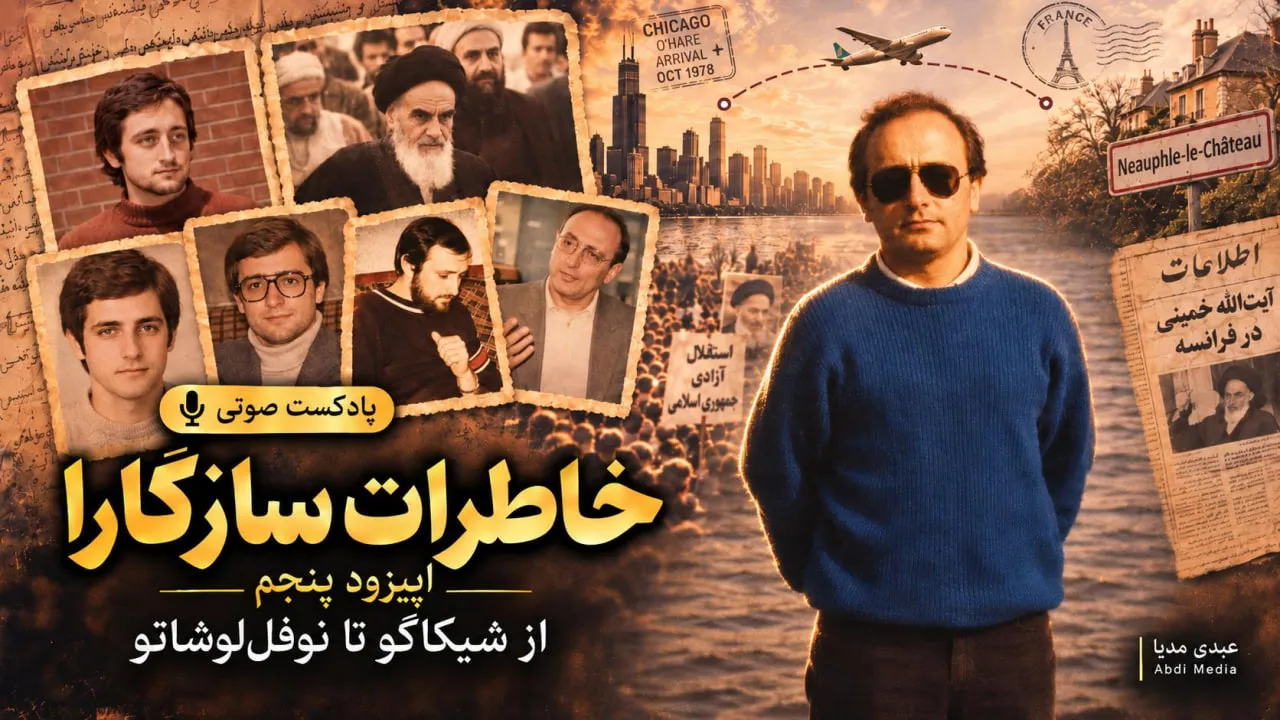
Episode 5: From Chicago to Neauphle-le-Château.
I also completed a thesis on three periods of religious intellectualism with Dr. Martin, and we knew there was an organization called the Freedom Movement Abroad; we distributed its publication in the association. One day Reza Tabatabai told me about the "Payam-e Mojahed" that a liaison from the kids of this same movement had spoken with him and had proposed me and you, and if we accept, we would become members. I told him, let me think a little. That liaison, whom I later became well acquainted with, was Hadi Nejad-Hosseinian. He said, why do you want to think? I said, this is an organization that if you are exposed, the Shah's regime will give you ten years in prison. Later, I think I know its founder is Engineer Bazargan. I like these people, but let me think a little, and then I will tell you. I thought for two or three days and said I agree, and I became a member of the Freedom Movement of Iran Abroad. From here, in fact, besides the association's activities, we had a series of secret activities, including that we set up a separate fund under a certain name; the movement's correspondence was with there. I carried out a series of tasks for the movement, including Dr. Yazdi—well, now he would speak with us separately. In fact, it can be said that the Freedom Movement of Iran Abroad in America was at most perhaps fifteen or twenty members, but it was a political organization that stood behind the Islamic Association, looked after the association, and we were careful that there would be no fight and no split, and also that it would not fall into the hands of the National Front people, for example, in its elections.
Yazdi would also, separately, sometimes when he came to Chicago or somewhere, we would see each other and have a separate meeting, or Nejad-Hosseinian, for example, would set up a meeting. Reza and I separately rented a place on... Street. It was a very dangerous place too—a dirty, filthy apartment, but it was cheap. Only because we had bought a stencil machine and put it there; we would reproduce things and do the movement's work that we wanted to do. We would go to that apartment; it was secretly arranged. Incidentally, its landlord was an old American man. He would say, "In my youth here in Chicago, you come out at the intersection of three states, the FBI"—he said they were not there at that time; these states had separate police. He said, "We would go into Indiana, rob a bank, then come to Chicago, and they could not catch us." He said, "These buildings were bought from the proceeds of bank robberies; they gave up stealing and robbing banks."
It was a hidden place, that street, because it was cheap. We took a dirty, filthy, small apartment and carried out activities. The work I did for the movement was not like now—there was no internet. We had shortwave radio; we listened to Radio Iran news, and various publications that were neither internet nor site nor anything—we would read them from Western newspapers. Several of us were assigned to read the Washington Post and the New York Times and extract and send for... The Payam-e Mojahed was prepared there; its editor-in-chief was Reza Rouhani. Later we became acquainted and found out it was Reza, and we helped the Payam-e Mojahed publication come out.
Our other work was acting as a political office for the Movement of the Deprived in Lebanon; the other sections of the movement did the same. Specifically, I read the Israel Post in Western publications, the Wall Street Journal—several newspapers—we would extract their Middle East news, translate them, sometimes place and paste them on A4 paper and send them. Yazdi would archive these for various analyses. Yazdi told me, "Your mind is good; do two things. One, a new science had emerged from the army called intelligence analysis." In fact, all intelligence organizations put different pieces of information next to each other. Because if you know one hundred percent of an incident, it does not need analysis; analysis is when, for example, you know 40 percent and the other 60 percent you can help with statistical and mathematical estimates—you have different methods. But information analysis was in fact one of my missions. I had taken and read several books on this from the library. I had started working on translating this—that you make information pamphlets. One of my tasks in the movement was to help with information analysis: from the news that arrives from Iran, we could analyze it.
Among them was the escape of Taghi Shahram from Sari prison and the blow that the Mujahedin-e-Khalq received—it split from the top. One of the things we analyzed was that Lieutenant Ahmadi, meaning SAVAK here, probably knew that Taghi Shahram had become a communist and turned a blind eye, and he escaped. When he returned to the Mujahedin-e-Khalq organization, he was an important factor from above that caused the big split in the Mujahedin-e-Khalq in 1977. Their ideological statement came out and really split the Islamic movement in two. It destroyed the Mujahedin-e-Khalq organization. By 1978, in a way, the Mujahedin-e-Khalq organization had lost its breath; it was not the axis of the Islamic movement and so on at all. It had split from the prison; a group had realized it had problems; from outside the prison too.
Another task Yazdi assigned me, which later caused me trouble—because our mental model was all armed war—was that it is good for us to work on the model of people's armies. Because we win when this war becomes a people's war; two guerrilla organizations and so on cannot defeat the Shah. Let us reach... for example, like the Algerian FLN. Therefore, another of my tasks was to study people's armies like the Swiss army, the Israeli army—where all ordinary people... America—and also large people's guerrilla organizations like... to some extent the Algerian FLN, the Irish—the Irish Liberation Army. I had started; I would also get their books from the library, find them, read them. We would work on the people's armies model, because we thought—we were in love with the Vietnam War—we would wage a long guerrilla war with the Shah. No one had any conception of civil preliminaries and violence. We thought in America—the Black movement in America, which was also very important, and we were very supportive of it because we were anti-American. Malcolm X was in it; he had become a Muslim—his name was...—and he was a supporter of armed war and so on; he was also killed. And Luther King was fundamentally a deviation in the Black struggle—they fooled the Blacks, for example, they put one over on them. Incidentally, Luther King was the real man of the matter who, with his brilliant struggle, was able to get the Civil Rights Act passed in America. But in fact, we saw it this way: being revolutionary is the same armed war, because the literature of civil resistance and nonviolent struggles had not yet become knowledge. Gandhi had done things; Lawson had gone to India and learned from Gandhi, and had returned with Luther King and they had imitated that model in America in the 1960s and had also succeeded. But there was a distance. It was only in the 1980s that Gene Sharp and Adam Roberts made pamphlets, built political theory for it in the university, and then the CNC institute applied and taught these. Now it has become a knowledge and a strong path of struggle with hundreds of reasons and successes and a brilliant record. Therefore, another of my tasks in the Freedom Movement was those studies that I had started, and it was with Yazdi himself.
Another thing I can say is that in the summer of 1977, when that pamphlet announcing the ideological positions of the Mujahedin-e-Khalq organization came out, the Muslims were in mourning. That pamphlet was apparently written by Taghi Shahram. The gist of his talk is that we patched this old aba of Islam from everywhere; it tore; we put a scientific patch on it—in fact, we put a Marxist patch on it—then we came to the conclusion that we should throw this aba away altogether. We threw it away and took up pure science, which is Marxism; we became communists. This was a blow to the head of the Islamic movement, because they thought the world had ended, Islam had reached a dead end, it was over. In the Islamic Association of Students, two things were done—two things, in my opinion, wise, in America. One, a very good seminar was held in Texas. I think nearly two thousand student kids from across America came to that seminar. Incidentally, Engineer Mousavi and Ms. Rahnavard had also come from Iran that summer; they were in Washington. They were good students of Shariati. Engineer Mousavi had a mustache and was very much in the style of Samad Behrangi—round black glasses and short hair, and this kind of Samad Behrangi look. He smoked Homa cigarettes in the style of Shariati, one after another. We arranged speeches for them at the seminar; both of them gave Quranic speeches, and it was very good. But the seminar was dedicated to analyzing this same book of Taghi Shahram—that, for example, one of them was about the issue of revelation and denying the role of the masses. One speaker was Ali Sadeghi, one was Dr. Yazdi, each giving a different answer. Each of them explained and rejected one of these pamphlets for the association kids at that seminar, that his words are nonsense. But better than this—now that I look back—those speeches were not very deep. The one who gave fundamental depth to this work, very well, was Dr. Soroush, whom the Islamic Association invited from London to America. Dr. Soroush—the kids who had studied at the Alavi School knew him, and the kids of the London seminary also knew him well, but he was not very well known. When Soroush came to America, for nearly—I think—50 different cities during the two months he was in America, the Islamic Association arranged programs for him. Dr. Soroush spoke for four nights in each area. One night he spoke about the philosophy of history, where, well, the dominant insight was Marxism. Dr. Soroush—not that he was a student of Popper too; his name was Mr. Karimi, because it was not common to use our own names. I was "Mohsen of Chicago"; no one knew I was Mohsen Sazegara, because of SAVAK. Later we found out we were afraid for nothing; SAVAK was more foolish than this.
A limited number were known by name and surname. Dr. Soroush came to America under the name Karimi. One night he spoke about the philosophy of history—that this is nonsense—and explained Popper's poverty of historicism. One night he spoke about the philosophy of science—what is science at all, what is not science, and that you say Marxist, where is it science? One night he spoke about the foundations of philosophical thought and ethics and "first philosophy," and the exercises that Dr. Soroush—who is also a very good teacher—would do with the kids in each area of each association. After he spoke for an hour or two, it was mainly from this same pamphlet of the Mujahedin-e-Khalq and the early works of the Mujahedin-e-Khalq. In fact, Soroush insured the Muslim kids, opened everyone's eyes to the fact that this Mujahedin-e-Khalq organization has problems from its very early works. Do not think they were very Islamic; that reached a dead end. These, for example, became Marxism. First, Marxism itself has fundamental problems—not that, well, the philosophical tool and philosophy of science and Popper's views, which his enemies destroyed the Marxists with—but also the views of the Mujahedin-e-Khalq. I remember Dr. Soroush, when the first philosophy [session] ended, would take the examples and bring them, and the kids themselves would answer. This caused Dr. Soroush's tapes to be recorded in every area. He was constantly traveling to Iran and back; we sent them to Iran and they were reproduced in Iran, and many university kids went and saw that this thinking had problems from its very beginning. Second, the implementation—the Texas kids, I think, implemented the pamphlet; we sent them to Iran, it went and was distributed in the association. And in fact, it can be said that it was a good opportunity for a fundamental housecleaning with the views of the Mujahedin-e-Khalq type, which had problems from the foundation.
I became acquainted with Soroush during the four nights he was in Chicago, at my and Reza Tabatabai's house. I remember in the morning we went to a big bookstore in Chicago; he also bought two or three books. In the mornings he would go to the edge of Lake Michigan and read these philosophical books. The first time I saw him, he would put his hand in the middle of the paper, read one page, go to the next page—very fast reader. While he was in Chicago, he read two or three books and finished them and posted them to London, to his own library in London. He said, "I will keep these." And "The Restless Nature of the Universe" was his lecture in London; I transcribed it. Incidentally, it reached him at our house, and he gave it to me, and I read it. There he corrected it right there; later it became the book "The Restless Nature of the Universe," which is extraordinary.
I mean, I remember Motahhari had gone to London, had seen Dr. Soroush, and had been impressed, and then had taken it and given it—Mr. Khomeini had also read it. Khomeini had also practiced philosophy in his youth; he had said, "What things the youth do!" He had also praised it a lot. Soroush came to Paris when we were at Neauphle-le-Château; he wanted to see Khomeini. Yazdi had said, "So-and-so has come and wants to see you." Khomeini had said, "Who is he?" He had said, "The author of 'The Restless Nature of the Universe.'" He had said, "Tell him to come." He had seen Dr. Soroush with enthusiasm and eagerness. That caused me to become acquainted with Dr. Soroush.
The association's demonstrations, going into the street—one of them is the famous incident that happened in 1978. Carter had come to power; the Shah came to America. Later, especially because Carter had come to power with the slogan of human rights, the Shah was worried that the Americans might want to remove him. His eye was very much on the Americans' hands. Apparently, on the night of January 1978, Carter was supposed to go to Iran, stay no more than six hours—just a dinner, for example—and then go to India. Then they saw that the Shah was very weakened and very worried. Carter stayed one night, and apparently in the negotiations with the Shah he assured him: "This human rights that I talk about—well, you should moderate, for example—but I do not mean you; I mean the communists." That is, this pressure was on the Eastern Bloc and the Soviet Union, especially so that the Jews would not be harmed, so that four and a half to five million Jews would be freed and go to Israel—now one and a half million of Israel's population are of Russian origin. They gave the Shah a lot of assurance. Carter's famous speech at the dinner table: "Your Highness, in this turbulent region you have created an island of stability and calm and so on." But nine days later the Qom incident happened—that is, the spark of the Islamic Revolution was struck nine days later.
When the Shah came to America, everyone had already mobilized. Well, the revolutionary atmosphere in Iran was rising; they came and there was a big demonstration in Washington. All the lines of the Confederation had mobilized; the lines of the Islamic Association came from across America. Then everyone wanted to demonstrate in front of the White House. As a result, the police had divided the spaces. We had not gotten a space. We came to the conclusion that the association should move instead of standing still, but arrange it in such a way that we come from three streets further away and arrive exactly at the moment when they bring the Shah by helicopter to the White House. Unaware that on this side were the kids of the middle line—the Shah's regime had also made a mistake; it had thought the embassy—that Ardeshir Zahedi would bring a number of his own supporters to demonstrate in favor of the Shah, for example. The police had allowed these people on this side. The result was that these middle-line kids, who were also very thuggish and tough—I said they would also beat us up—on this side had Shah placards; on that side had placards of SAVAK and thirty thousand prisoners, torture and death, and pictures of the martyrs. They had sticks with cardboard things pasted on them. These middle-line friends could not tolerate it—as if on that side, what is democracy? They stood and said "Long live the Shah." They pulled the sticks of these placards and attacked; beatings and fighting. It was exactly at the same time that we, the Islamic Association, had to pass through the middle of their crowd to demonstrate. We also had a loudspeaker. Ms. Ebtekar, whom we called Mary's sister, had grown up in America and had a completely American accent, was speaking behind it. It broke into a fight; they fell on each other and beat each other. The police intervened and fired tear gas. The wind carried this gas—exactly at the same time that the Shah was standing and Carter too, in that yard behind the White House, usually called the "Walk," and they give short speeches. This tear gas went and tears came to the Shah's eyes, and he had taken out his handkerchief. The photographers took pictures. I remember we printed this poem on the front page of Payam-e Mojahed and wrote beneath it: "Cry, O Shah, cry, and wail, since you killed at the bottom—this is how you are, this is how you are—cry." In short. This became very famous—the Shah crying at the Walk ceremony—and it also became hot news; all the press ran it.
When Carter came to power, we in the Freedom Movement Abroad made an analysis—Yazdi also wrote that analysis as the editorial of Payam-e Mojahed. The title of the article was "America in a Dead End: Militarizing Iran," but its content was better than this. Our analysis was: well, the human rights that Carter came with and actually won with—its target is more the Soviet Union, but inevitably it must also moderate the dictators of the world. And the Shah, because he is the most famous dictator in the world—correct—we said the Shah is America's puppet, a U.S. puppet, and we said these things in all the demonstrations—but it is forced to moderate the Shah a little. Therefore, in Iran they will inevitably give a little freedom. And so it happened. This was the winter of 1976—meaning Carter had won but had not yet become president; the interval from November when he wins to January when he takes the oath. We said this will cause, soon, a little space to open in Iran, like the years 1960 and 1961. No one imagined the Islamic Revolution would win, but we said let us give depth and breadth to the Islamic movement. The practical action was that we sent a message to Engineer Bazargan—we sent this same analysis, that Engineer Bazargan, you must write your last book in prison; there is no problem with that either. Bazargan had no objection to going to prison again, but we, so that the people would not be fooled by four off-the-cuff freedoms—in short, if I want to say it in today's language, with the reformists they would not be able to—of course, now I believe these ideas were wrong—but because our thesis was the overthrow of the Shah, the Shah's regime must fall with a revolution. We sent a message to Engineer Bazargan: you come and write an article publicly, make an analysis that with the Shah's presence nothing will be solved, nothing will be reformed; the Shah must go. So that they cannot pull off this game—give four freedoms, calm the revolutionary atmosphere. Incidentally, Engineer Bazargan also wrote a very good article—a detailed analytical article, "The Country at a Crossroads," analyzing from the 1953 coup, the things the Shah had done, the freedoms, and so on. At the end of the article, his conclusion was that the country has reached a crossroads now: either one person must sacrifice himself for the nation, or a nation is sacrificed for one person. And since the nation cannot be sacrificed for one person, therefore there is no way—the last sentence of the article was that the Shah must go. Meaning, we want freedom, give it; do whatever you want, but the bottom line must be that the Shah goes, because he has both violated the constitutional law of the Constitutional [Revolution] and been a dictator. When Bazargan wrote this article, it also reached abroad. Yazdi took it and went to Najaf and spoke with Mr. Khomeini. Khomeini—these things of his were clever—liked it very much. He had said, "This is a very good idea." Because it was supposed to be signed from outside the prison and inside the prison, and the Muslim kids, for example, inside the prison and inside the country and outside the country, well-known figures.
A letter with two hundred signatures would come out beneath this same analysis, with a clear demand at its end: the Shah must go. Mr. Khomeini had said, "It is a very good idea. It is also not important whether he is Muslim or non-Muslim; whoever is somehow opposed to the Shah, try to get his signature under it; the more the better. This is the very thing that could later create that unity—the thing that is now absent." And he had said, "If you do this work, I too will support and endorse it—this work and this word." The Freedom Movement kids inside took this under their arm and held meetings with various spectrums: "We want to publish this; sign it." For example, in this same process, suppose General Madani—he was a nationalist officer inclined to the National Front and had been set aside and was out of favor—he signed, for example. General Gharani was someone who wanted to stage a coup against the Shah; he too had said, "Put my signature too." In the various Muslim sections, many well-known figures had said they would sign, and they signed under it. Among the clerics, apparently they had spoken with this same Hashemi and others; a group falls into the hole of the National Front people—because the National Front people were also there, like Dr. Seddiqi, may God have mercy on him, who was alive, a number of well-known figures—these same Bakhtiar and Dariush Foruhar would hold meetings with them. They would say, "Do not write at the end 'the Shah must go'; say the same slogan of Mossadegh: the Shah must reign, not rule." Our friends would argue that the period for this has passed—what do you mean reign not rule? This constitution has been put in a jar and its water drunk; everything has been turned upside down. It fell into the hole of these people. When we made contact—I heard from Yazdi—"Well, sir, what happened? We were waiting for them inside to say this is finalized, to be published, and for signatures to be collected under it." These friends of the movement inside, like Hashem Sabbaghian and Mohammad Tavassoli, Abdolali Bazargan would say, "For now, what happens is that every Friday we gather, eat chelo kabab, discuss, and these people prevaricate and do not sign." This letter got stuck like this. But the movement did not stop. First, Khomeini, in my opinion, cleverly understood what to do; he took up the reins and went—the path must be taken, and it will not stop—and he began issuing declarations. And the events also helped. Mostafa Khomeini died, and everyone—all of us—sent condolence telegrams. We thought SAVAK had killed him; later it became clear he had a heart attack himself. But in the thank-you reply that he sent to everyone, Khomeini wrote that, but for example, the country is in danger, and thank you for your condolences, but so on. Declaration after declaration.
On the other hand, Shariati died. Shariati's own death—the death came from outside, a heart attack and so on—well, of course, Dr. Soroush is now an eyewitness. These were the first people who reached Shariati's body, and there was a hand-to-hand struggle with SAVAK. They wanted to steal Shariati's body and bring it to Iran, make him a great Islamologist, and say Shariati cooperated with SAVAK, to defame him. Shariati smoked 50 cigarettes a day, and secondly he had an emotional life; he was exactly at the age of a heart attack, 44. Soroush said, "We arrived"—that same night they had also informed him. His little daughter was supposed to come out; SAVAK had found out Shariati had left. They had seen with Mazinani—everywhere banned from travel, under the name Ali Shariati. SAVAK was so foolish that it had not looked at this person's birth certificate. In his birth certificate he is Ali Mazinani. They had a person—the kids at the passport office quietly issued a passport, and he came out. He goes to Paris, walks with Dr. Habibi, asks about the old kids, asks about Bani Sadr. Laughing—I heard this from Dr. Habibi—he says, "How is the Seyyed?" He says, "He still wants to be the first president of Iran." Habibi turns to him and says, "I came—my books that I talked like this have been published; my first task is to edit and organize these myself while I am alive." And then he tells Habibi, "If something happens to me, you do this work on my behalf." Then when he comes to London, his little daughter was supposed to come; SAVAK had found out and had stopped her. They give him this news; he was very upset. Cigarette after cigarette; he slept alone. In the morning when they come, they see his hand was right on his chest, lying prone. His heart gave out, and you gasp for breath. Because it was reported—SAVAK in Iran immediately wrote "the great Islamologist" and so on. Those articles "Islam and Marxism" and "The Schools of the Western World"—he had articles that were against Marxism. These were published in the Kayhan newspaper immediately; they blew it up, wanted to bring him to Iran and attach him to themselves. The kids took care and set up a watch. Then immediately they telegraphed Ehsan Shariati, who was in America; they called; he came immediately to England as Shariati's executor. They did not let the Iranian embassy take the body. They took the body to Zainabiya in Damascus and held ceremonies there. They said, "We will place the body in trust until Iran is freed, then we will take Shariati." He had willed to be buried behind the Hosseiniyeh Ershad. After the revolution too his body did not come; later Dr. Minachi placed a memorial stone for Dr. Shariati behind the Hosseiniyeh Ershad, but his body remained in Damascus.
Take less than a minute, register and share your opinion under this post.
Insulting or inciting messages will be deleted.
Sign Up