
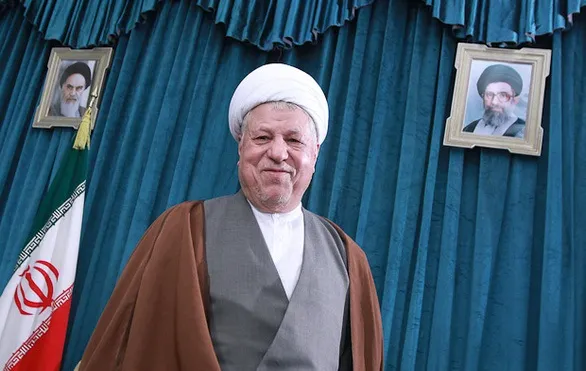
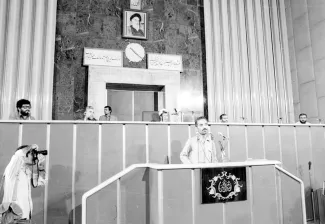
We went to Tbilisi University. In the university hall, a group of professors and students gathered to award me an honorary doctorate. The president of the university talked about my scientific, technical and cultural services, then a professor, a student and the head of the department of oriental studies. with warm feelings
We went to Tbilisi University. In the university hall, a gathering of professors and students had assembled to grant me an honorary doctorate. The university president spoke about my scientific and technical and cultural services, and then a professor and a student and the head of the university's Oriental Studies department spoke. With the warm feelings of those present, they presented the doctorate. I too gave a thankful speech and gave explanations about the importance of Georgia's independence and cooperation with Iran. Effat and Faezeh and the wife of Mr. Shevardnadze had also come.
From there we went to the city's only mosque. A group of children and adolescents, girls and boys, from the Muslim-inhabited area had been brought. They had hung a curtain in the middle of the gathering; half was managed by Sunnis and the other half by Shia. The mosque is old and has recently been repaired. I spoke with both groups. I gave two pieces of carpet to the two sections. I prayed a two-rak'ah prayer as a gift to the mosque. The Shia imam, who is also the servant, was praying beside me and had followed me. He did not know the matter, and he also recited aloud. He had gotten ahead of me. When the Hamd and Surah were finished, he started again from the beginning. A seminary student without a turban from the Islamic Propagation Office was there leading them. I spoke with the children. The girls had good hijab. I said to give a gift to everyone. I told the mayor who was accompanying us to expand the mosque.
From an uphill alley with cobblestones and humble houses around the mosque, we went to the airport and flew toward Batumi Port. Mr. Shevardnadze also came with me. We got out at the former Soviet military base of Esaki, forty kilometers from the port; currently the base is empty. Previously it was very important due to confrontation with NATO. By car we moved toward the port. The region is very green and promising; similar to the situation of Gilan and Mazandaran with less development. During the Soviet era, they converted the swamps into agricultural lands. On the way we passed over abundant and water-rich rivers that flowed into the Black Sea.
Beside a diversion dam that opened and closed with considerable gates. Instead of a regulatory dam, and in the port of Poti, which has a population of about fifty thousand and is an old and green city, we stopped. The port director gave explanations. The port's capacity is six million tons with a nine-meter draft, which currently operates with about one million tons. During the Soviet era it was fully active, and he explained the development plan up to twenty million tons. They have pinned their hopes on the transit of Iranian goods, and Mr. Shevardnadze said that even in his sleep he constantly sees Poti, Baku, Bandar Abbas. It was arranged that they would give a plot of land there for Iranian trucks that are to be transferred by truck-carrier ships to a port in the west, the Black Sea.
Then we moved toward Kaliguti in Adjara. It is a very beautiful city on the Black Sea coast that was previously the sanatorium and resort of the entire Soviet Union. They said about six million travelers a year used to come there; it is in the Autonomous Republic of Adjara. Its president came to welcome and said it has a population of five hundred thousand, of whom three hundred thousand are Muslims. In an interesting building we had prayer and rest and lunch. Then beside the coast they gave an explanation of a new method of coastal development that might be useful for our coasts on the Caspian Sea; it was arranged that a group would come to Iran.
We moved toward the port of Batumi. On the way, very interesting with tea gardens and citrus, and at my request we went to the house of a citizen named Jamal and his wife Nina beside the road. They offered hospitality and answered our questions. We went to the city of Batumi. The people had a magnificent gathering in the streets. In the city mosque we spoke with several of the clerics who appeared to be of little learning and donated two carpets.
We went to the port. We got on a ship and took a tour of the sea. Originally it was an oil port for exporting Baku oil, which is currently cut off and it mainly has non-oil activity. On three sides of the pier are green heights with tea plantations and forests and beautiful buildings. I did not know that the coast there is so beautiful. It was arranged that if Turkey agrees, we would export some of the goods by transit through Turkey from this port.
They said the Black Sea is dying. Its depths are completely dead and the surface waters are alive; probably due to the abundance of sulfur from the sea floor. They are thinking of a remedy. We flew from Batumi Airport toward Tbilisi. On the way I discussed a bit with Mr. Nadezhda about Marxism and socialism. He said he has become completely disbelieving. In his youth he was strongly believing. At night I had dinner alone.
Take less than a minute, register and share your opinion under this post.
Insulting or inciting messages will be deleted.
Sign Up