
After morning prayer, we went to the airport and flew to Lucknow. In order to see the city and the arrival of the journalists' plane, which was a little late due to a malfunction, we flew a short distance over Lucknow. They received a warm welcome and there were many people lined up on both sides of the streets
After the morning prayer we went to the airport and flew toward Lucknow. To see the city and also to wait for the journalists' plane that had flown with a slight delay due to a defect, we flew briefly in the airspace of Lucknow. They gave a warm welcome and in the streets too many people had lined up on both sides and expressed their feelings. At the intersections, they had usually blocked both sides with barriers and a large number of people with bicycles and cars and so on were crowded. The state's governor was with me and gave good explanations about the city and the state.
We went to the governorate building that had been built as the center of government during British rule. It is an interesting building. In most of the state centers of India, such buildings have remained from the British. We negotiated with Mr. Mulayam, the Chief Minister of the state. Despite his small stature, he is very energetic and, because of his recent victory over other parties, even the Congress Party, he is very spirited. They struggle with the slogan of social justice, which as a result has attracted the lower classes of India and religious minorities and non-Hindus, including Muslims. It is interesting that he expresses explicit opposition to the demolition of the Babri Mosque.
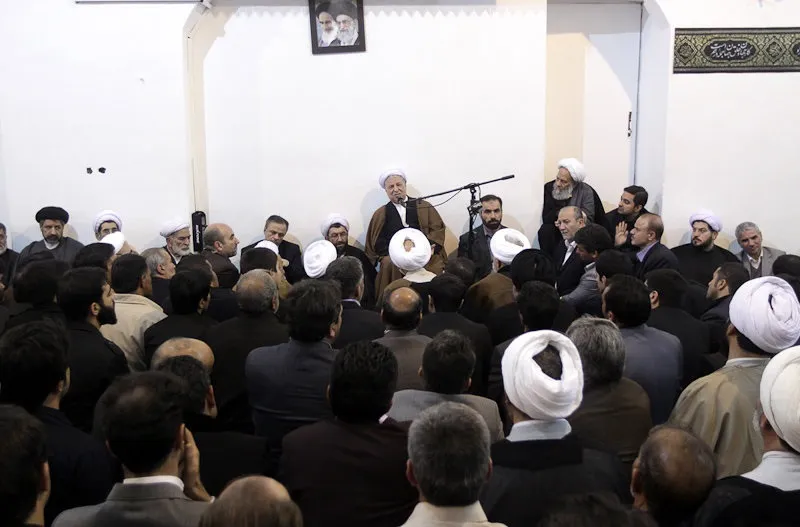
Until we reached the Asaf al-Dawla Hosseiniyeh, the people's gathering place, he sat in the car instead of the governor and said a lot about his victory and following the justice-seeking ideals of the Islamic Revolution. In the Hosseiniyeh, the people, with a huge gathering under the hot sun, welcomed us with warm expressions of feelings, and the slogan "Heydar, Rafsanjani, Iran" was abundant.
Mr. Chief Minister and Kalb-e Sadeq and Mukhtar and others spoke with welcome speeches and praise of me and the Iranian Revolution and the Imam. They had made several platforms with cloth awnings for us guests, but because the people were under the sun, it was bitter for me. I did not deem it advisable not to use it. They had arranged the floor of our platform with cushions and white cloths and pillows.
Mr. Mousavi, the deputy of Mr. Dinparvar, the Leader's representative, was opposed to the clerical leaders and spokespersons of the meeting and admonished me not to praise them. I think with this disagreement he cannot render any service. It was announced that we would help repair this important historical work. Later one of them said it is better that the money be spent on propaganda, not the building. I too gave a detailed speech about unity among the followers of the divine religions and the cooperation of Iran and India and the experiences of the countries of the region.
We returned to the governorate. The governor and his wife arranged a more formal meeting with me and Effat, presenting cultural gifts. A group of Shia and Sunni clerics came. Mr. Mousavi gave a welcome speech and I spoke about unity and avoiding division and the importance of the clergy after the victory of the Iranian revolution. Later they complained why Mr. Moghaddam had not let any of them speak. I met with and thanked the members of the reception committee who had worked very hard, and also visited the museum of Gandhi's photos and works.
With a send-off we returned to Delhi. Effat and the other ladies who were with us went by plane to the Taj Mahal. On the way, Mr. Salman Khurshid, the minister accompanying us who is the representative of this same state, gave good explanations about the state's situation and climate and agriculture and so on. At their request, we took pictures with two of their figures, Messrs. Seyyed Reza and Razavi, and with their group of pilots.
After the prayer and a little rest we went to the Indian Parliament. The Prime Minister and the Speaker and the Presiding Board and the representatives gave a warm welcome. The Speaker and the Prime Minister of India and I spoke, which was broadcast directly on radio. The ambassadors and ministers were also there. We returned to the residence. I read the reports. Our trip to India has wide coverage in the world press and media. The news of the crash of an Iranian military plane in today's maneuver saddened me. I rested for an hour and on the large balcony in front of the room that overlooks the garden, I wrote today's memoirs up to this hour.
At sunset we went to Hyderabad House. In a ceremony in my presence and the Prime Minister's and the journalists', the memoranda of understanding were signed by the foreign, oil, culture, and higher education ministers. During the work, I asked Mr. Rao questions about the Hindu religion; they do not have a heavenly book and prophet and have collected the sayings of the scholars and sages in books called the Vedas, which are the axis of practice. He said they are monotheists and also consider humanity as one. In answer to my question about the Hindu caste system, he did not have a correct answer. His father was a Brahmin and he also has training in this regard. He said he has not performed the austerities to reach the Brahmin rank and hopes to reach the Brahmin rank.
Then we had a private meeting. He said Mrs. Bhutto has asked America to mediate in the Kashmir issue, but India does not trust America and would like Iran to mediate; but after the elections and not now. Regarding the presence of gas on Qeshm Island, he asked so that they can decide about a fertilizer factory. Regarding the Bafq-Mashhad railway, he said they are seeking to secure financial resources from a third-party source. Regarding the upcoming parliamentary elections, he said he is hopeful of the Congress Party's victory. Several by-elections show this.
From there we went to the Culture House. A group of Iranians, including students and employees and miscellaneous individuals, were gathered. With the welcome and performance of two anthems by the girl and boy students and the ambassador's report and my speech about Iran's progress after the revolution, it was held. Then we had a meeting with Shia and Sunni clerics. Messrs. Dinparvar and Taghavi and one of the Sunni clerics spoke and I gave a speech about the important duties of the clergy after the victory of the Islamic Revolution and the formation of a successful Islamic government and the necessity of unity. The Sunni scholar also called the experience of the Iranian revolution very important for the Islamic world and a turning point. Many of them gifted works of their own and poems and works they had about me and took pictures. I did not stay for dinner there. I came to the residence. With a light dinner, with thunder and lightning and light rain, I slept; in this season they usually have rainless clouds and thunder and lightning.
Take less than a minute, register and share your opinion under this post.
Insulting or inciting messages will be deleted.
Sign Up